

After long-term bonds broke 2%, insurance funds turned to equity assets, with high dividends and high ROE as the top choices
 I'm LongbridgeAI, I can summarize articles.
Recently, the yield on 30-year government bonds has fallen below 2.0%. Guosen Securities believes that the central level of long-term bond rates continues to decline, further increasing the pressure on investment returns for insurance funds. Since the beginning of this year, companies represented by Great Wall Life, CPIC, and Ruizhong Life have been increasing their stakes in high-quality listed companies, mainly concentrated in industries such as public utilities, transportation, and banking, which have high dividends and relatively stable ROE levels
01 Matters
Recently, the yield on 30-year government bonds has fallen below 2.0%. As an absolute return institution primarily focused on allocating fixed-income assets, the returns on insurance assets are under pressure. On December 18, according to an announcement disclosed by the Hong Kong Stock Exchange, Ping An Asset Management increased its holdings of 67.255 million shares of China Construction Bank H-shares, costing approximately HKD 424 million. After this increase, Ping An Asset Management holds a total of 12.054 billion shares of CCB H-shares, accounting for 5.01% of the total CCB H-shares and 4.82% of the bank's total equity.
Guosen Non-Bank Viewpoint: The key to breaking the deadlock for insurance funds may focus on equity assets and long-term equity investments. With long-term interest rates on the asset side declining, coupled with ongoing fluctuations in the equity market, insurance companies are significantly pressured on the asset side. Additionally, the maturity of high-quality non-standard assets brings certain pressure to enhance investment returns for insurance funds. Meanwhile, under the new financial instrument standards, fair value measurement and changes accounted for in current profit and loss (FVTPL) equity assets exacerbate fluctuations in the income statement. Insurance companies can achieve a certain smoothing of accounting profits by taking stakes in listed companies, reducing the volatility of investment returns from equity instruments; however, taking stakes also requires insurance companies to have a strategic industrial vision, combining perspectives from both the primary and secondary markets. We expect that in the future, insurance companies will further increase their holdings in listed companies with high dividends, high capital appreciation potential, and high ROE attributes, matching the long-term and stable demand on the asset side of the insurance industry.
02 Comments
1. Asset returns under pressure, insurance funds initiate a new round of "stake-taking wave"
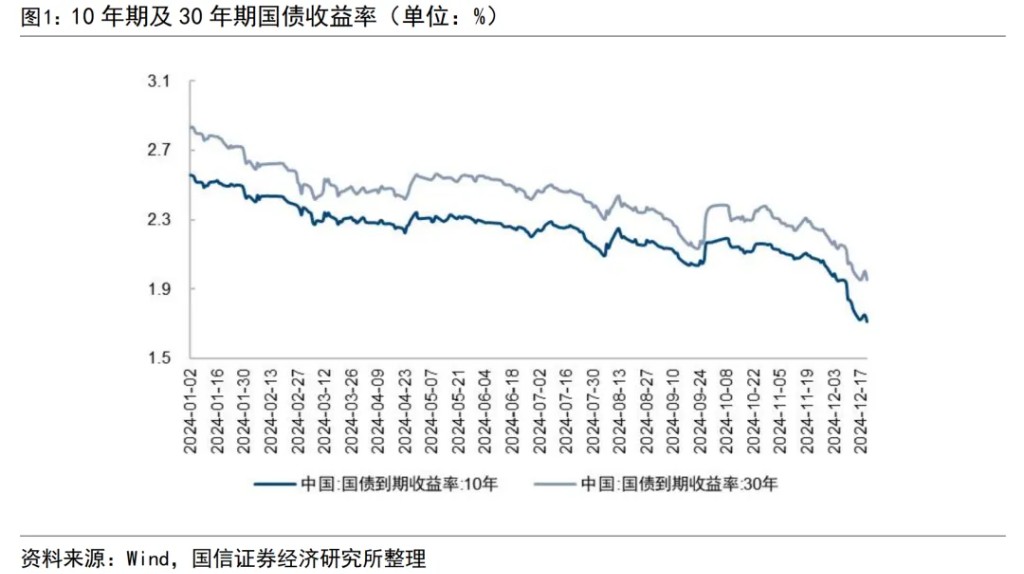
The central rate of long-term bonds continues to decline, further increasing the pressure on investment returns for insurance funds. As of December 20, the yields on 10-year and 30-year government bonds were 1.71% and 1.96%, respectively, down 0.85bp and 0.87bp from the beginning of the year. Against the backdrop of relatively fixed costs of existing liabilities, the continued decline in long-term bond yields further increases the asset-liability matching pressure for insurance companies. As absolute return institutions, insurance funds rarely engage in credit downgrades, thus further intensifying the "asset shortage" pressure.
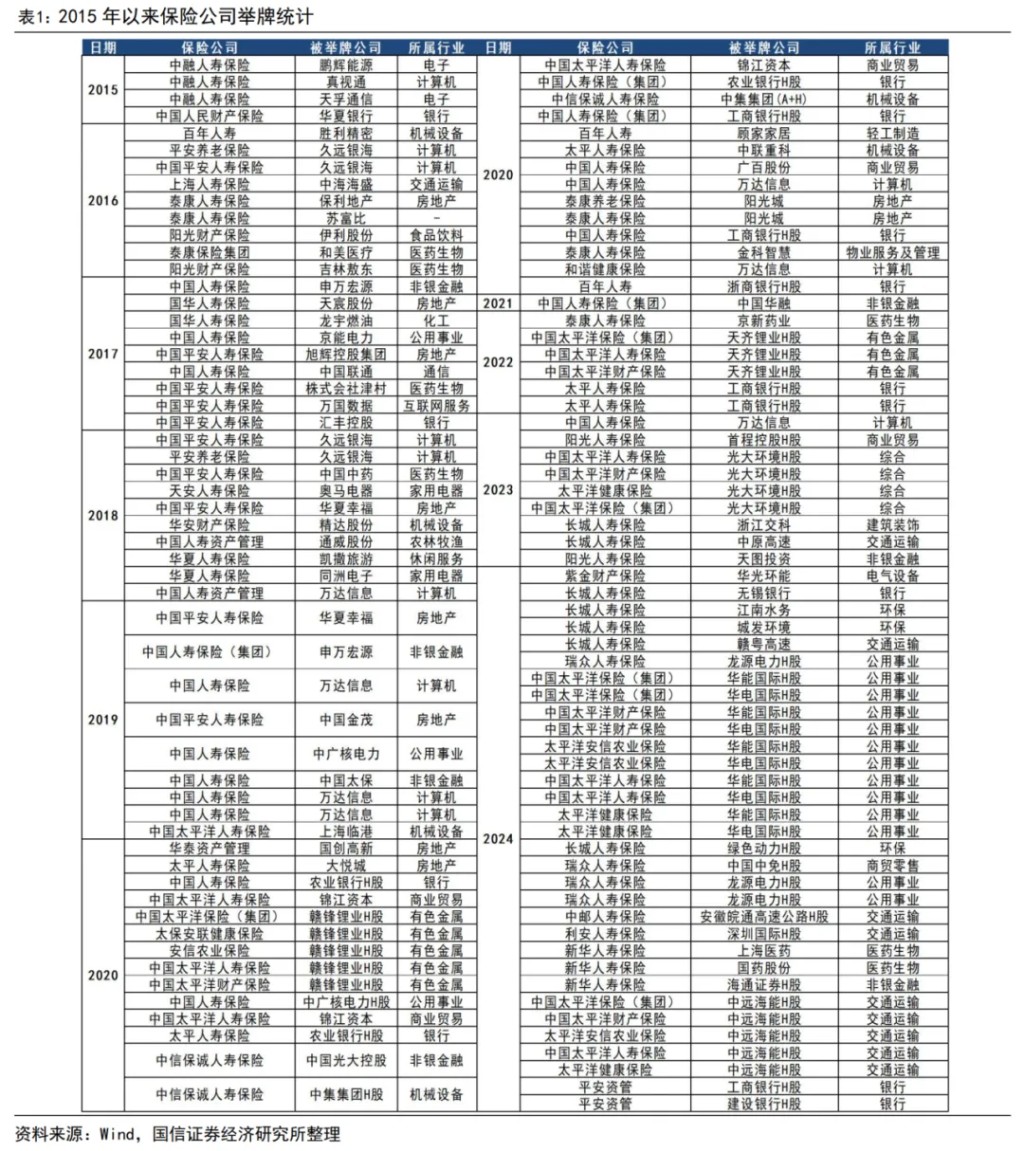
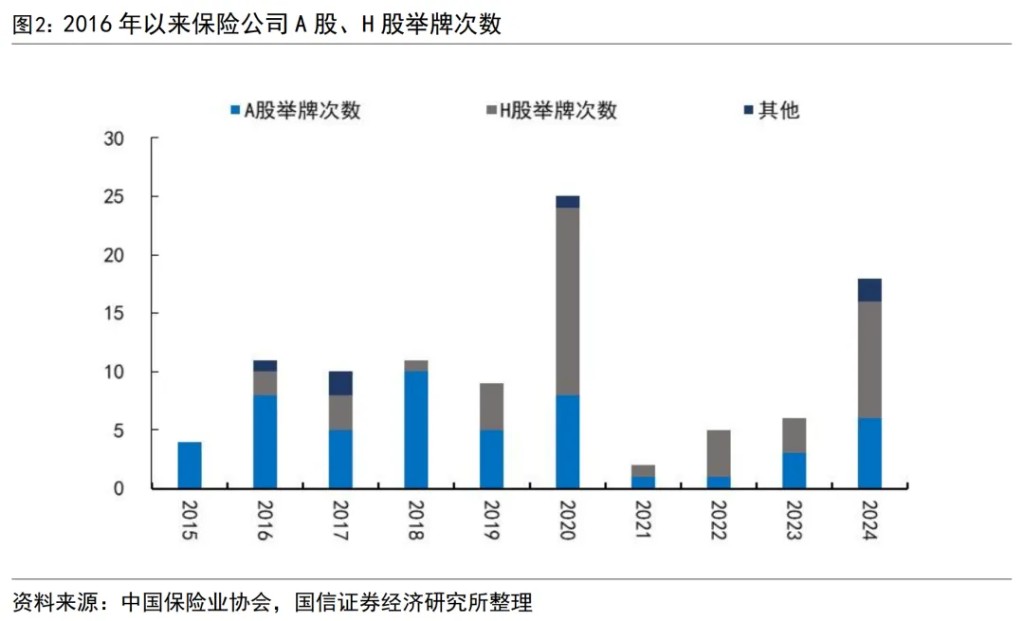
Since the beginning of this year, companies represented by Great Wall Life, CPIC, and Ruizhong Life have increased their stakes in high-quality listed companies, mainly concentrated in industries such as public utilities, transportation, and banking, which have high dividends and relatively stable ROE levels.
Recently, Ping An Asset Management has taken stakes in both Industrial and Commercial Bank of China H-shares and China Construction Bank H-shares, and the cost-performance ratio of Hong Kong stocks is gradually being valued by insurance funds. Since 2020, the insurance liability side has rapidly expanded due to the high growth of participating life insurance, and to meet asset-liability matching and investment return requirements, the demand for dividend-type equity assets has increased, leading to a significant rise in the number of stake-taking in undervalued, high-dividend Hong Kong stock assets by insurance funds. In addition, insurance funds are further increasing equity investment returns by utilizing the discount advantage of Hong Kong stocks and the exemption policy for corporate income tax
2. Analysis of the Motivations Behind Insurance Capital's Shareholding
Under the new standards, the asset classification of insurance companies is more transparent, but equity investments may directly increase profit and loss volatility. On January 1, 2023, the insurance industry fully implemented IFRS 9 (hereinafter referred to as "I9") and IFRS 17 (hereinafter referred to as "I17"), which brought certain changes to the accounting measurement methods for the liabilities and assets of insurance companies. The implementation of I9 has a significant impact on the measurement of financial instruments on the asset side of insurance capital, making the classification more objective. According to the accounting method, asset classification is more transparent; I9 divides financial assets into three categories: financial assets measured at fair value with changes recognized in profit or loss (FVTPL), financial assets measured at fair value with changes recognized in other comprehensive income (FVOCI), and financial assets measured at amortized cost (AC). The adjustment of the new financial instrument standards directly increases the volatility of the profit and loss statement of insurance companies. Under the new standards, more equity-type assets are classified as FVTPL items, such as funds and a large number of equity assets that cannot pass the SPPI test being designated for FVTPL measurement, directly increasing profit and loss volatility. In addition, according to the new financial instrument standards, once equity assets are designated as FVOCI, this decision is irrevocable; only dividends can be recognized in profit and loss, and the difference between the selling price and purchase price upon disposal cannot be recognized in profit and loss, but only in retained earnings. Therefore, insurance companies will classify a large number of equity assets as financial assets measured at fair value with changes recognized in profit or loss (FVTPL), leading to a greater impact of fair value changes of financial assets caused by capital market fluctuations on the profit and loss statement.
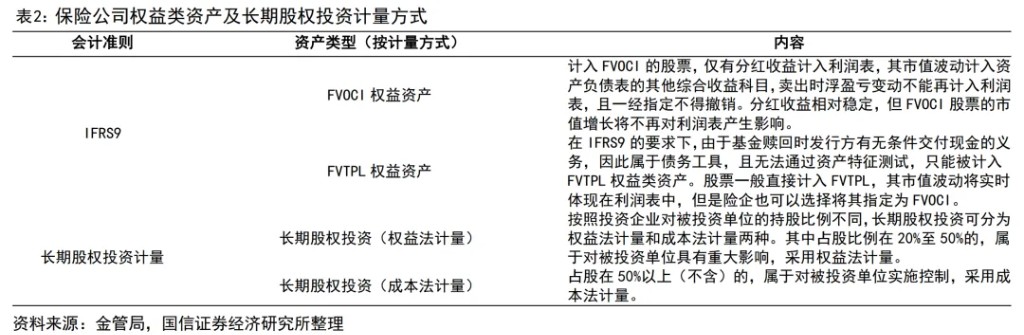
Long-term equity investments have stable investment value in the medium to long term, but caution is needed regarding impairment risks. According to the accounting standards for long-term equity investments, when holding voting shares of listed companies that have significant influence (associates), insurance companies should recognize and measure them according to the equity method in the long-term equity investment accounting standards. Insurance companies should recognize current investment income and other comprehensive income (OCI) based on their share of changes in owners' equity resulting from the net profit and other comprehensive income (OCI) realized in the A-share listing year, and adjust the book value of long-term equity investments accordingly, reducing the book value of long-term equity investments when cash dividends are actually received. When insurance capital holds shares in listed companies, the fluctuations in the stock price of the listed company do not reflect in the current profit and loss of the insurance company; only the current net profit will affect the investment income of the insurance company. Therefore, from the perspective of accounting standards, insurance capital's shareholding in listed companies has a certain smoothing effect on profit volatility. However, measuring investments through the equity method also requires attention to potential impairment loss risks. On one hand, from the perspective of accounting standards, insurance companies need to assess whether there is a possibility of impairment on the balance sheet date; if the market price of the asset significantly declines during the period, it indicates that the asset may be impaired. For assets with indications of impairment and whose recoverable amount is less than the book value, It is necessary to make provisions for asset impairment losses, which may have a certain negative impact on the investment returns of insurance funds. Therefore, insurance funds mainly choose targets with long-term stable investment value, such as low valuation, high dividend yield, and ROE, with investments concentrated in industries like banking, public utilities, and infrastructure.
3. The transition period for the second phase of "Solvency II" is extended, optimizing industry risk clearance
On December 20, the National Financial Regulatory Administration issued a notice regarding the extension of the transition period for the solvency regulatory rules for insurance companies (hereinafter referred to as the "Notice"), clarifying that "for insurance companies significantly affected by the switch from old to new rules on solvency adequacy ratio, they may communicate with the Financial Regulatory Administration and its dispatched agencies regarding the transition period policy before January 15, 2025. The Financial Regulatory Administration will determine the transition period policy for each company by the end of February 2025."
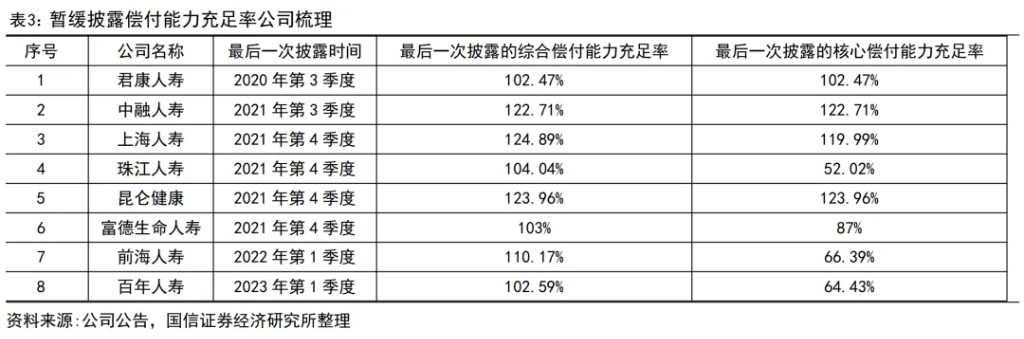
The proportion of equity investments by insurance funds is restricted by solvency regulatory indicators, which to some extent affects the willingness and ability of insurance companies to increase equity investments. It is expected that corresponding policy adjustments will open up some space for equity allocation by insurance funds. The second phase of Solvency II has stricter recognition of actual capital, raising the recognition standards for specific assets of some insurance fund investments, leading to a decrease in the actual capital of insurance companies, thereby affecting their solvency adequacy ratio. Against this backdrop, the solvency adequacy ratio of insurance companies has generally declined. After the implementation of the second phase of Solvency II rules, the constraints on insurance companies' asset allocation have shifted from "soft constraints" to "hard constraints," making it more difficult for insurance companies to balance capital occupation and returns on the asset side. They need to enhance capital utilization efficiency through refined management, adjusting equity allocation coefficients to provide space for further encouraging insurance funds to allocate equity assets. Additionally, according to regulatory requirements, equity assets generally have higher risk weights compared to fixed-income assets, resulting in higher capital consumption for insurance companies' equity asset allocation. According to the "Insurance Asset Risk Classification Measures (Draft for Comments)," the risk classification standards for equity assets are stricter than those for fixed-income assets, leading to increased capital consumption, thereby limiting the scale and enthusiasm of insurance funds entering the market. According to regulatory requirements, the regulatory proportion of equity assets for insurance companies can account for up to 45% of total assets at the end of the previous quarter, while the current proportion of equity investment in the insurance industry is about 12%, indicating significant room for improvement. It is expected that with the extension of the transition period, insurance companies represented by small and medium-sized insurers may open up some equity allocation space, with the main allocation direction expected to focus on OCI high-dividend stocks.
Author of this article: Kong Xiang S0980523060004, source: [Wang Jian's Perspective](https://mp.weixin.qq.com/s?__biz=MzIwMDA4MjcwMQ==&mid=2653057611&idx=1&sn=84444f6e8014052c4e1dd6fed449c679&chksm=8c3a33dd7098d3c2b133054f2f214dcaae3c5209bbf423a986aed5c5114939a7525708125376&mpshare=1&scene=23&srcid=1223dSNie1KS3ZzbeWUMsrnr&sharer_shareinfo=1681d30 e166d4f6bd9224cafff4f2a91&sharer_shareinfo_first=1681d30e166d4f6bd9224cafff4f2a91#rd), Original title: "[Guoxin Non-Bank Financials · Insurance] Analysis of Insurance Capital Allocation Behavior After Long-term Bonds Break 2%"