

Nvidia Is Now Cheaper Than the Average S&P 500 Stock: Wall Street Still Sees Record Profits
 I'm LongbridgeAI, I can summarize articles.
Nvidia stock trades at an 11% discount to the S&P 500, its widest gap since April 2015, despite expected profits growing 30-fold since 2022. While Wall Street analysts maintain buy ratings with average price targets implying significant upside, concerns persist regarding the sustainability of customer spending and financing costs for neocloud providers. Nevertheless, investors view the current valuation as an opportunity given Nvidia's dominant position in the AI boom.
In April 2015, Nvidia Corp. (NASDAQ:NVDA) was a $12 billion maker of graphics cards for video gamers.
Today, it is worth more than $5 trillion and powers the artificial intelligence boom.
Yet, Nvidia’s stock has just hit its biggest discount to the market since then.
Wall Street expects Nvidia to earn $12.03 per share over the next 12 months. At the end of 2022, that estimate was roughly 40 cents.
At around $215, the stock trades at about 18 times those expected earnings. The S&P 500, tracked by the SPDR S&P 500 ETF Trust (NYSE:SPY), trades at 19 times.
So why is the market paying less for a company that keeps earning more?
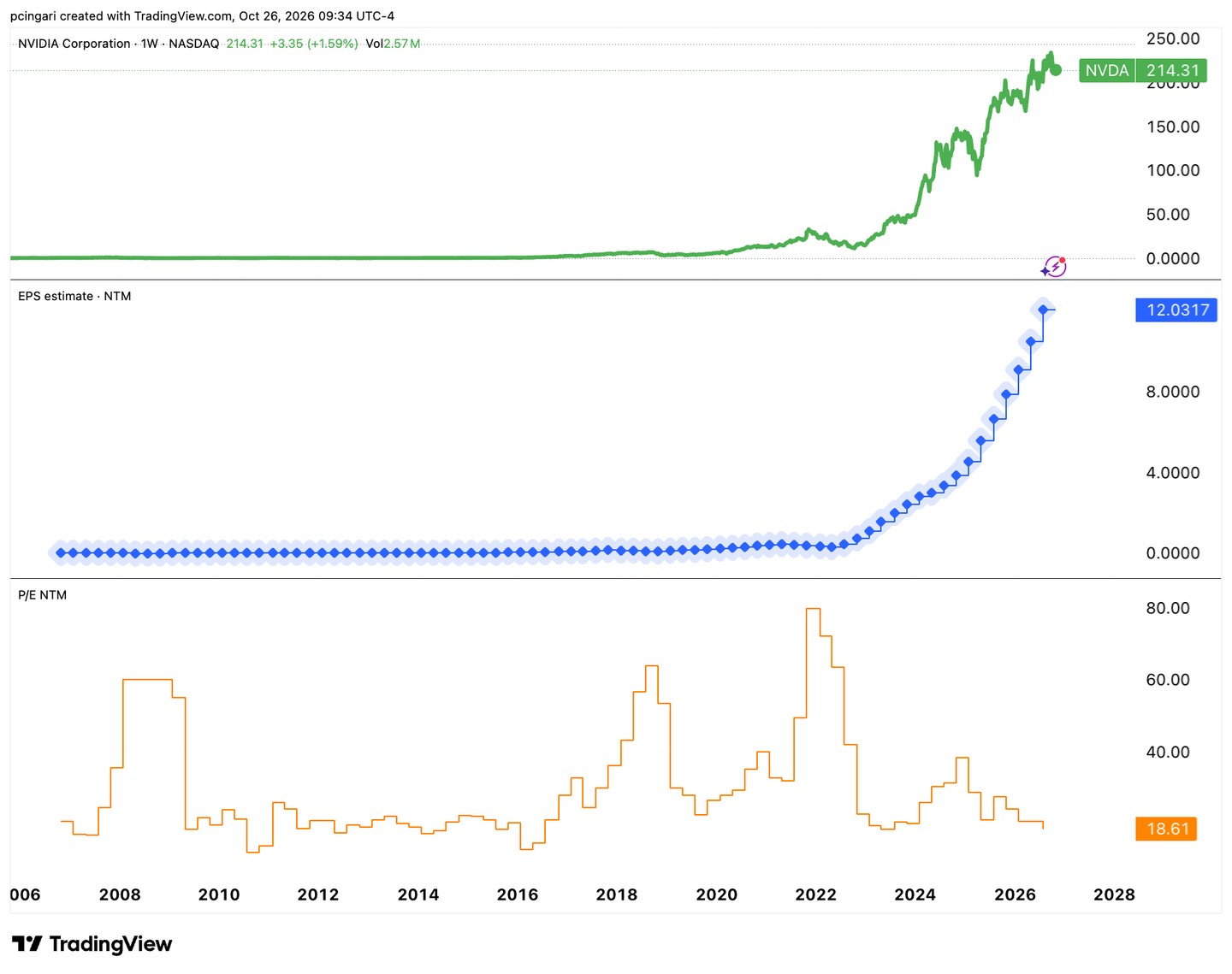
Nvidia weekly chart, next-12-month EPS estimate and forward P/E ratio. Source: TradingView
Nvidia Stock Trades at an 11% Discount to the Market
When OpenAI launched ChatGPT in November 2022, Nvidia traded at more than 40 times forward earnings.
Since then, profits have risen far faster than the share price.
As a result, the multiple fell to 18 at Friday’s close, less than half its 2022 level and near the lowest reading in eight years.
The comparison with the broader market is even more striking.
At Friday’s close, Nvidia traded at an 11% discount to the average company in the S&P 500. The gap had not been this wide since April 2015, when the company’s biggest customers were still gamers rather than hyperscalers.
Two Fears Are Weighing on Nvidia Stock
The first concern is how long its biggest customers can keep spending.
Microsoft Corp. (NASDAQ:MSFT), Amazon.com Inc. (NASDAQ:AMZN), Alphabet Inc. (NASDAQ:GOOGL), Meta Platforms Inc. (NASDAQ:META), Oracle Corp. (NYSE:ORCL) and Space Exploration Technologies Corp. (NASDAQ:SPCX) are on track to invest $930 billion this year. Estimates point to $1.35 trillion next year.
After that, however, the curve flattens. Projections show $1.45 trillion the following year and $1.415 trillion the year after.
For this reason, if spending stops growing, Nvidia’s growth faces the same ceiling.
Read Also: Meta Just Burned Cash for the First Time Since Its IPO Year: Wall Street Raised Its Targets Anyway
The second fear is the neoclouds.
Companies such as CoreWeave Inc. (NASDAQ:CRWV) and Nebius Group N.V. (NASDAQ:NBIS) borrow money to buy Nvidia chips, then rent that computing power to AI developers.
The model works as long as demand stays high and money stays cheap. Lately, both conditions are being tested.
Investors now demand more than 16% to lend to CoreWeave, and its shares have lost 42% over the past month. Nebius is down 38% over the same stretch, and both fell more than 3% in early trading Monday.
Even Jensen Huang acknowledged the problem on Oct. 22, saying demand for computing far exceeds the capital available to finance it. Nvidia fell 4.4% that day.
The financing question resurfaced Monday. Meta, which plans a $95 billion funding push for its AI ambitions, said Nvidia, Advanced Micro Devices Inc. (NASDAQ:AMD) and Broadcom Inc. (NASDAQ:AVGO) had each indicated interest in buying up to $5 billion of shares in its stock offering.
In other words, the chipmakers are now helping fund one of their biggest customers.
Read Also: CoreWeave Bonds Stop Bleeding After SpaceX Results, But Investors Still Demand 3x Treasury Yields
Wall Street Still Sees the Discount as an Opportunity
Analysts, however, are not backing away.
Nvidia has a consensus Buy rating from the 29 analysts tracked by Benzinga Analyst Ratings. Their average price target of $343 implies about 59% upside. Over the past three months, targets have ranged from $300 to $515, the high end set by Raymond James.
The most recent call came on Oct. 22, when Needham analyst N. Quinn Bolton maintained a Buy rating and a $300 target.
| Date | Firm | Price Target | Action | Rating |
|---|---|---|---|---|
| Oct 22, 2026 | Needham | $300 | Maintains | Buy |
| Oct 1, 2026 | Cantor Fitzgerald | $350 | Maintains | Overweight |
| Sep 29, 2026 | Rosenblatt | $390 | Maintains | Buy |
| Sep 10, 2026 | Piper Sandler | $300 | Initiates | Overweight |
| Aug 27, 2026 | Evercore ISI Group | $465 | Raises | Outperform |
| Aug 27, 2026 | Raymond James | $352 → $515 | Raises | Strong Buy |
Cantor Fitzgerald analyst C.J. Muse reiterated an Overweight rating and a $350 target after attending Huang’s GTC Berlin keynote.
Muse said Nvidia’s guidance for more than 70% revenue growth in calendar 2027 looks very conservative.
He highlighted demand that still supports well above 100% growth, and supply deals that should expand Nvidia’s substrate capacity 2.5 times over three years.
With shares trading at less than 10 times Cantor’s calendar 2028 earnings estimate, the stock is “simply too hard to ignore,” Muse said.
The Market Has Doubted Nvidia Before
In 2015, investors priced Nvidia as a gaming company with limited prospects. That discount turned out to be one of the great mispricings in market history.
Today, they are pricing the world’s main AI supplier as if its growth is about to stall.
Whether that doubt proves equally misplaced no longer depends on demand for Nvidia’s chips. It depends on whether its customers can keep paying for them.
Image via Hepha1st0s/ Shutterstock
Login to unlock3,739characters for free
Due to copyright restrictions, please log in to your Longbridge account to view this content.
Thank you for your understanding and support of licensed content.