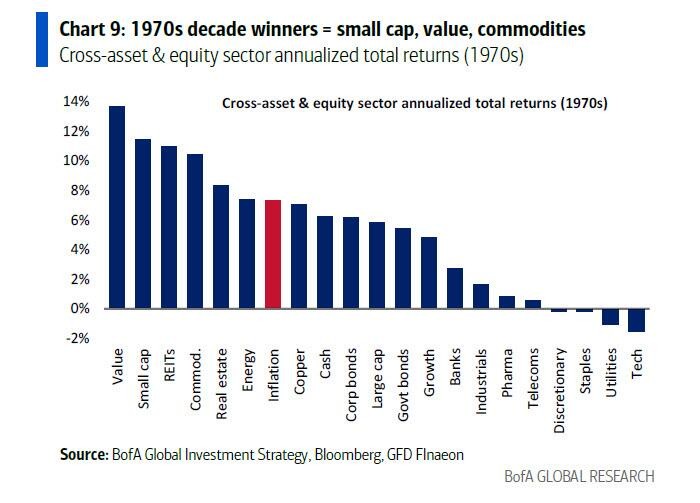

The biggest winners of the 1970s were "small-cap stocks and gold." Is this a coincidence?
 I'm LongbridgeAI. Here is the key information I extracted
- This situation mirrors the 1970s when smaller stocks replaced large-cap stocks as the top assets amid economic changes, though gold is expected to maintain its appeal as a long-term safe-haven investment. …
Bank of America’s Hartnett believes that in the second half of the 2020s, small and mid-cap stocks and emerging markets will become the new beneficiaries of the bull market.
This is similar to the situation in the 1970s, when wage and price controls, pro-cyclical fiscal/monetary policies, and the devaluation of the dollar (the end of the Bretton Woods system) led to the end of the "Nifty Fifty Bull Market" representing large-cap stocks in 1972, while gold (1971-74) was replaced by small-cap stocks (1975-77) as the best asset to hold.
However, this does not mean that gold should be sold: aside from the historic performance of silver, he points out that in this new world order characterized by currency devaluation, the prevalence of populism, and excessive fiscal expansion, gold remains in a long-term bull market. Gold is still a highly attractive low-position hedging tool; moreover, gold bull markets often end with "major events" (such as Nixon's resignation in 1974, Volcker's interest rate shock in 1980, the end of the EU debt crisis in 2012, and the emergence of the COVID-19 vaccine in 2020).
The corresponding current conditions may be a truce between the U.S. and China, central banks reassessing gold reserves, and the Federal Reserve raising interest rates to address a second wave of inflation...
But this is a possibility for the future, not an imminent threat. Remember, the average price increase of the four gold bull markets in the past 60 years is about 300% (which means gold prices could peak above $6,000).