

META: Core biz breathes easier; Muse P&L still up in the air?
 I'm LongbridgeAI, I can summarize articles.
Hi everyone. This is Dolphin Research.
Compared with last quarter’s awkward print, this time $ Meta Platforms.US delivered a set of numbers that let investors exhale: core revenue, profit ex one-offs, and Q4 guidance all beat. Near term, opex guidance did not balloon because of Muse either.
That said, the Street’s other key focus — 2027 guidance — lacked concrete numbers. Equity financing expectations will also keep bulls sober despite an improved near-term outlook.
Meta typically hosts a call-back after the earnings call. Dolphin Research will check for incremental disclosures and publish a summary; follow our community updates if interested.
Key takeaways:
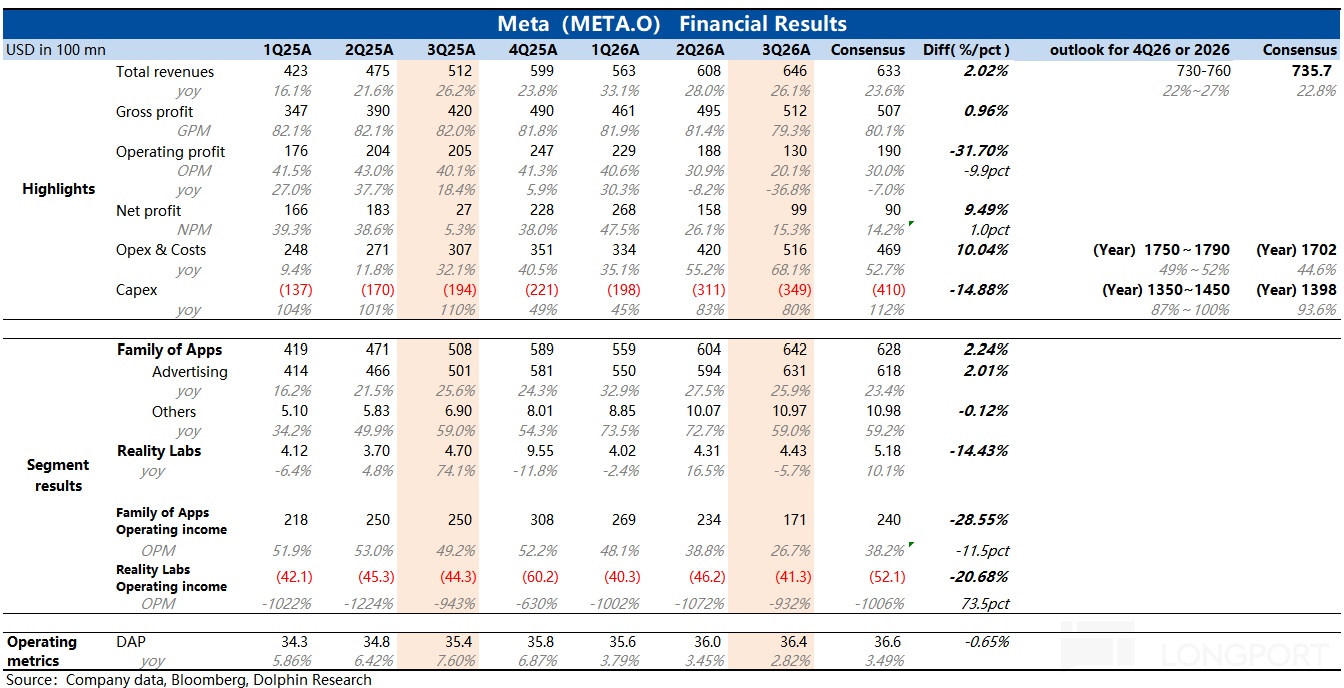
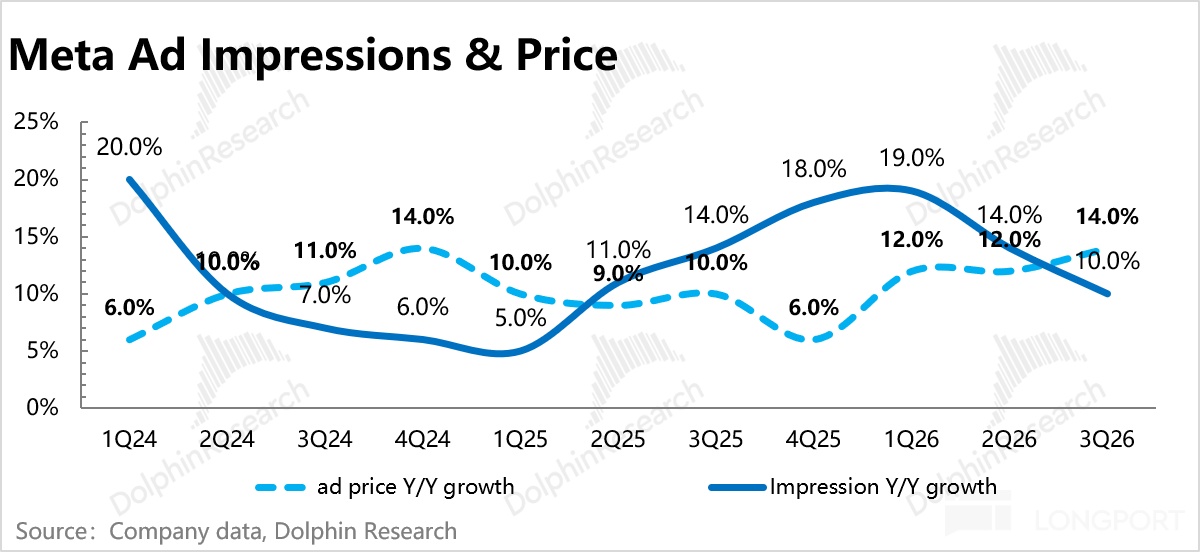
1) Core biz solid: Q3 total revenue +26%, a modest beat, with Q4 guidance at $73-76bn; the midpoint aligns with buy-side expectations. Growth was largely price-driven (+14%), now accelerating for a third straight quarter. GEM, Andromeda, and gen-AI recall models showed quantified conversion gains, reinforcing Meta’s ad AI ROI narrative.
Q3 industry-wide ad demand was healthy on the World Cup and political ads. Meta’s print thus mainly highlights the resilience of its core competitive edge.
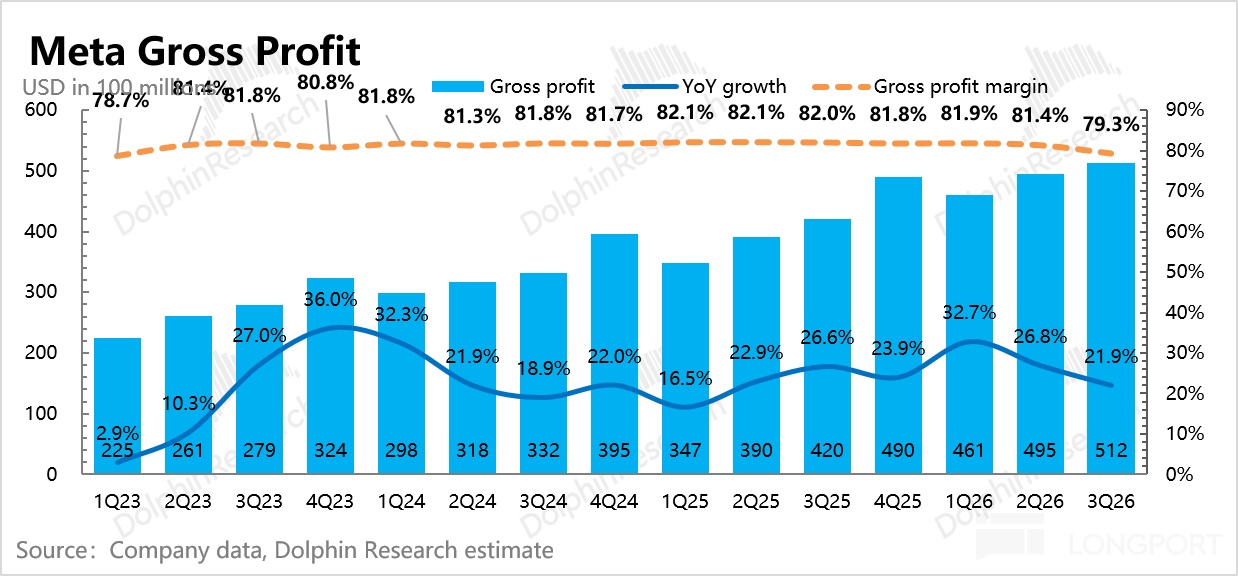
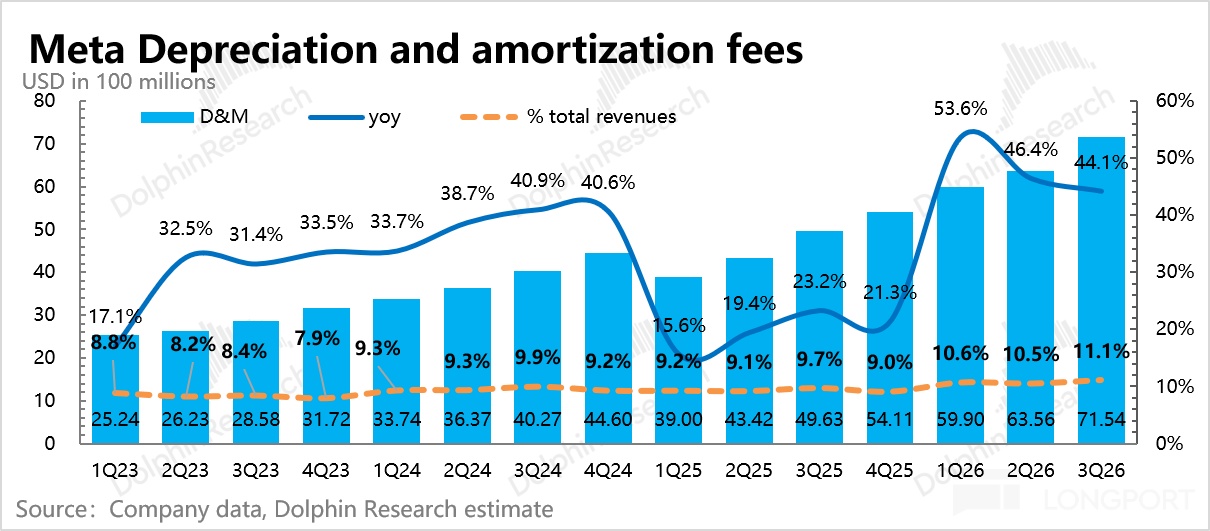
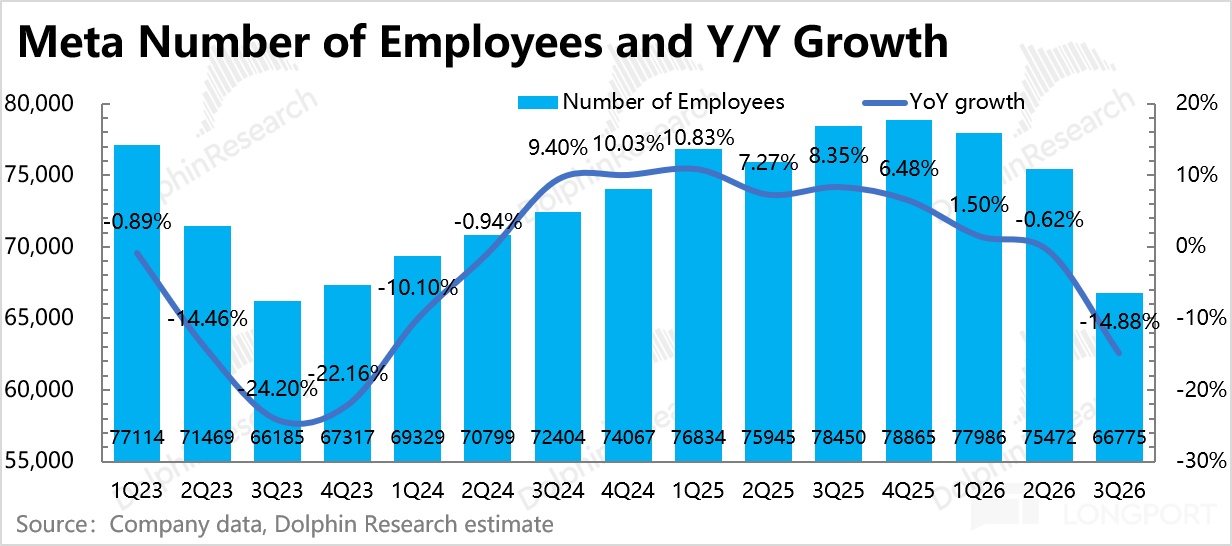
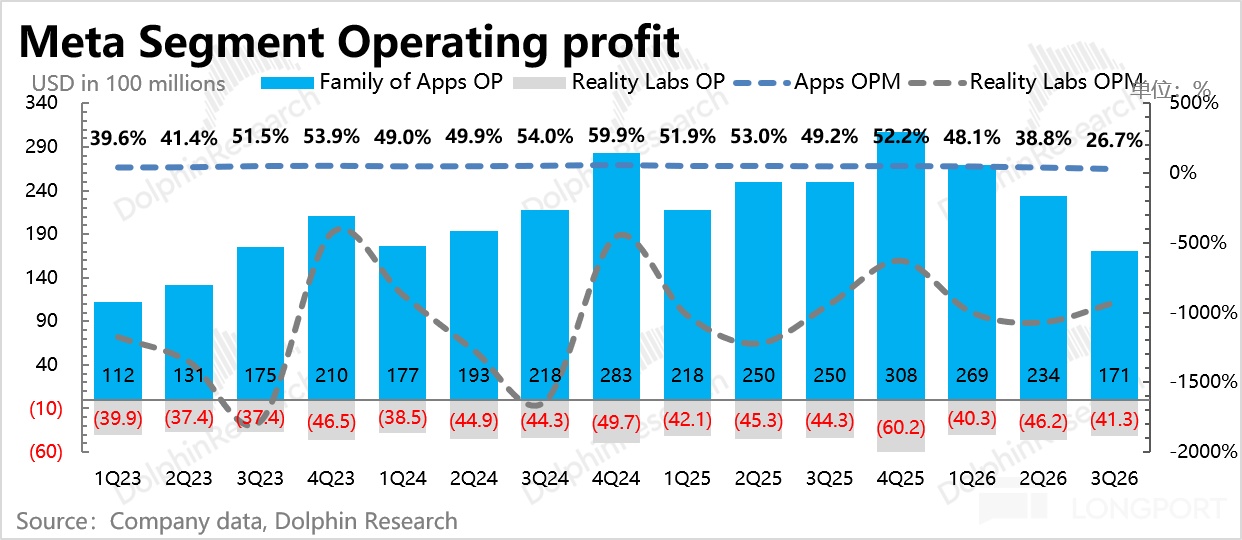
2) Headcount cuts offset AI depreciation: Ex the $9.9bn multi-state settlement (teen social addiction, child privacy cases), Q3 OPM held around 35% and even improved QoQ. While that seems at odds with rising D&A from AI buildout, the 15% workforce reduction boosted efficiency and offset incremental depreciation.
Full-year opex guidance only added the settlement, with no other uplift. This implies a Q4 OPM at about 33% at the midpoint, a touch softer than Q3, showing AI investment remains a directional drag on margins.
Management did not provide a 2027 opex guide. With Muse, the cloud leasing biz, and Meta’s own compute rollout, this year and next are peak spend years. Near term, Muse monetization will ramp slowly, and we expect meaningful contribution only in 2028, so depreciation headwinds to profit will continue to build.
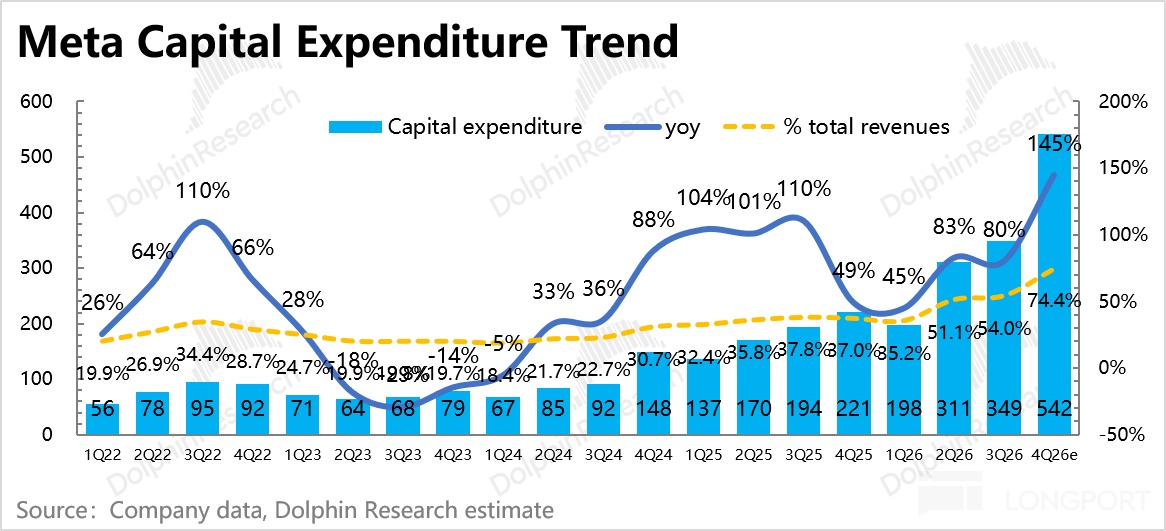
3) Capex annualizing to ~$200bn+ in Q4: Q3 capex was $34.9bn, below estimates, but Q4 needs to catch up. The full-year lower bound was nudged higher, implying Q4 capex at a midpoint of ~$54bn; annualized, the next 12 months would exceed $210bn, broadly in line with most houses, with some more aggressive at $230-250bn.
On 2027, management said budgeting is ongoing but investments will remain aggressive to support core and new AI projects. They also said existing and in-flight capacity can be flexibly allocated across model training, core growth, and new products. Mark emphasized building compute to serve 1bn+ users over the next few years.
The key debate: whether Muse’s compute needs fit within the prior deployment framework (14GW in 2025) or require incremental near-term capacity.
We think most should fit the prior plan, but a blowout Muse could still force adds: Muse is not a whim but part of Mark’s two-year AI narrative, long prioritized internally at Tier-0. Even before media reported the cloud leasing push and the plan for 14GW by end-2025, there were delays in the personal AI assistant launch; we now know targeted security work on user permissions preceded Muse’s release.
As Muse penetration rises, capex need not be marked up materially from prior expectations. However, Muse likely crowds out compute for cloud leasing, which could pressure the near-term 2027 ROI per unit of compute, given leasing monetizes at higher rates.
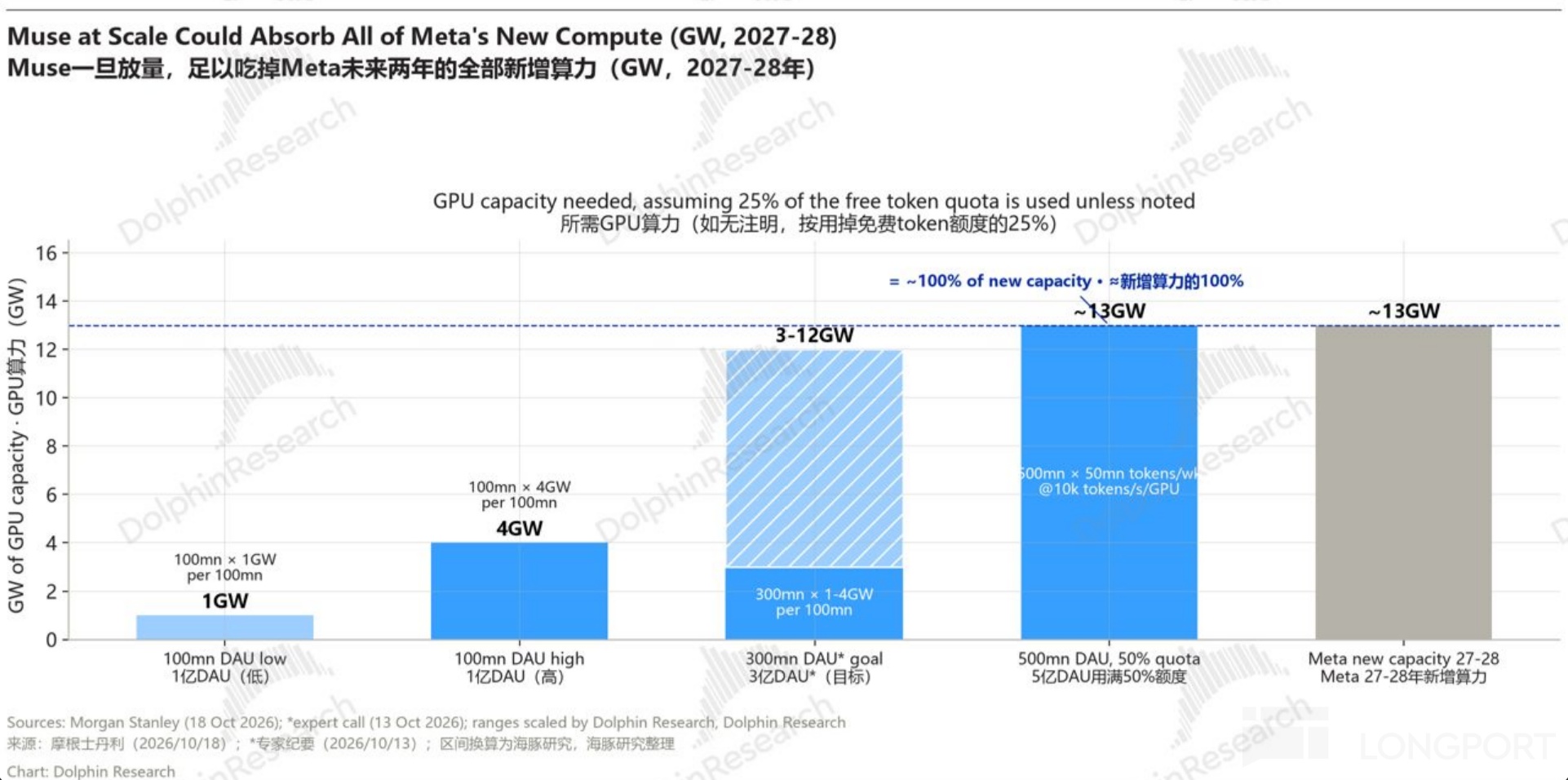
If Muse stays red-hot — say MAU surpasses 2bn (DAU 500mn+) — compute needs could almost fully consume Meta’s two-year reserves. Mark said capacity is planned for 1bn MAU; if usage exceeds that, current build plans will fall short.
Thus, a 2025 capex of ~$220bn has upside risk, driven by whether Muse over-allocates compute and by the company’s desire to keep the cloud leasing biz stable.
4) Muse’s first scorecard: After ~6 weeks live, Muse has 10mn+ users in the U.S. and Canada; about 25% use it daily. Shopping is the top use case; over 25% of WAU shop via Muse, with an Avg. ticket over $200. Management expects >10x efficiency gains in compute costs within a year and will push monetization earlier than the prior ‘grow-first’ playbook.
Versus our prior assumption — 30% MAU shopping penetration with $500 annual ticket — Muse is tracking ahead. Delivery still depends on broader user penetration and MAU scale; the monetization delta between 100mn and 1bn users far exceeds 10x.
5) Financing: framework set, details TBD: At the current pace, Meta’s full-year FCF turns negative next year with high certainty. On a strict basis (cash + short-term investments minus total interest-bearing debt), net cash is not ideal either, so financing expectations have lingered.
What the market needs now are financing details. This time, the company outlined the approach: beyond the $30bn off-BS JV and $25bn in bonds this year, future funding will rely on a new non-voting Class C for potential equity issuance. With higher rates and weakening balance sheet optics, the advantage of debt has narrowed.
The Class C dividend will be paid as a stock dividend of one Class C share per Class A or B share. The distribution is effectively a 1-for-2 split; Class C starts trading on Jan 19, 2027. Theoretically, ownership remains unchanged post dividend, but the company acknowledged Class C could trade at a discount to Class A, so subsequent issuance could be doubly dilutive — more shares needed for the same raise, on top of the base dilution.
There is no specific financing plan yet. Class C is intended for fundraising, employee comp, and M&A, while preserving Zuckerberg’s voting control. Given control constraints, under the current structure, Meta could theoretically raise up to about $700bn in equity before Mark’s voting power slips below 50%, suggesting an upper bound for potential equity financing.
6) KPI snapshot
Dolphin Research View
Q3 in a line: ads remain strong, cost control beat, and Muse signaled the ‘how’ and ‘sooner’ of monetization, but granular 2027 ROI math is still missing, which some bulls may fault.
Last quarter we said investors wanted a clearer AI ROI trajectory. This quarter, beyond a stable ad base to support the AI-for-ads narrative and cloud leasing for surplus compute, Meta focused on ToC monetization and spend control to clarify the ROI path.
1) Muse provided a monetization path. Management stressed shopping and explicitly said it will charge merchants per facilitated transaction, and do so earlier than before. That aligns with our Sept take — subscriptions will be limited given high per-user costs; real monetization lies in take rates on transactions.
2) Spend control beat, with a 15% headcount cut — Q3 total costs ex one-offs grew much slower than feared. On whether Muse needs compute beyond plan, Q3 guidance implies not — full-year capex did not jump, and while 2027 is uncertain, near term Muse appears within the planned compute framework. Growth-wise, this year and next are peak investment years.
If Muse exceeds expectations — say above the 1bn users management envisioned — extra capacity would be required beyond current plans. Class C essentially preps a financing channel for that. Periodic equity issuance will temper bullish enthusiasm.
Valuation: At a post-close mkt cap of ~$1.86tn, Meta trades at ~23x our neutral 2027 post-tax OP (~$80bn), near the 25x midpoint. In late Sept, Muse optimism drove multiples to ~26x; some bulls even penciled in 28x+, or skipped 2027’s margin hit and modeled off 2028.
We then suggested most of the multiple repair was done and gains could be locked gradually, given slowing incremental Muse momentum and the need to confirm retention. With this print, investors should also hedge the risk that 2027 AI investment guidance could top expectations.
After some multiple compression, management’s push for earlier take-rate monetization via Muse leaves room long term. From a long-view, positions can be built and added on pullbacks. Near term, financing overhang and Muse checkpoints will sway sentiment, so the stock likely oscillates around a 25x anchor, implying swings around a ~$2tn mkt cap.
Details below
I. Core biz underpins the AI ROI story
Q3 total revenue was $64.6bn (+26% YoY), 2% above Bloomberg consensus and above the top end of company guidance ($64bn). Ad revenue was $63.1bn (+26% YoY; same at constant FX), with volume +10% (about 2ppt below expectations) and price +14% (about 3ppt above).
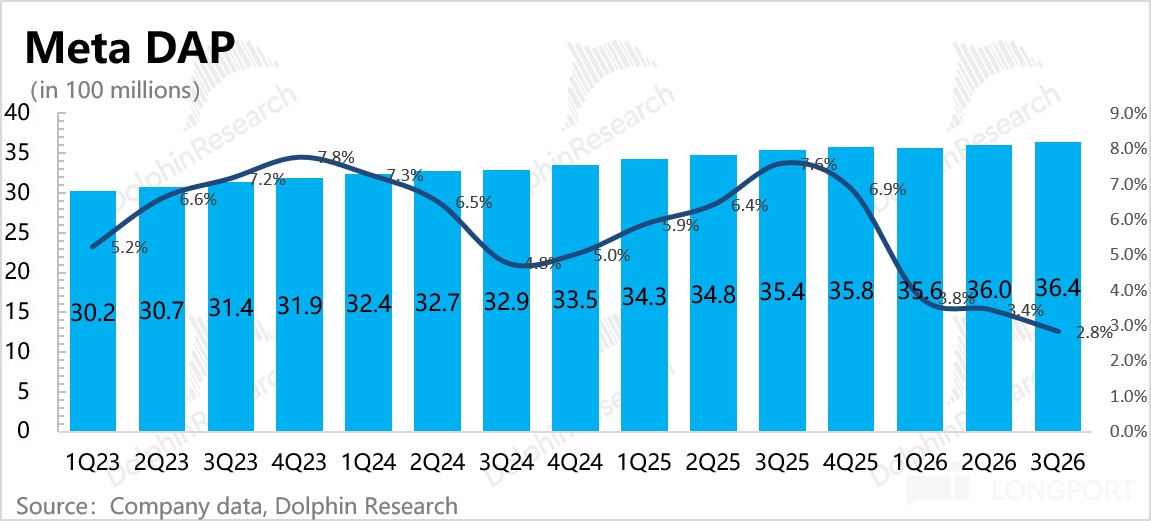
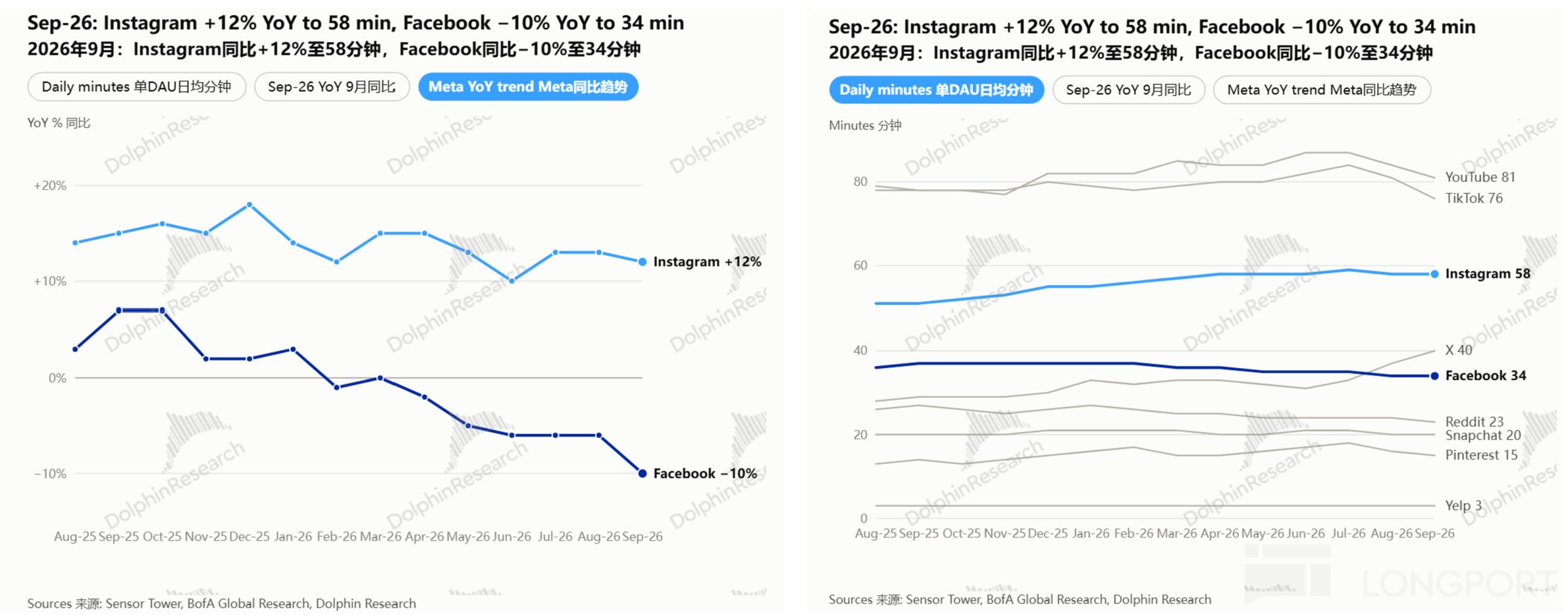
Volume is slowing (user traffic +3%, Facebook time down) while pricing accelerates. In a solid ad market, AI-driven recommendation and buying efficiency improved Meta’s pricing power. That underpins further gains.
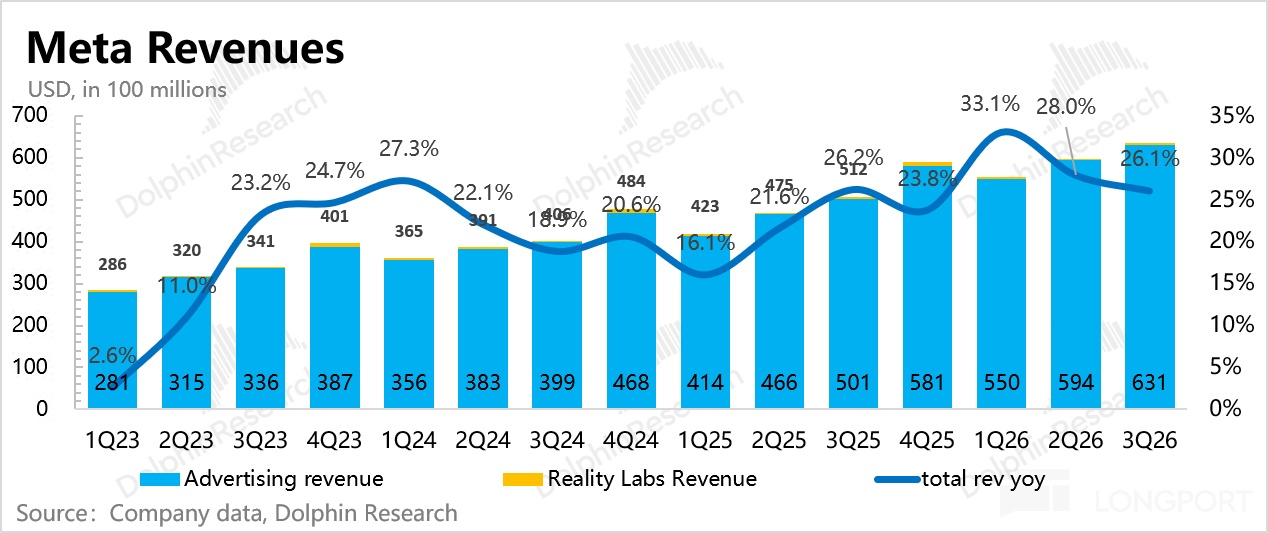
Q4 guidance topped buy-side: revenue at $73-76bn; midpoint $74.5bn (+24% YoY), 1.3% above consensus, and the top end $76bn above the pre-print buy-side range of $74-74.5bn. This is the most reassuring element: even with the World Cup tailwind fading in Q4 (industry uplift totaled ~400bps per checks), core momentum is not slowing as feared.
II. Headcount cuts offset AI depreciation
Ex the ~$10bn settlement, Q3 OPM held at 35%, 3ppt above consensus, though down nearly 5ppt vs last year’s 40%. Implied Q4 OPM is ~33%, down QoQ, underscoring that AI spend continues to compress margins.
Drilling down, core opex fell in absolute terms QoQ on layoffs, lowering the opex ratio and offsetting D&A up 44% YoY and 11% QoQ. That explains the margin hold.
Q3 capex was $34.9bn, well below expectations, but mostly timing. Full-year lower bound rose by $5bn, narrowing the range to $135-145bn. This back-solves to $49.2-59.2bn in Q4, with a midpoint that annualizes to >$210bn — consistent with current 2027 capex assumptions.
Q3 FCF was -$2.1bn, the first negative in years. We expect full-year 2027 FCF to remain negative, necessitating financing.
III. Muse’s first ‘report card’ — take rate first
Muse has >10mn users in the U.S. and Canada after ~6 weeks, with ~25% daily use. Per Sensor Tower and others, U.S. DAU is ~2.5mn and daily downloads ~300k; with WhatsApp and Instagram funnels, DAU can scale quickly.
Retention is more critical — turning curiosity into 3-5 weekly habitual use. Some platforms show Muse 14-day retention at ~20%, slightly below ChatGPT. We see that as middling.
Shopping is the top use case, with >25% of WAU shopping via Muse and Avg. order above $200. Management expects >10x compute cost efficiency within a year and plans to monetize earlier than before. But 2027 will still be cost-heavy: beyond inference compute, the CPU sandbox also matters; see our prior hardware stack and incremental cost discussion.
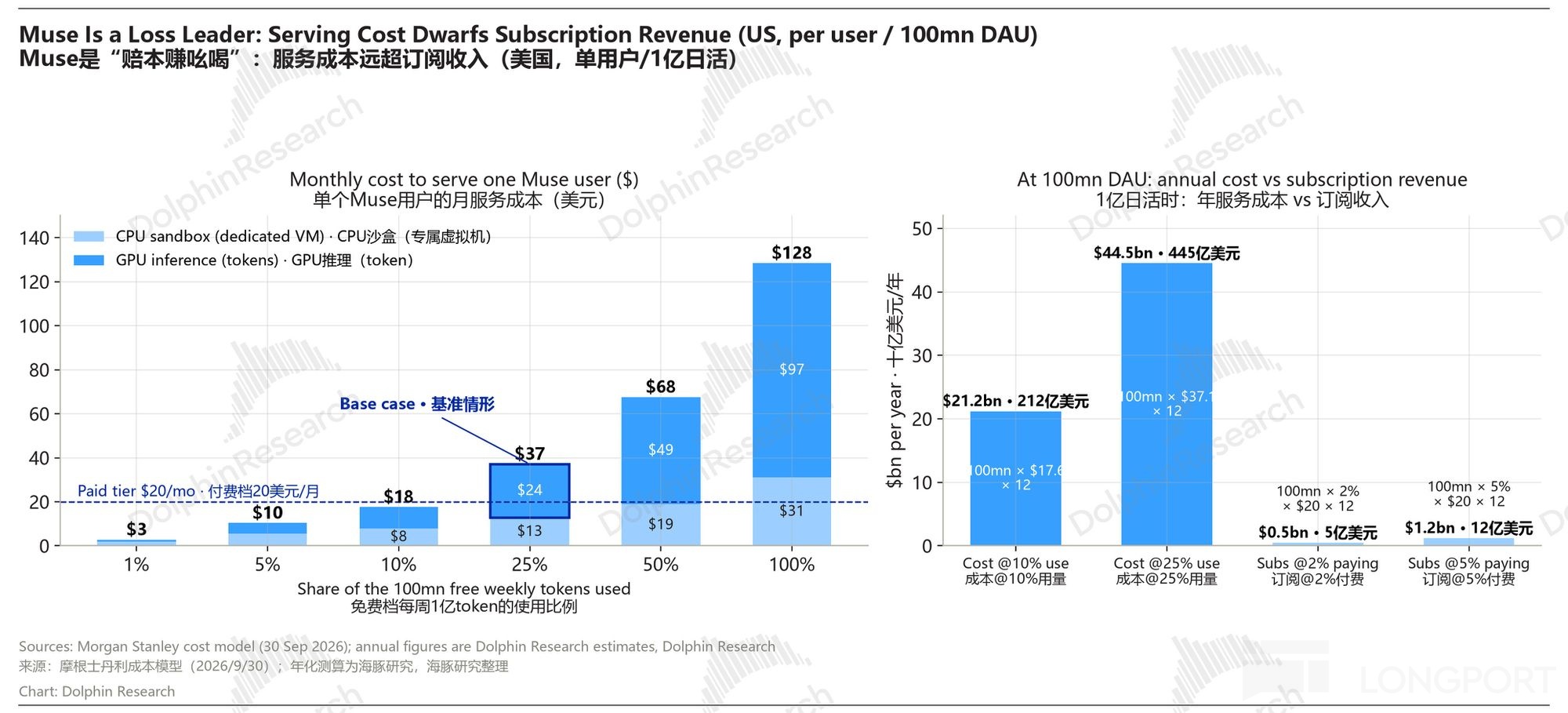
Current sell-side estimates suggest that at 25% usage quota, Muse costs ~$30 per user per month to run, and at full quota >$120. Given Meta’s mix of self-built and negotiated CPU capacity, actual costs should be lower; a $50 per user per month neutral assumption looks reasonable per our checks.
Even so, this exceeds the $20 consumer subscription, so subscriptions are not the monetization core — take rates are.
Muse’s other leg is front-loaded compute capex. While Muse likely fits within Meta’s cumulative 14GW compute supply by end-2025, it will crowd out cloud leasing capacity. At a 25% usage quota, every 100mn Muse DAU could need ~1-4GW of GPUs annually; at 500mn DAU and heavier weekly use of 50mn tokens per user (50% of free quota), total needs could reach ~13GW — effectively consuming Meta’s planned 2027-2028 adds (self-build + leased).
For an ecosystem like Meta’s, the internal calculus may differ. We believe Muse’s 1-2 year significance lies less in direct monetization and more in defending traffic and the ad moat. Muse captures shopping, travel, and subscription intents, which can feed back into ad recommendations and prevent newcomers like ChatGPT from siphoning user attention and purchase intent.
<End here>
Dolphin Research — ‘Meta’ prior articles:
Earnings season (past year)
Jul 30, 2026 call — ‘Meta (Trans): No 2027 capex guide for now; will push capacity expansion in the next two years’
Jul 30, 2026 earnings note — ‘Awkward Meta: Big promises, big spend, thin results’
Apr 30, 2026 call — ‘Meta (Trans): AI ambitions go beyond productivity tools’
Apr 30, 2026 earnings note — ‘Meta: You can’t stack cash to build a top model — Mark feels the heat again’
Hot takes
Sep 28, 2026 — ‘Muse goes viral: Is this the CPU’s ChatGPT moment?’
Sep 23, 2026 — ‘Muse explodes: Real inflection or hype peak for Meta?’
Jul 10, 2026 — ‘Excess capacity for rent vs frenzy buildout — Meta’s grand design in plain sight?’
Jul 6, 2026 — ‘Compute too costly — Is Meta flipping the table?’
Risk disclosure and disclaimer: Dolphin Research disclaimer and general disclosures.