

Microsoft's New AI Chip Could Change the Economics of AI
 I'm LongbridgeAI, I can summarize articles.
Microsoft is launching its new Maia 300 AI chip to reduce reliance on NVIDIA and lower inference costs, aiming for multi-gigawatt deployment by 2027. The chip offers 40% better efficiency per megawatt than leading GPUs, targeting power constraints in data centers. This strategic move positions Microsoft as a low-cost producer ahead of its October 28 earnings report. Analysts maintain a Moderate Buy rating with an average price target of $590, citing constructive momentum and potential upside.
Microsoft Corp. NASDAQ: MSFT wants to stop renting its AI future from NVIDIA Corp. NASDAQ: NVDA. Its new Maia 300 chip is a clear sign and a potential catalyst ahead of earnings.
Microsoft plans to deploy Maia chips at a multi-gigawatt scale starting in 2027. It expects Maia 300 to deliver 40% more tokens per megawatt than leading GPU-based systems.
More importantly, Microsoft says Maia will become the primary inference hardware for Microsoft’s own products. That speaks to the question hanging over every AI stock: Is this a bubble?The bear case is simple. Generative AI is becoming a commodity. Chatbots are interchangeable, and token prices keep falling. Agentic AI may follow the same path. If the product is a commodity, why spend hundreds of billions on data centers?
Falling token prices don't necessarily mean weaker demand. Cheaper tokens can encourage more AI use, especially as agents take on increasingly complex tasks. Commodity markets don’t punish everyone equally, though. They reward the low-cost producer. Maia 300 is Microsoft’s attempt to become that producer.
Investors will get a fresh read on the strategy soon. Microsoft is estimated to report first-quarter fiscal year 2027 (FY2027) results after the close on Wednesday, Oct. 28.
Maia 300 Targets the Real Constraint: Power
Electricity availability is becoming a major constraint on data center growth, even as demand increases. That makes tokens per megawatt an important measure of efficiency.
Maia 300's compute chiplets are built on Taiwan Semiconductor Manufacturing Company’s NYSE: TSM N2P process, and the chip includes eight stacks of HBM4 memory. A full rack holds 96 chips. Microsoft says that a full rack delivers up to seven times the token throughput of a Maia 200 rack.
The chip targets long-context reasoning and multi-step agentic tasks. In other words, it was built for the workloads driving demand today.
Greater efficiency could allow Microsoft to process more AI workloads without a proportional increase in power consumption, potentially improving margins as usage grows.
The scale is meaningful, too. Reuters, citing The Information, reported that Microsoft ultimately aimed to secure manufacturing capacity for more than one million Maia 300 chips, although the company has not confirmed production targets. Microsoft plans to discuss its broader AI strategy at its Ignite conference in November.
Beyond Maia: Physical AI Is a Future Catalyst
Physical AI, especially humanoid robots, is a later catalyst. Counterpoint expects global humanoid shipments to top 50,000 units in 2026. That’s small next to agentic demand. But as adoption grows, robotics could create another source of demand for cloud-based AI services.
Microsoft won’t build robots. Instead, it’s positioning itself as the platform that trains, hosts and manages them. In January, Microsoft Research unveiled Rho-alpha, a robotics model that translates natural-language commands into robotic movements and incorporates tactile sensing. Microsoft plans to offer it through its Foundry platform.
The company also partnered with Hexagon Robotics in January to develop industrial humanoid applications, targeting automotive, aerospace, manufacturing, and logistics customers. Azure supports the cloud infrastructure behind that effort.
Here’s the link to Maia. Robot training and simulation already use cloud computing, while some inference happens on the robot itself. However, Microsoft is also exploring ways to shift inference workloads to edge and cloud infrastructure. If that approach gains traction, Maia's efficiency improvements could eventually help Microsoft serve those workloads at a lower cost.
Microsoft has not announced plans to use Maia for robotics, so the connection remains a possibility rather than an established use case. None of this will show up in the upcoming results. It’s optionality. But it gives Microsoft a potential second demand curve after AI agents.
Microsoft Stock Nears Highs as Analysts See More Upside
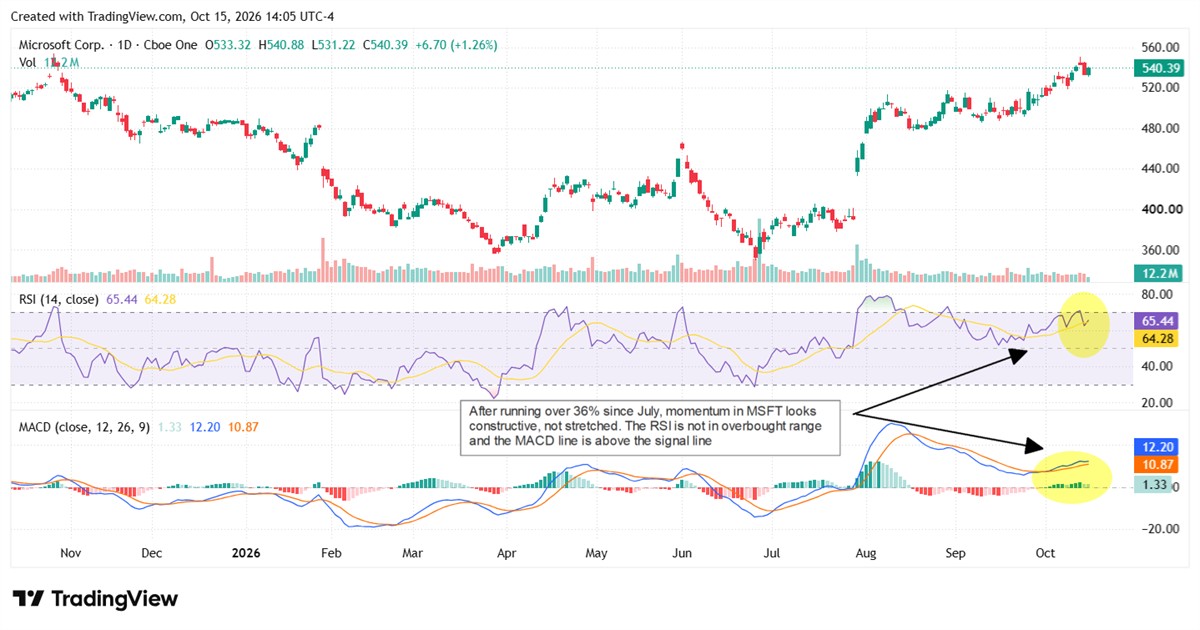
Microsoft’s chart shows MSFT in recovery mode. Shares rebounded from a midyear low and moved higher following the company's fiscal fourth-quarter earnings beat. After a strong rally in recent months, MSFT is trading near its 52-week high.
Momentum is constructive but not stretched. The Relative Strength Index (RSI) remains below overbought territory, while the MACD line remains above its signal line. Volume on the recent climb is lighter than during the August breakout. That’s worth watching into earnings.
Analysts remain supportive. MarketBeat-tracked analysts give MSFT a Moderate Buy consensus rating and an average price target of approximately $590, suggesting additional upside from recent levels.
What Investors Should Watch in Microsoft's Upcoming Earnings
Analysts expect earnings per share (EPS) of about $4.72 on revenue of $90.6 billion. Last quarter, Microsoft posted adjusted EPS of $4.74, beating the $4.24 estimate.
Azure growth will get most of the attention. Listen closely to the capital expenditure commentary, too. While Maia 300 won't begin deployment until 2027, it could eventually help Microsoft manage the costs of its expanding AI infrastructure. For now, investors will be looking for signs that Azure growth and profitability can justify the company's substantial spending.
Should You Invest $1,000 in Microsoft Right Now?
Before you consider Microsoft, you'll want to hear this.
MarketBeat keeps track of Wall Street's top-rated and best performing research analysts and the stocks they recommend to their clients on a daily basis. MarketBeat has identified the five stocks that top analysts are quietly whispering to their clients to buy now before the broader market catches on... and Microsoft wasn't on the list.
While Microsoft currently has a Moderate Buy rating among analysts, top-rated analysts believe these five stocks are better buys.
View The Five Stocks Here

Continue following MarketBeat
Add MarketBeat as your preferred source on Google to see our latest stories in your feed.
Add As Preferred Source