

CoinShares Q2 Mining Quarterly Report: Mining Companies Exit at a Loss
 I'm LongbridgeAI, I can summarize articles.
CoinShares' Q2 2026 report highlights that listed Bitcoin miners are below cash break-even, with average production costs at $75,500 against a BTC price of $58,400. Key trends include companies exiting mining to pivot to AI data centers due to regulatory bans and grid bottlenecks making electrified sites scarce assets. While contracted AI capacity trades at high premiums, uncontracted miners face undervaluation, emphasizing the shift from pure mining to infrastructure leasing.
Author:Luke Nolan Source: CoinShares Translation: Shan Ouba, Jinse Finance
I. Executive Summary
In the second quarter of 2026, the listed mining industry as a whole was below the cash break-even point. Bitcoin closed at $58,400 at the end of the quarter, less than half of its all-time high in October 2025. For the first time since the Chinese ban, the network has experienced a six-month decline, with hashrate about 50% below trend levels. The average monthly hashrate price in June hit a record low of $27.7/PH/s/day. In the second quarter of 2026, the average pre-tax cash cost for listed miners to produce one Bitcoin was approximately $75,500. Three key themes emerged this quarter: Paying to stop mining: Core Scientific paid $41.9 million to cancel its next-generation Proto hardware with 15 EH/s. Keel ceased mining on June 29 and will record zero mining revenue in the third quarter, while at least 35 EH/s of hashrate will leave the listed group when IREN and Cipher complete their delisting. Keel and Cipher also sold their BTC reserves while redirecting the funds to data center development.
Regulation is turning already-powered sites into scarce assets: At least 225 data center construction bans or restrictions have been recorded in 30 states, of which 151 remain in effect, with New York State introducing the first statewide suspension. The U.S. interconnect queue is approximately 2,600 GW, exceeding the nation's total installed capacity, with data centers accounting for 87% of the ERCOT 410 GW high-load queue. A recent deal valued three fully leased AI data centers at approximately $27 million/MW, while some publicly traded mining companies have powered but unleased capacity for less than $3 million/MW. Existing grid access is becoming increasingly valuable.
Premiums have been priced in, but revenue has not yet been realized: Companies with contracted AI or HPC capacity are trading at an average of 12.9x EV/NTM sales, while uncontracted mining companies are trading at 3.7x. ...>
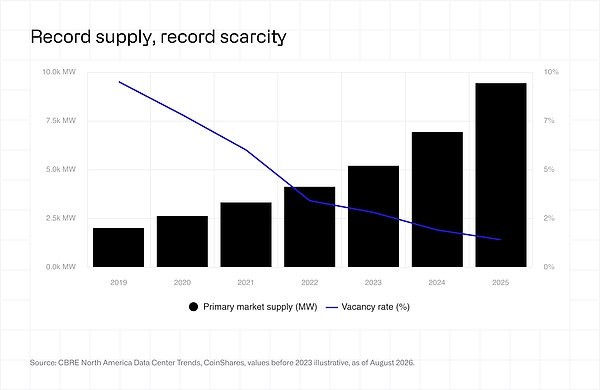
Keel is an exception, trading at 18.3x despite having no contracted tenants. The disclosed backlog of over $100 billion currently only supports approximately $1.1 billion in annualized AI/HPC revenue, of which about 550MW is billed, and over 4GW is contracted. Valuation will increasingly depend on converting contracted capacity into billed revenue. II. Regulation is making electrified sites scarce assets. A new constraint has emerged in the US that we believe fundamentally reprices the asset base of listed miners: building new data centers is becoming increasingly difficult. According to ElectricChoice's tracking, at least 225 data center construction bans or restrictions have been recorded in 30 states, 151 of which remain in effect. The most significant development occurred on July 14, 2026, when New York became the first state to implement a statewide ban, suspending environmental permits for facilities of 50MW and above for one year. Maine went further, completely banning new data center construction in April 2026, while restrictions have spread to the county level in states such as Ohio, Michigan, Georgia, and Indiana, where more than a third of counties have taken steps to restrict development. Crucially, projects with completed permit applications are often grandfathered, meaning existing permits now possess an option value that new entrants cannot replicate. Regulatory barriers exacerbate already severe grid bottlenecks. According to a Queued Up study by Lawrence Berkeley National Laboratory, the U.S. interconnection backlog is approximately 2,600 GW, roughly twice the country's total installed capacity, and the median wait time from application to operation for projects scheduled for completion in 2025 is now over five years. In the PJM region, projects scheduled to be operational in 2025 are averaging over seven years from initial application to operation, while transformer delivery times are now over 160 weeks. ERCOT's own high-load queue data shows that data centers account for 87% of the 410 GW queue. The practical consequence is that, no matter how much capital is available, existing power stations cannot be rebuilt within a commercially relevant timeframe. The market is responding by charging significant premiums for existing capacity. According to CBRE, despite a 36% year-over-year increase in supply, the primary market vacancy rate fell to a record 1.4% by the end of 2025 and reached only 0.3% in NUV by the first quarter of 2026, while pre-leasing rates were around 70%, compared to the historical norm of 40% to 50%. The recent $3.5 billion acquisition of three leased AI facilities in NUV sets a benchmark of approximately $27 million/MW for stable AI infrastructure. Publicly traded miners with energized but unleased capacity are currently trading at a fraction of that benchmark, in some cases below $3 million/MW, for assets requiring tenants rather than permits. This repricing is perhaps best exemplified by a publicly traded miner that rejected a takeover offer valued at just over $1 billion in 2024, but a year later agreed to a $9 billion all-stock sale—almost a ninefold increase for a substantially similar 1.3GW footprint—before shareholders rejected it in October 2025, deeming the price insufficient. More recently, another major operator agreed to pay up to $600 million, or about $300,000/MW, for a Texas land site with 2GW of grid capacity rights and no existing structure, and its stock price rose 15% after the announcement.
It's important to note that power capacity is a necessary but not sufficient condition. The cost of converting mining infrastructure to AI-grade facilities is estimated at $8 million to $15 million per megawatt, compared to $700,000 to $1 million per megawatt for mining itself. Therefore, the premium primarily flows to operators with credible conversion paths and contracted tenants. Nevertheless, the direction is clear: regulation and grid congestion have reversed the historical discounts applied to mining sites, transforming what was once considered idle, low-grade infrastructure into one of the scarcest licensed power capacities in the United States.
We must remind you that power capacity is a necessary but not sufficient condition. The cost of converting mining infrastructure to AI-grade facilities is estimated at $8 million to $15 million per megawatt, compared to $700,000 to $1 million per megawatt for mining. Therefore, the premium primarily flows to operators with credible conversion paths and contracted tenants. Nevertheless, the direction is clear: regulation and grid congestion have reversed the historical discounts applied to mining sites, transforming what was once considered idle, low-grade infrastructure into one of the scarcest licensed power capacities in the United States.
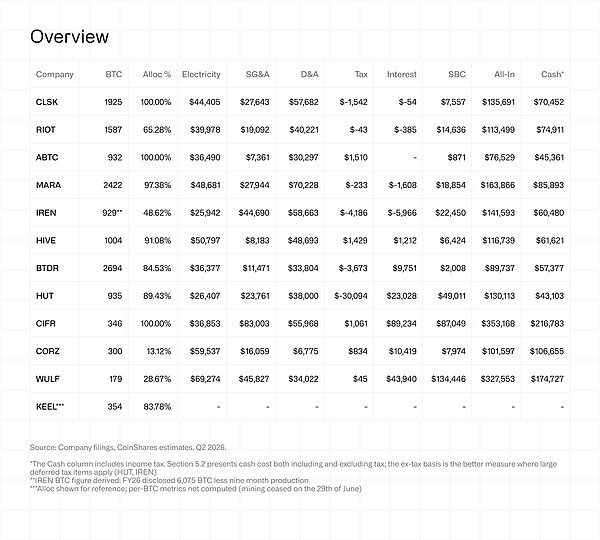
5.2 Company-by-Company Breakdown
CLSK CleanSpark Inc
Bitcoin Mining: $1,925
Total Cost: $135,691/Bitcoin
RIOT Riot Platforms Inc
Mining Bitcoin: 1,587
Total Cost: $113,499/Bitcoin
Cash Cost: $74,911/Bitcoin
Cash Cost (excluding tax): $74,955/Bitcoin
IREN Iren Ltd
Bitcoin Mining: 929
Total Cost: $141,593/Bitcoin
Cash Cost: $60,480/Bitcoin
Cash Cost (excluding tax): $64,667/Bitcoin
HIVE HIVE Digital Technologies Ltd
Mining Bitcoin: 1,004
Total Cost: $116,739/Bitcoin
Cash Cost: $61,621/Bitcoin
Cash Cost (excluding tax): $60,192/Bitcoin
VII. Outlook for Q3 2026 and Beyond
- At least 35 EH/s of hashrate will exit the listed mining companies: Keel has already completed its cleanup; IREN plans to complete its exit by December 31, 2026, with an existing installed capacity of 23.2 EH/s; Cipher will most likely exit by the end of 2027, with the Odessa site at 11.6 EH/s. TeraWulf is also reducing its remaining 145MW of mining capacity; the impact on the overall network hashrate depends on whether the mining machines are directly scrapped or resold to the market. The rebound in Bitcoin prices is unlikely to reverse the major trend of transformation towards AI: Core Scientific spent $41.9 million to cancel an order for a new generation of 15EH/s mining machines; several companies have already signed 15-year hashrate leasing contracts for their facilities. Future new mining capital expenditures are more likely to come from RIOT, MARA, HIVE, and Bitdeer, as these companies still retain business flexibility. Whether hashrate prices can continue to recover still depends on the price of Bitcoin. At the end of Q2, when the price of Bitcoin was $58,400, only ABTC, BTDR, HIVE, and IREN in the sample had cash costs lower than actual output revenue. Bitcoin rebounded to around $77,000, and hashrate prices recovered to $38/PH/s/day. Q3 Key Observations: Can Bitcoin hold above $70,000 for the entire quarter, thereby generally improving mining profitability across the industry? Mining hardware prices are likely to decline. Bitmain and Bitdeer's next-generation hardware (less than 10J/TH) will enter mass production in the second half of 2026; additionally, cancelled 15EH/s Proto orders may return to the market. For companies still committed to mining, the economic conditions for equipment upgrades will improve. AI/HPC revenue will accelerate in the second half of 2026. Over $100 billion in signed orders correspond to only about $1.1 billion in annualized revenue. Core Scientific already has 437MW billed; Cipher's Black Pearl rental started billing in August; IREN aims to achieve $4 billion in annualized operating revenue by December. We expect the industry's overall annualized revenue to more than double before the next report is released. Financing conditions will become an increasingly critical differentiating factor for companies. Hut secured $7.5 billion in non-recourse project debt in Q2; Cipher and IREN secured financing at 6% interest rates. Project-level financing costs are more meaningful than GAAP book profits. Especially noteworthy is the $1.95 billion in warrant revaluation losses incurred by these three companies this quarter. Appendix: Methodology Allocation: Self-mining revenue / Total revenue. Applied to sales, general and administrative expenses, depreciation and amortization, stock-based compensation, interest, and taxes. Bitcoin Total Cost = Electricity (minus power curtailment) + Sales, General and Administrative Expenses (excluding stock-based compensation) + Depreciation and Amortization + Net Interest + Income Tax + Stock-based Compensation — allocated to mining revenue share where applicable. Bitcoin Cash Cost = Operating Costs (excluding depreciation and amortization) + Sales, General and Administrative Expenses (excluding stock-based compensation) + Net Interest + Income Tax — allocated to mining revenue share. Electricity figures are net of curtailment/demand response credits. They exclude impairments, fair value revaluations, and non-operating items (e.g., Bitcoin revaluation gains/losses, fair value changes of derivative instruments, debt conversion incentive expenses). Unless otherwise stated, figures are in thousands of US dollars.