

Kospi Capped at 6,800 as Samsung and SK Hynix Weakened; SoftBank Lifts Nikkei 225 to Buck Trend
 I'm LongbridgeAI, I can summarize articles.
Japanese and South Korean stocks ended mixed on September 17. The KOSPI closed down 0.04% at 6,715.41 points, weighed down by declines in Samsung Electronics and SK Hynix. Conversely, the Nikkei 225 rose 0.33% to 64,136.03 points, supported by late-session buying driven by SoftBank's gains. Despite initial morning highs, profit-taking reversed gains in Korea, while Japan saw a divergence between Kioxia and SoftBank.
TradingKey - Japanese and South Korean stocks ended mixed as chip giants struggled, dragging the KOSPI lower, while late-session buying pushed the Nikkei higher.
During the Asian session on September 17, Japanese and South Korean stocks opened higher after digesting negative spillovers from US markets in the morning. However, afternoon profit-taking weighed on equities, a trend most pronounced in South Korea, where the market ultimately reversed gains to close lower.
Among them, two intraday rallies in the KOSPI were ultimately capped, with the index finishing down 0.04% at 6,715.41 points. Both major heavyweight stocks pulled back, as Samsung Electronics fell 0.02% to close at 253,000 won, while SK Hynix slipped 0.8% to 1,745,000 won.
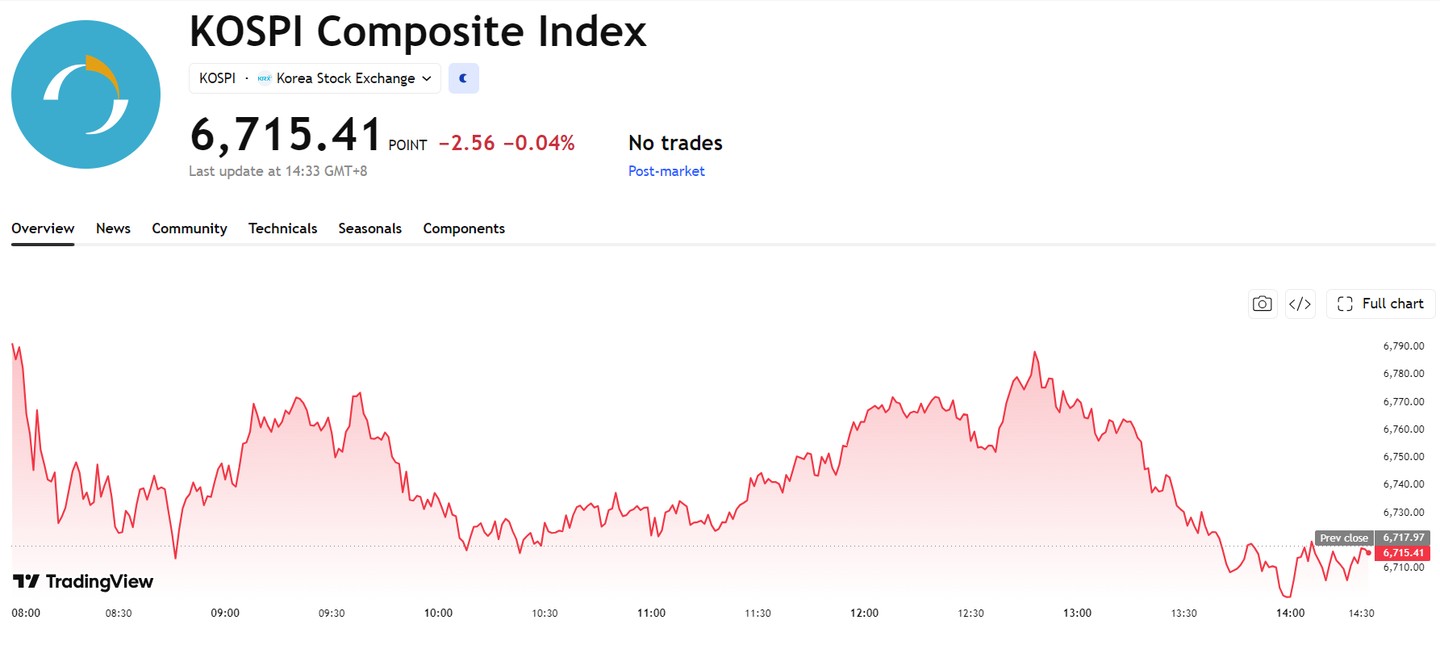 KOSPI Index Chart, Source: TradingView
While the Nikkei 225 Index also saw its intraday gains capped, a notable late-session rally helped it close up 0.33% at 64,136.03 points. Performance between two key heavyweights diverged, with Kioxia dropping 1.77% to 49,880 yen, while SoftBank gained 1.04% to 6,247 yen.
Stock market weightings in Japan and South Korea are heavily concentrated in semiconductors, the AI supply chain, and electronic components. As long as global AI server demand and advanced packaging capacity remain strong, the tech sector will remain the primary defense supporting downside for the indices in the second half of the year. Looking forward, market trends warrant close attention to capital expenditures on global AI computing infrastructure buildouts and the strength of inventory pull-ins during the fourth-quarter consumer electronics peak season.
Find out more