

How did ZEC surge from $50 to $1200 in the past year?
 I'm LongbridgeAI, I can summarize articles.
ZEC surged from $50 to $1200, driven by Grayscale's spot ETF launch providing institutional access, post-vulnerability trust restoration after the 'Ironwood' upgrade, and a short squeeze fueled by concentrated bearish positions.
Written by: Shannon@Jinse Finance
On September 6, 2026, the privacy coin Zcash token ZEC touched $1200 during trading, setting a new high in nearly ten years. ZEC's market capitalization also successfully entered the top ten of the crypto market capitalization.
Rewind to a year ago, when the price of ZEC was around $50. As of press time, the price of ZEC has reached $1200.
Looking further, you will find that ZEC started its rise at this time a year ago.
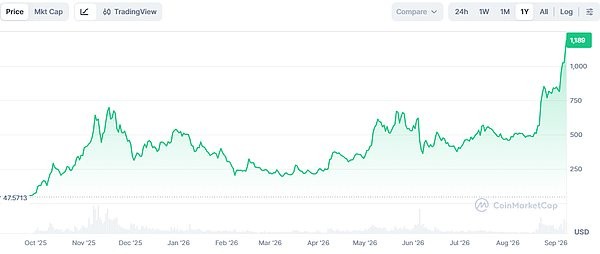
The growth curve of ZEC's rally has been both volatile and phenomenal.
The price of ZEC in this round of market activity has been both dramatic and frenzied.
Before September 2025, ZEC had been hovering around $50 for three years; After Naval's recommendation in late September 2025, it began to surge, reaching $650 in a month and a half; As the crypto market turned bearish at the end of 2025 and the beginning of 2026, ZEC gradually declined, hovering around $200 around March 2026; In May 2026, ZEC briefly rose to $690, but due to a mintage vulnerability, it fell to around $250 in early June; In August, ZEC broke through the $900 mark, reaching a new high since 2018; On September 4th, it reached the $1000 mark; On September 6th, the price surged to $1200 during trading, representing a cumulative increase of approximately 370% from its low three months prior and over 20 times its value a year ago. This dramatic rise is actually the result of a confluence of multiple factors, rather than being driven by a single news item. Driving Factor 1: The Final Step Towards Compliance – Grayscale's Spot ETF Launch The most direct catalyst for this rally was Grayscale's formal conversion of its Zcash Trust into a spot ETF listed on the NYSE Arca, ticker symbol ZCSH, which began trading on August 25th. This is the first spot ETF product in the history of the US market to track privacy coins. For ZEC, the significance of this product lies in opening up a previously non-existent "compliant funding channel." Traditional institutions and conservative investors can gain ZEC price exposure through stock accounts without directly holding tokens or facing the operational and compliance hurdles of exchanges or self-custodied wallets. Since its launch, the product has seen rapid capital inflows, with a cumulative net inflow exceeding $34 million, including a record high of $12.6 million in a single day on September 2nd. Grayscale's Zcash ETF (ZCSH) holds $463.2 million in ZEC. For a coin whose total market capitalization has long been considered a "niche privacy asset," this level of institutional attention is unprecedented. Driving Factor Two: Panic Buying and Market Recovery Due to a "Trust Crisis" This surge also has an easily overlooked background. ZEC experienced a severe trust crisis in June of this year. At the time, a security researcher disclosed a vulnerability in Zcash's shielded transaction pool (Orchard) that could be used to forge assets. Following this news, the price of ZEC plummeted by over 60% from around $650, briefly falling below $300. The market seriously questioned the reliability of the core privacy technology. Subsequently, the Zcash core development team completed the "Ironwood" upgrade in July, successfully fixing the vulnerability, and network integrity and market confidence gradually recovered. In a sense, this rally from $300 to $1200 was not only "new growth" but also a double whammy of "trust restoration + valuation reassessment." After confirming the security of the core privacy mechanism, the market re-priced back the premium lost due to panic. Furthermore, the panic caused by this trust crisis shook out most ZEC holders, making it easier to pump the price. The combination of ETFs and the short squeeze effect led to this round of accelerated price increases from $300 to $1200. Furthermore, on-chain data shows that the size of Zcash's shielded liquidity pools continues to climb, with a significant proportion of the circulating supply being stored in fully encrypted privacy pools. This, to some extent, confirms the narrative of "real-world demand supporting the price," rather than being driven solely by speculative funds. Driving Factor Three: Leveraged Fueling by Short Selling ETFs brought in incremental funds, but what truly caused the price to exhibit a "vertical rise" was the short squeeze effect caused by concentrated short selling. As the price of ZEC gradually approached and broke through the psychological barrier of $1000, traders who shorted the coin were repeatedly proven wrong. Data shows that even after several consecutive days of price increases, a significant proportion of accounts on Binance and OKX maintain net short positions, with the long/short ratio reaching 0.61 and 0.32 respectively at one point, indicating that a considerable number of traders are continuously adding to their short positions in a bearish market. For example, Garrett Jin, the largest ZEC short holder on Hyperliquid and a whale, has suffered a paper loss of over $25 million due to his shorting of ZEC. He opened a short position of 32,760 ZEC at $444 in early July. As of press time, he is still increasing his ZEC short position. As prices continued to hit new highs, these short positions were forced to close one by one. The closing process itself required buying tokens in the market to repay borrowed positions, which in turn further pushed up prices, creating a positive feedback loop of "the higher the price, the more short squeeze, and the more short squeeze, the higher the price." In just a few trading days from September 2nd to September 6th, liquidation data showed that over 90% of the liquidations came from short positions. This is the key technical reason why ZEC was able to jump from $900 to $1200 in such a short time. Driving Factor Four: The Privacy Coin Narrative Rekindled If ETFs and short squeezes were the "trigger" for this accelerated rise, then what truly supports ZEC's continued ability to attract capital, rather than just a brief surge, is the continuous strengthening of the privacy coin narrative over the past year. This narrative was actually foreshadowed as early as October 2025.
- Naval's "endorsement" effect.On October 1, 2025, renowned tech investor Naval Ravikant wrote on X, "Bitcoin is insurance against fiat. Zcash is insurance against Bitcoin." This tweet directly caused ZEC to surge by over 60% in a single day, and subsequently boosted the entire privacy coin sector by over 35% in the following month. ZEC itself saw a cumulative increase of over 700% in the following three months.
- The Winklevoss brothers establish a "privacy coin version of MicroStrategy."In November 2025, Gemini exchange co-founder Tyler Winklevoss reorganized one of his listed shell companies into Cypherpunk Technologies, specifically for accumulating ZEC. The initial purchase involved over 200,000 ZEC tokens (approximately $50 million) at an average price of around $245, with a public stated goal of capturing 5% of the total ZEC supply. He likened this strategy to "If bitcoin is digital gold, Zcash is digital cash," attempting to replicate the capital operation model of Michael Saylor's MicroStrategy, which accumulated Bitcoin and boosted market capitalization. This was further supported by the technical endorsement of Ethereum founder Vitalik Buterin. In February 2026, Vitalik Buterin made a second donation to Shielded Labs, the Zcash privacy technology team, supporting its "Crosslink" upgrade project, and publicly praised Zcash as one of the "most principled and privacy-focused" projects in the crypto industry. Such continued endorsements from top developers further solidified ZEC's position among "orthodox privacy assets." This also served as a parallel narrative of "digital gold" with a fixed supply. Like Bitcoin, ZEC has a total supply cap of 21 million coins, uses a proof-of-work mining mechanism, and experiences halving cycles. In a liquidity-driven bull market, this "scarce asset" narrative is naturally easy for funds to draw parallels to Bitcoin's early performance, attracting speculative capital to position themselves early. It's worth noting that this narrative's continued momentum is paradoxically linked to the tightening global regulatory environment. The EU's new Anti-Money Laundering Regulation (AMLR) will ban anonymized cryptocurrencies and anonymous accounts from July 2027, and several European exchanges have already begun restricting Monero trading. However, Zcash, with its "optional privacy" (users can choose to make transactions transparent or hidden), is seen by the market as a more "compliant" alternative to Monero. Conversely, it has absorbed some of the funds and user demand spilling over from Monero amidst tightening regulations. In conclusion, ZEC experienced a dramatic price surge from $50 to $1200 over the past year. Essentially, this is the result of a rare convergence of five factors: "compliant fund entry (ETF) + panic selling (technical vulnerability wiped out all ZEC holders) + trust repair (vulnerability successfully patched) + technical short squeeze (short sellers liquidated) + narrative fermentation (the revival of privacy assets)." This also illustrates once again that in the crypto market, whether a token can tell a sufficiently grand story that coincides with current sentiments (privacy, tightening regulations, decentralized hedging) often determines short-term price movements more than its technical details. Whether intentional or unintentional, or even due to a technical vulnerability completely wiping out all holdings...