

🔥 Buy the Quiet, Sell the Headlines? A Beginner’s Guide to USO, Oklo & Vistra
 I'm LongbridgeAI, I can summarize articles.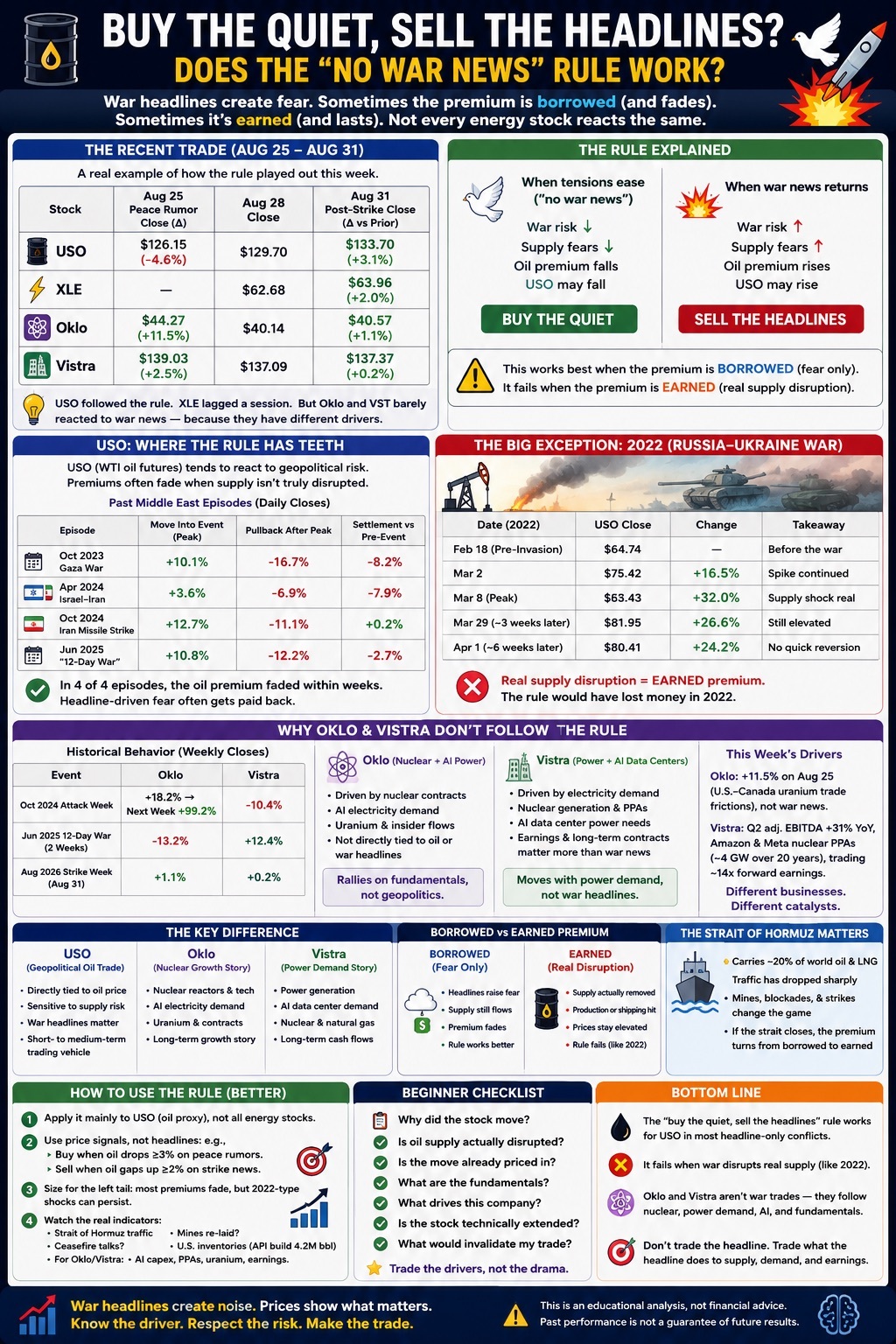
🧠 The Big Idea: “Buy When It’s Quiet, Sell When War News Returns”
A popular trading idea is simple: buy energy stocks when geopolitical tensions appear to be cooling, then sell when war headlines return.
But does this strategy actually work?
Looking at USO, Oklo and Vistra, the answer is only partly yes. The strategy has historically worked much better for oil prices and USO than for nuclear and power stocks such as Oklo and Vistra.
The biggest lesson for investors is that not every energy stock reacts to war headlines in the same way. Understanding what actually drives each company is more important than simply trading the headline.
📊 The Recent Trade: What Happened?
The trading window around August 25–31 provides a useful example.
Stock | Aug 25 | Aug 28 | Aug 31 |
🛢️ USO | $126.15 (-4.6%) | $129.70 | $133.70 (+3.1%) |
⚡ XLE | — | $62.68 | $63.96 (+2.0%) |
☢️ Oklo | $44.27 (+11.5%) | $40.14 | $40.57 (+1.1%) |
🔋 Vistra | $139.03 (+2.5%) | $137.09 | $137.37 (+0.2%) |
The pattern is interesting.
USO behaved almost exactly like the “buy the peace, sell the war” strategy would suggest.
But Oklo and Vistra barely reacted when the strike news returned.
That tells us something important:
USO is much more directly connected to geopolitical oil risk than Oklo or Vistra.
🛢️ USO: Where the Strategy Makes the Most Sense
USO is the clearest example of this trading concept because it provides exposure to WTI crude oil futures.
When investors become worried about a Middle East conflict, they can immediately price in a potential supply disruption.
That creates what traders often call a “geopolitical premium.”
📈 When tensions rise:
War risk ↑➡️ Supply fears ↑➡️ Oil prices ↑➡️ USO potentially ↑
🕊️ When tensions fall:
War risk ↓➡️ Supply fears ↓➡️ Oil premium falls➡️ USO potentially ↓
This is why USO can be much more sensitive to geopolitical headlines than a company such as Vistra.
📉 Historical USO Pattern
Looking at several previous Middle East episodes:
Episode | Move Into Event | Pullback After Peak |
🇮🇱 Gaza war, Oct 2023 | +10.1% | −16.7% |
🇮🇱🇮🇷 Israel–Iran, Apr 2024 | +3.6% | −6.9% |
🇮🇷 Iran missile strike, Oct 2024 | +12.7% | −11.1% |
⚔️ 12-day war, Jun 2025 | +10.8% | −12.2% |
The important observation is that these geopolitical oil premiums often faded after the initial fear passed.
That supports the basic idea behind:
🟢 Buy the fear/premium when it becomes excessive
🔴 Sell when the market starts pricing in the risk
But there is a HUGE warning.
⚠️ 2022 Shows When the Strategy Can Fail
The biggest mistake would be assuming:
“Every war-related oil spike eventually falls.”
That isn’t true.
The Russia–Ukraine invasion in 2022 is the perfect counterexample.
USO moved from approximately $64.74 on February 18 to $75.42 by March 2, then reached around $85.43 by March 8.
The problem?
This wasn’t simply fear.
The conflict threatened real physical oil supply.
Russian exports faced sanctions and disruption risks, while the market became concerned about actual barrels disappearing from the global supply chain.
🧠 This creates two different types of war premium:
BORROWED PREMIUM 💭
War headlines create fear → oil rises → supply remains available → premium eventually disappears.
EARNED PREMIUM 🛢️
War disrupts actual supply → fewer barrels available → higher oil price can persist.
That’s the most important distinction in this entire strategy.
🚨 The Beginner Rule
Don’t simply ask:
“Is there war news?”
Instead ask:
“Is this war actually removing oil from the market?”
If the answer is NO, the oil spike may be temporary.
If the answer is YES, be extremely careful about betting against the trend.
🌊 Why the Strait of Hormuz Matters
The current conflict is particularly important because the Strait of Hormuz is a major global energy chokepoint.
If shipping through the Strait becomes seriously disrupted:
🚢 Tanker traffic ↓🛢️ Oil supply availability ↓📈 Oil prices ↑📈 USO potentially ↑
That could transform a temporary geopolitical premium into a real supply shock.
Therefore, investors should watch actual tanker traffic and physical supply, not just headlines.
☢️ Oklo: Don’t Treat It Like an Oil Stock
This is where the strategy starts breaking down.
Oklo isn’t primarily an oil/geopolitical trade.
Its investment story is connected much more closely to:
☢️ Nuclear power🤖 AI data-center electricity demand⚡ Long-term power contracts🏗️ Reactor deployment💰 Financing and commercialization🟡 Uranium/nuclear sentiment
That’s why Oklo can sometimes move dramatically even when oil is doing something completely different.
For example, on August 25, Oklo jumped approximately 11.5%, while the broader geopolitical story was moving toward de-escalation.
Then when the strike news returned, Oklo moved only around +1.1% on August 31.
🧠 Lesson:
Oklo’s biggest driver isn’t simply “war or peace.”
Its valuation is much more connected to the future economics of nuclear power and AI electricity demand.
⚡ Vistra: A Completely Different Energy Story
Vistra is another excellent example.
At first glance, investors might put Vistra into the same “energy stock” bucket as USO.
That’s misleading.
Vistra’s major investment story increasingly involves:
⚡ Electricity demand🤖 AI data centers☢️ Nuclear power🏭 Power generation🤝 Long-term agreements with major technology companies
That means geopolitical oil headlines may have far less impact on Vistra’s underlying business.
This explains why Vistra barely moved during the latest strike.
📈 The AI Power Connection
One of the biggest long-term themes for Vistra and Oklo is:
AI → More Data Centers → More Electricity Demand
AI models require enormous amounts of computing power.
More computing power means:
➡️ More data centers➡️ More electricity consumption➡️ Greater demand for reliable power➡️ Increased interest in nuclear and other generation sources
This is a completely different investment thesis from:
War → Oil supply fears → USO
🔥 Why the Three Stocks Behave Differently
Think of them as three different trades:
🛢️ USO
Main driver: Oil price + geopolitical supply risk
☢️ Oklo
Main driver: Nuclear + AI power demand + future reactor economics
⚡ Vistra
Main driver: Electricity demand + power prices + nuclear/AI data-center demand
So using one rule for all three is dangerous.
📊 The Most Important Comparison
Factor | 🛢️ USO | ☢️ Oklo | ⚡ Vistra |
War sensitivity | 🔥🔥🔥 High | 🟡 Moderate/indirect | 🟡 Moderate/indirect |
Oil exposure | 🟢 Very high | ❌ Low | ❌ Low |
Nuclear exposure | ❌ | 🟢 High | 🟢 High |
AI power theme | ❌ | 🟢 High | 🟢 High |
Main catalyst | Oil prices | Nuclear growth | Electricity demand |
Best for | Oil/geopolitical trade | Long-term nuclear growth | Power + AI demand |
🎯 The Better Trading Rule
Instead of saying:
“Buy when there is no war news and sell when war news returns.”
A better rule would be:
🛢️ For USO:
Watch physical oil supply.
If geopolitical fear rises but oil supply remains intact → the premium may eventually fade.
If actual production or transportation is disrupted → don’t automatically sell.
☢️ For Oklo:
Watch:
Nuclear contracts + reactor progress + uranium + AI electricity demand.
Don’t automatically sell because of a war headline.
⚡ For Vistra:
Watch:
Power prices + electricity demand + nuclear generation + data-center contracts + earnings.
Again, war headlines are secondary compared with the company’s fundamental drivers.
🧠 Beginner Checklist Before Trading Energy Stocks
Before buying or selling, ask these 7 questions:
1️⃣ Why did the stock move?
Was it war news, earnings, AI demand, uranium, oil or something else?
2️⃣ Is the supply actually disrupted?
Fear isn’t the same thing as physical shortage.
3️⃣ Is the move already priced in?
If everyone expects oil to rise, the market may have already reacted.
4️⃣ What are the company’s fundamentals?
Revenue, earnings, margins and cash flow still matter.
5️⃣ What is the company’s main business?
USO, Oklo and Vistra may all be called “energy,” but their economics are very different.
6️⃣ Is the stock technically extended?
After a huge rally, even good news may not be enough.
7️⃣ What would invalidate your trade?
Always know what would prove your original thesis wrong.
🚀 Bottom Line
The “buy the quiet, sell the headlines” strategy has some evidence behind it — but mainly when applied to oil and USO.
The historical pattern suggests that headline-driven oil premiums can mean-revert when physical supply isn’t disrupted.
But 2022 proves that a genuine supply shock can completely break the strategy.
And that’s why investors should not put USO, Oklo and Vistra into the same basket simply because they are energy-related.
🛢️ USO = Geopolitical oil trade
☢️ Oklo = Nuclear + AI electricity growth
⚡ Vistra = Power generation + AI data-center demand
The biggest beginner lesson: don’t trade the headline alone. Trade what the headline does to the underlying supply, demand and earnings. 📈
This is an educational framework, not financial advice. Geopolitical markets can move extremely quickly, and past price behavior does not guarantee future results.
$SpaceX(SPCX.US)


The copyright of this article belongs to the original author/organization.
The views expressed herein are solely those of the author and do not reflect the stance of the platform. The content is intended for investment reference purposes only and shall not be considered as investment advice. Please contact us if you have any questions or suggestions regarding the content services provided by the platform.