

Three "defensive" stocks, stress-tested: Hasbro, Royal Caribbean, Manulife
 I'm LongbridgeAI, I can summarize articles.
Three "defensive" stocks, stress-tested: Hasbro, Royal Caribbean, Manulife
The following is an informational analysis and does not constitute investment advice or a buy/sell recommendation.
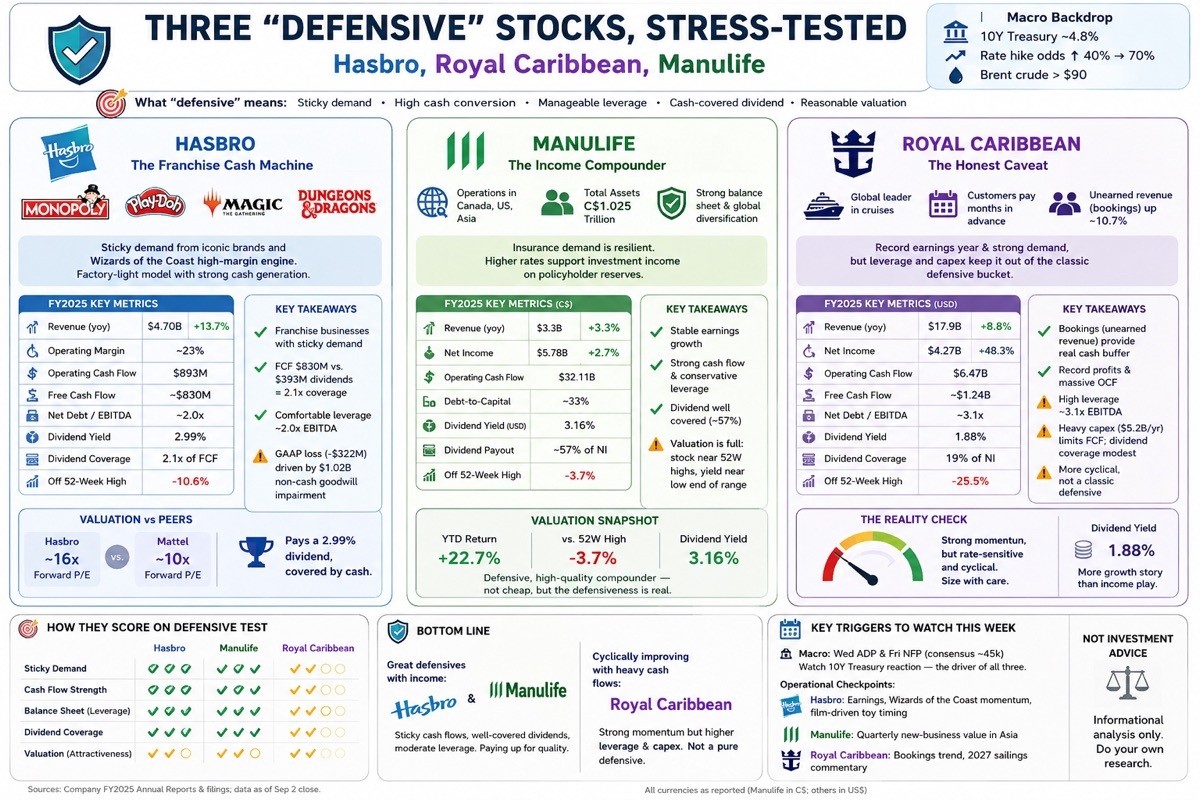
Against the backdrop you shared — the 10-year Treasury pushing toward 4.8%, market-implied odds of a rate hike jumping from roughly 40% to 70% in a single week, Brent above $90 — the market is repricing anything with a long-duration, far-future cash-flow story. When discount rates rise, the stocks that hold up best tend to be the ones whose cash flows do not depend on a perfect macro outcome. That is the real test of "defensive": not the label, but cash-flow certainty, balance-sheet headroom, and a visible income stream.
Your three picks run that test across genuinely different business models — a toy-and-games franchise, a global life insurer, and a cruise operator. They score very differently, and the honest headline is that only two are classic defensives. The third is defensible on different grounds, with a caveat attached.
What "defensive" means in this environment
A defensive stock is not simply "low beta." It is a company where (1) demand is sticky through downturns, (2) cash conversion is high, (3) leverage leaves room for error, (4) the dividend is covered by cash flow rather than accounting earnings, and (5) the valuation does not already price in perfection. Judged that way, the three names separate clearly:
| Metric (FY2025) | [stock Hasbro] | RoyalCaribbean | Manulife¹ |
|---|---|---|---|
| Revenue growth (yoy) | +13.7% | +8.8% | +3.3% |
| GAAP net income | -$322M (impairment-driven) | $4,268M | C$5,782M |
| Operating margin | ~23% | ~27% | n/a (insurer) |
| Operating cash flow | $893M | $6,465M | C$32,105M |
| Free cash flow | ~$830M | ~$1,236M | n/a (insurer) |
| Net debt / EBITDA | ~2.0x | ~3.1x | ~33% debt-to-capital |
| Dividend yield | 2.99% | 1.88% | 3.16% |
| Dividend coverage | 2.1x of FCF | 19% of net income | ~57% of common NI |
| Off 52-week high | −10.6% | −25.5% | −3.7% |
¹ Manulife reports in Canadian dollars; price/valuation in USD. Data as of the Sep 2 close; FY2025 annual reports.
[stock Hasbro] — the franchise cash machine
Hasbro's business is the definition of sticky demand: Monopoly, Play-Doh, Peppa Pig, Magic: The Gathering and Dungeons & Dragons. The profit engine is Wizards of the Coast, whose tabletop and digital games carry high-margin, high-retention revenue that moves on game releases, not on GDP.
The FY2025 numbers back the description: revenue of $4.70 billion, up 13.7% year over year, gross margin around 64%, and operating income of $1.06 billion, up 40.4%. Operating cash flow was $893 million against capital spending of just $63 million — this is a factory-light business — leaving roughly $830 million of free cash flow against $393 million of dividends paid, a 2.1x coverage ratio. Net debt sits near $2.4 billion, about 2x EBITDA, which is comfortable for a business this stable.
The headline that scares people — the $322 million GAAP loss — is almost entirely a non-cash $1.02 billion goodwill impairment from the eOne era, a balance-sheet cleanup rather than destruction of the toy business. [citation 36] The real watch-item: revenue has been reshaped downward by the eOne divestiture (from $6.4 billion in 2021 to $4.1 billion in 2024 before rebounding), and common equity is thin at roughly $566 million, so per-share earnings can swing hard quarter to quarter. [citation 36][citation 37]
Valuation is the honest trade-off: Hasbro trades near 16x forward earnings versus [stock Mattel] at barely 10x — but Mattel pays no dividend, while Hasbro's 2.99% yield is covered twice over by cash flow. [citation 38] You are paying a premium for the franchise quality and the income. It is a classic defensive with a quality premium.
Manulife — the income compounder
Manulife is the most textbook defensive of the three: an insurer and wealth manager across Canada, the US and Asia, whose total assets have crossed C$1.025 trillion. [citation 39] Insurance demand barely notices rate cycles — if anything, higher rates lift investment income on policyholder reserves, which is the opposite of the headwind hitting long-duration growth stocks.
FY2025 profitability is a picture of stability: net income of C$5.78 billion, up 2.7%, continuing a steady climb (C$5.46 billion in 2023 → C$5.63 billion in 2024 → C$5.78 billion). [citation 40] Common dividends of C$2.98 billion absorb roughly 57% of earnings attributable to common shareholders, a sustainable payout for a regulated insurer. [citation 40][citation 41] Leverage is modest — about C$25 billion of debt against C$48.5 billion of common equity, around 33% debt-to-capital. [citation 39]
The caveat is valuation, not business. The stock is up 22.7% year to date and sits barely 4% below its 52-week high, which is why the 3.16% dividend yield is near the low end of its own one-year range. [citation 42] Book value has re-rated far above its historical median. You are paying for Asian wealth-growth optionality on top of the defensive core — the defensiveness is real, but the entry price is no longer "cheap" by the insurer's own history.
RoyalCaribbean — the honest caveat
Royal Caribbean is the pick that sits least comfortably in a defensive bucket, and it should be said plainly. What it offers instead: a record earnings year, an improving balance sheet, and momentum in demand. FY2025 revenue of $17.9 billion grew 8.8%, and net income of $4.27 billion jumped 48.3% — a 24% net margin that would look good for a software company, let alone a cruise line that lost $5.3 billion as recently as 2021. [citation 43]
The defensive argument is real but different: customers pay for cruises months in advance, and the unearned-revenue (bookings) balance rose about 10.7% last year. That advance-cash pile is a genuine buffer, and operating cash flow of $6.5 billion is massive. [citation 44][citation 45] The counter-argument is equally visible: net debt of roughly $20.5 billion, about 3.1x EBITDA; a capex program of $5.2 billion a year on new ships leaves only about $1.2 billion of free cash flow after an $824 million dividend — coverage that is adequate, not abundant. [citation 44][citation 45] And the stock's −25.5% drawdown from its high in this rate-stress tape shows exactly how the market classifies it: as a cyclical that had run far.
So think of Royal Caribbean as "cyclically improving with heavy cash flows," not as a defensive income stock. Its 1.88% yield is a token compared with the other two. The lead indicator to watch is bookings: as long as unearned revenue keeps growing, the cash-flow argument holds; if that rolls over, the defensiveness rolls over with it. [citation 44]
How to use this
For a defensive tilt into the payrolls risk, the natural reading of the scorecard: Hasbro and Manulife earn the label on every criterion — sticky demand, cash-covered dividends, moderate leverage — with the honest caveat that both now carry fuller-than-cheap valuations. Royal Caribbean only passes if you accept leverage and cyclicality in exchange for growth and momentum; if what you want is defense, it is the one to size with the most care, and the one where the 3.16%–2.99% income of the other two is absent.
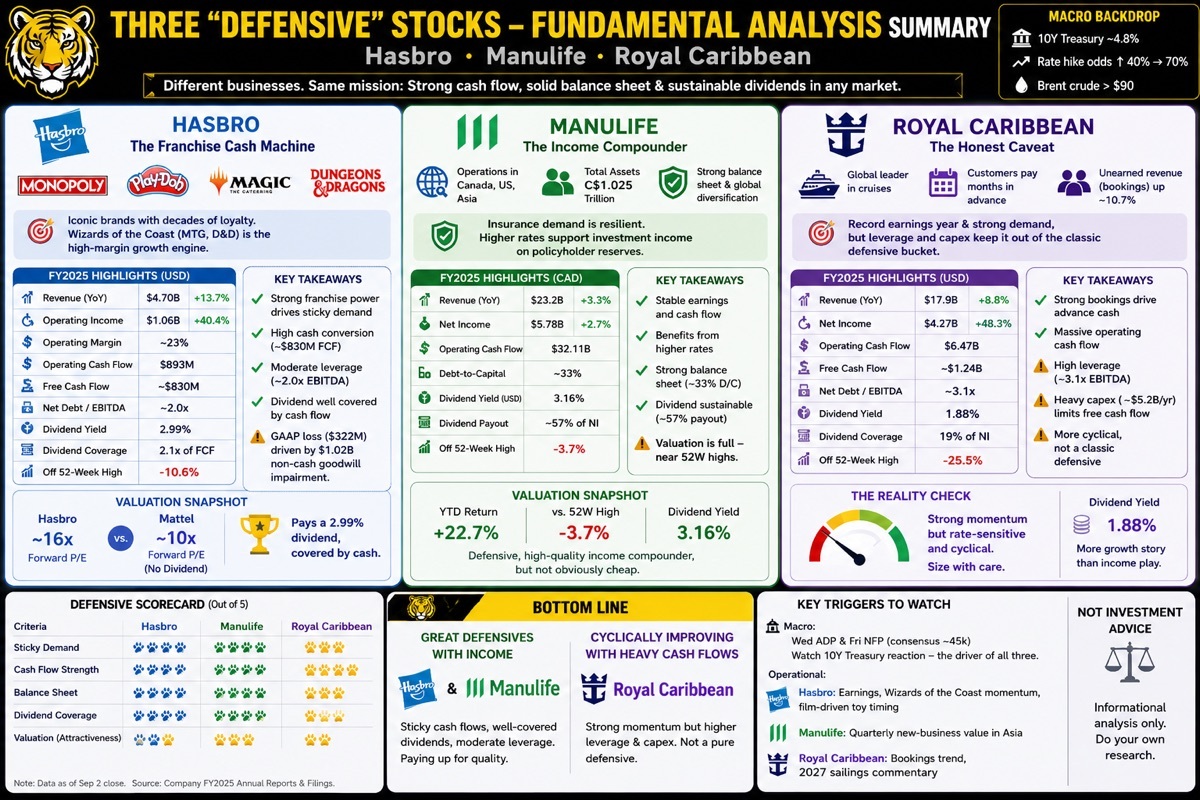
Concretely, the decision points this week: Wednesday's ADP report and Friday's nonfarm payrolls (consensus near 45k) decide whether the "hike odds" narrative fades or firms — watch the 10-year's reaction, since all three names respond to it. Beyond that, the operational checkpoints are Hasbro's next earnings (Wizards of the Coast game-line momentum and any film-driven toy timing), Manulife's quarterly new-business value in Asia, and Royal Caribbean's quarterly booking commentary on 2027 sailings.
Nothing above is a recommendation to buy or sell any security. It is a framework: five tests, three businesses, real numbers from the latest filings. The conclusion under those tests is yours to draw.


The copyright of this article belongs to the original author/organization.
The views expressed herein are solely those of the author and do not reflect the stance of the platform. The content is intended for investment reference purposes only and shall not be considered as investment advice. Please contact us if you have any questions or suggestions regarding the content services provided by the platform.