
O

Sep 12 at 06:41 AM
Dbs Sbs , grab and singtel 4 stocks in daily life I do and stocks related
 I'm LongbridgeAI, I can summarize articles.
🚇🍜 Why I Take Public Transport, Spend on Food, and Invest in the Companies
:
“If you are trying to build wealth, why don’t you drive a nice car? Why are you still taking the MRT and buses?” 😂
My answer is simple.
Because I would rather look financially comfortable than look financially rich.
For me, wealth is not about showing everyone that I can afford something.
It is about having the freedom to decide where my money goes.
And if I have a choice between spending a large amount of money on a car and spending that money on good food, experiences and investments, I know which one I would choose.
I choose food, investments and freedom. 🍜📈🚇
🚇 Public Transport Is Not a Sign That I Cannot Afford a Car
Living in Singapore makes this decision even easier.
We have an extremely developed public transport system.
I can take the MRT, LRT or bus to many places without worrying about parking, petrol, road tax, insurance, maintenance and the other costs associated with owning a car.
More importantly, when I take public transport, I can use the journey productively.
I can read.
I can research stocks.
I can check my portfolio.
I can reply to messages.
I can watch educational videos.
Or, honestly, I can just relax. 😂
That is something people sometimes forget.
A car doesn’t automatically give you more freedom.
Sometimes it gives you another financial responsibility.
🍜 I Would Rather Spend My Money on Food
This is probably the funniest part of my financial strategy.
I don’t want to live like a monk just because I want to build wealth.
I still want to enjoy life.
If I have extra money, I would much rather spend it on good food with family and friends than spend hundreds of thousands of dollars trying to look successful.
There is nothing wrong with owning a car.
If someone genuinely needs one for work, family responsibilities or convenience, it can be a very sensible decision.
But if I can comfortably take public transport, then I don’t see the need to spend a huge amount simply because society tells me that someone successful should drive.
My definition of wealth is different.
I want my money to produce something for me.
A car generally becomes an expense.
An investment can potentially become an asset.
And food?
Well… food makes me happy. 😂🍜
So I would rather have a good meal and continue investing than have an expensive car sitting outside my home.
💰 The Real Cost of Looking Rich
The biggest lesson I have learned is that looking wealthy and being wealthy are completely different things.
Someone can drive an expensive car but have a huge monthly loan.
Someone can wear expensive watches but have very little cash.
Someone can live in a beautiful home but spend every dollar they earn.
And someone else can take the MRT every day while quietly building a multimillion-dollar investment portfolio.
You cannot determine someone’s financial position simply by looking at them.
That is why I don’t feel embarrassed taking public transport.
The MRT doesn’t reduce my wealth.
If anything, it can help me protect it.
📱 My First Stock: Singtel — Because I Use GOMO
One of the interesting parts of my investment strategy is that I like owning companies whose products I actually use.
For example, I use GOMO, which is provided by Singtel Mobile. GOMO operates on the Singtel network and offers no-contract mobile plans.
So when I pay my mobile bill, I can think about the bigger picture.
I am not necessarily saying:
“Because I use GOMO, I must buy Singtel shares.”
That would be poor investment logic.
Instead, I see it as a useful connection between consumer behaviour and business ownership.
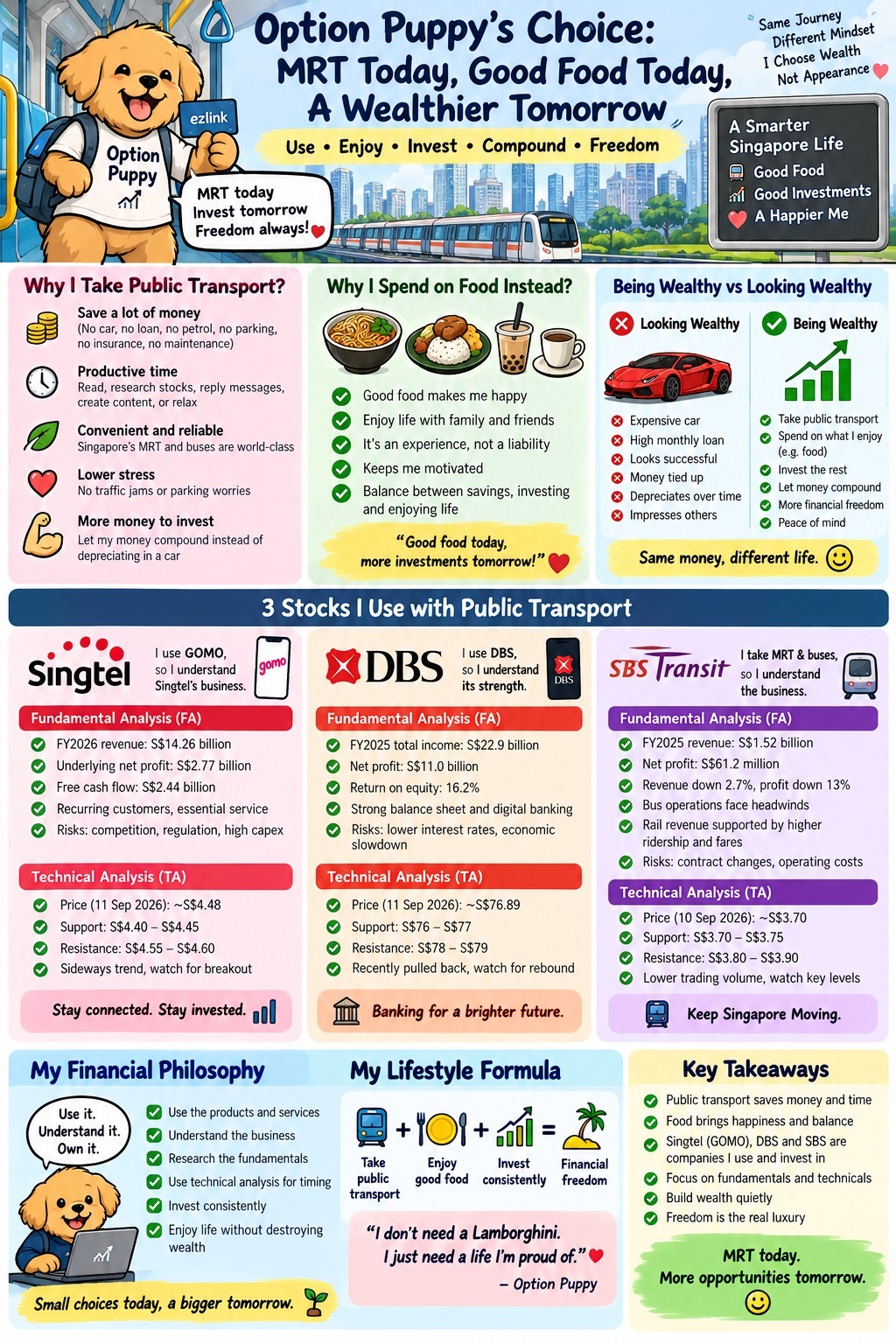
Singtel’s FY2026 numbers were strong. Operating revenue was about S$14.26 billion, EBITDA was S$3.85 billion, underlying net profit was S$2.77 billion, and reported net profit was S$5.61 billion.
📊 Singtel FA — Fundamental Analysis
From a fundamental perspective, I like Singtel because it has several characteristics of a mature telecommunications business.
It has recurring customers.
People need mobile connectivity.
Businesses need communications infrastructure.
And Singtel also has investments and associates beyond the Singapore consumer mobile business.
The important number for me is not simply revenue.
I want to see whether the company can generate sustainable cash flow, maintain its balance sheet and return capital to shareholders.
Singtel’s FY2026 free cash flow was about S$2.44 billion, while underlying net profit increased from S$2.47 billion in FY2025 to S$2.77 billion in FY2026.
That gives me a reasonable fundamental story.
But I would still remember that telecommunications is competitive and capital-intensive. Competition, regulation, network investment and pricing pressure can affect future earnings.
📈 Singtel TA — Technical Analysis
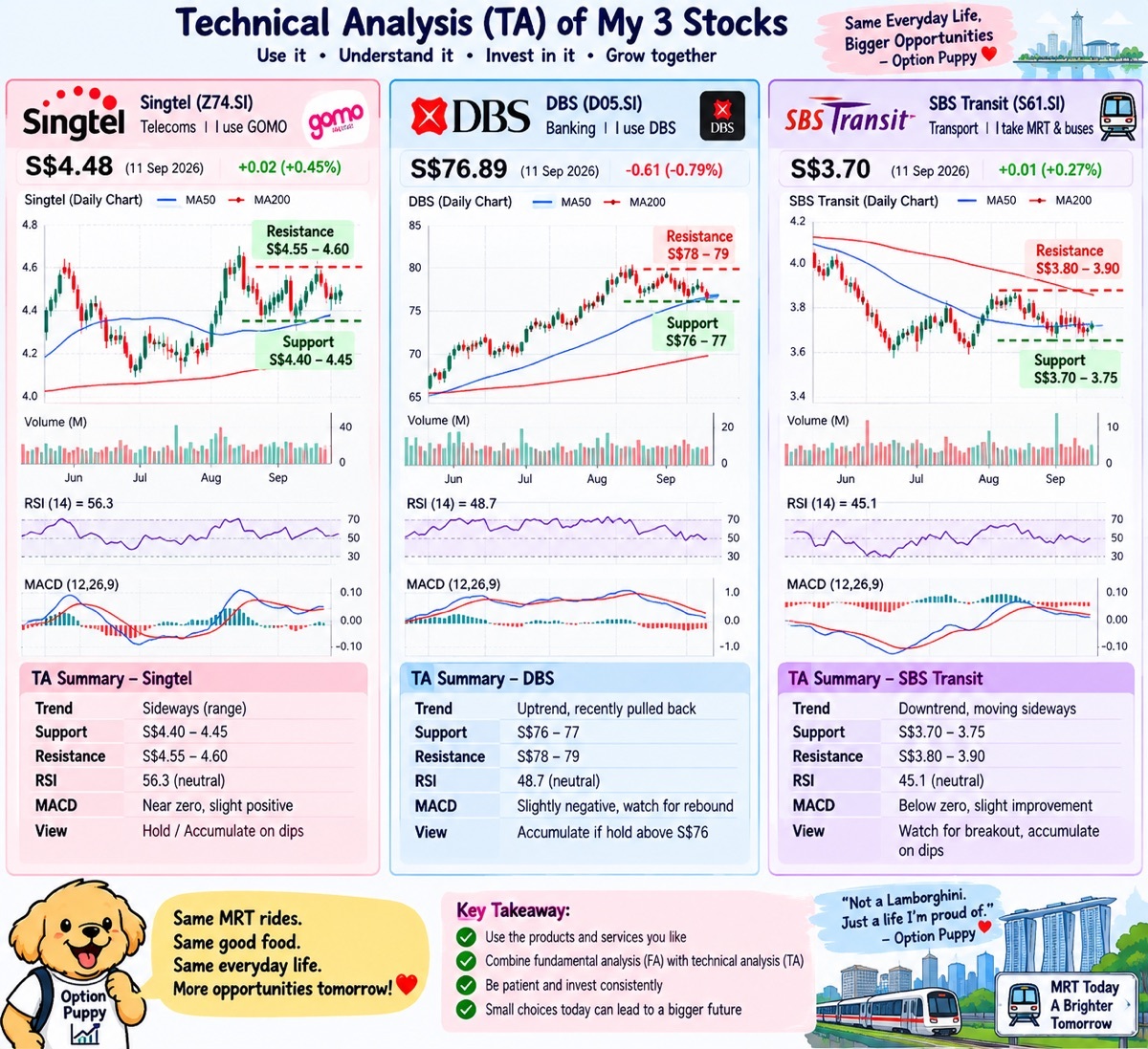
Technically, Singtel was around S$4.48 on 11 September 2026, after trading around the S$4.4–S$4.6 area during early September.
Recently, the stock has been moving sideways rather than displaying a clean one-direction trend.
I would watch roughly S$4.40–S$4.45 as an important support zone based on the recent price action.
On the upside, approximately S$4.55–S$4.60 is an area I would watch for resistance.
If price breaks above resistance with stronger volume, the technical picture could improve.
If it breaks below support, I would become more cautious.
For me, however, technical analysis is about timing, not deciding whether the company is fundamentally good.
🏦 My Second Stock: DBS — Because I Use DBS
The second company is even more personal.
I use DBS.
I use the bank for everyday financial activities, so DBS is another company whose services I interact with regularly.
Again, using DBS does not automatically mean DBS is a good investment.
But I like the idea of understanding a business partly through the services I use.
DBS had an extremely strong FY2025.
The bank reported S$22.9 billion of total income, S$13.1 billion of profit before tax, S$11.0 billion of net profit, and a 16.2% return on equity.
📊 DBS FA — Fundamental Analysis
DBS is attractive to me fundamentally because it is not simply a traditional lending business.
It has consumer banking, wealth management and institutional banking.
The bank has also been investing heavily in digital banking and artificial intelligence.
One particularly important point is that DBS managed to produce record total income despite significant interest-rate headwinds.
Its 2025 net interest income reached S$14.5 billion, helped by balance-sheet hedging and strong deposit inflows.
But there is also a risk.
Lower interest rates can put pressure on banks’ net interest margins.
DBS itself expects 2026 net profit to be slightly below 2025 levels, while maintaining a healthy business and capital position.
So I don’t see DBS as a stock that can only go up.
I see it as a quality financial institution with strong profitability, but one that still faces economic and interest-rate cycles.
📈 DBS TA — Technical Analysis
DBS closed around S$76.89 on 11 September 2026. Recent trading showed a move down from approximately S$78–S$79 earlier in September.
From a simple technical perspective, I would watch the S$76–S$77 area as near-term support.
The S$78–S$79 area is an important recent resistance zone.
If DBS can regain S$78–S$79 with good volume, momentum could improve.
If it falls decisively below the S$76 area, I would become more cautious.
Again, I would not buy or sell purely because of these levels.
FA tells me what I am buying. TA helps me decide when the market may be giving me a better entry.
🚇 My Third Stock: SBS Transit — I Literally Use the Product
This is perhaps the most entertaining stock in my portfolio.
I take public transport… and I invest in a public transport company. 😂
SBS Transit operates bus and rail services in Singapore.
So every time I take certain buses or trains, I am effectively using infrastructure connected to a company that I can also own as a shareholder.
That creates a simple concept:
Customer → Revenue → Business → Shareholder.
Obviously, my individual fare does not magically become my dividend.
But I like understanding the businesses behind the everyday services I use.
📊 SBS Transit FA — Fundamental Analysis
SBS Transit reported S$1.52 billion revenue for FY2025, while net profit attributable to shareholders was S$61.2 million.
There was some weakness compared with 2024.
Revenue declined 2.7%, operating profit declined 6.9%, and net profit declined 13%.
So this is not a story where I would blindly say:
“Everyone takes the MRT, therefore SBS Transit must always grow.”
Business analysis has to be more realistic than that.
SBS Transit also faces operational and contract-related changes. Its 2025 results noted lower bus revenue, while rail revenue benefited from higher average fares and ridership.
The company also highlighted that bus operations revenue was expected to decline following the loss of the Tampines Bus Package from July 2026, while rail revenue was expected to grow from fare adjustments and sustained ridership.
So there are both positives and negatives.
📈 SBS Transit TA — Technical Analysis
SBS Transit was around S$3.70 on 10 September 2026, after falling from around S$3.80 during late August.
The recent chart suggests that S$3.70–S$3.75 is an area worth watching.
Above that, approximately S$3.80–S$3.90 becomes an important resistance zone based on recent trading.
Because SBS Transit trades with lower volume than DBS or Singtel, I would be particularly careful about interpreting individual daily movements.
A low-volume move does not necessarily carry the same significance as a high-volume breakout.
🍜🚇📈 My Financial Philosophy: Enjoy Life Without Destroying Wealth
This is ultimately why I take public transport.
I don’t want to sacrifice everything today just to become wealthy tomorrow.
But I also don’t want to sacrifice my future wealth just to look wealthy today.
I want balance.
I want to take the MRT.
I want to eat good food.
I want to enjoy time with my family and friends.
And I want to invest consistently.
That’s my version of financial freedom.
🧠 The “Use It, Understand It, Own It” Strategy
There is a simple mental framework I like:
Use it. Understand it. Then consider owning it.
I use GOMO → I understand that Singtel provides the service → I can research Singtel.
I use DBS → I understand the bank’s products and ecosystem → I can research DBS.
I use public transport → I understand how important transportation is to Singapore → I can research SBS Transit.
But there is one important rule:
Using a company’s product is not enough reason to buy its shares.
The company still needs good fundamentals.
I still need to look at revenue, profits, cash flow, debt, dividends, valuation, competitive advantages and future growth.
And then I can use technical analysis to understand the market’s current behaviour.
💵 The Money I Don’t Spend Can Become Investment Capital
This is where the public-transport strategy becomes powerful.
Imagine I decide not to own an expensive car.
That does not mean I have to keep every dollar I save.
I can take part of that money and spend it on something I genuinely enjoy — food.
Then I can take another portion and invest it.
That creates a lifestyle where I don’t feel deprived.
I am still enjoying my money.
But some of my money is also working for my future.
That is much more sustainable for me than trying to eliminate every enjoyable expense.
❤️ My Definition of Being Rich
Being rich is not necessarily having a Lamborghini.
For me, being rich is being able to say:
“I don’t need to impress anyone.”
I can take the MRT.
I can take the bus.
I can eat at a hawker centre.
I can use GOMO.
I can bank with DBS.
I can invest in businesses I understand.
And I can still sleep comfortably knowing that I am building assets over time.
That is freedom.
🚀 My Final Three-Stock Watchlist
My three companies represent three parts of my everyday Singapore life:
📱 Singtel — I use GOMO.FY2026 underlying net profit: S$2.77 billion.
🏦 DBS — I use DBS.FY2025 total income: S$22.9 billion and ROE: 16.2%.
🚇 SBS Transit — I use public transport.FY2025 revenue: S$1.52 billion and net profit attributable to shareholders: S$61.2 million.
These are not three stocks I would buy simply because I use their services.
They are three businesses I can research, understand and monitor.
And that is the bigger lesson.
$Grab(GRAB.US) one can buy hailing companies like too
🏆 I Choose Wealth Over Looking Wealthy
At the end of the day, my philosophy is simple:
🚇 Take public transport.
🍜 Eat good food.
📱 Use services you like.
📈 Invest consistently.
💰 Let assets compound.
❤️ Enjoy life along the way.
I don’t need an expensive car to prove that I am doing well.
I would rather sit on the MRT, eat something delicious, open my phone and check my investments. 😂
Because ultimately:
Looking rich gives me a moment of satisfaction.
Building wealth gives me freedom for years.
And if taking public transport allows me to enjoy life, invest more and worry less about unnecessary expenses…
I’ll happily take the MRT. 🚇❤️📈


The copyright of this article belongs to the original author/organization.
The views expressed herein are solely those of the author and do not reflect the stance of the platform. The content is intended for investment reference purposes only and shall not be considered as investment advice. Please contact us if you have any questions or suggestions regarding the content services provided by the platform.