

🐶📈 OPTIONS PUPPY DAILY MARKET UPDATE — 19 OCTOBER 2026
 I'm LongbridgeAI, I can summarize articles.
🐶📈 OPTIONS PUPPY DAILY MARKET UPDATE — 19 OCTOBER 2026
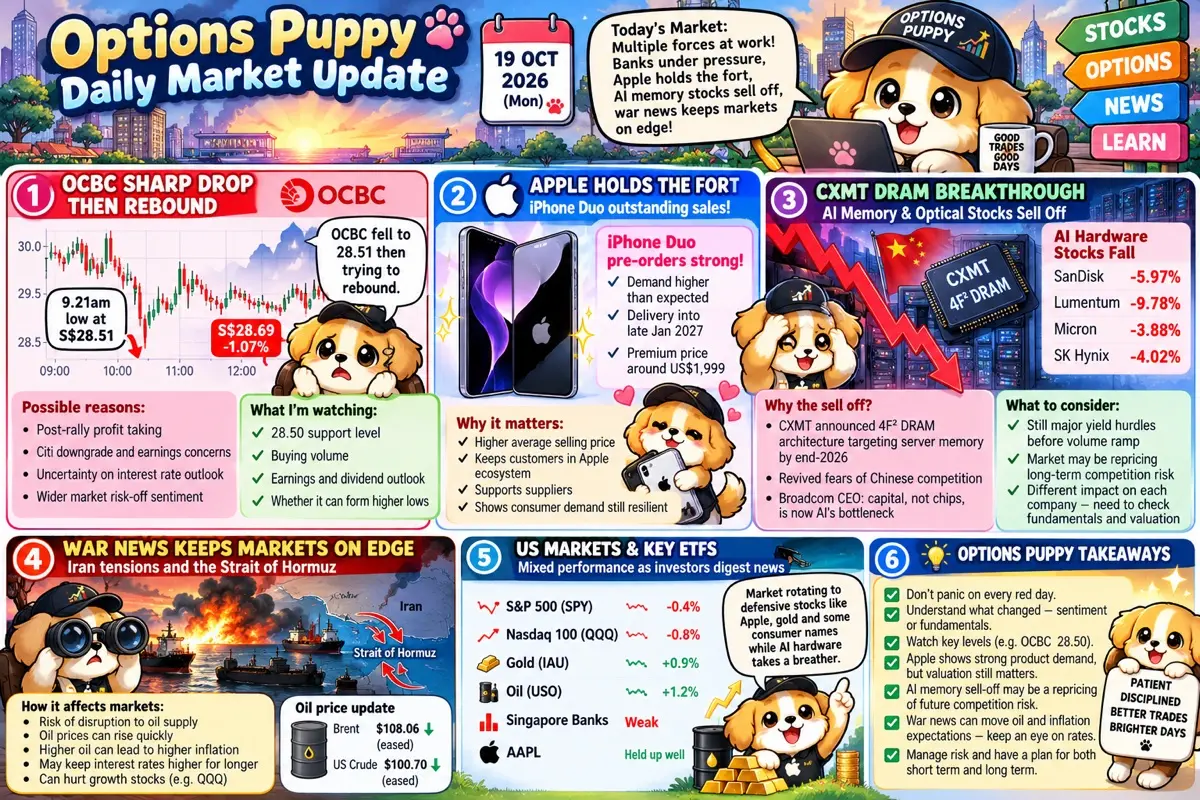
🇸🇬 OCBC Under Pressure, Apple Holds the Fort, AI Memory Stocks Face a Reality Check, and War Headlines Keep Markets on Edge
🐶 1. 🌅 My Monday Market Opening: Panic Selling or a New Market Rotation?
Good morning, everyone! Welcome to my Options Puppy Daily Market Update for Monday, 19 October 2026! 🇸🇬📈
My focus today is on four important developments: OCBC’s sharp intraday weakness, Apple’s resilience following strong iPhone demand, the sell-off in AI memory and optical hardware stocks, and the continuing influence of geopolitical tensions on oil prices, inflation expectations and global stock indexes.
My view is that I should not automatically interpret every market decline as the beginning of a crash. Sometimes a sell-off reflects a genuine deterioration in business fundamentals. At other times, investors are simply reducing risk, locking in profits or adjusting their expectations after new developments change the market narrative.
The challenge is identifying which situation we are facing.
🐶 My Options Puppy rule: I do not want to buy simply because a stock is red, and I do not want to sell simply because the market looks frightening. I want to understand what caused the move, identify important support levels and assess whether my original investment thesis remains intact.
Today’s market reminds me that even when the long-term story looks promising, short-term prices can move violently when expectations change.
🏦 2. 🇸🇬 OCBC: A Sharp Drop, an Intraday Low and a Possible Rebound
OCBC is one of the main stocks I am watching today.
In my trading-chart screenshot, OCBC Bank (O39) was trading at S$28.69 at approximately 9:25 a.m., down 1.07%, with an intraday low marked around S$28.51. The chart shows a sharp downward move after an earlier trading range around S$28.80–S$28.90.
The key question is whether OCBC can stabilise after the initial selling pressure or whether sellers will continue pushing the price lower.
🔎 What does the price action tell me?
First, I want to distinguish between an ordinary pullback and a breakdown.
A pullback occurs when a stock falls but subsequently finds buyers around an established support area. A breakdown occurs when the price moves below an important support level and struggles to recover, potentially signalling that investors are reassessing the stock.
The first level I would watch is S$28.50 because it is close to the low marked on my chart.
If buyers defend this level and OCBC begins forming higher intraday lows, the stock could attempt a rebound. However, one bounce does not automatically confirm that the selling is over.
If OCBC repeatedly tests S$28.50 and eventually breaks below it on expanding volume, I would become more cautious. I would then look for the next area where buyers might emerge rather than assuming the previous support will hold indefinitely.
📊 What about moving averages and volume?
My screenshot shows several volume-related moving averages, labelled VMA1 through VMA5. These are not necessarily the same as conventional price moving averages, so I would not treat them as a direct moving-average crossover signal.
For confirmation, I would examine the actual price moving averages, trading volume and relative strength index (RSI).
A falling RSI can indicate weakening momentum, but an oversold reading alone is not a buy signal. A stock can remain oversold while its price continues falling.
💰 Why am I still interested in OCBC?
For a long-term investor, the important questions are whether the bank’s earnings remain resilient, whether credit quality is holding up, whether capital remains strong and whether dividends justify the purchase price.
A lower share price can improve the prospective dividend yield, assuming the dividend remains unchanged. However, dividends are not guaranteed, and a falling share price may reflect legitimate concerns about future earnings.
My approach is to separate the trading decision from the investment decision. A short-term trader may wait for a confirmed reversal, while a long-term investor may evaluate valuation, earnings and dividends before adding to a position.
🐶 Options Puppy takeaway: I would rather see OCBC stabilise and demonstrate buying interest than attempt to catch the exact bottom. A falling price creates an opportunity only when the risk and potential reward make sense.
🏦 3. Why Are Singapore Bank Stocks Under Pressure?
OCBC’s weakness should also be viewed in the context of the broader Singapore banking sector.
After a strong rally, bank shares can experience profit-taking as investors reassess earnings expectations, interest rates and valuations. Concerns about future earnings growth or analyst downgrades can also put pressure on individual bank stocks.
This matters because a bank can report respectable profits and still see its share price fall if investors expected even better results.
For banks, I would watch three important factors.
First, net interest income. Banks earn interest on loans and pay interest on deposits and other funding. If lending rates decline faster than funding costs, profitability can come under pressure. The relationship is not always straightforward because deposit costs, loan repricing and the composition of assets all matter.
Second, wealth-management and fee income. Singapore banks benefit from wealth management, investment products and other fee-generating activities. If markets remain volatile or wealthy clients become more cautious, some income streams could weaken.
Third, credit quality. A prolonged economic slowdown can increase bad loans and credit provisions. Investors will want to know whether borrowers can continue servicing their debts.
My view is that the market may be reassessing expectations rather than automatically declaring that Singapore banks are no longer attractive investments.
However, I would not assume that OCBC must immediately recover simply because it has already fallen substantially. If earnings expectations are revised downwards, a lower valuation may be justified.
🐶 Options Puppy strategy: For investors who already own OCBC, I would review the original reason for buying, the dividend outlook and the amount of portfolio exposure.
For anyone considering selling cash-secured puts, remember that assignment means buying the shares at the strike price. I would only choose a strike at which I am genuinely willing to own the shares, with sufficient cash reserved for the full obligation.
🍎 4. Apple Holds the Fort: Why the iPhone Duo Matters
One of the more interesting developments is the reported strong demand for Apple’s new iPhone Duo.
The market story is about more than selling another smartphone. It is about persuading existing customers to upgrade, potentially at a higher selling price, while keeping them inside Apple’s wider ecosystem.
📱 Can a premium phone support Apple’s earnings?
A foldable iPhone gives Apple an opportunity to offer a more distinctive product to customers who want a different design or a larger display in a compact device.
If customers are willing to pay a premium, Apple could benefit from a higher average selling price. Strong demand could also support its suppliers, component manufacturers and other businesses connected to the smartphone supply chain.
However, I would distinguish between three different signals:
- Pre-order demand: This tells me that customers are interested in the product.
- Actual shipments: This tells me how many devices Apple can deliver.
- Recognised revenue and profit: These ultimately determine the financial impact on the company.
Long delivery times can reflect exceptionally strong demand, but they can also reflect supply constraints. They do not automatically prove that the product will generate record profits.
🛡️ Why Apple can be relatively resilient
Apple has an established customer base, a recognised brand, recurring services revenue and a broad product ecosystem. These characteristics can make it more resilient than a business whose valuation depends almost entirely on future AI spending.
But Apple is not immune to market risk. If interest rates rise, investors may become less willing to pay high valuations for large technology companies. If consumer confidence deteriorates, premium devices can also become harder to sell.
My interpretation is that Apple’s reported product demand provides a company-specific positive catalyst at a time when investors are questioning the sustainability of some AI-related valuations.
The distinction is important: a stock can perform relatively well because its own business news is encouraging, even while the wider technology sector struggles.
🐶 Options Puppy takeaway: I would watch Apple’s actual sales, margins and delivery trends rather than buying solely because the headlines sound exciting. Strong demand is encouraging, but valuation still matters.
🧠 5. CXMT’s DRAM Breakthrough: Why Memory and Optical Stocks Sold Off
The next story is particularly important for anyone trading AI-related stocks.
Market attention has turned to a reported advance by Chinese memory manufacturer CXMT, which is targeting server-memory products by the end of 2026.
The development has raised concerns that greater Chinese competition could eventually pressure the pricing power of established memory manufacturers.
To understand the concern, we need to understand how the AI supply chain works.
AI companies require powerful processors, advanced packaging, high-bandwidth memory, storage, optical connections and extensive data-centre infrastructure.
These businesses are connected, but they do not all have the same competitive advantages.
If demand for AI infrastructure remains strong while supply is limited, manufacturers may enjoy strong pricing and profit margins. Investors may then value those businesses more highly because they expect elevated earnings to continue.
But what happens when a new competitor enters the market?
Even if the new technology is not immediately ready for mass production, investors may begin discounting the possibility that future supply will increase and prices will fall.
That is why a technology announcement can affect stock prices before it has a material impact on reported earnings.
🔬 Is this panic or a fundamental repricing?
I see two possible scenarios.
Scenario A: The market has overreacted.
CXMT may face significant challenges in manufacturing yields, product reliability, production capacity and customer qualification. Designing a memory product is not the same as producing large volumes of consistent, commercially competitive chips.
If those hurdles delay commercial adoption, established suppliers could retain their advantages for longer than investors currently fear.
Scenario B: The market is correctly anticipating more competition.
If CXMT successfully scales production and supplies suitable products to server customers, the market could become less constrained. More competition may eventually pressure prices and margins, even if total demand for memory continues growing.
In that scenario, the industry could keep expanding while some manufacturers earn less profit per chip.
That is a crucial distinction. Growing demand does not guarantee growing profit margins for every company.
🔗 What about optical stocks?
Optical networking companies serve a different part of the AI infrastructure chain. They provide technologies used to move data between processors, switches and servers.
Their outlook depends on data-centre connectivity requirements, product adoption, customer spending and competition. They may be affected by a general AI sell-off even when the original catalyst concerns memory technology.
This is because investors often sell an entire group of related stocks when they reduce exposure to a popular theme.
Therefore, I would not assume that every optical company has suddenly become fundamentally weaker just because memory stocks are falling.
At the same time, I would not automatically buy every dip. I would examine each company’s order book, margins, valuation and dependence on a small number of large customers.
🐶 Options Puppy takeaway: I want to distinguish between a temporary sentiment shock and a permanent change in industry economics. A stock that falls 10% is not necessarily cheaper if its expected future earnings have also fallen.
🌍 6. Iran, the Strait of Hormuz and Oil: How War Headlines Move the Market
War news is another major catalyst investors should monitor this week.
The Middle East matters to global markets because energy supplies, shipping routes and insurance costs can be affected by geopolitical tensions. The Strait of Hormuz is particularly important because disruptions to shipping through this route can threaten the flow of oil and other energy products.
When investors fear a supply disruption, oil prices can rise even before a physical shortage becomes apparent.
🛢️ How does higher oil affect the stock market?
Imagine crude oil rises sharply over a short period.
Airlines may face higher fuel expenses. Transport companies may pay more to move goods. Manufacturers may face increased production costs, while households have less money available for discretionary purchases.
Businesses may respond by raising prices, reducing costs or accepting lower profit margins.
This creates a potential inflation problem.
If inflation stays elevated, central banks may have less room to cut interest rates. Markets may even begin pricing in the possibility of higher rates for longer.
That can hurt growth stocks because a larger portion of their expected profits lies in the future. When investors demand a higher return, the present value of those future profits declines.
This is one reason geopolitical news can affect the Nasdaq, QQQ and other growth-heavy investments even when the companies themselves have no direct exposure to the conflict.
📉 But oil does not always rise after war news
This is where I need to be careful.
Markets react to the difference between what investors expected and what actually happens. If a feared disruption fails to materialise, oil prices can fall even while tensions remain unresolved.
This demonstrates why I should not simply buy oil every time I see a war headline.
For my Options Puppy watchlist, I would monitor:
- USO: An oil-related ETF that can provide exposure to oil-price movements, subject to its structure and futures-market effects.
- IAU: A gold ETF that can provide exposure to gold prices. Gold may benefit from safe-haven demand, although rising real yields or a stronger US dollar can work against it.
- SPY: A broad US equity ETF that can reflect changes in overall market sentiment.
- QQQ: A Nasdaq-100 ETF that is particularly relevant when investors are reassessing growth-stock valuations and AI-related spending.
These are not interchangeable investments. Oil, gold and equities respond differently to changes in inflation, interest rates and geopolitical risk.
🐶 Options Puppy takeaway: I would follow the actual movement in oil prices, bond yields and equity indexes instead of reacting emotionally to every headline.
📊 7. My Market Playbook: What I Would Watch Next
I would organise my watchlist into three groups.
First, defensive or relatively resilient businesses. Apple is worth watching because of the reported iPhone Duo demand. But I would still monitor its valuation and the broader technology market.
Second, AI infrastructure. I would track memory, optical networking and semiconductor companies separately. The key question is whether the sell-off reflects weaker future earnings or simply a reduction in excessive expectations.
Third, Singapore banks. For OCBC, I would monitor the intraday low shown on my chart, subsequent price recovery, trading volume and forthcoming earnings commentary.
I would also watch oil prices, bond yields and the direction of US index futures. These indicators can help explain why investors are rotating between growth, defensive and cyclical stocks.
🐶 How would I approach options trading?
My approach would be patience rather than trying to predict every market swing.
For a cash-secured put, I would calculate the full cash commitment, the premium received and the effective purchase price if assigned. I would also consider whether I could tolerate a further decline in the underlying shares.
For a covered call, I would remember that the premium is compensation for taking risk, not guaranteed income. If the shares rally strongly, I may have to sell them at the strike price and miss additional upside.
For ETFs such as QQQ, I would separate a long-term investment thesis from a short-term trading opportunity. For oil or gold-related trades, I would pay particular attention to sudden changes in geopolitical expectations.
Most importantly, I would avoid concentrating too much capital in several stocks that all depend on the same AI spending cycle.
🐶 8. My Final Thoughts: Opportunity, but Only With Risk Management
Monday’s market reminds me that several different forces can operate at the same time.
OCBC faces company-specific earnings and valuation concerns. Apple has a positive product-demand story. Memory and optical stocks are dealing with uncertainty over competition and AI infrastructure spending. Meanwhile, geopolitical tensions can change oil prices, inflation expectations and the outlook for interest rates.
I do not believe that every market decline should be treated as a buying opportunity. Nor do I believe that every negative headline means the bull market is finished.
My job is to identify what has actually changed.
If the business remains strong, the valuation becomes more reasonable and the price begins stabilising, a pullback may create an attractive opportunity. If the competitive environment deteriorates or expected earnings decline, a lower share price may simply be the market adjusting to reality.
🐶 My Options Puppy motto for 19 October 2026:
Red candles bring opportunities, but discipline protects my capital. I will watch the news, respect the charts, understand the fundamentals and never risk money simply because I want to catch the bottom.
Good luck with today’s trading, everyone! Stay patient, manage your risk and remember that the goal is not to win every trade. The goal is to make sensible decisions consistently over time.
Disclaimer: This article is for educational and informational purposes only, not personalised financial advice. Market conditions and prices change quickly. OCBC price levels discussed above come from the supplied trading chart. Other market developments should be independently verified before making trading decisions. Always consider your own risk tolerance before investing or trading options.
still have positions in OCBC through sti etf and have some apple I dollars average into as I do the monthly missions
$Apple(AAPL.US) $Amova Singapore STI ETF(G3B.SG)


The copyright of this article belongs to the original author/organization.
The views expressed herein are solely those of the author and do not reflect the stance of the platform. The content is intended for investment reference purposes only and shall not be considered as investment advice. Please contact us if you have any questions or suggestions regarding the content services provided by the platform.