

🐱 My Grab Wheel Strategy – Part 1: From Selling Cash-Secured Puts to Covered Calls
 I'm LongbridgeAI, I can summarize articles.
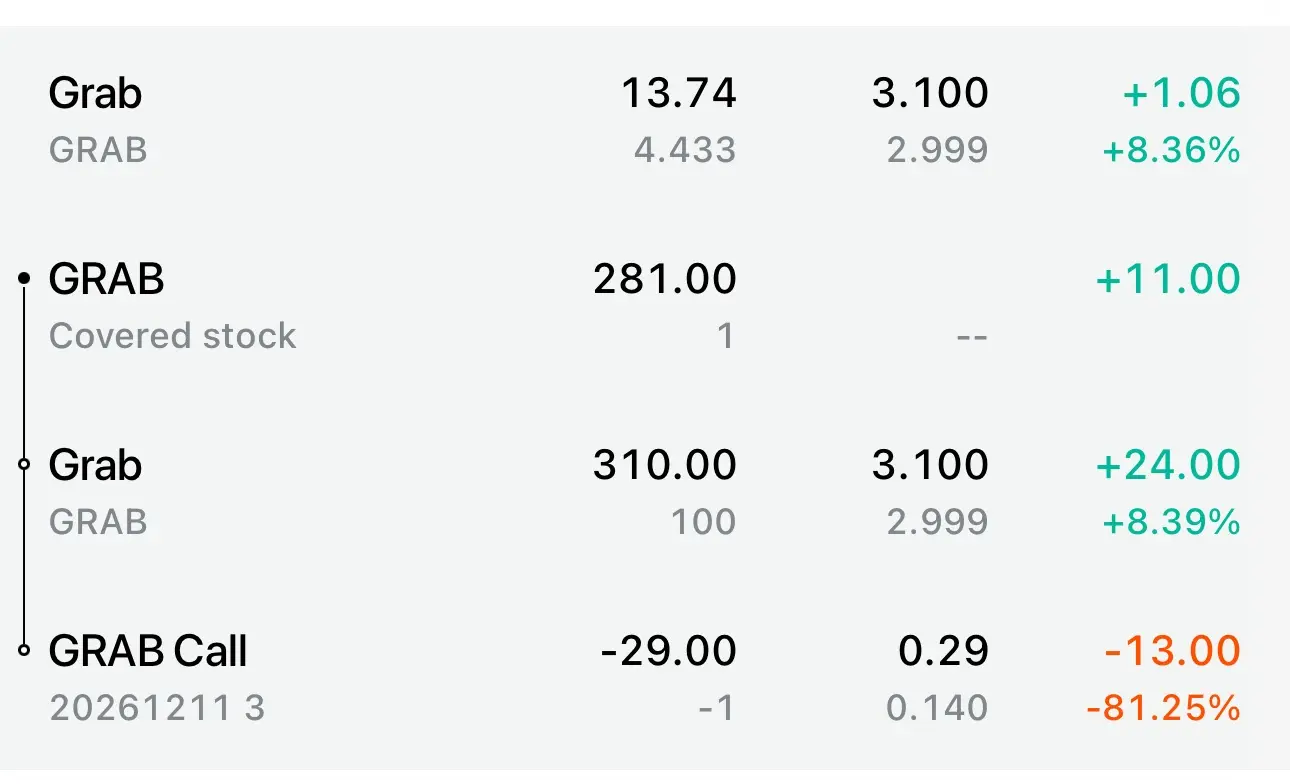
Sometimes, I don’t need to chase a stock when I can let the options market pay me while I wait. This is exactly why I like the wheel strategy.
My latest example is Grab (GRAB). I started by selling a cash-secured put at the $3 strike price. My intention was straightforward: I was comfortable owning Grab at $3, so instead of immediately buying 100 shares in the market, I sold a put and collected an option premium.
Eventually, my put was assigned, and I became the owner of 100 Grab shares.
But that is not the end of my strategy. In fact, that is where the second part of the wheel begins!
I have now moved on to selling a covered call at the same $3 strike price, collecting another $0.15 per share in premium.
Let’s look at how I approach this trade.
1️⃣ Why am I making this trade now?
The wheel strategy is attractive to me because it gives me two ways to generate option income.
First, I sell cash-secured puts when I am willing to buy a stock at a particular price. If the stock stays above my strike price, I keep the premium without owning the shares.
If the stock falls below my strike price and I get assigned, I receive 100 shares for every standard options contract.
Instead of treating assignment as a failure, I see it as the next stage of my strategy.
For Grab, I was comfortable buying at $3. That was the price I was prepared to own the shares, so I was happy to let the put assignment happen.
Now that I own 100 shares, I can sell covered calls against them.
This is important because I don’t want my capital sitting idle while I wait for the stock to move higher.
I would rather collect another premium while giving myself an opportunity to sell my shares at a price I have already considered acceptable.
2️⃣ My second move: Selling a $3 covered call
After receiving my 100 Grab shares, I sold one covered call at the $3 strike price.
My premium collected was approximately $0.15 per share.
Since one standard options contract represents 100 shares:
- Shares owned: 100
- Covered call strike price: $3
- Premium received: $0.15 per share
- Gross premium collected: $15
- Expiration: 11 December 2026
That means I receive another $15 in premium for agreeing to sell my 100 shares at $3 if the call is exercised.
I like this approach because I am generating additional income from shares I already own.
Of course, there is a trade-off. If Grab rises significantly above $3, I may have to sell my shares at $3 and miss out on some potential upside.
However, my objective is not necessarily to capture every dollar of a stock’s upward movement.
My objective is to build a repeatable income strategy.
3️⃣ Why I am comfortable selling calls at the same $3 strike
Some investors might ask why I would sell another call at $3 when the market price is already around $3.10.
Wouldn’t I be selling my shares too cheaply?
This is where I look at the bigger picture.
I am not looking at the covered call in isolation. I am looking at the entire wheel cycle.
I originally sold a put at $3 because I was willing to buy Grab at that price. Now I am selling a call at $3 because I am also comfortable selling my shares at that price.
The $3 strike is my chosen entry and exit level.
The $0.15 premium gives me an additional cushion against my shareholding cost.
For example, before considering the original put premium, my effective cost after collecting the covered call premium would be:
$3.00 - $0.15 = $2.85 per share.
For 100 shares, that represents an effective cost of $285, excluding transaction fees and any original put premium.
If I also collected a premium from the original cash-secured put, that would further reduce my overall cost basis.
This is why I prefer to evaluate the wheel strategy as a complete cycle rather than judging each option trade separately.
4️⃣ What happens if Grab goes above $3?
There are two possible outcomes.
Scenario A: Grab stays above $3 at expiration.
My covered call may be exercised, and I may have to sell my 100 shares at $3.
I receive the agreed share sale proceeds and retain the $15 covered call premium.
I can then return to the first stage of the wheel by selling another cash-secured put at a price where I am comfortable buying Grab again.
The cycle starts over.
Scenario B: Grab falls below $3 at expiration.
My covered call may expire worthless.
I keep my 100 shares and the $15 premium.
I can then consider selling another covered call, depending on the market price, implied volatility and the premium available.
The important thing is that I do not have to panic simply because the stock moves around.
I already have a plan for both outcomes.
5️⃣ Why I like the wheel strategy for income generation
The biggest attraction of the wheel strategy is that it allows me to earn option premiums at different stages of stock ownership.
I do not need to wait for capital gains alone.
There are two income opportunities:
🐱 Stage 1 – Cash-Secured Put
I sell a put at a price where I am happy to purchase the shares. I collect the premium while waiting.
🐱 Stage 2 – Covered Call
If I get assigned, I sell covered calls against my shares. I collect additional premiums while waiting for the shares to be called away.
Once my shares are sold, I can return to selling cash-secured puts.
This creates a continuous cycle of potential premium income.
However, I must remember that option premiums are not guaranteed profits. A falling stock can create losses that exceed the premiums collected, and a covered call can limit my upside.
The strategy works best when I choose companies I genuinely do not mind owning.
6️⃣ What is my plan from here?
For Grab, I will continue monitoring the $3 level.
My current plan is to let the covered call work until expiration.
If my shares are called away at $3, I can move back to selling cash-secured puts and wait for another opportunity to enter Grab.
If the call expires worthless, I will still own my 100 shares and can evaluate another covered call.
I will also watch Grab’s business performance, revenue growth, profitability, competition and overall market sentiment.
I do not want to sell calls blindly just because the premium looks attractive. I need to consider whether the strike price is worth accepting and whether the premium compensates me adequately for the risk.
7️⃣ My biggest lesson from Part 1
The wheel strategy is not about predicting exactly where Grab will trade tomorrow.
It is about having a plan for different price movements.
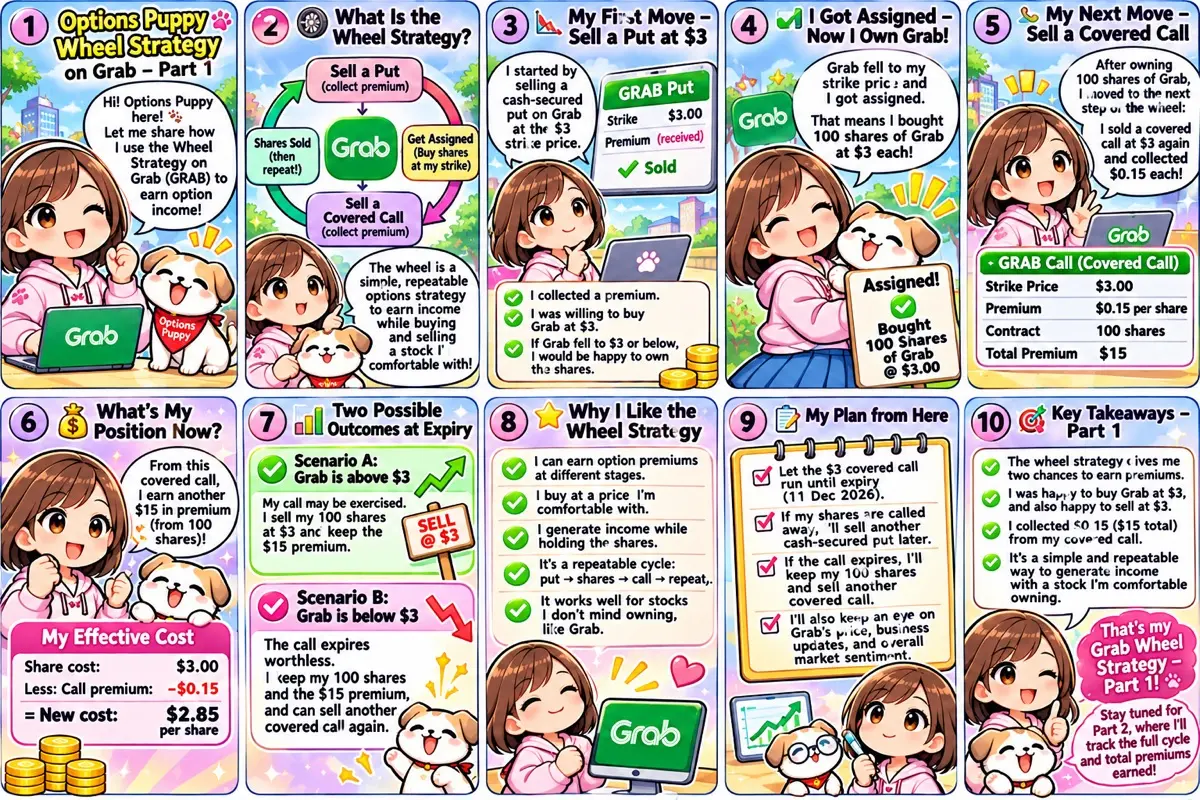
I was prepared to buy Grab at $3, and I am prepared to sell Grab at $3.
In between, I am collecting premiums.
My first put assignment did not mean the strategy ended. It simply allowed me to move from selling puts to selling covered calls.
That is the beauty of the wheel strategy.
My objective is simple: Buy at a price I like, collect premiums while holding, and sell at a price I have already accepted.
$Grab(GRAB.US) Stay tuned for Part 2, where I will track what happens to my Grab covered call and calculate the combined premiums from the complete wheel cycle.
This is my personal trading strategy and not financial advice. Options involve risks, including assignment, opportunity cost and potential losses on the underlying shares.
The copyright of this article belongs to the original author/organization.
The views expressed herein are solely those of the author and do not reflect the stance of the platform. The content is intended for investment reference purposes only and shall not be considered as investment advice. Please contact us if you have any questions or suggestions regarding the content services provided by the platform.