
💡 BLINK FANS MARKET TALK: NVIDIA EARNINGS — WHY CAN OPTION PRICES DROP EVEN WHEN THE STOCK GOES UP?
 I'm LongbridgeAI, I can summarize articles.
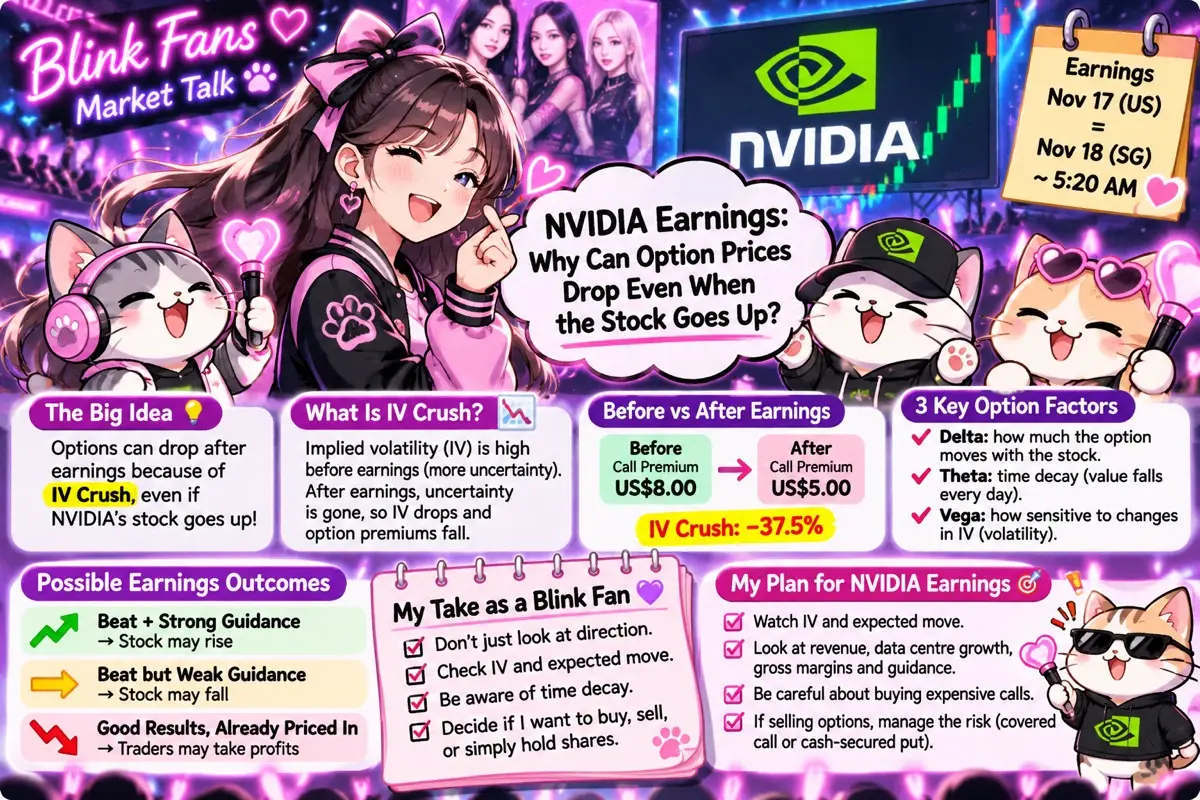
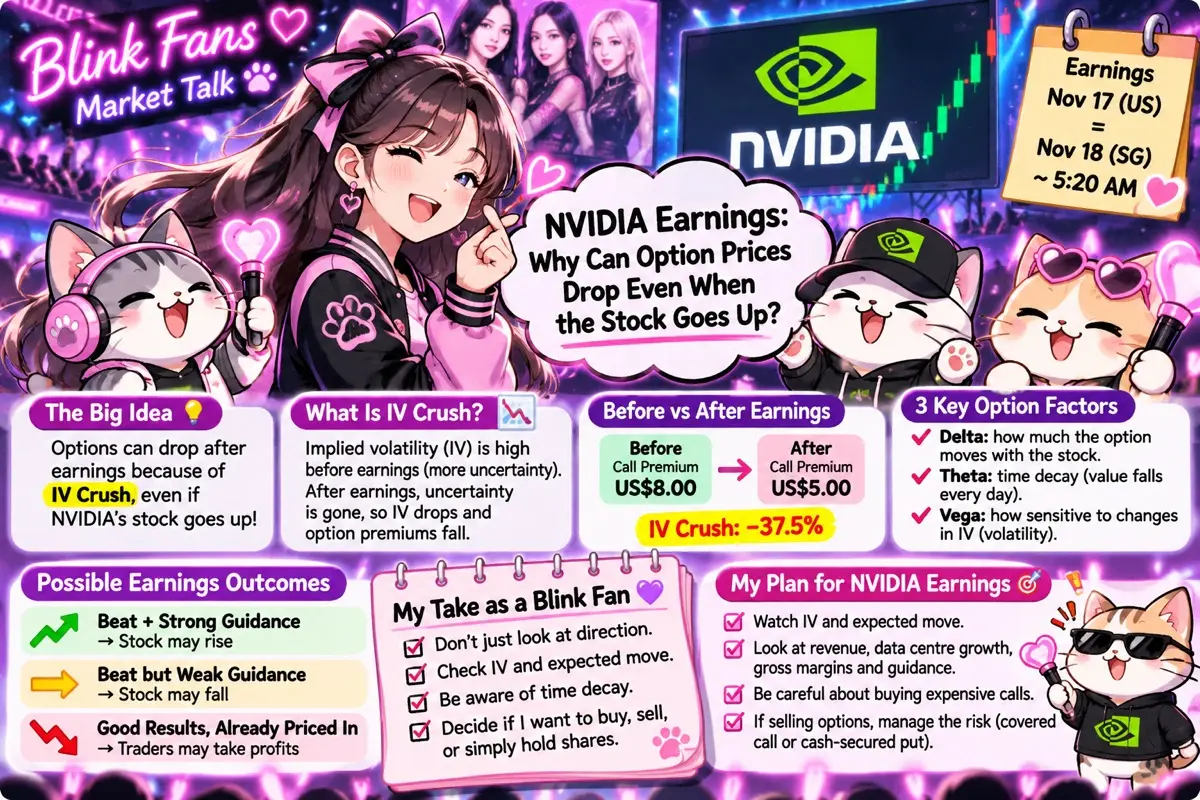
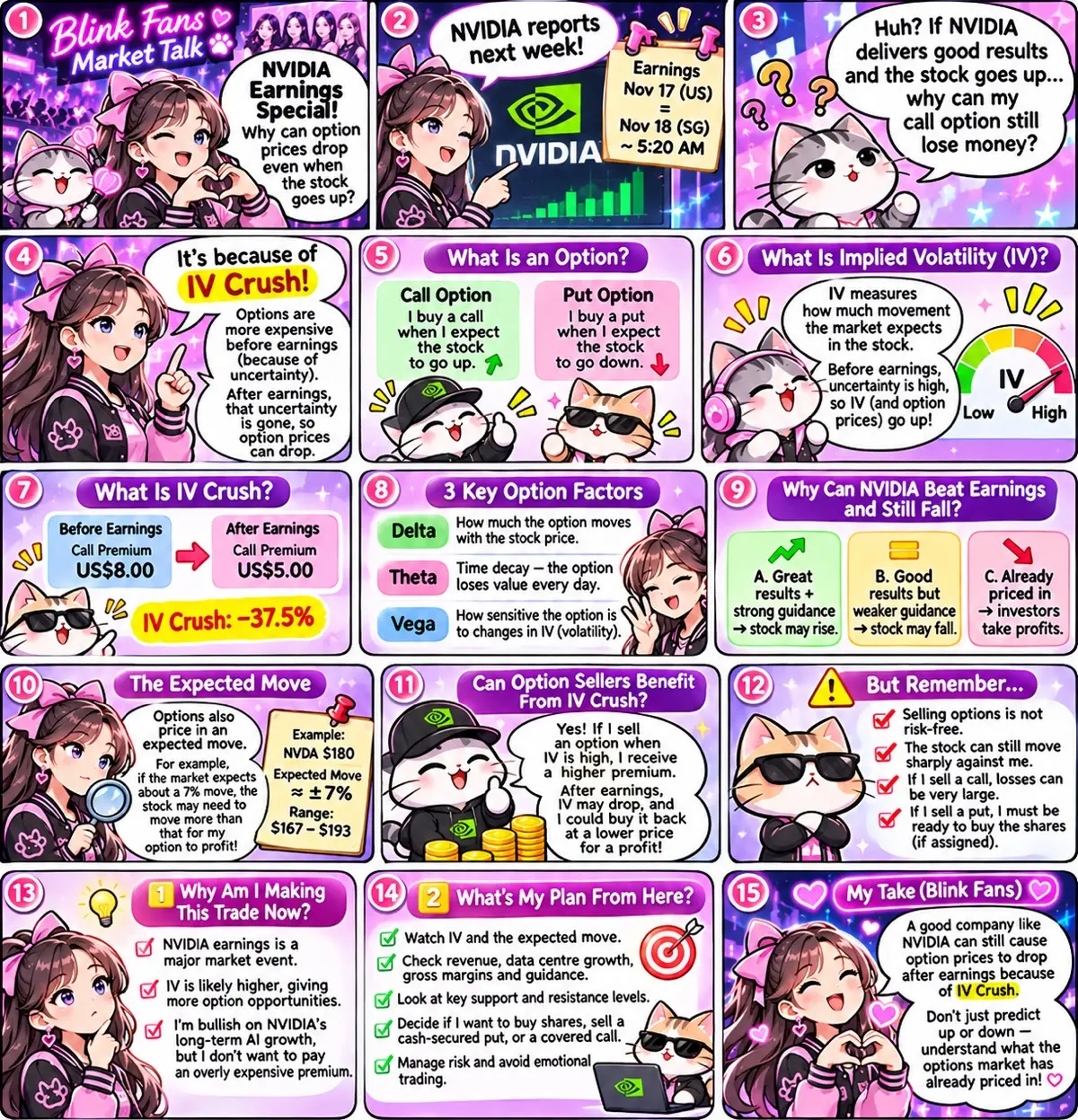
🐱📈 The Big Question: NVIDIA is reporting earnings next week. If the company delivers fantastic results, why can investors still lose money buying call options?
When I look at NVIDIA ($NVIDIA(NVDA.US)), I see one of the most important companies in the global technology market. Its graphics processing units (GPUs) power artificial intelligence, data centres, cloud computing and the growing AI infrastructure industry.
Every earnings season, investors watch NVIDIA closely. Expectations are enormous, analysts publish price targets, options traders prepare their strategies, and the market starts pricing in a potentially big movement.
But there is something beginners need to understand.
You can correctly predict NVIDIA’s direction and still lose money on your options trade.
Imagine buying a NVIDIA call option because you believe the company will beat earnings. NVIDIA announces excellent results, the stock rises by 2%, and yet your call option loses value.
How is that possible?
The answer is something called IV Crush (Implied Volatility Crush).
Today, let’s break down how earnings affect options, why option premiums can collapse after announcements, and what I would watch before making an options trade.
1️⃣ 🗓️ When Is NVIDIA Reporting Earnings?
According to NVIDIA’s official investor announcement, NVIDIA will release its third-quarter fiscal 2027 results on Tuesday, November 17, 2026, at approximately 1:20 PM US Pacific Time.
For investors in Singapore, that is approximately Wednesday, November 18, at 5:20 AM Singapore time. The earnings conference call follows at 6:00 AM Singapore time. NVIDIA Investor Relations +1
This is an important event because NVIDIA is not just another technology company.
It is a major supplier of AI computing infrastructure. Its results can influence sentiment across the semiconductor industry, including companies involved in chip manufacturing, memory, networking, cloud computing and data centres.
When NVIDIA reports, investors will be looking at:
- Revenue growth: Is demand for AI chips still increasing?
- Data centre revenue: Are major technology companies continuing to spend?
- Gross margins: Is NVIDIA maintaining its profitability?
- Forward guidance: Does management expect more growth?
- Supply: Can NVIDIA manufacture and deliver enough chips?
- Competition: Are AMD and other chipmakers becoming stronger competitors?
The market is not simply asking whether NVIDIA made money.
It is asking whether NVIDIA can continue growing faster than investors already expect.
That difference is extremely important for options traders.
2️⃣ 📈 What Exactly Is an Option?
Before understanding IV Crush, let’s go back to the basics.
An option is a financial contract that gives a buyer the right, but not the obligation, to buy or sell a stock at a predetermined price before or on a specified expiration date.
There are two common types.
Call option: I buy a call when I expect the stock price to increase.
Put option: I buy a put when I expect the stock price to decrease.
For example, imagine NVIDIA is trading at US$180.
I buy a call option:
- Stock price: US$180
- Strike price: US$185
- Expiration: 20 November
- Premium: US$8
- Contract size: 100 shares
I pay US$800 for one standard options contract, excluding fees.
For this trade to become profitable at expiration, NVIDIA needs to rise above US$193.
Why?
Because my break-even price is:
US$185 strike + US$8 premium = US$193.
Even if NVIDIA rises from US$180 to US$185, I can still lose my entire premium if the option expires worthless.
This is where beginners sometimes misunderstand options.
Being bullish does not automatically mean buying a call is a good trade.
I must consider how much I am paying, how far the stock needs to move and how much time I have.
3️⃣ 🌪️ What Is Implied Volatility (IV)?
This is probably one of the most important concepts for anyone trading options around earnings.
Implied volatility measures how much movement the options market is pricing into a stock.
It is not a prediction of whether the stock will go up or down.
It measures the market’s expectation of potential movement.
Imagine NVIDIA is trading normally.
During an ordinary trading week, investors might not expect a particularly large movement.
But suddenly, earnings are approaching.
Everyone starts wondering:
- Will NVIDIA beat earnings?
- Will Jensen Huang provide strong guidance?
- Will AI spending continue?
- Will the company announce new developments?
- Will investors sell after the announcement?
Uncertainty increases.
As traders compete to buy options for potential protection or speculation, option premiums can become more expensive.
This can push implied volatility higher.
Think of IV as the price of uncertainty.
The more uncertainty investors are willing to pay for, the more expensive options can become.
4️⃣ 💥 What Is IV Crush?
Now comes the interesting part.
IV Crush happens when implied volatility drops sharply after an important event.
Before earnings, investors are nervous because nobody knows the results.
After earnings, the announcement is public.
The uncertainty surrounding that particular event disappears.
Consequently, the options market may reduce its volatility expectations.
Option premiums can fall significantly.
This is why an options buyer can lose money even when the stock moves in the correct direction.
Let’s use a simple example.
Illustrative NVIDIA call option
Before earnings
US$8.00
Call premium
After earnings
US$5.00
Call premium
Premium decline
-37.5%
Hypothetical illustration, not a live NVIDIA option quote.
Imagine I purchased one call contract for US$800.
After earnings, the call is worth only US$500.
I have lost US$300.
But here is the interesting part: NVIDIA might actually have increased in price!
Why did I lose money?
Because the increase in the stock price was not enough to compensate for the decline in implied volatility and the passage of time.
This phenomenon is known as IV Crush. Why Options Can Lose Value +1
5️⃣ 🧮 Three Things That Determine an Option’s Price
I want beginners to remember three important factors.
A. Delta — How Much Does the Option Move?
Delta measures how sensitive an option’s price is to a US$1 movement in the underlying stock, all else being equal.
For example:
If my call has a delta of 0.50, a US$1 increase in NVIDIA could increase the option price by approximately US$0.50.
This is an approximation, not a guarantee.
B. Theta — Time Is Money
Theta measures how much value an option loses as time passes, all else being equal.
Options have an expiration date.
Every day that passes brings the contract closer to expiration.
For buyers, time decay is generally an enemy.
For sellers, time decay can be a source of potential profit.
C. Vega — The IV Factor
Vega measures how sensitive the option price is to a change in implied volatility.
If an option has a vega of 0.20, a one-percentage-point decrease in IV could reduce its price by approximately US$0.20, assuming other factors remain unchanged.
Imagine the stock price barely moves, but IV falls from 70% to 40%.
That is a 30-percentage-point decline.
The effect on the option premium can be substantial.
This is why I never look at the stock price alone when studying an options trade.
6️⃣ 🎢 Why Can NVIDIA Beat Earnings and Still Fall?
This is another important lesson for beginners.
Suppose Wall Street expects NVIDIA to deliver fantastic revenue growth.
NVIDIA then reports excellent results.
But the stock falls.
Why?
Because the market is forward-looking.
Investors are not only buying what NVIDIA has already achieved. They are buying what they believe NVIDIA can achieve in the future.
Let’s look at three scenarios.
Scenario A
Excellent earnings and strong guidance
NVIDIA beats expectations and management provides encouraging future guidance. Investors become more confident, and the share price could rise.
Scenario B
Excellent earnings but weak guidance
NVIDIA delivers strong historical results, but investors worry that future growth may slow. The stock could fall despite beating estimates.
Scenario C
Strong results already priced in
Investors have already bought the stock ahead of earnings. When the announcement arrives, some traders take profits. The stock could decline even with good numbers.
This is why earnings trading can be difficult.
The company can perform well while the stock performs badly.
And options introduce another layer of complexity because volatility can change at the same time.
7️⃣ 🐱 Why I Need to Understand the Expected Move
Before buying or selling NVIDIA options, I would look at the expected move.
The expected move is an estimate of how much the options market is pricing the stock to move over a particular period.
One common way to estimate it is by looking at the price of an at-the-money straddle.
A straddle involves buying one call and one put at the same strike price and expiration.
For example, imagine:
- NVIDIA trades at US$180.
- The US$180 call costs US$7.
- The US$180 put costs US$6.
The combined premium is US$13.
This suggests an approximate expiration break-even range of US$167 to US$193.
It does not guarantee that NVIDIA will remain inside this range.
It simply shows the movement required for the combined position to break even at expiration, before fees.
This is a useful way to understand what the market is already pricing in.
If the market expects a 7% movement, I need to ask whether I believe NVIDIA can move more than that after earnings.
If I expect only a 2% movement, paying an expensive premium for a short-dated option may not make sense.
8️⃣ 💰 Can Option Sellers Benefit From IV Crush?
Now let’s look at the other side of the market.
Instead of buying options, I can consider selling options.
Option sellers receive premiums upfront.
When IV is elevated before earnings, premiums may become more attractive.
For example, imagine I sell a call option for US$8.
After earnings, IV collapses and the same option becomes worth US$4.
If I buy it back for US$4, I have made US$4 per share, or US$400 per standard contract, before transaction costs.
This is the potential benefit of IV Crush.
However, there is a very important warning.
Selling options before earnings is not free money.
What happens if NVIDIA suddenly jumps US$30?
My short call could become extremely expensive to buy back.
If I sell an uncovered call, my potential loss is theoretically unlimited.
If I sell a cash-secured put, I must have sufficient cash to purchase the shares if assigned.
If I sell a covered call, I must be comfortable potentially having my shares called away.
The premium is compensation for accepting risk.
It is not guaranteed income.
9️⃣ 🐱 My Favourite Lesson: Do Not Confuse Direction With Profitability
Let’s compare two traders.
Trader A — Buys a call
Buys an expensive NVIDIA call before earnings because she expects a big rally.
Exposed to IV Crush
Trader B — Owns shares
Owns NVIDIA shares and does not have an option expiration date to worry about.
No option IV exposure
Both traders believe NVIDIA will rise.
But their risks are different.
Trader A pays a premium and faces time decay and changes in implied volatility.
Trader B owns the actual shares and faces the normal risks of stock ownership, including price declines.
This is why I believe beginners should understand the underlying stock before moving into options.
Sometimes owning shares is a simpler way to express a bullish view.
🔟 📊 What Would I Watch Before NVIDIA Earnings?
I would pay attention to five things.
1. Implied volatility
Is IV already unusually high compared with its historical levels?
2. Expected move
How much movement are options pricing in?
3. Open interest and liquidity
Are the options sufficiently liquid, with reasonable bid-ask spreads?
4. Expiration date
Does the option expire immediately after earnings, or does it have several weeks remaining?
5. Technical position
Is NVIDIA approaching an important support or resistance level?
I would also watch the broader Nasdaq and semiconductor sector.
NVIDIA does not trade in isolation. If technology stocks are under pressure because of interest-rate concerns or changes in market sentiment, even strong company results might not be enough to create a sustained rally.
1️⃣1️⃣ 🧠 Why Am I Making This Trade Now?
My reason for studying NVIDIA ahead of earnings is simple.
I want to understand the opportunity before the market becomes too emotional.
NVIDIA remains an important company in the AI infrastructure industry, but its earnings announcement creates uncertainty for both stockholders and options traders.
The recent analyst headlines in the screenshot show that some institutions have adjusted their views and price targets while retaining buy ratings.
That tells me something important: a change in price target does not automatically mean an analyst has turned bearish.
I want to distinguish between the company’s long-term business outlook and the short-term market reaction.
I am bullish on the long-term importance of AI infrastructure, but I do not want to pay an unreasonable premium simply because everyone is excited about earnings.
My approach is to examine the option prices, expected move and risk before deciding whether to buy shares, sell a cash-secured put or consider a covered call.
1️⃣2️⃣ 🔭 What’s My Plan From Here?
Here is what I would monitor.
Situation | What I would consider |
NVIDIA pulls back | Study support and possible entry prices |
Earnings beat expectations | Watch guidance and market reaction |
IV rises significantly | Be careful about buying expensive options |
IV collapses | Reassess option premiums |
Stock breaks resistance | Evaluate whether the move has follow-through |
Stock breaks support | Reconsider my bullish assumptions |
I would not automatically buy calls before earnings.
I would not automatically sell puts just because premiums look attractive.
And I would never sell an option without understanding the assignment and potential loss.
My priority is capital preservation.
I want to participate in NVIDIA’s long-term AI growth, but I also want to avoid paying too much for short-term excitement.
🐱 Final Thoughts: Earnings Are Not a Guaranteed Winning Lottery Ticket!
The biggest lesson from NVIDIA earnings is that a good company does not automatically make every options trade profitable.
A call buyer needs the stock to move sufficiently in the right direction, within the available time, to overcome the premium paid and the effects of changing volatility.
A put buyer faces the same problem in the opposite direction.
An option seller may benefit when volatility falls, but can suffer substantial losses if the stock makes a large unexpected move.
Remember these three things:
- Delta: How sensitive is my option to the stock price?
- Theta: How much time value am I losing every day?
- Vega: How much could my option lose if IV falls?
When I understand these three concepts, I become a more informed options trader.
NVIDIA earnings are exciting, but I don’t need to gamble on every announcement.
Sometimes the smartest trade is waiting until the market reveals its direction.
🐱💜 Blink Fans Market Talk: Don’t just predict whether NVIDIA will go up or down. Understand what the options market has already priced in!
Educational article only. Options involve substantial risks, including the possibility of losing the entire premium paid or more than the initial credit received when selling certain options.
Further reading
- NVIDIA’s official November 2026 earnings announcement
- Charles Schwab: Understanding implied volatility
- Understanding IV Crush after earnings
$NVIDIA(NVDA.US)
The copyright of this article belongs to the original author/organization.
The views expressed herein are solely those of the author and do not reflect the stance of the platform. The content is intended for investment reference purposes only and shall not be considered as investment advice. Please contact us if you have any questions or suggestions regarding the content services provided by the platform.