

🐶 Options Puppy Beginner Guide: (NBIS) Nebius Earnings — AI Demand Is Exploding,
 I'm LongbridgeAI, I can summarize articles.
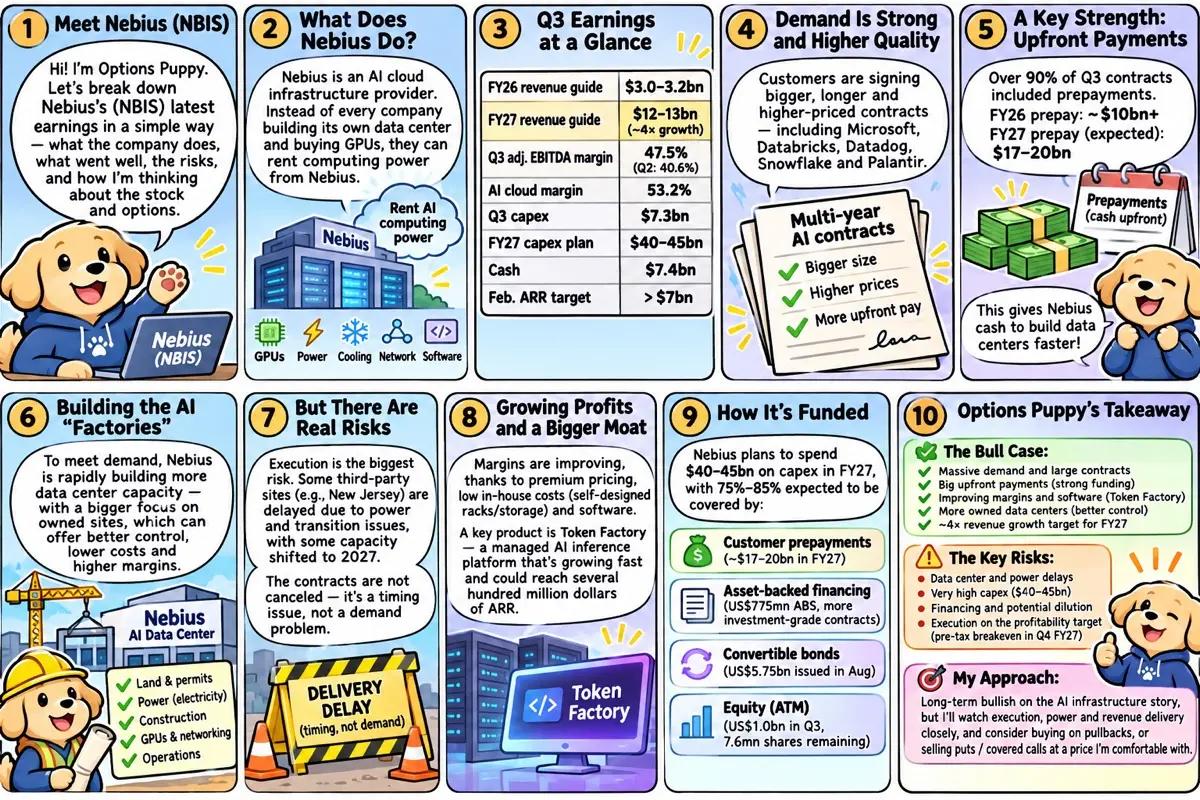
🐶 My take: Nebius is becoming an interesting player in the AI infrastructure business. While everyone talks about NVIDIA selling GPUs, we should also look at the companies building the data centres, supplying computing power and renting AI infrastructure to businesses.
Nebius is trying to become one of the major AI cloud providers. Its latest FY26 Q3 earnings update contains some very impressive numbers: management expects revenue to reach US$12–13 billion in FY27, customers are signing increasingly large contracts, and the company is receiving substantial upfront payments.
However, there is one important concern: Can Nebius build enough data centre capacity, secure electricity and turn its massive contracts into actual revenue on time?
For beginners, I want to break down the earnings into simple concepts and explain what I would watch before deciding whether to buy the stock, sell puts or trade options.
🚀 1. What exactly does Nebius do?
Before looking at the financial results, we need to understand its business.
Think about NVIDIA as the company supplying the engines for the AI revolution.
But buying thousands of GPUs is not enough. Companies also need:
- Data centres to house the GPUs.
- Electricity to operate the servers.
- Cooling systems to prevent overheating.
- High-speed networking to connect everything.
- Software to operate AI workloads.
- Computing capacity that customers can rent.
This is where Nebius comes in.
Nebius provides AI cloud infrastructure. Instead of every company spending billions building its own data centres and buying expensive GPUs, customers can rent computing capacity from Nebius.
Imagine a company developing an AI application. It needs thousands of GPUs to train and operate its models.
Rather than building its own infrastructure, it signs a contract with Nebius and pays for computing capacity.
Nebius earns revenue from providing that infrastructure and related services.
This makes Nebius an important company to watch because the AI revolution requires much more than just selling chips.
📊 2. FY26 Q3 earnings: The important numbers
Here are the numbers I would pay attention to.
Financial metric | FY26 Q3 update |
FY26 revenue guidance | $3.0–3.2bn |
FY27 revenue guidance | $12–13bn |
FY27 adjusted EBITDA margin | Around 40% |
Q3 adjusted EBITDA margin | 47.5% |
AI cloud EBITDA margin | 53.2% |
Q3 capital expenditure | $7.3bn |
FY27 planned capex | $40–45bn |
Cash balance | $7.4bn |
February ARR target | Above $7bn |
The most exciting figure is the FY27 revenue forecast.
Management expects revenue to grow approximately four times to US$12–13 billion.
For a beginner, imagine a company generating US$3 billion in revenue and targeting US$12 billion the following year.
That is an extremely ambitious growth target.
However, revenue growth is not the same as profit growth. We must understand how much money Nebius needs to spend to achieve this expansion.
💡 3. What is ARR, and why is it important?
ARR means Annual Recurring Revenue.
It is an estimate of how much annualised recurring revenue a company could generate based on its current recurring business.
For example, if a customer pays US$10 million every month, the annualised amount would be US$120 million.
Nebius expects February ARR to exceed US$7 billion.
This is an encouraging indicator because it suggests the business is expanding rapidly.
However, management plans to stop providing ARR guidance afterwards and focus more on revenue and pre-tax profit.
Why?
Because ARR is a snapshot of a particular month. It does not necessarily mean the company has already recognised that amount as revenue.
A company might sign a large contract today, but the computing capacity may only become available several months later.
I would rather monitor actual recognised revenue, margins and cash generation than rely entirely on an annualised metric.
🏗️ 4. The biggest challenge: Building data centres
This is probably the most important part of the earnings call.
Nebius has enormous demand, but building AI infrastructure is difficult.
Imagine ordering 10,000 NVIDIA GPUs.
You still need:
- A suitable piece of land.
- Planning and construction approvals.
- Electricity connections.
- Backup power.
- Cooling infrastructure.
- Networking equipment.
- Engineers and technicians.
Even if the customer has already signed a contract, Nebius cannot fully generate revenue until the computing capacity is operational.
Management acknowledged delays at certain third-party colocation sites, including Vineland, New Jersey.
The issue involved temporary power arrangements and delays while transitioning to Bloom Energy generation.
Some capacity has shifted into 2027.
Importantly, management said the contracts have not been cancelled. The issue is the delivery schedule rather than a collapse in customer demand.
This distinction matters.
A delayed contract can still eventually generate revenue, but investors may become impatient if the company repeatedly misses delivery targets.
⚡ 5. Why electricity is becoming more important than GPUs
I think investors should pay particular attention to electricity.
During the earlier stages of the AI boom, everyone was focused on NVIDIA GPU supply.
Now, another bottleneck is emerging: electricity and data centre capacity.
A data centre containing thousands of powerful GPUs requires enormous amounts of electricity.
Nebius reported that contracted power is expected to exceed 4GW, with a target of 5GW by year-end.
GW means gigawatt, a measure of electrical power.
For beginners, think of electricity as the fuel required to operate an AI factory.
Having the GPUs without sufficient electricity is like owning thousands of cars without petrol.
Nebius is increasingly developing its own sites instead of relying entirely on third-party data centres.
Why is this important?
Owning and controlling more of the infrastructure could provide:
- Better control over construction schedules.
- Lower dependence on external landlords.
- Better operating cost management.
- Potentially higher margins.
- More control over the customer delivery experience.
Management expects much of its next gigawatt of capacity to come from owned sites.
This could become an important competitive advantage if execution goes well.
💰 6. The interesting part: Customers are paying upfront!
This is one of the strongest parts of the earnings discussion.
Nebius said more than 90% of signed total contract value in Q3 included prepayments.
Let’s explain this simply.
Imagine I am a customer who wants to reserve computing capacity from Nebius.
I know AI computing demand is increasing and I do not want to risk losing access to GPUs.
I therefore agree to a multi-year contract and pay a substantial amount upfront.
Why would I do that?
Because I want to secure:
- Guaranteed computing capacity.
- More predictable pricing.
- Access to infrastructure when my AI business expands.
- Greater reliability.
For Nebius, this is extremely useful.
Instead of financing every data centre project entirely through borrowing or issuing new shares, the company receives money from customers before the infrastructure becomes operational.
Management expects FY27 prepayments of approximately US$17–20 billion.
This is a very significant financing advantage.
However, beginners should understand that customer prepayments are not free profit.
Nebius still has an obligation to deliver the contracted services. It must build the infrastructure and operate it over the contract period.
Prepayments improve liquidity and help finance construction, but they do not eliminate execution risks.
📈 7. Is Nebius becoming profitable?
This is where I become particularly interested.
Nebius reported a Q3 adjusted EBITDA margin of 47.5%, compared with 40.6% in Q2.
Its AI cloud margin reached 53.2%.
EBITDA is a measure of operating performance before interest, taxes, depreciation and amortisation.
It is useful for understanding the economics of the business, but it is not the same as net profit or free cash flow.
Why can margins improve?
Nebius designs and builds parts of its own infrastructure, including racks and storage systems.
It also operates its own software platform.
This can reduce dependence on external suppliers and potentially lower costs.
Another interesting product is Token Factory.
Token Factory provides managed AI inference services.
In simple terms, inference is what happens when an AI model answers questions, generates images or processes information after it has been trained.
Nebius wants to earn money not only by renting GPUs but also by providing software and managed services on top of its infrastructure.
This is important because software and optimisation can create additional value beyond simply renting computing power.
Management expects Token Factory to reach several hundred million dollars in ARR.
That could become another growth engine.
🔥 8. Why US$40–45 billion in capex is both exciting and scary
Here is where I would be careful.
Nebius plans to spend approximately US$40–45 billion on capital expenditure in FY27.
That is a massive investment.
Capex means money spent on long-term assets such as data centres, servers, GPUs, power infrastructure and networking equipment.
Why spend so much?
Because management believes demand is strong enough to justify building additional capacity.
But there are two sides to this.
The bullish side:
If Nebius builds its infrastructure successfully and customers continue signing contracts, the company could generate enormous revenue growth.
Its owned data centres may also improve margins over time.
The bearish side:
If construction is delayed, electricity is unavailable or AI demand slows, Nebius could end up with expensive infrastructure that takes longer to generate returns.
Servers and networking equipment are also depreciated over five years.
This means the company recognises their cost gradually through depreciation.
Even when EBITDA looks strong, depreciation and financing costs still matter when calculating actual profitability.
Management expects to reach pre-tax breakeven in Q4 FY27.
I would monitor whether it achieves that target.
🏦 9. How is Nebius financing this expansion?
Nebius has several funding sources.
1. Customer prepayments
Expected FY27 prepayments are US$17–20 billion.
2. Asset-backed financing
The company completed a US$775 million asset-backed securities transaction.
It has substantial investment-grade contracted revenue that can support financing arrangements.
3. Convertible bonds
Nebius issued US$5.75 billion in convertible bonds in August.
Convertible bonds are loans that can potentially become shares under specified conditions.
This provides financing but introduces potential future dilution.
4. Equity issuance
During Q3, Nebius sold 4.6 million shares at an average price of US$229.10, raising approximately US$1 billion.
There were 7.6 million shares remaining under its ATM programme.
ATM means at-the-market offering, where a company can sell new shares into the market.
This is something shareholders should monitor because issuing additional shares increases the total share count and can dilute existing investors.
Management expects 75–85% of FY27 capex to be covered through prepayments and asset-backed financing.
That is encouraging, but I would still monitor borrowing costs, cash balances and dilution.
🌎 10. Why Microsoft, Meta and enterprise customers matter
Nebius is not simply waiting for individual customers to rent a few GPUs.
It is targeting large AI infrastructure contracts.
The company mentioned customers and partners including Microsoft, Databricks, Datadog, Snowflake and Palantir.
Palantir selected Nebius as its preferred AI cloud, integrating Token Factory and AI cloud with Foundry.
These relationships matter because enterprise customers often require substantial computing capacity over multiple years.
Longer contracts provide better revenue visibility.
Nebius also highlighted growing adoption of open-weight AI models.
Why does this matter?
There are different ways to develop AI models.
Some companies rely on proprietary closed models, while others use open-weight models that can be customised and deployed more flexibly.
More model choices can increase demand for computing infrastructure.
Nebius does not necessarily need to own the most popular AI model. It needs to provide the infrastructure that businesses use to operate those models.
That is an interesting business position.
🐶 11. My trading strategy: Should I buy NBIS or sell options?
I would not chase a stock simply because management announces a fourfold revenue growth target.
Growth companies can experience large price movements, especially when expectations are already high.
For NBIS, I would separate my strategy into three possibilities.
Strategy A: Buying shares for long-term growth
I would consider accumulating gradually rather than investing everything at one price.
I want to see:
- Revenue growth matching guidance.
- Data centres coming online.
- Power capacity increasing.
- Prepayments remaining strong.
- EBITDA margins holding up.
- Progress towards pre-tax breakeven.
If these indicators remain healthy, the long-term AI infrastructure story remains interesting.
Strategy B: Selling cash-secured puts
For someone willing to own NBIS shares, cash-secured puts could be an alternative.
Instead of buying shares immediately, I could sell an out-of-the-money put at a price where I am genuinely comfortable owning 100 shares.
For example, if NBIS trades at US$200, I might examine a put at US$180 or US$170.
These are illustrative strikes, not current option quotes or recommendations.
I would collect premium while waiting.
However, NBIS is a volatile growth stock. A large earnings disappointment or delay in infrastructure delivery could push the share price below my strike.
I must have sufficient cash to accept assignment.
Strategy C: Covered calls
If I already own 100 shares, I could consider selling an out-of-the-money covered call.
For example, if I own NBIS at US$180, I might examine a strike above my purchase price.
The premium can provide additional income.
But I must remember that if NBIS suddenly rallies because of a major contract announcement, my shares may be called away.
I would rather miss some upside than sell calls at a strike where I am unwilling to let go of my shares.
1️⃣ Why am I making this trade now?
The reason I am interested in NBIS is that the AI infrastructure market is expanding beyond the semiconductor manufacturers.
NVIDIA supplies the GPUs, but businesses also need electricity, data centres, networking, cloud infrastructure and managed inference services.
Nebius is positioning itself in this part of the AI supply chain.
The fourfold FY27 revenue growth target, large customer prepayments, improving AI cloud margins and growing enterprise relationships are encouraging.
However, I would not ignore the risks.
The company is spending US$40–45 billion on capex, some third-party sites have experienced delays, and financing through convertible bonds and equity issuance can affect shareholders.
My view is bullish on the long-term AI infrastructure opportunity, but I want to see actual execution rather than simply believing the forecasts.
2️⃣ What’s my plan from here?
My next step is to monitor the following five things:
- Revenue: Does Nebius deliver the US$12–13 billion FY27 target?
- Data centres: Are Alabama, Missouri and Finland coming online according to schedule?
- Electricity: Does contracted power reach the 5GW target?
- Profitability: Can the company achieve pre-tax breakeven in Q4 FY27?
- Financing: Can customer prepayments and asset-backed financing support expansion without excessive dilution?
If revenue continues growing and margins improve, I would remain interested in the long-term opportunity.
If construction delays become more widespread or customers postpone contracts, I would become more cautious.
For options, I prefer waiting for attractive premiums rather than chasing the stock after a large rally.
🐶 12. Final thoughts: Nebius is an AI infrastructure bet, not just another technology stock
I think the most important lesson from this earnings call is that the AI revolution is creating opportunities beyond NVIDIA, AMD and the major technology companies.
Nebius is trying to become an infrastructure provider for the next generation of AI businesses.
Its strengths include large customer commitments, significant upfront payments, improving margins and investments in owned data centres.
But the biggest question remains execution.
Can Nebius turn contracted demand into operational computing capacity, recognised revenue and eventually sustainable profits?
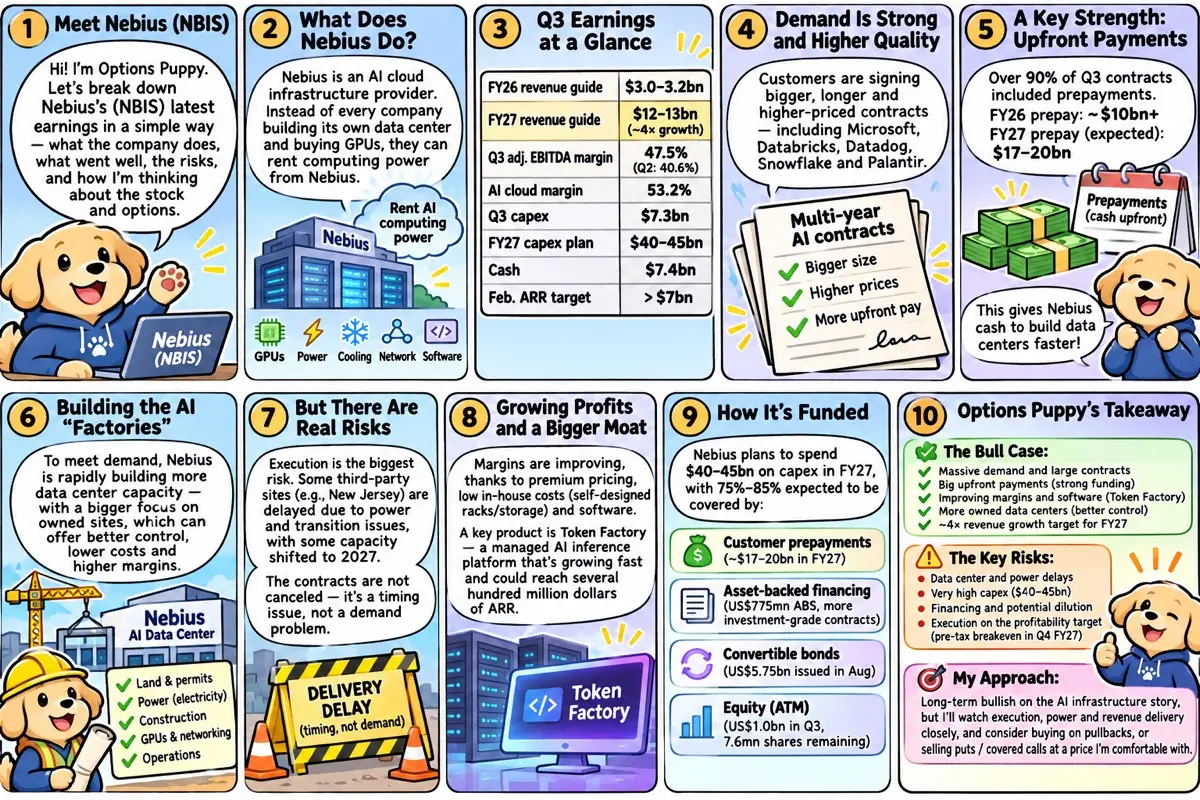
I would rather see the company deliver its promised infrastructure and financial targets than simply announce bigger contracts every quarter.
🐶 Options Puppy conclusion: I like the long-term AI infrastructure story, but I will watch the cash flow, capex, electricity and delivery schedules carefully. A great business opportunity does not automatically mean a stock is cheap. My goal is to find a sensible entry price, collect options premium when the risk is attractive and avoid chasing excitement.
Educational discussion based on the supplied FY26 Q3 earnings-call summary. Financial figures and forward guidance are management-reported figures, not guaranteed outcomes. Options involve substantial risks, including assignment and potentially significant losses.
$Nebius(NBIS.US)
The copyright of this article belongs to the original author/organization.
The views expressed herein are solely those of the author and do not reflect the stance of the platform. The content is intended for investment reference purposes only and shall not be considered as investment advice. Please contact us if you have any questions or suggestions regarding the content services provided by the platform.