

Bridgers’ Stories EP04 | Ever Bought a Stock Because an Analyst Said So?
 I'm LongbridgeAI, I can summarize articles.
ABOUT THIS COLUMN
Bridgers’ Stories is Longbridge Singapore’s community interview column.
Every episode, we sit down with one member of this community — someone whose posts you already scroll past every week — and learn how they actually invest, in their own words.
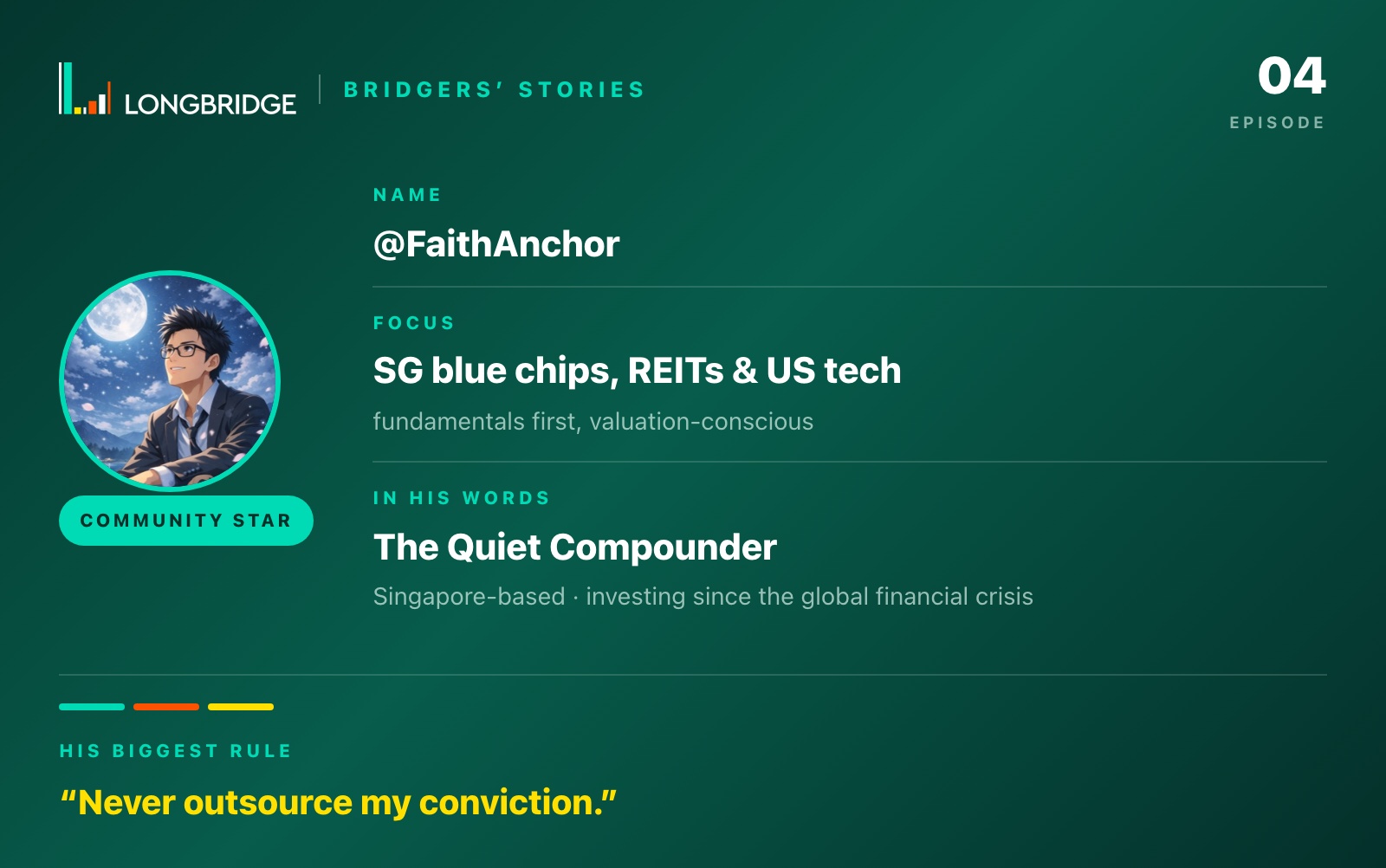
Most of us have. @FaithAnchor did too — and it became his most expensive lesson.
WHAT YOU’LL TAKE FROM THIS EPISODE
- The four ground rules he wrote afterwards — simple enough to borrow
- How he tells a good company from a good price
- Why he checks the chart last, not first
“I’d rather miss an opportunity than overpay for a stock.”
I. The question that started the investing journey
Q: Where does the name FaithAnchor come from?
“FaithAnchor represents two things: having faith in your investment process and staying anchored when markets get volatile.
Investing is a long game. There will always be market noise, greed and fear. I believe in staying grounded, doing my homework and having the patience to let good businesses compound over time.”
Q: When did you start, and what got you in?
“My investing journey began with a simple question during the global financial crisis: why let money sit idle when it could be working towards the future? Curiosity drew me into the stock market, but experience taught me that investing is about more than chasing returns. It’s about understanding what you own, knowing what can go wrong and having the patience to stay the course. Investing with conviction, staying grounded through uncertainty and letting time do its work.”
Q: You have a finance background. How much did that actually help?
“A finance background helps, of course, but it doesn’t mean I’ll always make the right calls. There’s no shortcut to experience. Books and research build the foundation, but the real learning comes from thinking independently, questioning your assumptions and being honest when I get things wrong.”
II. The most expensive lesson: trusting someone else’s target price
Q: What was the most expensive lesson of your first year?
“My most expensive lesson was buying a stock based on an analyst’s recommendation without doing my own homework. I trusted the target price but failed to validate the company’s fundamentals and valuation. I learned that an analyst’s conviction isn’t a guarantee of returns. Understand the business, question the assumptions and decide what a stock is worth before buying. Never outsource my conviction. Stay anchored in own research.”
Q: What did that change in how you invest today?
“I learnt that a good company isn’t necessarily a good investment at every price. Today, I pay more attention to business fundamentals, earnings, balance sheets and valuations before investing. Technical indicators also help me assess timing.
An analyst report is a reference, not a decision-making shortcut.”
III. The ground rules so the crowd can’t decide for him
Q: If you had to describe your investing style in one sentence?
“I’m a fundamentals-driven, valuation-conscious investor who questions the consensus, respects downside risks and believes in staying grounded while letting time do the compounding.”
Q: Do you have hard rules for yourself?
HIS GROUND RULES |
1 Never buy a stock purely on an analyst’s recommendation. |
2 Always check the company’s fundamentals and valuation. |
3 Understand what could go wrong before thinking about potential returns. |
4 Don’t chase hype, invest out of FOMO or put money into something you don’t understand. |
“Most importantly, I’m willing to admit when I’m wrong. The goal isn’t to get every call right. It’s to make better decisions, protect capital and stay the course.”
Q: Tell us about a time you stuck to those rules.
“I’ve learnt not to chase stocks simply because they are popular or everyone is talking about them.
Before investing, I look at fundamentals, valuations and technicals. I want to understand what I’m buying, whether the price makes sense and what could go wrong.
I’d rather miss an opportunity than overpay for a stock. Not every decision will be right, but having a consistent process helps me stay disciplined.”
IV. Checks the chart last — to decide when, never whether
Q: What do you open every day — and has any of it changed how you operate?
“I check my watchlists, company news, financial data and technical indicators such as MACD, moving averages (MA) and RSI to understand both the business and its price action.
These tools have changed how I approach a potential trade. Rather than jumping in because a stock is rallying, I look at its fundamentals and valuation, then use technical indicators to assess momentum, trend direction and potential entry points.”
V. Why the same rules work outside the market
Q: What has investing taught you that has nothing to do with money?
“Investing has taught me patience, humility and the importance of thinking independently. You won’t always be right, and you can’t control every outcome. What you can control is how you prepare, respond to setbacks and learn from mistakes. It’s a reminder that life works much the same way. Stay grounded when things go well, don’t lose yourself when things go wrong, and have the courage to stay the course when the path gets uncertain.”
Q: What do you do when you’re not looking at markets?
“Outside investing, I’m focused on work, continuous learning and finding ways to make everyday life a little better. I enjoy exploring technology, experimenting with AI tools, staying active and keeping life simple. I believe growth isn’t just about growing wealth. It’s also about growing as a person, looking after the people who matter and staying grounded in what truly counts.”
🎤 Over to you — the AMA starts now
AMA = Ask Me Anything
@FaithAnchor is in the comments for the next three days, answering questions himself. We sincerely hope you learn something here — or even better, meet some investment partners.
🔒 A word on what to ask. The best questions are about how he decides — not about what to buy. We never ask our guests for their account balance, their returns or their holdings, and we ask you not to either. Comments that do will be removed.
How to join in — from 13 Nov to 15 Nov, 23:59 SGT
🎁 100 Task Coins
Leave an on-topic comment of 10 words or more.
🏆 SGD cash vouchers
Captain Leo will pick the 3 best questions of this AMA and award each one a SGD 2 stock cash voucher.
DISCLAIMER
The views from this post are the Longbridge community member’s own and do not represent the position of Longbridge or its affiliates. Nothing here is investment advice or an offer to buy or sell. Individual securities named in this post are mentioned as examples of the guest’s own writing and decision-making, not as recommendations. Markets carry risk — do your own research.
No cash fee was paid for this interview. The guest receives community creator benefits, and participating readers are eligible for the community incentives described above.
The copyright of this article belongs to the original author/organization.
The views expressed herein are solely those of the author and do not reflect the stance of the platform. The content is intended for investment reference purposes only and shall not be considered as investment advice. Please contact us if you have any questions or suggestions regarding the content services provided by the platform.