

 Rate Of Return
The most comprehensive data sharing of 30 Chinese cigar butt stocks - Exploring the value of cigar butt stocks

Friends who have read Warren Buffett's early (1950s-1960s) letters to shareholders should be aware of his three primary investment strategies during that period: 1. Value investing (commonly known as "cigar butt" investing); 2. Arbitrage investing (privatization arbitrage); 3. Control investing. Although times have changed, and the investment environment and challenges may have evolved, I believe the essence of Buffett's approaches still holds value in today's market.
Recently, I've been systematically reviewing the financial statements of cigar butt stocks and have compiled some interesting data, which I'd like to share with you today.
I won't go into lengthy explanations about the logic and definitions of cigar butt investing. Instead, I'll focus on summarizing the data and screening methods for 31 U.S.-listed cigar butt companies.
First, here's a chart:
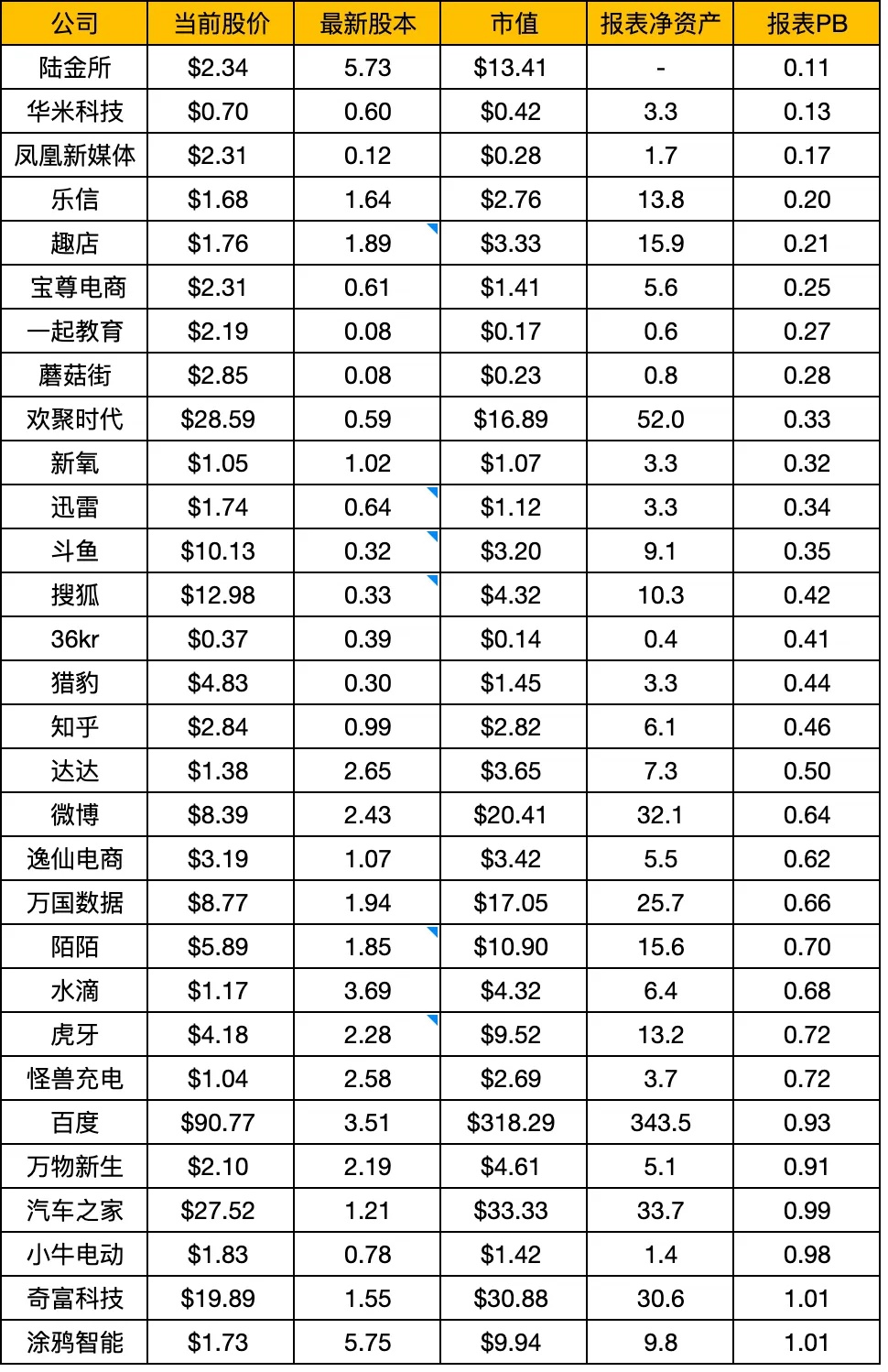
The above shows 31 Chinese concept stocks I've been tracking with a price-to-book (PB) ratio below 1.
Next, let's categorize these companies:
1. Asset-heavy companies:
Their PB ratios appear low, but their assets mainly consist of plants and equipment, which are often inflated and difficult to assess for liquidation value. For example, GDS Holdings reports net assets of $2.57 billion but has $4-5 billion in interest-bearing debt, with net cash at -$4.42 billion.
2. Financial companies:
Many financial firms show impressive reported profits and cash flows with low PB ratios. However, these companies are complex, and it's hard for the average investor to judge whether their profitability is sustainable. A slight increase in default rates could wipe them out.
For instance, Lufax, Qifu Technology, and Lexin—three P2P companies—all have solid profits and low P/E ratios. Lufax's core PB is even below 0.2.
3. Profitable scale companies:
These differ significantly from pure cigar butt stocks. They currently have strong profitability, and some even exhibit sustainability. They're included here solely because their PB ratios have fallen below 1.
Examples include Baidu, Weibo, Autohome, and Momo. The first two have stable and sustainable profits, while the latter two are currently profitable but with slightly weaker sustainability.
4. Pure cigar butt companies:
The remaining 23 companies either have failing core businesses with continuous losses, barely break even on interest income, or have marginally profitable operations.
These are what I consider pure cigar butt stocks—companies with little hope or sustainability in their core businesses, offering opportunities only in the discount between liquidation value and market capitalization.
Of the four categories:
The first lacks cigar butt value and is excluded.
The second may have opportunities, but financial complexity puts it outside my circle of competence, so it's excluded.
The third, despite higher PB ratios than other cigar butts, has stable profits and is temporarily retained for further analysis.
The fourth undergoes initial screening: companies with PB ratios below 0.5 are kept, while those above are removed.
Note: From a margin of safety perspective, lower PB ratios generally indicate greater investment value. Thus, we first exclude PB ratios above 0.5 (with rare exceptions, such as companies holding undervalued real estate or equity in valuable firms).
After screening, the chart looks like this:
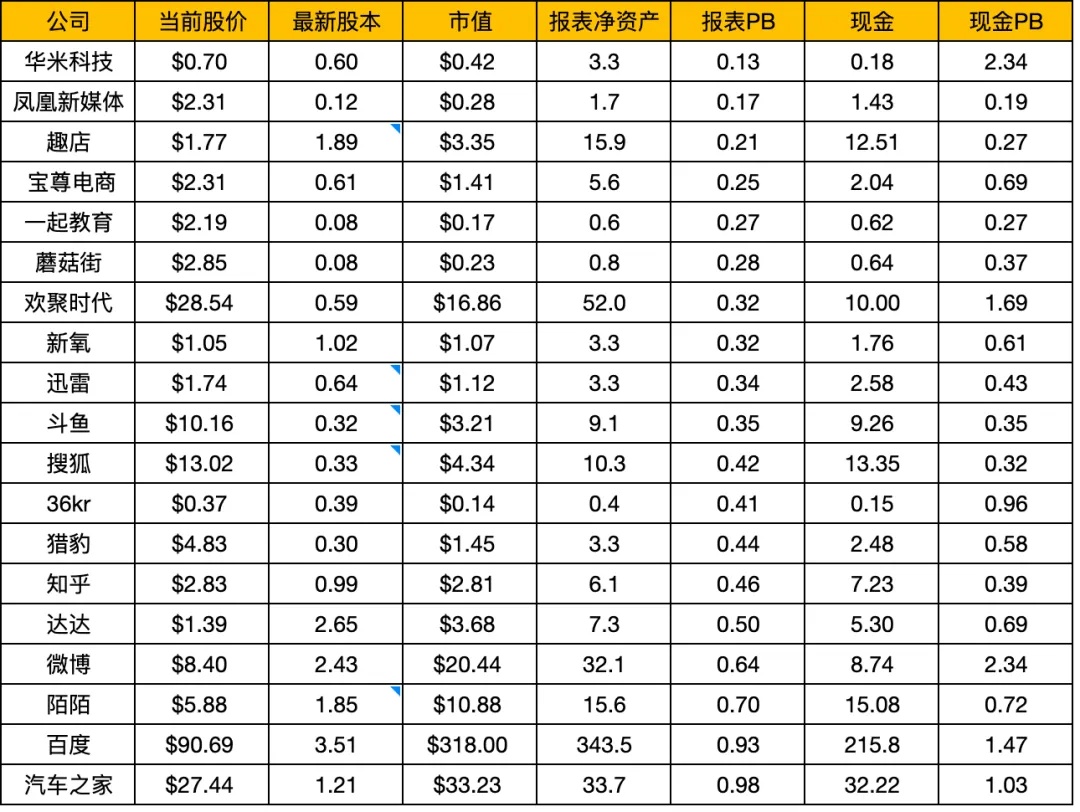
After this round, 19 companies remain. The next step would be to conduct detailed liquidation value calculations using Buffett's cigar butt methodology. However, given the complexity and space constraints, I'll simplify by using cash as a proxy for liquidation value to preliminarily exclude some companies. Setting a low threshold to avoid over-filtering, we exclude companies with cash/market cap above 0.7, removing Huami, Joyy, and 36Kr. This leaves 16 companies.
Note: Joyy is embroiled in a $2 billion+ acquisition dispute with Baidu. If the $2 billion prepayment from Baidu is retained, Joyy becomes a strong cigar butt; otherwise, it's less attractive. We'll monitor the dispute's progress.
Next, we add more dimensions: buybacks, dividends, and profits.
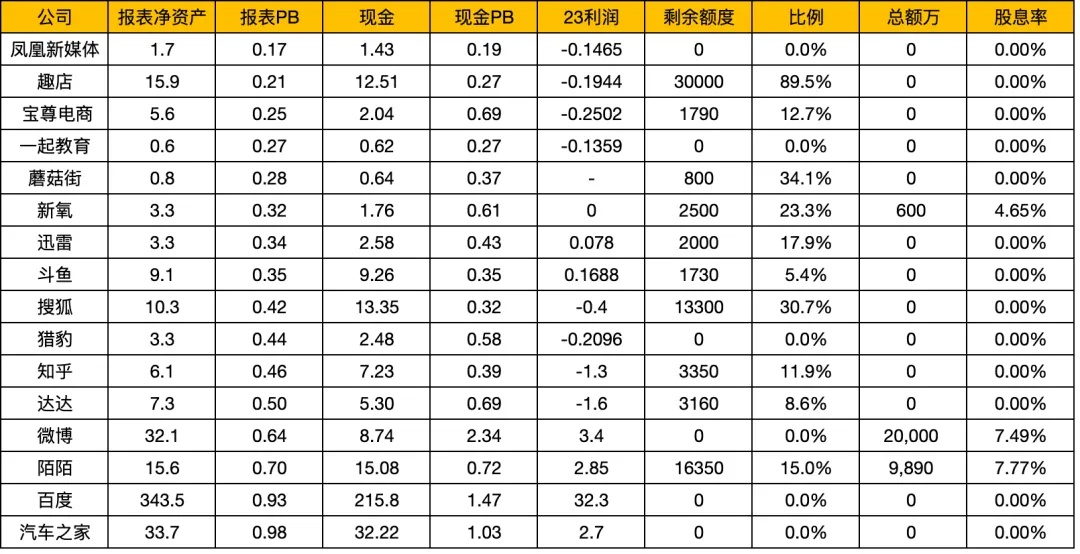
Note: 2023 profits are calculated as operating profit + interest income - income tax, excluding non-recurring items like impairment losses or investment gains.
Now, let's briefly analyze the remaining 16 companies:
1. Phoenix New Media:
A lean-asset media company with clean financials. Fixed and intangible assets are minimal, and its PB ratio below 0.2 suggests little inflation. Despite recent losses, the annual loss of $14.65 million is manageable. Even after three years of losses, the cash PB would be ~0.28, offering a solid margin of safety. The only downside is the lack of dividends or buybacks. Investment-worthy.
2. Qudian:
Recently exited financial services entirely. Its balance sheet is clean, with no goodwill and minimal fixed/intangible assets. Net assets are mostly cash, with a cash PB of 0.27. Annual losses of $19.44 million would raise the PB to only 0.28 in three years, maintaining a strong margin of safety. Most importantly, it has authorized a $300 million buyback and has repurchased over 40% of shares since IPO. Investment-worthy.
3. Baozun:
Fixed assets + intangibles + goodwill total ~$200 million, or 36% of total assets—too high. Its cash PB of 0.69 and recent heavy losses further indicate poor asset quality. Pass.
4. 17EdTech:
A lean-asset firm with clean financials. Both PB and cash PB are below 0.3, indicating severe undervaluation. However, the education sector is tough, and the company's heavy losses could deplete cash reserves in four years. Pass.
5. Mogujie:
No recent annual report available. Temporarily pass.
6. So-Young:
Goodwill of $80 million + fixed/intangible assets total $110 million, or 33% of net assets. Adjusted PB is much higher than the reported 0.32. Cash PB of 0.61 is also high. Pass.
7. Xunlei:
Goodwill + fixed/intangible assets total $86 million (26% of net assets). Deducting these, PB is ~0.44, close to its cash PB of 0.43. It has been marginally profitable for two years with no cash drain and recently announced a $20 million buyback. Watchlist candidate.
8. DouYu:
Lean-asset with clean financials. Intangibles + fixed assets + goodwill total $20 million (<3% of net assets). Core operations lose money, but ~$1 billion in cash generates enough interest to offset losses. PB and cash PB are both ~0.35. With $17.3 million left in buybacks and Tencent as a major shareholder (potential merger with Huya), investment-worthy.
9. Sohu:
Fixed assets ($270 million) + goodwill ($50 million) account for 30% of net assets. However, Sohu's fixed assets are mainly its Beijing headquarters, purchased long ago at cost and now undervalued. Thus, its reported PB of 0.42 is overstated, while its cash PB of 0.32 is low. With $130 million in buybacks ongoing, investment-worthy.
10. Cheetah Mobile:
Goodwill ($80 million) + intangibles ($29 million) + fixed assets ($7 million) total $117 million (35% of net assets). Adjusted PB is ~0.68, and cash PB is 0.58—too high. Pass.
11. Zhihu:
Lean-asset with $44 million in goodwill + fixed/intangible assets (7% of net assets). Cash PB of ~0.4 is undervalued, but annual losses exceed $100 million, draining cash. Pass.
12. Dada Nexus:
Cash PB of 0.69 is too high, and annual losses exceed $100 million. Pass.
13. Weibo:
Annual profits exceed $300 million, with deep moats and sustainable earnings. A PB of 0.64 is cheap for such a company. Dividends of ~$200 million/year yield ~10%. Two red flags: 1) $2.6 billion in interest-bearing debt despite strong cash flows; 2) management historically misused $500 million in cash. Watchlist candidate—monitor cash changes and major shareholder repayments.
14. Momo:
Fixed + intangible assets total $100 million (6.4% of net assets). Cash PB of ~0.72 isn't deeply undervalued, but steady annual profits of ~$200 million could lower it to ~0.52 in three years. However, live-streaming is declining, making future profits uncertain. Watchlist candidate.
15. Baidu:
It's sad to see Baidu trading below book value, but the company has underperformed for years, resting on its search engine laurels. Its $3 billion+ annual cash flow and deep undervaluation make it theoretically investment-worthy. However, Baidu has never paid dividends and barely repurchases shares. I'd rather invest in Alibaba. Pass.
16. Autohome:
Intangibles + fixed assets + goodwill total $600 million (18% of net assets). Adjusted PB is ~1.2, and cash PB is also above 1—not deeply undervalued. Annual profits of ~$300 million could lower cash PB to ~0.8 in three years. Stable dividends of ~$200 million/year yield ~6%. Watchlist candidate.
Final Thoughts:
After reviewing these 16 companies, my top investment picks are:
Qudian > DouYu > Sohu > Phoenix New Media
Watchlist candidates:
Xunlei, Weibo, Momo, Autohome, Joyy (no particular order).
Personally, I prefer cigar butts with PB and cash PB both below 0.3, selling at ~0.6. Of course, each case requires individual analysis.
All these stocks fluctuate, and market sentiment can suddenly create deep undervaluation or overvaluation. I track their real-time prices and PB ratios in a Tencent Docs spreadsheet to spot extreme opportunities instantly.
The spreadsheet (with more data than this article) is available here: https://docs.qq.com/sheet/DQUFUbWpiSVZQbXBZ?tab=BB08J2
$Qudian Inc-Spon(QD.US) $DouYu(DOYU.US) $Weibo(WB.US)
The copyright of this article belongs to the original author/organization.
The views expressed herein are solely those of the author and do not reflect the stance of the platform. The content is intended for investment reference purposes only and shall not be considered as investment advice. Please contact us if you have any questions or suggestions regarding the content services provided by the platform.
