

Hot sector! Want to get in but lack funds? "Fractional shares trading" can help!

The hottest AI semiconductor and stablecoin concept stocks in the current market are gaining momentum! But for star assets like NVIDIA (NVDA, current price $155.02), Tesla (TSLA, current price $325.78), and Circle (CRCL, current price $213.63), which cost hundreds or even thousands of dollars per share, the barrier to entry for buying a full share is simply too high? Don't worry, "fractional share trading" allows you to easily invest with low capital!
What are fractional shares in U.S. stocks?
Fractional shares, also known as partial shares, refer to stock holdings of less than one full share. Fractional investing allows investors to own a portion of these high-quality assets with as little as $1. The emergence of fractional shares enables investors with limited capital to participate in high-priced stock investments, lowering the entry barrier and increasing investment flexibility.
Why is now a good time for fractional share investing?
At this point in time, fractional share investing offers the following core advantages:
Low-barrier entry for bottom-fishing and risk diversification: Through fractional shares, investors can spread their capital across multiple stocks, avoiding idle funds or concentration risks associated with buying full shares. For example, $1,000 can be evenly allocated to buy fractional shares of Apple, Microsoft, and Tesla, achieving a more balanced portfolio.
Suitable for dollar-cost averaging to smooth volatility: In a bear market, regularly investing fixed amounts (e.g., $200 per month) in fractional shares can average down costs and avoid the timing risks of lump-sum investments. If the Nasdaq continues to drop by -20%, fractional share investing can automatically accumulate more shares at lower prices.
Flexible portfolio adjustments: If a stock experiences a significant drop, investors can quickly add fractional shares (e.g., adding 0.5 shares) without waiting for funds to buy a full share, allowing them to seize market opportunities more precisely.
Inverse pyramid averaging + fractional shares = a more scientific bottom-fishing strategy
For U.S. stocks, besides buying the dip, using strategies to bottom-fish is even more important. Traditional bottom-fishing methods often face the dilemma of "running out of ammunition too early." The inverse pyramid averaging method, by buying more as prices fall and leveraging the flexibility of fractional shares, can more scientifically capture market opportunities:
| Decline | Capital allocation | Advantage of fractional shares | Practical example (using a total investment of $1,000) |
| -15% | 30% capital | Small-scale testing | Invest $300: Diversify into fractional shares of favored stocks (e.g., $100 QQQ, $100 MSFT, $100 NVDA) or concentrate on one stock (e.g., $300 NFLX fractional shares). |
| -20% | 40% capital | Precise top-up of 0.X shares | Invest another $400: Focus on topping up existing holdings that remain promising (e.g., add $200 to NFLX, bringing total holdings to $500; add $100 to QQQ; use remaining $100 for new opportunities like AMZN fractional shares). |
| -25%+ | 30% capital | Avoid psychological pressure | Final investment of $300: During extreme market pessimism, boldly buy fractional shares of the most promising stocks that may have oversold (e.g., concentrate on adding $200 NFLX and $100 QQQ). |
Under this strategy, even if the market continues to decline, investors retain sufficient ammunition. And once a rebound begins, the accumulated fractional shares will quickly translate into substantial gains.
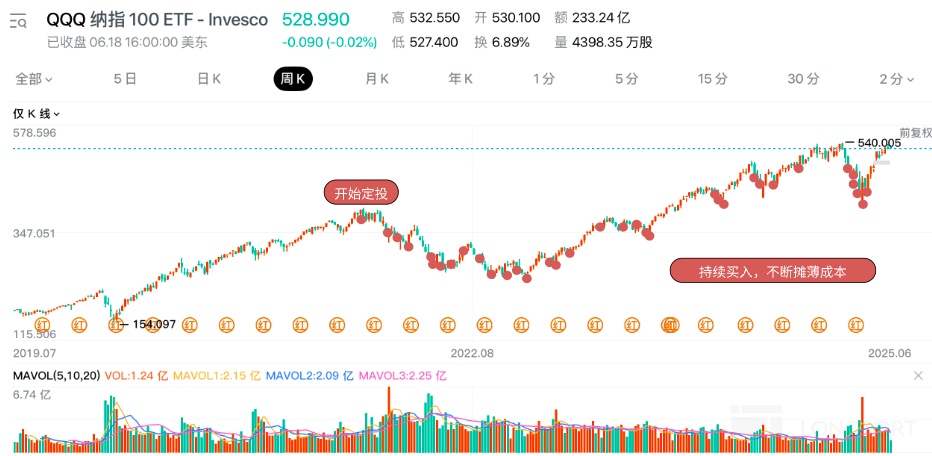
By combining fractional share investing with the right strategy, small-scale investors can easily build diversified portfolios. Beginners are advised to start with mainstream large-cap stocks, gradually accumulating experience and capital to lay a solid foundation for future investments.
The copyright of this article belongs to the original author/organization.
The views expressed herein are solely those of the author and do not reflect the stance of the platform. The content is intended for investment reference purposes only and shall not be considered as investment advice. Please contact us if you have any questions or suggestions regarding the content services provided by the platform.
