

Being 'homed' by Ninebot is not the worst news for Yadea.


After entering 2025, Ninebot Company (SH:689009) has stabilized its market value at 40 billion yuan, achieving a historic surpass over the leader Yadea (HK:01585).
How did this latecomer manage to steal the industry leader's home in the two-wheel electric vehicle market?
The incremental information implied behind this question is significant for both Yadea and Ninebot, as well as the two-wheel electric vehicle industry.
01 Two-wheelers are a uniquely Chinese industry
1. China is the largest single market
In transportation equipment, the annual domestic and export volume of electric two-wheelers exceeds 60 million units, with a market size of over 100 billion yuan, making it a relatively large industry. Moreover, China is the largest single market, accounting for over 80% of global demand, and the rapid development of electric vehicles has also made China the largest market for food delivery and instant retail globally.
Due to China's early restrictions on motorcycles and the explosion of small cars needing to wait until the per capita GDP exceeds 8,000 USD, as a substitute, small electric scooters have benefited from good road conditions and emerged rapidly. According to iResearch data, the domestic electric two-wheeler ownership has exceeded 420 million units.
The two-wheeler industry has also given birth to many listed companies, including established enterprises like Yadea Holdings, Aima Technology, Sunra, and Luyuan, with Yadea and Aima being the leaders among them, and newcomers like Niu and Ninebot.
The industry entered a mature stage after 2020, with annual shipments between 35-55 million units, mainly driven by replacement demand, accounting for about 60%. Demand pulses mainly depend on policies, and in 2019, Yadea expanded against the trend by seizing the opportunity of the new national standard, widening the gap with Aima and securing its leading position, raising its profit center from 500 million to 2.5 billion yuan.
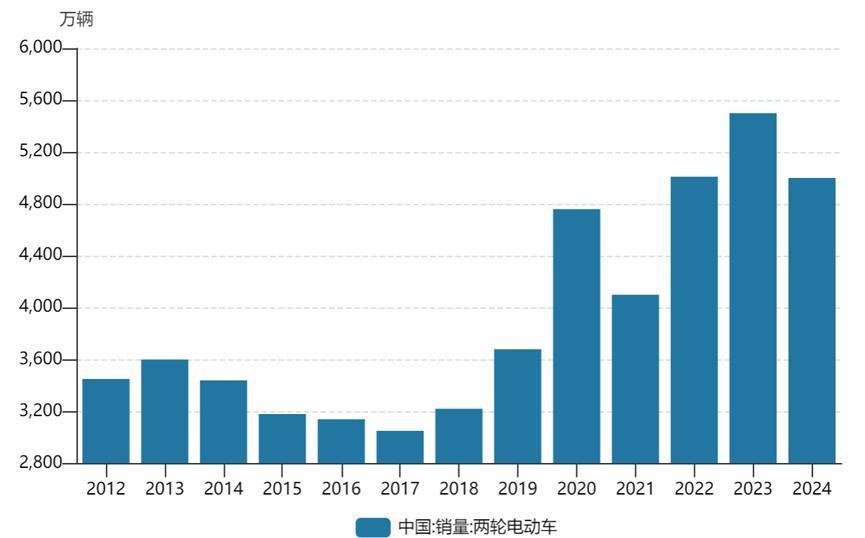
Figure: Annual sales trend of electric two-wheelers in China; Source: Wind
2. Excellent industry financial indicators and good structure
Car companies mainly focus on assembly, mastering brands and channels, with business models being front-store and back-factory. Therefore, leading companies like Yadea and Aima are doing well, with ROE steadily above 20%, and even second-tier brands like Sunra and Luyuan can achieve around 10% ROE.
Moreover, all electric two-wheelers are sold to consumers for cash, and facing a dispersed upstream, they can press prices and payments, so the cash flow performance of small electric scooter companies is also excellent.
After the national standard update in 2019, the electric two-wheeler industry quickly cleared out, with the number of brands shrinking by over 80% to around 100, gradually forming a pattern of three major brands: Yadea, Aima, and Tailg, with a combined share close to 60%, where Yadea holds 25-30%, Aima 15-20%, and Tailg around 15%, with other second-tier brands like Sunra and Luyuan.
Then there are new brands, or "new forces in two-wheelers," occupying niche markets, with Ninebot and Niu each taking a high single-digit share.
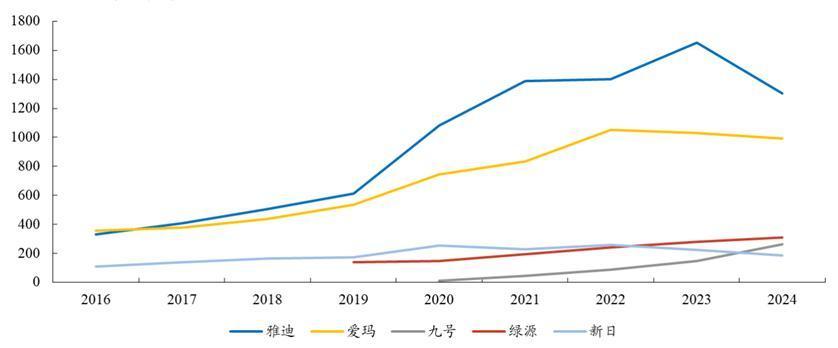
Figure: Changes in sales of electric two-wheeler brands; Source: Company announcements, Cinda Securities
3. New stories: State subsidies and new national standards, overseas expansion brings increments
First is the domestic market, with market expectations for a boom in 2025:
● Last year, the Ministry of Commerce included electric two-wheelers in the scope of state subsidies, combined with local subsidies, with single vehicle subsidy amounts reaching up to 500 yuan, which is already at the same level as home appliances, indicating policy support for the two-wheeler industry.
● Meanwhile, the Ministry of Industry and Information Technology officially released the "Safety Technical Specifications for Electric Bicycles (Draft for Comments)" as the new national standard, which is another elimination race for tail brands, with shares further concentrating towards the leaders.
Next is the overseas market, with great imagination space for the future:
● In 2024, China's electric two-wheeler export value reached a new high of over 40 billion yuan, with leading brands like Yadea already laying out production capacity overseas.
● Europe and the US mainly focus on E-bikes (electric assist bicycles), which are high-tech products, with a theoretical market space exceeding 40 billion USD, emphasizing the green and environmentally friendly attributes of products, with domestic companies expected to replicate the stories of motorcycles and all-terrain vehicles.
● Southeast Asian markets, including Vietnam, India, Thailand, and Indonesia, have also started promoting oil-to-electric conversion, with motorcycle bans and electric vehicle purchase subsidies.
02 It just looks beautiful
With a large domestic single market, and leaders forming brand and channel advantages, able to earn high ROE and excellent cash flow, and the domestic new national standard starting in 2025 leading to concentrated shares at the top, overseas demand has imagination space, it seems like a very beautiful story.
But the results are poor: Yadea Holdings' stock price closed flat for the year, underperforming the Hang Seng Index by nearly 20 points, and the second leader Aima Technology fell by over 15%. Investors who believe in this story are undoubtedly left hanging high on the mountain.
Where is the crack in the story?
1. Having a brand but no pricing power
As a consumer product to C, more than half of the two-wheeler demand comes from urban and rural areas, with quality-price ratio becoming the core, leading to each round of product upgrades and cost savings ultimately needing to be passed on to consumers. Taking Yadea as an example, over the past 10 years, the company's product average price has been around 1,500 yuan, as stable as a fake curve.
And the industry entered the stock market from 2020, which means most brands of electric two-wheelers are in an awkward situation of no increase in volume and no rise in price. Even this year's state subsidies only pulse and overdraft demand; and overseas demand, after in-depth research, is found to be pseudo-increment in the short term, with E-bikes needed in Europe and the US and domestic electric two-wheelers being two different products, and the road conditions in Southeast Asia and the cost-effectiveness of electric motorcycles not being high, motorcycles are still mainstream.
Without pricing power and growth, consumer products are even worse than Master Kong instant noodles. The result is: Yadea, Aima, Sunra, and Niu's gross profit margins in 2024 are all hovering at a low level of around 15%.
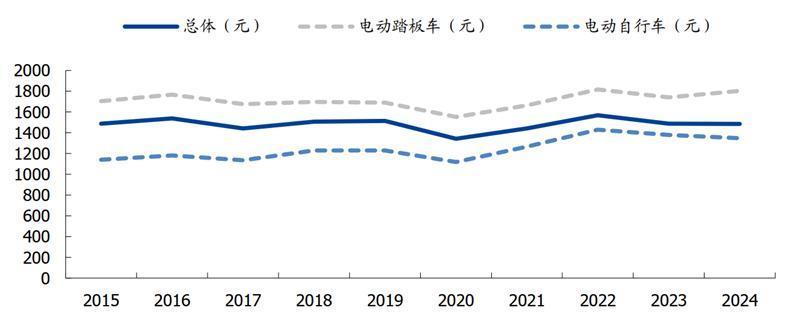
Figure: Yadea electric vehicle average price; Source: Company announcements, Guosheng Securities
2. The core of no pricing power; no vertical integration advantage
In the new energy vehicle industry, BYD masters batteries, Huawei and Li Auto master intelligent driving, able to earn excess profits. The same case also appears in the mobile phone industry, with Apple mastering core chips and operating systems, able to continuously sell at a premium, and Huawei as well.
Compared to these industries, electric two-wheelers are the weakest in supply-side differentiation, even leading brands have not formed obvious cost and technical advantages, all brands are trapped in inefficient internal competition, only able to seek incremental demand from consumers.
From the perspective of the industrial chain, the core components of electric two-wheelers upstream mainly include batteries and motors, with costs accounting for up to 40%. Batteries mainly rely on external suppliers like Tianneng and Chaowei, and motors depend on professional motor suppliers like Jinyuxing, Ananda, and Bafang.
Domestic leading companies achieving partial control of these industries is considered good, far from mastering them. And among the three-electric systems, the electric control is done by the car companies themselves, but the value content of electric control in two-wheelers is not high, so the differentiation is not significant.
Therefore, everyone has not pulled apart technical differences. A most intuitive example is that some buyers even purchase the vehicle and battery separately. The resulting bad consequence is: the stability of the pattern is actually very poor.
3. The real business model, competing for capacity and expanding stores
Unable to sell at a premium, leading to seemingly a brand cash flow business, but actually a scale competition business. The survival rule of all companies becomes daring to expand against the trend at the bottom of the industry cycle, relying on the advantage of scale to roll over competitors. For example, Yadea's expansion in 2019 and Aima's large capital expenditures in recent years.
Electric two-wheelers have an addiction to capacity expansion, reflected in high CAPEX/DA indicators, relying on scale to gain thin advantages, to roll over small brands. In 2023, Yadea's capacity exceeded 20 million units, Aima's capacity exceeded 10 million units, and they have made over 5 billion yuan in capital expenditures in recent years, planning six major production bases at home and abroad; Tailg's capacity exceeded 15 million units, Sunra's capacity exceeded 10 million units.
The combined capacity of the top four alone is as high as 60 million units, already able to meet global demand, so the industry is already seriously overcapacity. It is visible to the naked eye that future competition in the industry will be very fierce, which is why after the second quarter's industry sales growth rate fell, the stock prices of leading companies began to plummet.
And the way to expand scale outside the table is to increase the number of terminal stores.
Because users' car viewing, test driving, maintenance, and after-sales all happen offline, the electric two-wheeler industry has a distinct feature of offline channels being king. Yadea surpassed Aima back then by relying on the wild expansion of channels, with the gap in the number of channels between Yadea and Aima being small before 2019, and by 2023, Yadea's store count exceeded 40,000, increasing by 3 times, driving its market share to double growth.
And now, Aima's store count exceeds 30,000, Sunra and Luyuan each have around 15,000 stores, and new brands like Niu and Ninebot have thousands of stores. If you pay attention to street-side stores, you will find that offline electric two-wheeler stores have grown significantly in recent years, the density of electric vehicle stores can even be compared to low-price, high-frequency products like milk tea stores.
The cost of channel expansion is a decline in single-store revenue. Yadea and Aima's single-store revenue has fallen below 1 million yuan, and single-store sales have fallen below 400 units, even assuming a contribution of 200-300 yuan in store profit per unit, the average annual profit of a store is only 80,000-100,000 yuan. In addition, the electric two-wheeler channel is relatively flat, with low markup rates, so the profit growth space of stores is basically gone.
03 Outsider steals home
1. The rise of Ninebot proves the industry pattern is very unstable
Most of the listed companies in the two-wheel electric vehicle industry entered this industry around 2000, with founders' backgrounds mostly related to motorcycles or auto repair, still using the scale rule for low-dimensional competition.
But actually, the story of the strong getting stronger does not exist in this industry. Because only the scale advantage, for the two-wheelers with not very heavy investment, is difficult to form a core barrier. The biggest argument is that after 20 years of brutal survival of the fittest, the industry was finally stolen by the outsider Ninebot, who entered the market in 2019.
According to our tracking of Ninebot's operations, its sales target for two-wheelers this year is around 3.7 million units, but under the stimulus of state subsidies, it may eventually achieve sales of over 4 million units (1Q25 sales of 1 million units, revenue of 2.86 billion yuan), reaching 25% of Yadea's sales, and considering the higher unit price of 2,700-2,800 yuan, which is twice that of Yadea, Ninebot's electric vehicle revenue this year will reach about half of Yadea's.
Moreover, the company disclosed in its earnings call that its two-wheeler gross profit margin is expected to reach 25% in 2025, with a net profit margin of 10%.
Ninebot's net profit margin is 3 points higher than Yadea's, and from the perspective of net profit volume, the two may be on par by 2026.
In other words, Ninebot's outsider hunt took less than 7 years. This undoubtedly proves that there is no strong brand attribute in this industry, 7 years is just the lifecycle of an electric vehicle, without experiencing a complete product verification, the leader's throne is about to change hands.
2. Why Ninebot? New era entrepreneurs grasp new consumption trends
It must be said that new era entrepreneurs are indeed more in tune with the times. As a former Xiaomi affiliate, founded by a Beihang engineering man, Ninebot defines itself as a "smart mobility capability" company, with the methodology of "either create categories or revolutionize categories," starting from balance scooters and casually making electric two-wheelers, fitting the company's positioning of revolutionizing categories.
According to grassroots research, young groups pay more attention to personalized design appearance when purchasing electric vehicles, and are more concerned about intelligent functions, willing to pay a premium for them. This high-end market above 4,000 yuan only accounts for 10% of industry shipments, and the ones who ultimately eat it are not traditional brands, nor the high and mighty Niu, but the cross-border Ninebot who entered the market with a clear target group of young people.
For traditional brands, originating from urban and rural markets, these brands have a genetic bias when grasping demand. In addition, these entrepreneurs inevitably have a one-man show within the company, prone to cognitive lag behind the times.
And Ninebot, like ByteDance, implements a "no general" culture, without "XX General" titles in daily communication, internally canceling management positions; also conducts high-level Open Day, allowing employees to directly dialogue with senior management, better grasping young people's needs, such as choosing to deeply bind with game events and other innovative marketing models.
According to public information, the consumption share of young users under 35 years old reaches 66%.
3. Intelligent supply-side differentiation advantages exist, but are actually not significant
Another reason Ninebot's two-wheelers stand out is through its technology reuse, achieving superior two-wheeler intelligence, partially solving the industry's lack of voice on the supply side.
For example: 1) First launched non-contact unlocking; 2) Solved safety hazards like sudden acceleration due to mis-twisting and forgetting to retract the side stand through multiple sensors on the vehicle body, and successively self-developed and introduced active safety assistance systems like ABS, TCS, and RSC; 3) Self-developed RideyLong+RideyPOWER systems support long endurance and battery safety, optimizing battery and motor winding to achieve lower energy consumption, improving endurance by 20%+.
The result is the company's intelligent ranking has been the industry leader online for 3 consecutive years, with the highest online sales share above 4,000 yuan. This intelligent time difference was played well, but in our view, since it does not involve core technology, two-wheeler intelligence still remains at the stage of doing a show in a snail shell, and other brands can quickly catch up.
So we see that Ninebot's current single-store annual sales volume has reached around 400 units, catching up with Yadea and ranking in the industry's first tier. It also shows that same-store growth is no longer happening, only starting to follow the traditional enterprise's old path of competing for scale. In 2024, the company has over 7,300 stores, planning to increase to 10,000 stores in the future.
04 More Ninebots are on the way
In the era of deflation in various manufacturing industries, two-wheelers are considered a rare incremental industry. It is expected that this year, under the stimulus of the new national standard and state subsidies, industry shipments will reach a historical high of over 60 million units, bound to attract more attention.
Especially under the demonstration effect of Ninebot, it further proves that when it was thought that the old brand's victory was decided, new brands, like new forces in car manufacturing, can have structural opportunities. Taking Ninebot's financial model as an example, when sales reach 5 million, with a net profit of 200-300 yuan per vehicle, corresponding to an increment of 1-1.5 billion yuan, even if the sales scale is only in the millions, with a profit of 100 yuan per vehicle, there is still a profit of 100 million yuan, which is very considerable.
As mentioned earlier, the industry's upstream actually relies on external supply, with low barriers, and even the new national standard has made many car companies' assembly capacity a burden. In our view, the competition model of two-wheelers is extremely weak in preventing potential entrants, similar to milk tea: incremental market + low entry threshold + competing for new store openings.
Among the new forces, the once out-of-sight Niu is still an important player in the high-end market, with sales still exceeding 1 million this year. More interestingly, the three independent motorcycle giants, after stabilizing their position at Morgan Stanley, have also set their sights on this market, each establishing electric motorcycle sub-brands.
Taking Spring Power, which is best at grasping young people's trends and has the strongest brand building power, as an example, it established the electric vehicle brand Jihu, with sales of 100,000 units last year, and a target of 500,000 units this year, also starting to rapidly expand channels.
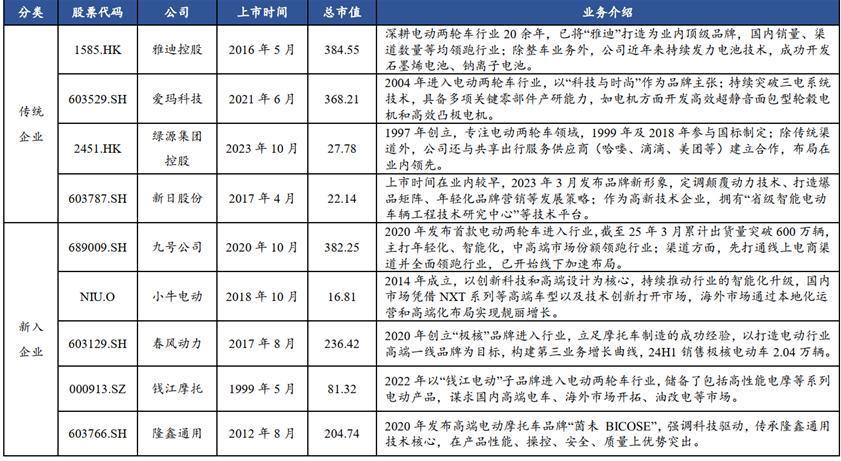
Figure: Electric two-wheeler companies; Source: Company announcements, Cinda Securities
As durable consumer goods, the total industry volume will inevitably decline after the new national standard and state subsidies, as experienced once in 2021. To prepare for this round of demand explosion, old brands have expanded massive capacity and laid out numerous stores. New brands, after enjoying the dividends of niche markets, are also starting to follow the traditional brand's old path of competing for scale.
The success of the outsider Ninebot has stimulated more new entrants, all wanting to share a piece of the pie. As demand is overdrafted, leading shares are instead challenged, the future ROE of the top may drop from over 20% to below 10%, continuing internal competition and deflation. For traditional brands and new forces, next year will be a year of close combat and fierce competition.
This article is based on public information and is for information exchange purposes only, not constituting any investment advice.
$Niu Tech (NIU.US) $AIMA(603529.SH) $YADEA(01585.HK)
The copyright of this article belongs to the original author/organization.
The views expressed herein are solely those of the author and do not reflect the stance of the platform. The content is intended for investment reference purposes only and shall not be considered as investment advice. Please contact us if you have any questions or suggestions regarding the content services provided by the platform.
