

 Total Assets
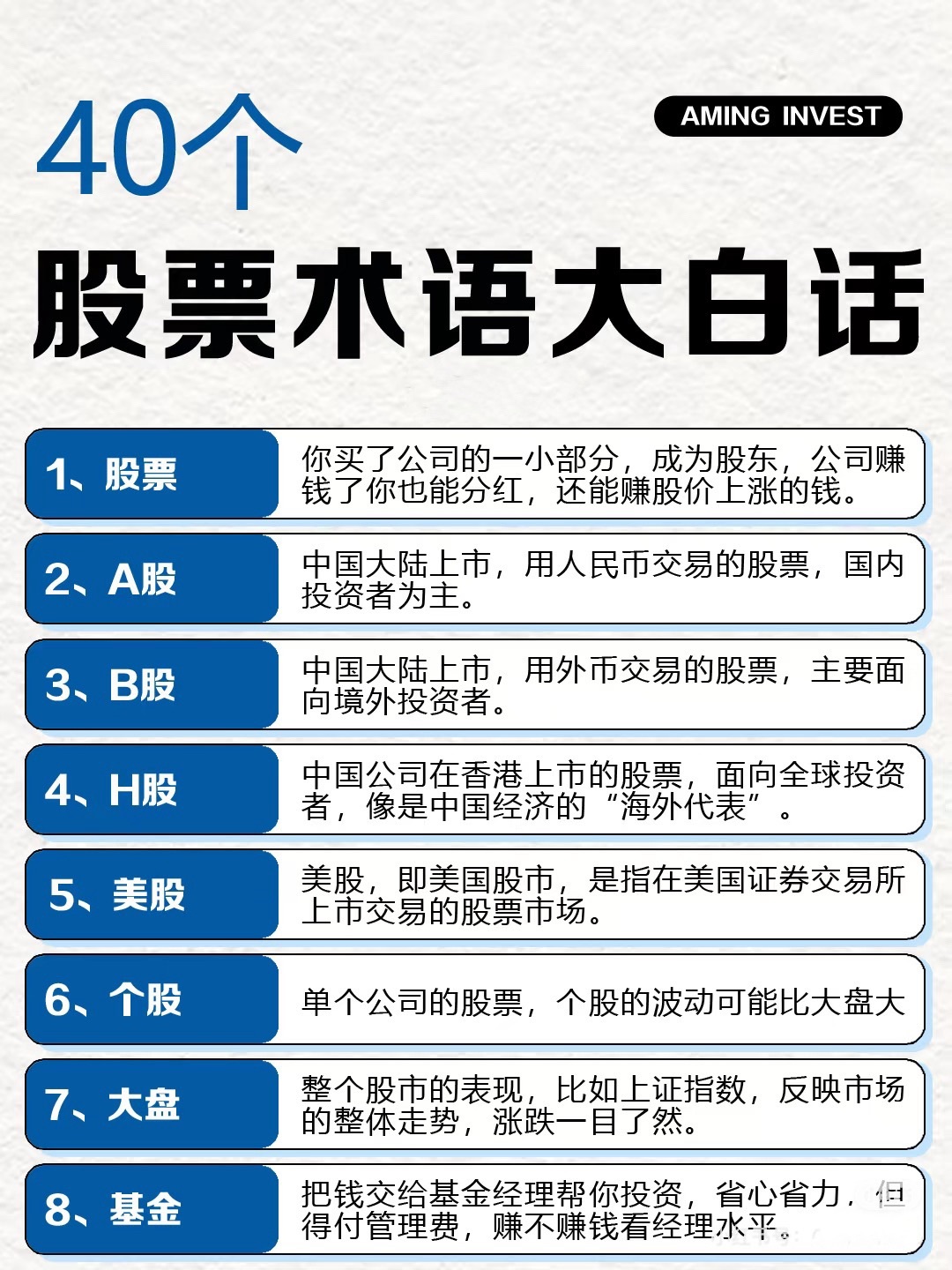
Fun and simple explanation~~~One sentence to instantly understand 40 stock terms

1. Plain talk about stocks: You buy a small part of a company, becoming a shareholder. When the company makes money, you can get dividends and also profit from the rise in stock price.
2. Plain talk about A-shares: Stocks listed in mainland China, traded in RMB, mainly for domestic investors.
3. Plain talk about B-shares: Stocks listed in mainland China, traded in foreign currency, mainly for overseas investors.
4. Plain talk about H-shares: Stocks of Chinese companies listed in Hong Kong, open to global investors, like an "overseas representative" of China's economy.
5. Plain talk about U.S. stocks: U.S. stocks refer to the stock market where stocks are listed and traded on U.S. exchanges.
6. Plain talk about individual stocks: The stock of a single company, which may fluctuate more than the broader market.
7. Plain talk about the broader market: The performance of the entire stock market, such as the Shanghai Composite Index, reflecting the overall market trend.
8. Plain talk about funds: Hand your money to a fund manager to invest for you, saving effort, but you pay management fees, and returns depend on the manager's skill.
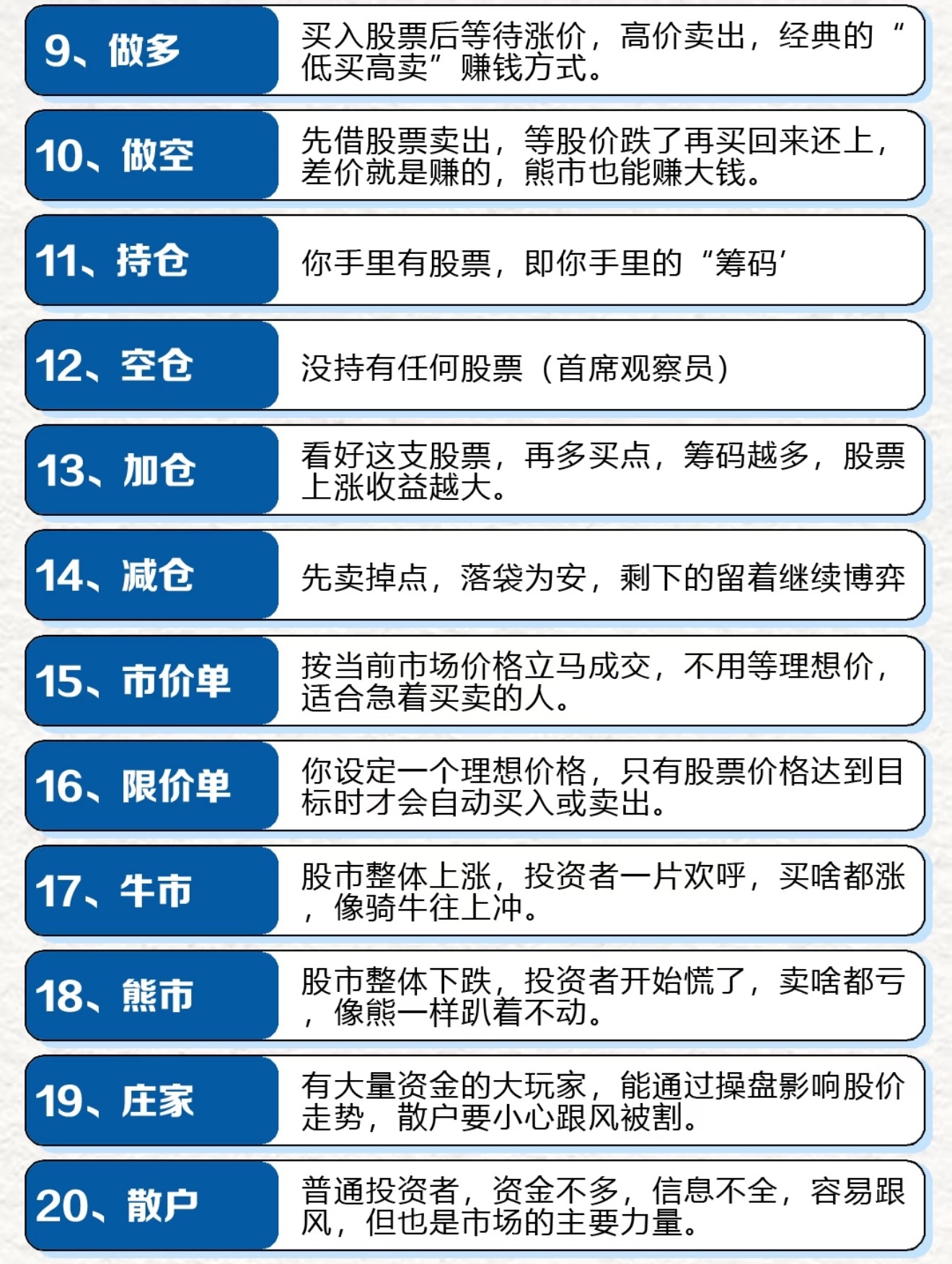
9. Plain talk about going long: Buy stocks and wait for the price to rise, then sell at a higher price—the classic "buy low, sell high" strategy.
10. Plain talk about short selling: Borrow stocks to sell first, then buy them back at a lower price to return, pocketing the difference—profiting even in a bear market.
11. Plain talk about holding positions: The stocks you currently own, your "chips."
12. Plain talk about empty positions: Not holding any stocks (Chief Observer).
13. Plain talk about adding to positions: Being bullish on a stock and buying more—the more chips you have, the greater the profit if the stock rises.
14. Plain talk about reducing positions: Selling some to lock in profits, keeping the rest for further play.
15. Plain talk about market orders: Execute immediately at the current market price, no need to wait for an ideal price—suitable for urgent trades.
16. Plain talk about limit orders: Set an ideal price, and the trade only executes when the stock reaches that target.
17. Plain talk about a bull market: The overall stock market rises, investors cheer, everything goes up—like riding a bull upward.
18. Plain talk about a bear market: The overall stock market falls, investors panic, everything loses value—like a bear lying low.
19. Plain talk about market makers: Big players with large capital who can influence stock prices—retail investors should be wary of following their moves.
20. Plain talk about retail investors: Ordinary investors with limited capital and information, prone to following trends, yet a major force in the market.
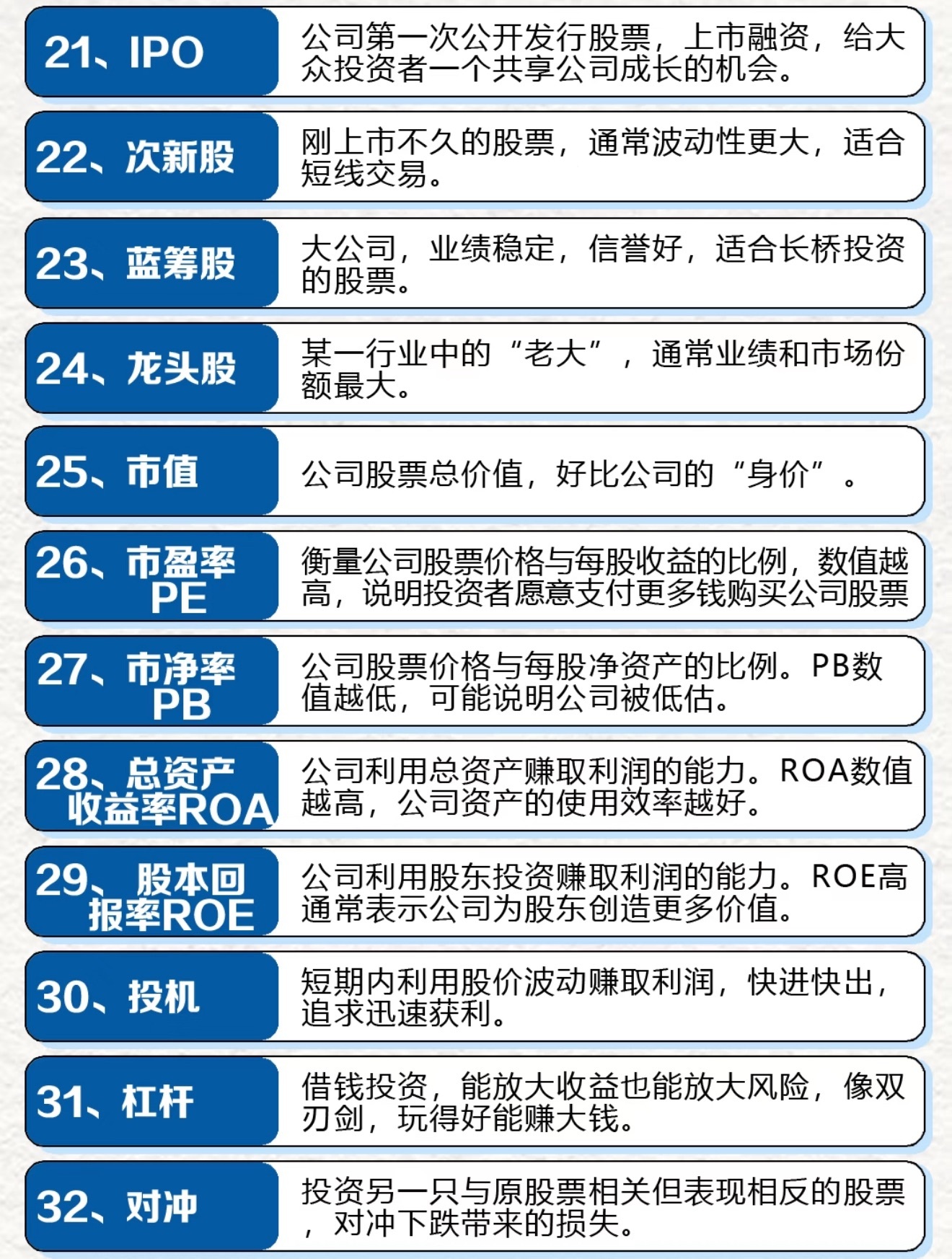
21. Plain talk about IPO: A company's first public offering of stock, raising capital and giving public investors a chance to share in its growth.
22. Plain talk about newly listed stocks: Stocks that have recently gone public, usually more volatile, suitable for short-term trading.
23. Plain talk about blue-chip stocks: Large, stable, reputable companies, suitable for long-term investment.
24. Plain talk about leading stocks: The "top dog" in an industry, usually with the best performance and market share.
25. Plain talk about market cap: The total value of a company's stock, like its "net worth."
26. Plain talk about P/E ratio: The ratio of stock price to earnings per share—higher values mean investors are willing to pay more for the stock.
27. Plain talk about P/B ratio: The ratio of stock price to net asset value per share—lower values may indicate the company is undervalued.$Alibaba(BABA.US) $Tesla(TSLA.US) $LI AUTO-W(02015.HK) $MEITUAN(03690.HK) $NVIDIA(NVDA.US) $Unitedhealth(UNH.US) $Faraday Future Intelligent Electric(FFAI.US) $C3.AI(AI.US)
The copyright of this article belongs to the original author/organization.
The views expressed herein are solely those of the author and do not reflect the stance of the platform. The content is intended for investment reference purposes only and shall not be considered as investment advice. Please contact us if you have any questions or suggestions regarding the content services provided by the platform.
