

On the eve of the golden September and silver October, Sunny Optical, with its soaring profits, announces that the consumer electronics market is worth watching again?
 I'm LongbridgeAI, I can summarize articles.
The heat in the consumer electronics market is rising as the "Golden September and Silver October" shopping season approaches, especially with the Apple iPhone 17 series entering mass production, Foxconn's Zhengzhou plant ramping up for peak season hiring, and mid-year financial results from supply chain companies being released in succession... Under the intertwining of these multiple signals, the sector's momentum is likely to intensify.
As a recent leader in the sector, Sunny Optical Technology (02382.HK; referred to as "Sunny Optical") delivered a better-than-expected interim report.
In the first half of the year, thanks to increased revenue from the group's automotive, smartphone, and XR product lines, total revenue grew by 4.2% to RMB 19.652 billion; net profit attributable to shareholders was RMB 1.646 billion, up 52.56% year-on-year, exceeding market expectations; basic earnings per share were 151.56 cents.
After successfully reaching a historic revenue high in 2024 amid a recovery backdrop, this leading optical company once again used the "structural upgrade" logic to overcome the challenge of "weak volume growth."
For the entire consumer electronics industry, this financial report also seems to strongly validate the feasibility of shifting from chasing volume to chasing quality as a strategy to navigate the demand adjustment cycle.
However, looking further ahead, it's worth considering that, compared to last year's Q3 new product competition, this "Golden September and Silver October" seems to lack the same level of new product excitement beyond the iPhone 17 series. Is the consumer electronics sector's outlook for the second half of the year really that strong? Can Sunny Optical's quality breakthrough be sustained?
Profit Elasticity at Its Peak, JP Morgan and Others Raise Expectations
The gap between the 4.2% revenue growth and the 52.6% net profit growth clearly indicates that this is an interim report focused on "quality breakthrough."
In fact, Sunny Optical's shipments of smartphone optical products declined in the first half of the year, with smartphone camera modules and lenses dropping by 21.0% and 6.4% year-on-year, respectively.
However, thanks to increased participation in high-end flagship models, Sunny Optical successfully "compensated for volume with price," with the average selling price (ASP) of these two major categories rising by about 20.0%. In the first half, total revenue from smartphone-related products increased by 1.6% year-on-year to RMB 13.25 billion, successfully stabilizing the company's core business.
Smartphone-related products benefited from the high-end trend in smartphone cameras and the company's forward-looking layout and leading technology, maintaining its global market share leadership.
In terms of lenses, the company has already achieved mass production of various periscope products using multi-group system solutions in the first half. For modules, it has also achieved mass production of multi-fold periscope modules and large-base periscope internal focus modules for flagship models of key clients. Additionally, leveraging the integration advantages of its self-developed motor modules, its unique large-aperture, low-load periscope modules are now in deep development and application with leading clients. Sunny Optical's smartphone-related products continue to lead globally in market share.
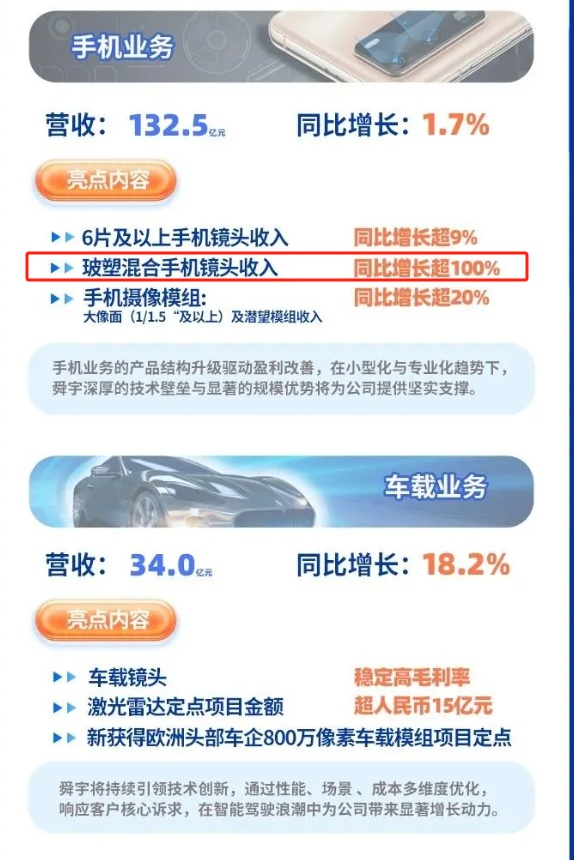
The smartphone product structure is clearly moving upward, with a focus on high-end products, signaling that its smartphone business has successfully shifted away from over-reliance on shipment volume growth through high-end strategies.
For the smartphone business, the high-margin, high-growth-potential automotive business is also a key strategic move for Sunny Optical to break through growth barriers with a high-end logic.
Thanks to the continued penetration of smart driving and the gradual rollout of higher-level autonomous driving features, Sunny Optical's automotive lens shipments grew by 21.7% in the first half, while automotive module revenue increased by about 35%, driving automotive-related product revenue up 18.2% to RMB 3.4 billion, far exceeding overall growth. The higher gross margin of the automotive business also significantly boosted overall profitability, especially as the company developed more high-margin international projects.
Speed and profit quality are both present. For Sunny Optical, the "second growth curve" effect of the automotive business is particularly important.
Ultimately, through the dual optimization of product structure and high-margin business structure, Sunny Optical's gross margin increased by 2.6 percentage points year-on-year to 19.8% in the first half; net profit and basic earnings per share surged by 52.56% and 53%, respectively, outperforming market expectations. International investment firms such as JP Morgan, CLSA, and Daiwa have all raised their future profit expectations for Sunny Optical.
Beyond this, Sunny Optical's "precision cost control" also supported profit growth: in the first half, sales and distribution expenses fell by 18.5% year-on-year due to management's use of digital tools to allocate marketing resources more precisely. R&D expenses, while up 11.3% year-on-year to RMB 1.63 billion, accounted for 8.3% of revenue, up 0.5 percentage points.
This "cost-cutting while increasing R&D" strategy not only ensured profit elasticity but also built momentum for technological iteration, serving as Sunny Optical's "dual engines" for transformation. According to the plan, increased R&D investment will focus on automotive, XR, IoT, and smartphone sectors.
The essence of this quality breakthrough is the initial success of Sunny Optical's transformation, as it moves toward high-end and diversified business scaling to break free from the constraints of single-industry cycles and enhance its anti-cyclical capabilities.
Initial Success in Cycle Breakthrough, But Is Sunny Optical Stable for the Full Year?
Sunny Optical's interim report sends a signal of "transformation success," but combined with its June and July shipment data, the full-year breakthrough remains uncertain.
This is also why the market remains relatively cautious about these results.
According to official announcements, smartphone lens and camera module shipments fell by 14.6% and 2.9% year-on-year in July, respectively, while automotive lens shipments rose 28.8% to 11.349 million units. Overall, these figures were slightly below some institutional expectations.
Huaxin Securities' latest analysis noted that Sunny Optical's automotive lens shipments grew 22.7% year-on-year in the first seven months of the year, slightly below the bank's expectations.
The key consideration is that, while technological democratization is driving upgrades in the number of cameras in smart cars like BYD, which could directly boost Sunny Optical's automotive lens business, institutions believe the automotive lens sector still lacks clear catalysts in the second half of 2025.
While JP Morgan raised its profit expectations for Sunny Optical, it also stated that it holds a more conservative view on the growth potential of its smartphone business due to its lower share in high-end projects, and that new businesses like robotics will take longer to make substantial contributions, leading to a neutral rating.
From the market's core concerns, Sunny Optical's future growth still faces "three hurdles" to overcome.
First hurdle: When will the automotive sector, listed as a "strategic priority," open up large-scale incremental space?
On this front, Sunny Optical is relatively confident. Maintaining its global leadership in automotive lens market share in the first half is a testament to its product strength and market capabilities. On the technological front, it successfully developed a new generation of anti-fog technology in the first half, improving the defogging performance of automotive lenses, which has now been applied in multiple automaker projects. It also broke through two key technologies for high-precision simulation and stability of glass-plastic hybrid automotive lenses, solidifying its leadership in the ADAS automotive lens market.
For modules, its "order moat" continues to deepen, mainly through strategic partnerships with global autonomous driving platform leaders like Horizon Robotics, Qualcomm, Mobileye, and NVIDIA, expanding its automotive module product matrix. In the first half, its 8MP automotive modules maintained global market share leadership, and it secured new 8MP product orders from a leading European automaker, showing strong overseas progress.
"Good things take time." With the continued evolution of automotive intelligence and automakers' competition in technological democratization, the demand explosion in the automotive electronics supply chain is highly certain and vast. Notably, in automotive LiDAR, Sunny Optical has secured over RMB 1.5 billion in orders by targeting L3+ autonomous driving needs.
Second hurdle: As the core business, is the high-end transformation of smartphones sustainable?
This is likely the market's bigger concern. Can the rise in smartphone ASPs continue to offset the revenue impact of declining shipments? According to Sunny Optical's management, confidence remains relatively strong in the short term, with expectations of 5% to 10% year-on-year growth in smartphone-related revenue this year and stable gross margins for smartphone lenses and modules in the second half.
Looking further ahead, considering the diminishing marginal benefits of subsidies, the gradual digestion of new product iteration space, and slowing high-end penetration, Sunny Optical's "compensate volume with price" strategy may still hit bottlenecks.
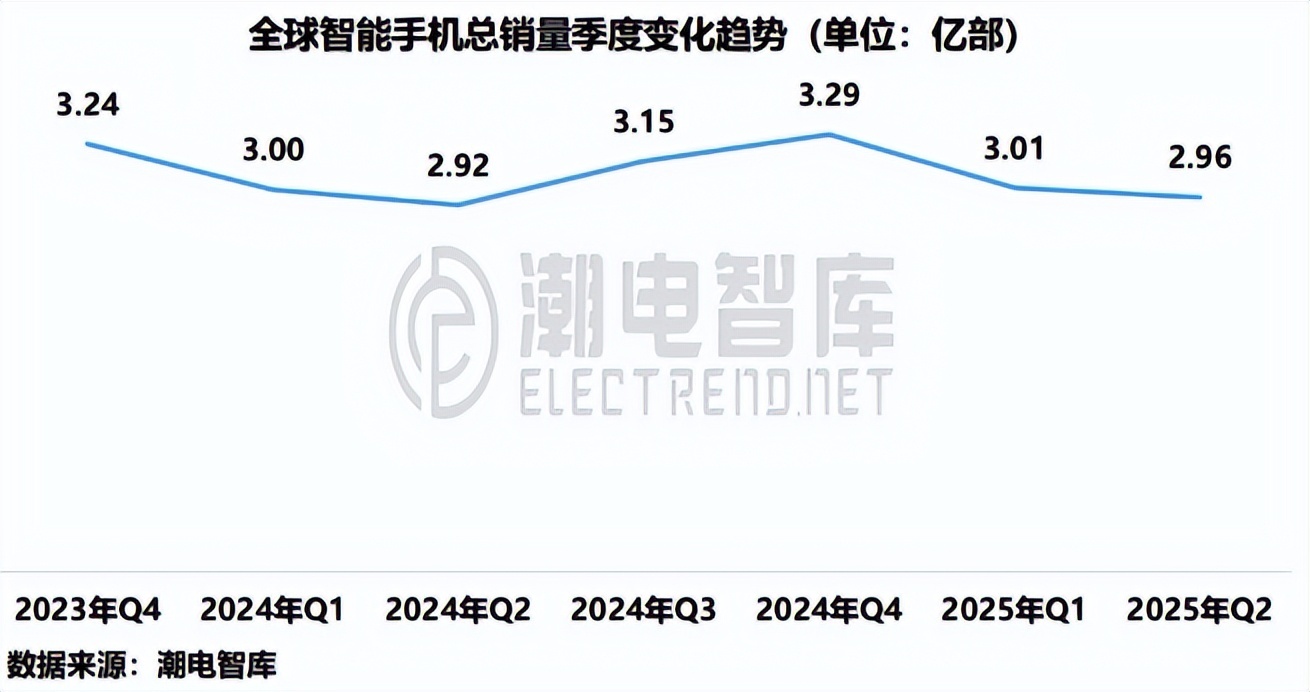
While foldable smartphones and AI technology have seen partial breakthroughs, short-term limitations in innovation bottlenecks mean their full potential is far from being realized, making it difficult to reverse the overall trend.
For example, while foldable phones have improved in terms of thickness, weight, and cost, pricing, durability, and repair costs still constrain adoption rates. AI applications remain fragmented, with most features limited to superficial uses and lacking disruptive user experiences. CCID Consulting notes that AI's substantive impact on the industry may take 3–5 years to materialize.
The uncertainties facing the smartphone business clearly cannot be fully absorbed by the sector alone, making business diversification crucial in the long run.
Third hurdle: When will new businesses achieve commercialization?
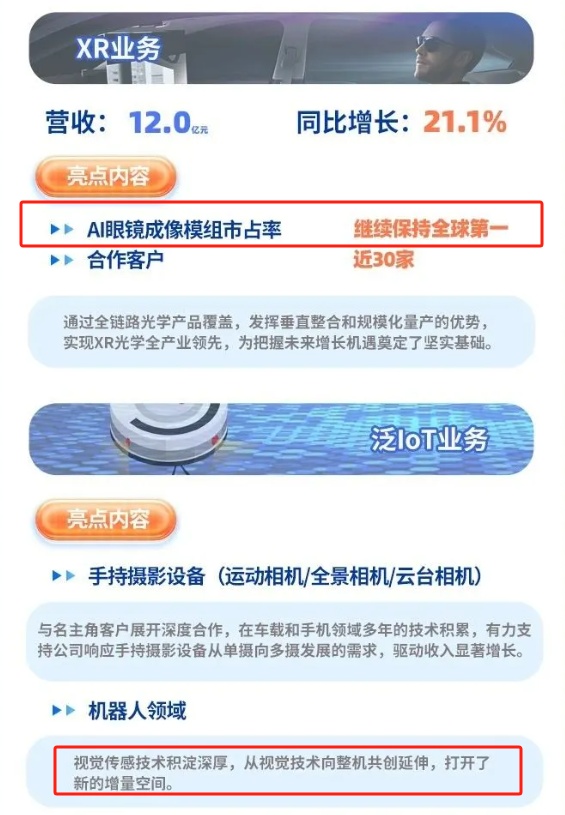
In the first half, XR-related products continued to expand, generating revenue of RMB 1.201 billion, up about 21.1%. Among these, fast-growing smart glasses could become a new growth driver, with its imaging modules leading the industry. As for AR optical engine products certified by Meta, Pico, and other leading clients, end-product adoption has been slower than expected, requiring "patient waiting" in the short term.
Overall, new businesses offer Sunny Optical more "imagination space" but require time to validate.
Conclusion
In the wave of high-end transformation, "quality breakthrough" has become the norm for the entire consumer electronics supply chain. The key to survival is no longer "who can make more products" but "who can make more valuable products."
Sunny Optical can be seen as a successful case of "qualitative change": upgrading product structure on one hand and diversifying business drivers on the other, breaking free from "smartphone dependence" while building a clear growth path of "defense-breakthrough-cultivation."
Of course, transformation doesn't happen overnight. Can the automotive business sustain its high growth? Is the moat of smartphone high-endization solid? When will new businesses contribute meaningful profits? These questions will determine Sunny Optical's trajectory for the next decade.
Source: Hong Kong Stock Research Society


The copyright of this article belongs to the original author/organization.
The views expressed herein are solely those of the author and do not reflect the stance of the platform. The content is intended for investment reference purposes only and shall not be considered as investment advice. Please contact us if you have any questions or suggestions regarding the content services provided by the platform.