



Mingming is busy sprinting towards the Hong Kong stock market. After 20,000 stores, the story has just reached a critical point.

While the capital market is still debating whether "consumption recovery has arrived," the bulk snack sector has already provided an answer: it's not that there's no demand, but that profits have been squeezed to the limit.
Recently, Mingming Henmang completed its overseas listing filing, just one step away from ringing the bell at the Hong Kong Stock Exchange. This snack chain giant, formed by the merger of "Snack Henmang" and "Zhao Yiming Snacks," has over 20,000 stores and a GMV exceeding 40 billion yuan in the first half of the year, widely regarded as the strongest contender for the title of "the first bulk snack stock on the Hong Kong Stock Exchange."
But in the eyes of the capital market, Mingming Henmang's significance has never been limited to "being the largest." It is more like an industry proposition laid bare: can a retail giant built on extremely low gross margins, high turnover, and franchise expansion truly possess the ability to be priced by capital in the long term?
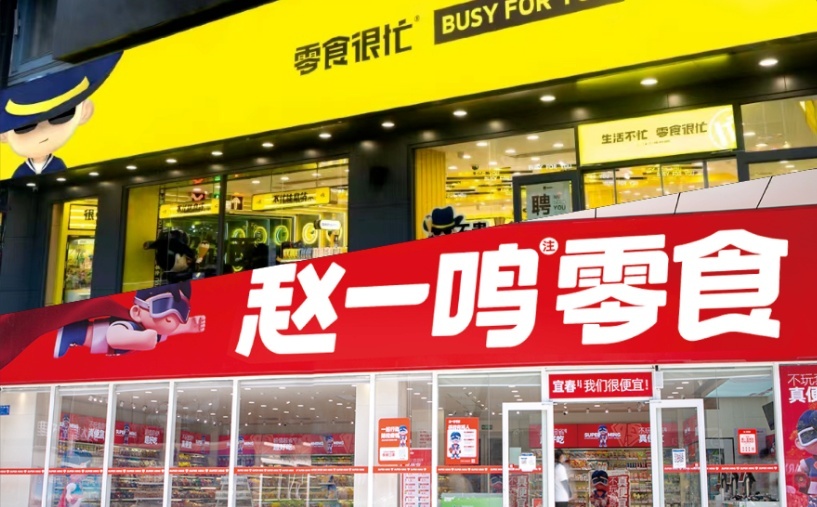
Scale is the first foundation: Mingming Henmang ascends the throne with "extreme efficiency"
In terms of store count, Mingming Henmang's rise can almost be described as "wild growth." As of September 2025, its stores have covered 28 provinces across the country, totaling over 20,000, far surpassing regional snack chain brands and creating a clear head effect.
But this is not a story of expansion solely reliant on franchise fission. The real turning point came after the merger of Snack Henmang and Zhao Yiming Snacks. This merger was essentially an industry-level "de-internal competition," rapidly raising the industry's entry barriers through scale integration, supply chain synergy, and brand concentration, leaving little room for small and medium players to survive.
What Mingming Henmang truly bet on was not the consumption upgrade in first-tier cities but the long-underestimated lower-tier markets. About 58% of its stores are located in counties and towns, where rental costs are low, consumption frequency is high, brand choices are limited, and price sensitivity is extreme—yet there is a stable demand for snacks.
This makes bulk snacks a "necessity-like discretionary consumption," and Mingming Henmang happens to be the first player to successfully execute this model.
In lower-tier markets, brands don't need to tell too many stories; price and turnover are the only language. Mingming Henmang's gross margin has always remained in the single-digit range of 7.5%–9.3%, seemingly thin but resulting in extreme operational efficiency.
Its inventory turnover days are only 11.7, below the industry average. This means goods hardly sit in warehouses, capital circulates rapidly, and store cash flow remains positive.
And the data speaks for itself. In 2024, Mingming Henmang's GMV reached 55.5 billion yuan; in the first half of 2025, its GMV climbed to 41.1 billion yuan, a year-on-year increase of 86.9%. During the same period, the company achieved revenue of 28.124 billion yuan and adjusted net profit of 1.034 billion yuan. This profit was not earned through high premiums but was the result of scale, speed, and supply chain pressure.
More critically, Mingming Henmang is not a "retailer" in the traditional sense but more like a highly digitized food wholesaler. The company uses big data and algorithmic models to participate in product selection and ordering, introducing several new SKUs every month to continuously stimulate repurchases and reduce the lifecycle risk of individual products.
This model is particularly effective in price-sensitive markets and also forms its core appeal to franchisees.
From this perspective, Mingming Henmang is not "selling snacks" but operating an extremely low-margin, highly efficient commodity circulation system. This is the fundamental reason it was able to clear the industry in a short time and secure the top spot.
Capital starts calculating another equation: Can the low-margin myth withstand scrutiny on the Hong Kong Stock Exchange?
Mingming Henmang's success today is almost entirely built on the logic of "scale first," But when the company truly enters the capital market, the rules have quietly changed.
The prospectus reveals that 99.5% of Mingming Henmang's revenue comes from supplying franchisees, and its business model is essentially a combination of "B2B wholesale + franchise expansion." This model is highly explosive during the expansion phase but also inherently carries risks: when store density becomes too high and incremental markets slow down, internal competition will emerge first.
In many county markets, overlapping stores of the same Mingming Henmang brand have already appeared, diluting customer traffic and prolonging franchisees' payback periods.
Clearly, scale does not only bring synergy but sometimes also means internal friction. At the same time, as store numbers rapidly expand, food quality and service consistency are also under pressure.
A more practical issue is that Mingming Henmang does not make money easily. Single-digit gross margins mean the company has almost no room for error. Fluctuations in logistics costs, raw material prices, or labor expenses will directly erode profits.
Such a profit structure may be acceptable at the operational level, but in the capital market, it is often labeled as "insufficient profit elasticity."
Meanwhile, industry competition is entering a phase of direct capital confrontation. "Hao Xiang Lai," under the Wanchen Group, also has a scale of 10,000 stores and has initiated the process of listing on the Hong Kong Stock Exchange. The confrontation between the two leading players is escalating from store wars and price wars to a contest of capital endurance and supply chain depth.
Moreover, what the capital market truly cares about is not whether thousands more stores can be opened but other sharper questions: Is the single-store model healthy? Are franchisees consistently profitable? Can supply chain efficiency continue to compress costs? And can the low-price advantage truly translate into long-term profitability?
This is also the collective test the bulk snack industry is about to face. Store count is no longer the most important metric; capital is more willing to pay for stable cash flow and predictable profits. This means Mingming Henmang will eventually have to make clearer trade-offs between scale and profit.
Conclusion
Mingming Henmang's success today is not because it told a new story right but because it took an old logic to the extreme: trading the lowest gross profit for the fastest turnover and the widest coverage.
But what the capital market cares about is no longer "extreme efficiency" itself but whether this efficiency is sustainable. When store expansion nears its ceiling and franchisee profits are repeatedly squeezed, scale no longer automatically equals a cushion. The real watershed lies in whether the company can evolve from selling goods to making the entire system profitable in the long run.
The copyright of this article belongs to the original author/organization.
The views expressed herein are solely those of the author and do not reflect the stance of the platform. The content is intended for investment reference purposes only and shall not be considered as investment advice. Please contact us if you have any questions or suggestions regarding the content services provided by the platform.
