
3.228 billion to 4.107 billion: Morphine sulfate sees a steady 3.5% growth, solidifying its role as the "rigid demand cornerstone" of global analgesics
 I'm LongbridgeAI, I can summarize articles.
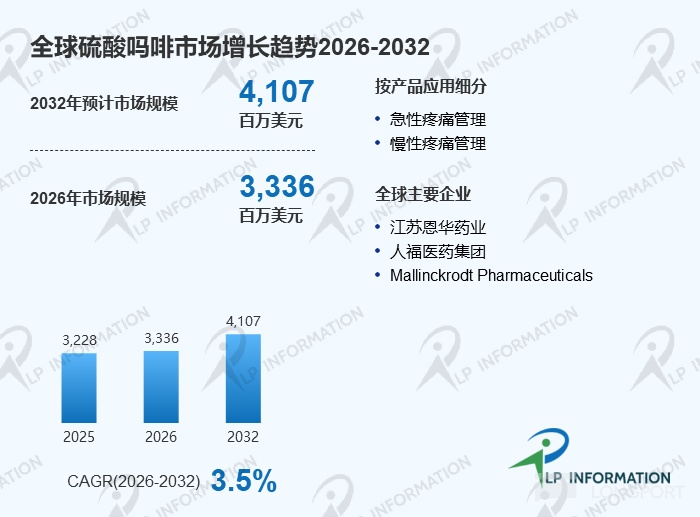
According to market research data from LP Information, the global morphine sulfate market size was approximately $3.228 billion in 2025 and is projected to reach $4.107 billion by 2032, with a compound annual growth rate (CAGR) of approximately 3.5% during the 2026-2032 period. In 2025, the global production volume of morphine sulfate was approximately 11 billion vials, with a global capacity of about 12 billion vials. The average market price was approximately $0.30 per vial, and the industry's comprehensive gross profit margin was around 45%.
Morphine Sulfate is an important pharmaceutical-grade opioid analgesic, primarily prepared by reacting morphine base with sulfuric acid to form a sulfate salt. It is widely used in the treatment of moderate to severe pain, including cancer pain, postoperative pain, trauma pain, intensive care, and palliative care scenarios. Due to its clear analgesic effects and long history of clinical application, morphine sulfate has long been one of the foundational drugs in the global pain management system.
In recent years, with the accelerating trend of global population aging, an increase in the number of cancer patients, growth in surgical procedures, and expansion of the chronic pain patient population, the demand for efficient analgesic drugs within the healthcare system has continued to rise. Simultaneously, improvements in global medical standards and the gradual perfection of pain treatment systems in developing countries have also driven steady growth in the morphine sulfate market.
However, due to the dependency and abuse risks associated with opioids, countries continue to strengthen regulation over production, distribution, prescription, and usage. The industry's development features a parallel trend of "growing medical demand + strict compliance management."
I. Industry Chain Analysis: A Highly Regulated System from Raw Material Supply to Terminal Healthcare
The morphine sulfate industry chain exhibits distinct pharmaceutical regulatory attributes, mainly comprising three stages: upstream raw material supply, midstream manufacturing, and downstream medical application.
The upstream stage mainly includes legal poppy cultivation, opium alkaloid extraction, morphine base purification, and the supply of medicinal excipients and packaging materials. Among these, poppy cultivation is strictly licensed by governments worldwide, concentrated mainly in countries and regions with legal medicinal poppy production systems. Raw material supply is influenced not only by agricultural conditions but also constrained by international narcotic drug management systems, making supply chain stability a key factor in corporate competition.
The midstream stage mainly involves the production of morphine sulfate active pharmaceutical ingredients (APIs), formulation development, and quality control. Enterprises must possess GMP-compliant production facilities and meet requirements such as sterile production, impurity control, stability studies, and batch tracking. Product forms mainly include injectables, regular tablets, sustained-release tablets, capsules, and oral solutions, with different dosage forms corresponding to different clinical application needs.
The downstream stage primarily enters hospitals, medical institutions, palliative care centers, specialized clinics, and some retail pharmacies through pharmaceutical commercial channels. Since morphine sulfate is a strictly regulated drug, its sales model differs significantly from ordinary drugs, typically requiring prescription management, inventory supervision, and flow tracking systems.
II. Production Side Analysis: High-Quality Manufacturing and Compliance Capabilities Become Core Competitiveness
From the production side, the morphine sulfate manufacturing industry has a high barrier to entry. On one hand, enterprises need to obtain relevant narcotic drug production qualifications and establish strict systems for raw material procurement, production control, and sales management; on the other hand, they must continuously invest in quality management system construction to meet regulatory requirements in different countries and regions.
Currently, global morphine sulfate production mainly consists of two models: API manufacturers and formulation companies. Some enterprises possess integrated capabilities from opium alkaloid extraction to final formulation production, allowing for better control over raw material supply and production costs; others focus on formulation development, producing injectables, oral agents, and sustained-release formulations by purchasing compliant APIs.
With changes in clinical demands, the production side is moving towards higher safety, higher stability, and differentiated dosage forms. For example, sustained-release morphine sulfate products can reduce dosing frequency, improving convenience for chronic pain patients; abuse-deterrent technologies and intelligent packaging solutions are also gradually becoming important development directions in certain markets.
III. Consumption Level Analysis: Cancer Pain and Aging Drive Medical Demand Growth
In terms of consumption demand, morphine sulfate is mainly applied in hospitals and professional medical institutions rather than the general consumer market. Its demand growth mainly comes from the increasing numbers of cancer patients, post-operative recovery patients, critically ill patients, and chronic pain patients.
Global population aging is becoming an important factor driving the growth of pain treatment demand. The elderly population is more prone to bone and joint diseases, cancer, and chronic disease-related pain, thus continuously increasing the demand for long-term pain management.
Furthermore, with the advancement of global palliative care system construction, more countries are beginning to focus on improving the quality of life for patients with late-stage diseases, leading to a gradual increase in the demand for standardized analgesic treatment. Especially in some developing countries, as medical resource coverage improves, previously unmet pain treatment needs are being gradually released.
At the same time, mature markets such as Europe and the US pay more attention to safe medication use. Through prescription monitoring, doctor training, and patient education, they aim to increase the proportion of medical use of opioids while reducing non-medical usage risks.
IV. Market Competitive Landscape Analysis: International Pharma Giants Hold Advantages, Local Enterprises Accelerate Layout
The global morphine sulfate market overall presents a highly concentrated competitive landscape, with major participants including Mallinckrodt Pharmaceuticals, Hikma Pharmaceuticals, Viatris, Pfizer, Fresenius Kabi, Teva Pharmaceutical, Sun Pharmaceutical, and other international pharmaceutical companies.
International enterprises hold significant positions in European and American markets, relying on mature opioid supply chains, global registration systems, hospital channels, and brand influence. In the injectable field, where technical requirements are high and regulations are strict, enterprises with large-scale production capabilities have obvious advantages.
In the Chinese market, companies such as Jiangsu Enhua Pharmaceutical and Humanwell Healthcare Group are actively laying out in the field of narcotic analgesics. By perfecting their product systems and enhancing production capabilities, they are strengthening their competitiveness in the domestic medical market.
In the future, market competition will not only focus on product supply capabilities but also manifest in compliance system construction, supply chain security, dosage form innovation, and global market access capabilities.
V. Regional Market Analysis: Mature Markets in Europe and the US Remain Stable, Emerging Asian Markets Show Promising Growth Potential
Regionally, North America and Europe remain the primary consumption markets for global morphine sulfate. The United States possesses a relatively complete pain management system and a large medical market scale. However, affected by the opioid crisis in recent years, regulatory policies have continued to tighten, placing higher demands on prescription and sales management.
The European market places greater emphasis on standardized pain treatment and medical accessibility. Many countries have improved the drug acquisition capabilities for cancer patients and chronic pain patients by perfecting their palliative care systems.
The Asia-Pacific region has become an area with significant future growth potential. With improvements in medical infrastructure, accelerated population aging, and increased awareness of pain treatment in China, Japan, India, and Southeast Asian countries, the demand for standardized analgesic drugs like morphine sulfate continues to grow.
Some parts of the Middle East and Africa currently have relatively small market scales. However, with the advancement of healthcare system construction and the promotion of basic medical drug supplies by international organizations, there is certain room for future growth.
VI. Analysis of Main Industry Drivers: Rising Medical Demand and Changing Treatment Concepts Drive Market Development
First, the increasing number of global chronic pain and cancer pain patients provides a long-term demand foundation for morphine sulfate. As cancer treatment levels improve and patient survival periods extend, the importance of pain management is further enhanced.
Second, the continuous increase in global surgery numbers also drives short-term analgesic demand growth. Surgical procedures, trauma treatment, and critical care all require effective analgesic solutions.
Third, the development of palliative care and hospice systems further expands market space. More healthcare systems are beginning to focus on patients' quality of life, with standardized opioid analgesic treatment becoming an important component.
Additionally, new dosage form development, abuse-deterrent technologies, and precise pain management concepts bring new development opportunities for the industry.
VII. Analysis of Market Restrictive Factors: Regulatory Pressure and Supply Chain Management Remain Main Challenges
The biggest challenge facing the morphine sulfate market comes from the strict regulatory environment. Due to the dependency risks of opioids, governments worldwide continue to strengthen production licensing, import/export management, prescription review, and circulation monitoring.
Secondly, raw material supply faces certain limitations. Medicinal poppy cultivation is constrained by international regulations, and high supply concentration may affect the stability of raw materials in some regions.
Third, public concern regarding the risks of opioids may also affect doctors' willingness to prescribe in some markets. Furthermore, significant differences in healthcare systems between different countries lead to obvious disparities in drug accessibility.
Enterprises need to address long-term industry challenges by improving compliance management, strengthening supply chain tracking, and enhancing safe medication use systems.
VIII. Industry Development Prospects Analysis: Safety, Standardization, and Precision Become Future Trends
In the future, the morphine sulfate industry will develop around three directions.
First, continuous optimization of product structure. Sustained-release preparations, controlled-release preparations, and safer administration methods will receive more attention to meet long-term pain management needs.
Second, increased digitalization of the supply chain. Enterprises will strengthen raw material tracking, production management, inventory control, and drug flow supervision to improve overall supply chain transparency.
Third, improved global medical accessibility will create new growth spaces. As healthcare systems in developing countries improve, the demand for standardized pain treatment will be gradually released.
Overall, the morphine sulfate market belongs to a mature pharmaceutical niche sector with relatively stable growth rates, but its foundational position in the pain management system remains irreplaceable. In the future, enterprises possessing compliant production capabilities, stable supply chain systems, and innovative dosage form R&D capabilities will maintain advantages in global market competition.


The copyright of this article belongs to the original author/organization.
The views expressed herein are solely those of the author and do not reflect the stance of the platform. The content is intended for investment reference purposes only and shall not be considered as investment advice. Please contact us if you have any questions or suggestions regarding the content services provided by the platform.