
Occupational Health and Safety "Heat Environment Sentinel": WBGT Index CAGR of 6.3%, Domestic Sensors and System Integration Welcome Development Opportunities
 I'm LongbridgeAI, I can summarize articles.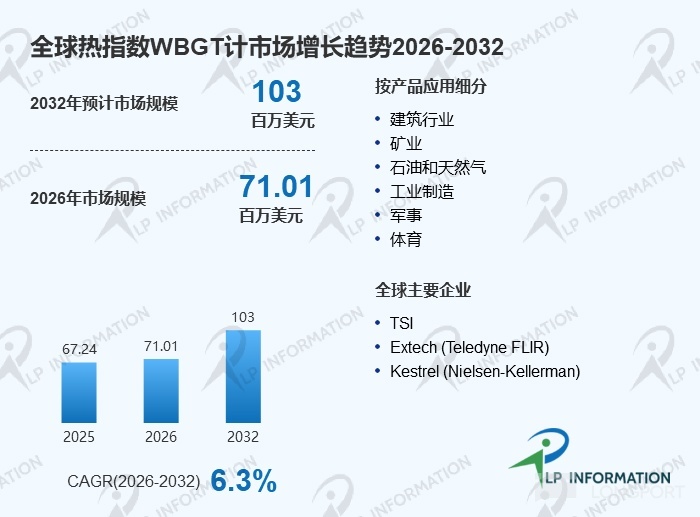
According to market research data from LP Information, the global Wet Bulb Globe Temperature (WBGT) meter market size was approximately $67.24 million in 2025 and is projected to reach $103 million by 2032, with a Compound Annual Growth Rate (CAGR) of approximately 6.3% during the 2026-2032 period. In 2025, the global shipment volume of WBGT meters was approximately 285,000 units, with an average market price of about $241 per unit, and the industry's overall gross margin was approximately 25%-35%.
A WBGT meter (Wet Bulb Globe Temperature Meter) is a professional monitoring device used to assess the risk of human heat load in high-temperature environments. By collecting environmental parameters such as dry-bulb temperature, natural wet-bulb temperature, black globe temperature, humidity, wind speed, and radiant heat, and combining them with the WBGT algorithm to calculate comprehensive heat stress indices, it determines the likelihood of personnel experiencing heat fatigue, heatstroke, and other heat-related health risks in high-temperature environments.
Compared to traditional temperature and humidity detection equipment, WBGT meters focus more on actual human heat exposure levels. They not only provide environmental parameter monitoring but also feature risk level assessment, over-limit alarms, data storage, wireless transmission, and connectivity to safety management platforms. Currently, this type of equipment is widely used in construction, mining, oil and gas, power facilities, industrial manufacturing, agriculture, sports training, military training, fire rescue, and public health management.
With the increasing frequency of extreme high-temperature weather globally and the continuous improvement of occupational safety regulatory systems in various countries, high-temperature operation risk management is shifting from traditional experience-based judgment to digital monitoring. Enterprises' demand for real-time grasp of employee heat exposure risks, reduction of occupational injury accidents, and compliance with EHS (Environment, Health, and Safety) management requirements continues to rise, providing long-term growth space for the WBGT meter market.
I. Industry Chain Analysis: Sensors, Algorithms, and Data Platforms Form the Core Competitive System
The WBGT meter industry chain mainly includes three links: upstream core component supply, midstream equipment manufacturing, and downstream application services.
The upstream mainly includes temperature and humidity sensors, black globe temperature sensors, natural wet-bulb components, wind speed sensors, microcontrollers (MCU), signal processing chips, batteries, power modules, wireless communication modules, and protective shell materials. Among these, sensor accuracy directly determines the reliability of equipment measurement, especially the collection capabilities of black globe temperature and wet-bulb temperature, which are key factors affecting the accuracy of WBGT calculations. International suppliers such as Sensirion, Bosch Sensortec, Vaisala, STMicroelectronics, and Texas Instruments have strong technical accumulation in the fields of environmental sensing and electronic components.
The midstream mainly consists of WBGT meter equipment manufacturers. Enterprises need to complete sensor integration, hardware design, algorithm development, calibration testing, protection level design, and software system development. Since WBGT meters involve occupational safety applications, they have high requirements for measurement accuracy, environmental adaptability, and long-term stability. Therefore, enterprises must not only possess hardware manufacturing capabilities but also establish a comprehensive calibration system and quality control process.
Downstream applications mainly include industrial enterprises, government agencies, safety regulatory departments, sports institutions, and professional service agencies. Among them, the construction, mining, manufacturing, and energy industries are currently the largest commercial application areas. Enterprises usually conduct real-time risk assessments in high-temperature operation areas by purchasing portable WBGT meters or deploying fixed monitoring systems.
In the future, industry chain competition will gradually shift from simple equipment manufacturing towards comprehensive solutions of "sensors + algorithms + software platforms + data services." Enterprises capable of providing a complete heat risk management system will gain a competitive advantage in the market.
II. Consumer Market Analysis: Industrial Safety Demand Becomes the Main Purchasing Force
From the consumer side, the WBGT meter market is driven mainly by enterprise customers and public institution customers, with the industrial sector accounting for a large proportion.
The construction industry is one of the important application markets. With the expansion of global construction project scales and increased working hours in open-air and high-temperature environments, construction enterprises need to formulate reasonable work-rest systems through WBGT monitoring to reduce the risk of worker heatstroke. Meanwhile, in large infrastructure construction projects, real-time heat risk monitoring has gradually become an important part of the safety management system.
The mining, oil and gas, power, and manufacturing industries also have high demand. These industries often present scenarios such as high-temperature equipment, confined spaces, and continuous outdoor operations, where employees are exposed to heat environments for long periods. Therefore, enterprises pay more attention to continuous monitoring, automatic alarms, and historical data traceability functions.
The sports training and military fields focus more on assessing personnel's ability to adapt to extreme environments. For example, when conducting training or sporting events in high-temperature regions, WBGT indicators have become an important reference for determining training intensity and rest arrangements.
With the enhancement of corporate safety awareness, procurement demand is shifting from single handheld detection devices to fixed monitoring networks, wireless data management systems, and cloud security platforms, further driving up market value.
III. Production Side Analysis: Europe and America Lead in Technology, Asia's Manufacturing Capacity Rises Rapidly
Global WBGT meter production enterprises are mainly concentrated in North America, Japan, Europe, and some parts of Asia.
The North American market possesses a relatively mature occupational safety system and is one of the important global consumption regions. US enterprises applied WBGT indicators to industrial safety management, military training, and occupational hygiene fields earlier. Companies like TSI, Kestrel, and Extech have strong influence in the professional measuring instrument market.
The European market places greater emphasis on occupational health regulations and industrial environmental monitoring. Enterprise products usually emphasize high-precision measurement, long-term data recording, and integration with industrial safety management systems. For instance, some European manufacturers have launched heat environment management solutions suitable for continuous monitoring at industrial sites.
The Japanese market, driven by high-temperature protection regulations, manufacturing safety management, and school sports safety needs, has formed a relatively complete industrial system for heat environment measurement equipment. Japanese enterprises have competitive advantages in miniaturization, high reliability, and portable equipment.
Other Asian regions, especially Taiwan, China, and mainland China, have developed rapidly in portable instruments, OEM manufacturing, and cost control, leveraging their electronic manufacturing industry chain advantages. In the future, Asian enterprises are expected to increase their global market share through price advantages, localized services, and intelligent features.
IV. Market Driver Analysis: Climate Change and Safety Regulation Drive Demand Growth
First, global climate change leading to an increased frequency of high-temperature weather is an important factor driving the development of the WBGT meter market. In recent years, many regions have experienced sustained high temperatures, exposing outdoor workers and industrial staff to higher heat risks, thereby increasing enterprises' demand for scientific heat management tools.
Second, stricter occupational health and safety regulations drive increased enterprise procurement demand. Europe, America, Japan, and some emerging markets continuously improve high-temperature operation protection standards, requiring enterprises to adopt risk assessments, work adjustments, and employee protection measures. WBGT monitoring equipment has become an important technical tool.
Third, industrial digital upgrades promote the intelligent development of products. Traditional manual inspection methods suffer from insufficient data continuity and delayed risk discovery. Digital WBGT meters can achieve real-time monitoring and early warning through wireless communication, cloud platforms, and data analysis.
Additionally, sports event safety management, military training environment assessment, and public health management needs are becoming new growth areas.
V. Market Restriction Analysis: Cost, Standard Differences, and Technical Requirements Constrain Promotion
Although the market prospect is good, the development of WBGT meters still faces certain challenges.
First, equipment costs limit the procurement of some small and medium-sized enterprises. Compared to ordinary temperature and humidity instruments, WBGT meters require more high-precision sensors and algorithm support, resulting in higher prices. This creates certain procurement pressure for small enterprises with limited budgets.
Second, there are differences in high-temperature risk assessment standards among different countries and regions. Some markets adopt different occupational safety norms, leading enterprises to adjust product certifications and software algorithms for different regions.
Third, user awareness still needs to be improved. Some enterprises are still accustomed to using air temperature as the judgment standard and do not fully recognize the importance of comprehensive heat load indices. Market acceptance needs to be improved through industry promotion and safety training.
Furthermore, long-term sensor stability, on-site calibration maintenance, and adaptability to complex environments are issues that enterprises need to solve to further enhance product competitiveness.
VI. Emerging Trend Analysis: Intelligence, Networking, and Wearability Become Development Directions
The WBGT meter of the future will present three major development trends.
First, the trend towards intelligent networking is obvious. Traditional handheld devices will gradually develop towards wireless transmission, cloud management, and intelligent alarms, achieving heat risk management across multiple areas, personnel, and time nodes.
Second, the application of wearable devices is increasing. With the 精细化 (refinement) of personnel safety management, lightweight, low-power wearable heat risk monitoring devices are expected to be applied in mining, fire fighting, military, and outdoor construction fields.
Third, the integration of artificial intelligence and data analysis technology is accelerating. Future devices will not only monitor the environment but also combine personnel activity intensity, working hours, and historical data to predict and analyze heat risks, enhancing the proactiveness of safety management.
VII. Regional Market Analysis: North America Leads, Asia-Pacific Has Prominent Growth Potential
From a regional market perspective, North America remains an important global market for WBGT meters, mainly driven by the perfection of occupational safety regulations, large industrial base scale, and high-temperature risk management needs.
The Asia-Pacific region has significant future growth potential. The rapid development of manufacturing, construction, and energy industries in China, India, Southeast Asia, and other regions, coupled with frequent high-temperature weather in some areas, has increased enterprises' demand for occupational health and safety equipment.
The European market focuses more on industrial safety standards, environmental policies, and the construction of intelligent monitoring systems, with product demands trending towards high-end and systematic directions.
The Middle East and Africa regions, due to hot climates and increased energy and infrastructure construction activities, will also become potential growth areas in the future.
VIII. Industry Development Prospect Analysis: Upgrading from Detection Tools to Heat Risk Management Platforms
Overall, the global WBGT meter market is in a steady growth stage. With the increase in extreme high-temperature events, the improvement of occupational safety regulations, and the rising demand for enterprise digital management, WBGT meters will gradually evolve from single environmental detection devices into comprehensive heat risk management systems.
The focus of future market competition will concentrate on measurement accuracy, smart connectivity capabilities, data analysis capabilities, and industry solution capabilities. Enterprises possessing sensor technology accumulation, software platform capabilities, and industry service experience will find it easier to obtain long-term competitive advantages.
As the demand for heat risk management in construction, industrial manufacturing, energy, sports, and public safety fields continues to rise, WBGT meters will play an increasingly important role in global occupational health and safety management systems.
Main companies include:
TSI, Extech (Teledyne FLIR), Kestrel (Nielsen-Kellerman), Kyoto Electronics Manufacturing, SATO KEIRYOKI MFG, LSI LASTEM, A&D Company, SIBATA SCIENTIFIC TECHNOLOGY, Senseca Italy Srl, REED Instruments, PCE Instruments, TES Electronic, Sper Scientific Instruments, General Tools & Instruments, Scarlet Tech, Hengxin AZ, Lu Chang Electronics, Triplett Test Equipment & Tools, Shiji Jiantong, etc.


The copyright of this article belongs to the original author/organization.
The views expressed herein are solely those of the author and do not reflect the stance of the platform. The content is intended for investment reference purposes only and shall not be considered as investment advice. Please contact us if you have any questions or suggestions regarding the content services provided by the platform.