

From selling drum machines to selling equipment online rates, Jiaxuan Intelligence's growth boundary is expanding outward.
 I'm LongbridgeAI, I can summarize articles.
The most expensive sound in a mine doesn't necessarily come from blasting; more often, it comes from the sudden silence of a conveyor belt. When a conveying system shuts down for a few hours, losses amplify along the mining, transportation, and mineral processing chain.
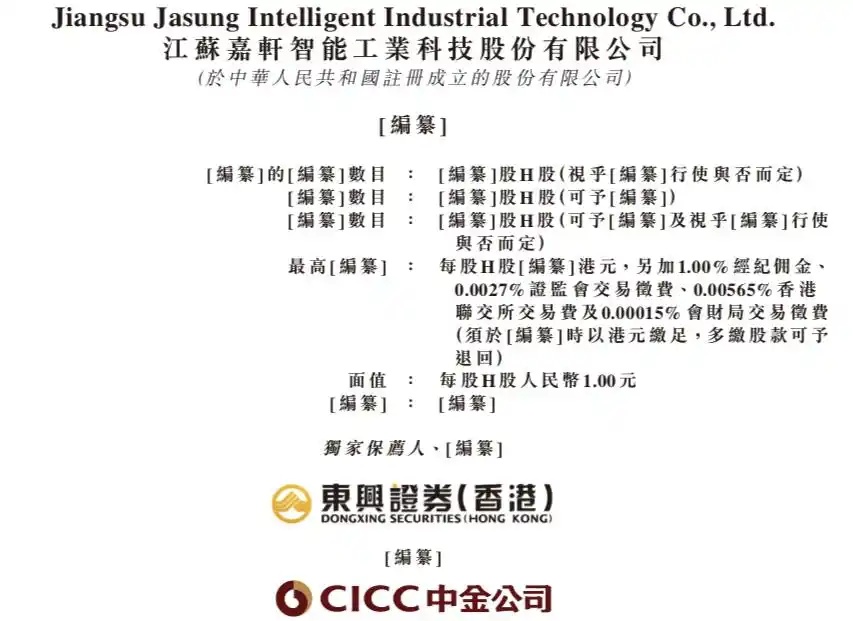
On June 30, Jiangsu Jiaxuan Intelligent Industrial Technology Co., Ltd. submitted its IPO application to the Hong Kong Stock Exchange, with Dongxing Securities (Hong Kong) acting as sponsor and overall coordinator. On July 8, the company appointed SDIC Securities (Hong Kong) as an additional overall coordinator.
According to the prospectus, based on 2025 revenue, Jiaxuan Intelligent holds an 80.3% market share in global industrial permanent magnet direct-drive drums and an 11.1% share in the global industrial permanent magnet electric drive solutions market, ranking first in both categories.
Berkshire Hathaway's 1989 shareholder letter contains a quote frequently cited by investors: "It is far better to buy a wonderful company at a fair price than a fair company at a wonderful price."
So, does being number one in a niche segment constitute sufficient conditions for Jiaxuan Intelligent to be considered an excellent company, or does it still require a broader product boundary, healthier cash collection, and sustainable service revenue?
Drum market nears absolute leadership; new revenue must come from a wider industrial electric drive boundary
Jiaxuan Intelligent's starting point is the substitution of traditional transmission chains. Conventional belt conveyor systems typically consist of asynchronous motors, couplings, gearboxes, and drums, involving many links, mechanical losses, and maintenance nodes. Permanent magnet direct-drive drums integrate the motor with load components, reducing intermediate transmission parts. The prospectus states that the company's solution can save 10% to 50% in energy consumption, achieve a system efficiency of up to 96%, and reduce failure points by over 50%. These metrics, derived from the company and Frost & Sullivan, need to be understood in the context of specific operating conditions, but they explain why heavy-load scenarios like mines and ports are willing to bear replacement costs.
High market share brings customer certification, process accumulation, and scale advantages, but also compresses the space for a single product to continue gaining share. In 2025, Jiaxuan Intelligent's revenue was 936 million yuan, a year-on-year increase of 7.3%; net profit was 41.57 million yuan, a year-on-year increase of 1.8%. Revenue from permanent magnet direct-drive drums dropped from 569 million yuan in 2024 to 488 million yuan, accounting for 52.1% of total revenue, down from 65.2%, while gross margin rose from 31.0% to 36.7%. Profits contributed by the main product remain stable, but revenue growth has shifted to other categories.
The fastest-growing category is the internal rotor permanent magnet motor, which generated 144 million yuan in revenue in 2025, nearly double the previous year, with gross margin increasing from 4.2% to 11.9%. Wind power generator component revenue increased from 18.31 million yuan to 68.15 million yuan, but gross margin fell to -2.7%. This data reveals the real cost of expanding product lines: new products expanding the addressable market need to go through production line ramp-up, customer validation, and pricing competition, meaning revenue scaling and profit release do not happen simultaneously.
However, industry space provides a foundation for expansion. According to Frost & Sullivan forecasts cited in the prospectus, the global industrial permanent magnet electric drive solutions market will grow from 8.1 billion yuan in 2025 to 27.2 billion yuan in 2030, with a CAGR of 26.3% from 2026 to 2030. Global penetration is expected to rise from 2.4% to 6.4% during the same period, and China's from 8.8% to 20.6%. Incremental demand mainly comes from asynchronous motor replacement, industrial equipment updates, and mine decarbonization. Jiaxuan Intelligent needs to replicate its drum leadership into general-purpose motors, variable frequency drives, shipbuilding, and new energy scenarios.
Overseas business is also in the expansion phase. During the track record period, the company's products entered more than ten countries, with overseas project contract totals reaching 93.8 million yuan, and it has obtained necessary certifications such as ATEX and CE for the US and EU markets. Compared to the 936 million yuan revenue scale in 2025, overseas contributions are still in the early stages, and local services, certification cycles, and delivery networks will affect the speed of volume growth.
Jiaxuan Intelligent currently needs to manage two sets of relationships: the drum business must maintain gross margins and industry status, while internal rotor motors, inverters, and new energy components must drive revenue expansion; the domestic market provides scale, while the overseas market provides new space. Advancing on both ends simultaneously will increase R&D, capacity, and service network investments, and will also test order quality.
Industrial AI first changes after-sales costs; large-scale charging still lacks key operational indicators
Jiaxuan Intelligent's AI route is built on the equipment itself. The company deploys sensors and controllers inside the drums to collect operational data in real-time and upload it to the cloud for condition monitoring, remote diagnosis, and decision support; deep learning models further evaluate product performance and lifecycle, shifting maintenance methods from post-failure repair to early warning. The prospectus also discloses that the company once commissioned universities to develop a deep learning fault diagnosis system for permanent magnet drums and plans to develop online diagnosis, intelligent operation and maintenance, and equipment condition prediction models for factory scenarios.
This route is closer to the budget criteria of industrial customers than generic AI. Mines and ports care about downtime duration, inspection manpower, spare part consumption, and energy consumption; model parameters themselves are hard to use as a procurement justification. Jiaxuan Intelligent has about 1,500 customers covering more than 20 industries, and equipment installations can provide multi-condition time-series data. If connected devices continue to increase, fault samples, operating curves, and maintenance records will accumulate as material for algorithm training. The company envisions using cross-scenario data to strengthen diagnostic capabilities, extending competitive advantages from hardware performance to data and algorithms.
Commercialization is still in the early stages. The revenue categories listed in the prospectus include permanent magnet direct-drive drums, internal rotor permanent magnet motors, variable frequency drives, wind power components, and other products. There is no separate listing for AI software, online O&M, or subscription service revenue, nor is there disclosure of the number of connected devices, paying customers, per-device service fees, or renewal rates. At this stage, AI is closer to a hardware function enhancement and after-sales efficiency tool, and has not yet formed a separately accountable business unit.
Subsequent growth quality depends on three observable changes: whether smart monitoring functions can increase hardware unit prices, whether O&M contracts can be separated from project deliveries, and whether equipment data can be reused across mine, port, and manufacturing scenarios. Industrial fault samples are scarce, and different loads, temperatures, and dust environments will interfere with model generalization; false alarms increase downtime checks, while missed alarms may bring safety liabilities. The threshold for industrial AI is not in the demo interface, but in long-term operational results and the amount of savings customers are willing to pay for continuously.
Industrial hardware companies often have data entry points but may not have data usage rights. Equipment is scattered across different customer sites, and data formats, network conditions, and security requirements are not unified. Jiaxuan Intelligent needs to provide sufficiently clear energy-saving benefits and improvements in downtime losses for customers to have the motivation to open data, install sensors, and purchase long-term services. This step is slower than developing diagnostic models and is closer to the essence of industrial commercialization.
Profitability maintains growth, but working capital is devouring cash formed by expansion
Jiaxuan Intelligent has been profitable for three consecutive years, but cash conversion is significantly weak. From 2023 to 2025, the company's operating activities had net cash outflows of 79.63 million yuan, 23.95 million yuan, and 131 million yuan, respectively. The main drag in 2025 came from an increase in inventory of 66.2 million yuan, an increase in accounts receivable and notes of 164 million yuan, and a decrease in contract liabilities of 38.3 million yuan. The net profit for the same period was 41.57 million yuan, creating a significant gap between the income statement and the cash flow statement.
Collection pressure extends into 2026. Trade receivables and notes receivable rose from 771 million yuan at the end of 2025 to 887 million yuan as of April 30, 2026, while cash and cash equivalents dropped to 54.27 million yuan; bank loans, other borrowings, and lease liabilities totaled approximately 620 million yuan. The accounts receivable turnover days in 2025 were 269 days. As of the end of April, the company still had 305 million yuan in net current assets and 709 million yuan in unused bank credit lines, providing short-term liquidity buffers, but expansion increasingly relies on external financing and collection management.
Customer concentration is not prominent, with the top five customers accounting for 26.1% of revenue in 2025, and the largest customer accounting for 8.1%; financial pressure stems more from longer settlement cycles rather than reliance on a single large customer. The rise in receivables is related to the increase in new industry customers, expanded sales of wind power components, and an increased proportion of credit settlements.
The issue is that if AI O&M continues to be tied to hardware projects and uses longer payment terms, new services may not immediately improve cash flow. Independent annual contracts, prepayment arrangements, and more standardized deliveries are more conducive to improving revenue visibility. Raw materials accounted for 89.9% of sales costs in 2025, and price changes in rare earth magnetic materials, copper, and electrical steel will still affect profits, while low margins in new businesses weaken the ability to pass on costs.
The use of raised funds also reflects the company's realistic focus: expanding capacity and automated production lines, increasing R&D investment, building overseas sales and service networks, strengthening supply chain synergy, and supplementing working capital. AI is part of product upgrades, and the prospectus does not set it as the sole funding direction.
Jiaxuan Intelligent first needs to complete the synergy of product expansion, overseas services, and cash collection, before having the conditions to convert equipment online rate, diagnostic accuracy, and service renewal rates into a new revenue structure.
Overall, the industry theme for the next few years will unfold along two paths: permanent magnet electric drives will continue to replace traditional asynchronous transmissions, and equipment manufacturers will further take over online monitoring and full-lifecycle O&M. Companies that can control hardware, data entry points, and on-site services simultaneously will have the opportunity to extend their revenue structure from one-time deliveries to continuous services. Jiaxuan Intelligent has already entered this path, and progress needs to be verified by collection cycles, new product gross margins, the scale of connected devices, and the proportion of service revenue.
For Jiaxuan Intelligent, an 80.3% market share is a very heavy weight; what needs to be placed on the scale next is a broader product matrix, more stable free cash flow, and industrial intelligent services that can be charged separately.
The copyright of this article belongs to the original author/organization.
The views expressed herein are solely those of the author and do not reflect the stance of the platform. The content is intended for investment reference purposes only and shall not be considered as investment advice. Please contact us if you have any questions or suggestions regarding the content services provided by the platform.