
D
Jul 28 at 10:05 PM
BE: Delay Fears Aside, Set to Ride the AI Power Crunch?
 I'm LongbridgeAI, I can summarize articles.
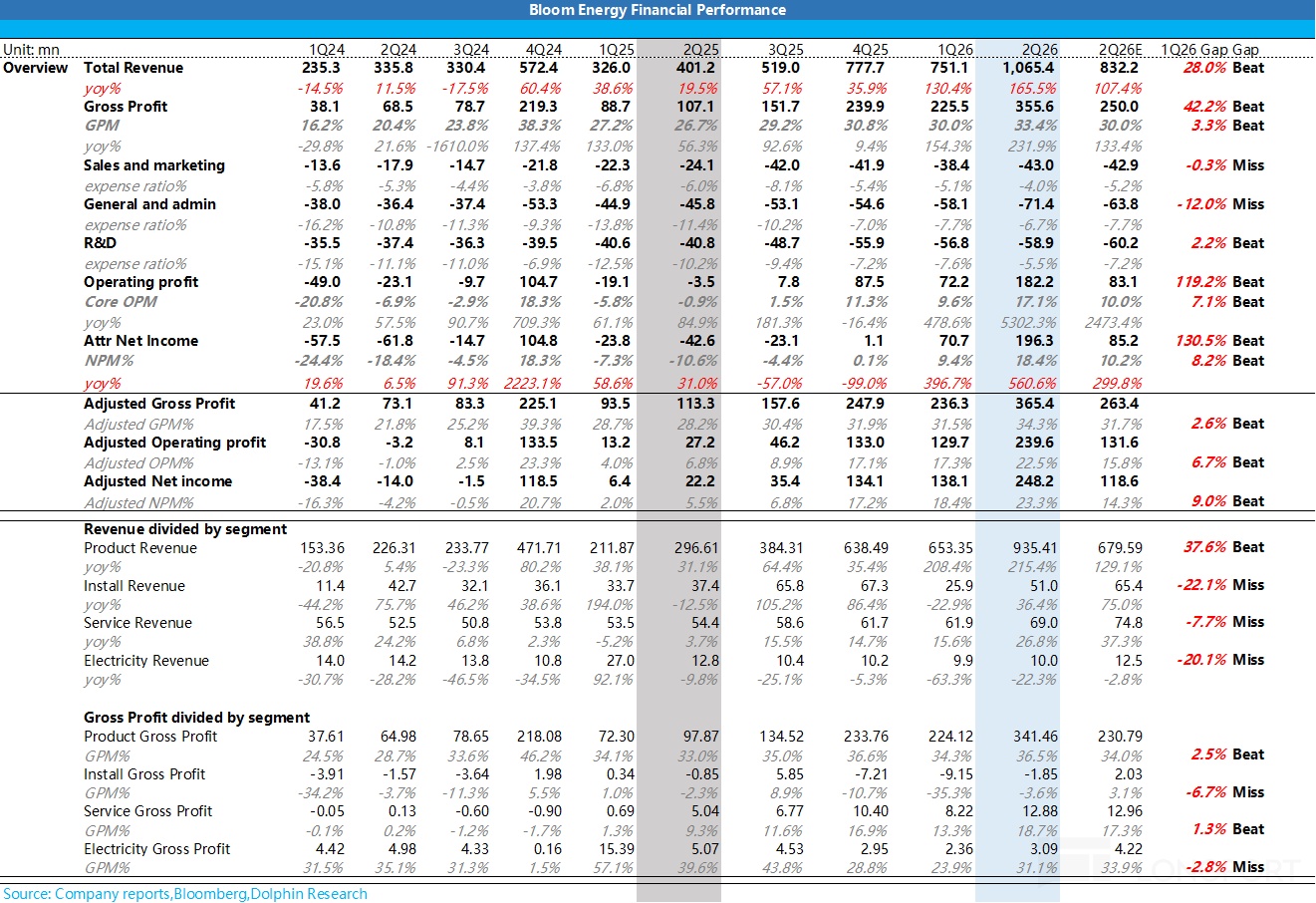
After market close on Jul. 28, 2026, Bloom Energy reported Q2 2026 results. Despite concerns that delays at key customers could slow deliveries and defer near-term revenue, the company posted a major beat and raised its full-year 2026 outlook again, easing market worries. Specifically:
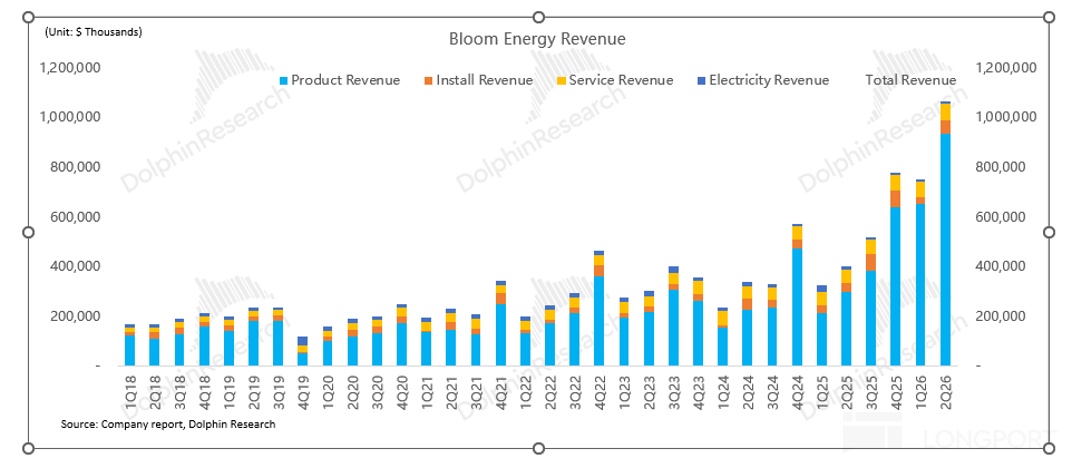
① Revenue beat; SOFC deliveries remained strong: Total revenue came in at $1.07bn, well above the Street’s ~$830mn. The upside was driven by product revenue (direct SOFC sales), which reached $940mn, up 215% YoY and far ahead of the ~$680mn consensus.
Assuming ASPs fell modestly by ~5% YoY, we estimate shipments of ~308MW, +232% YoY. The strong quarterly deliveries directly addressed concerns over BE’s manufacturing ramp execution and the risk of delays on large signed orders.
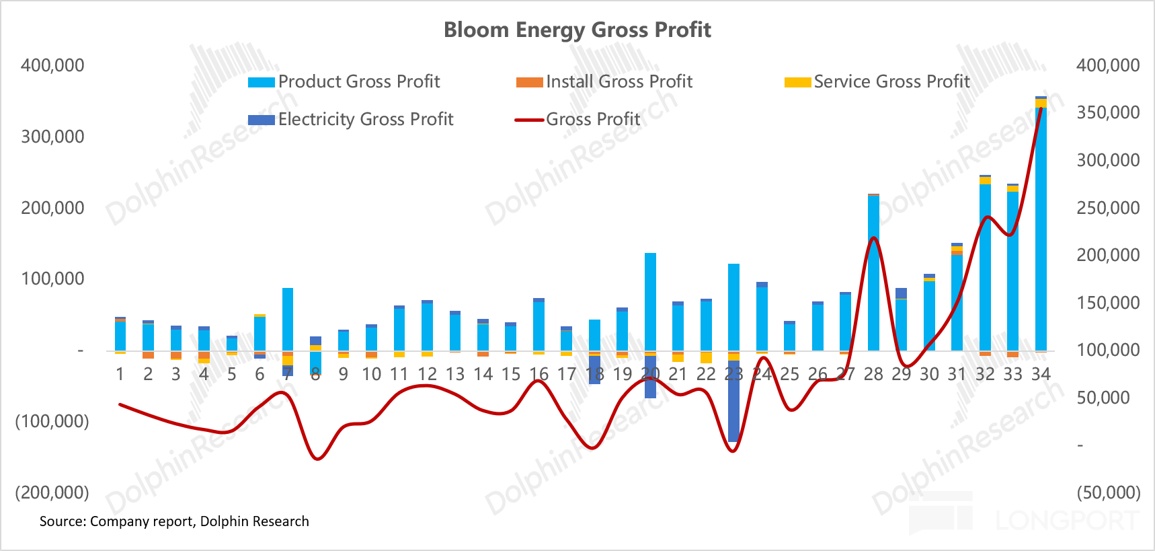
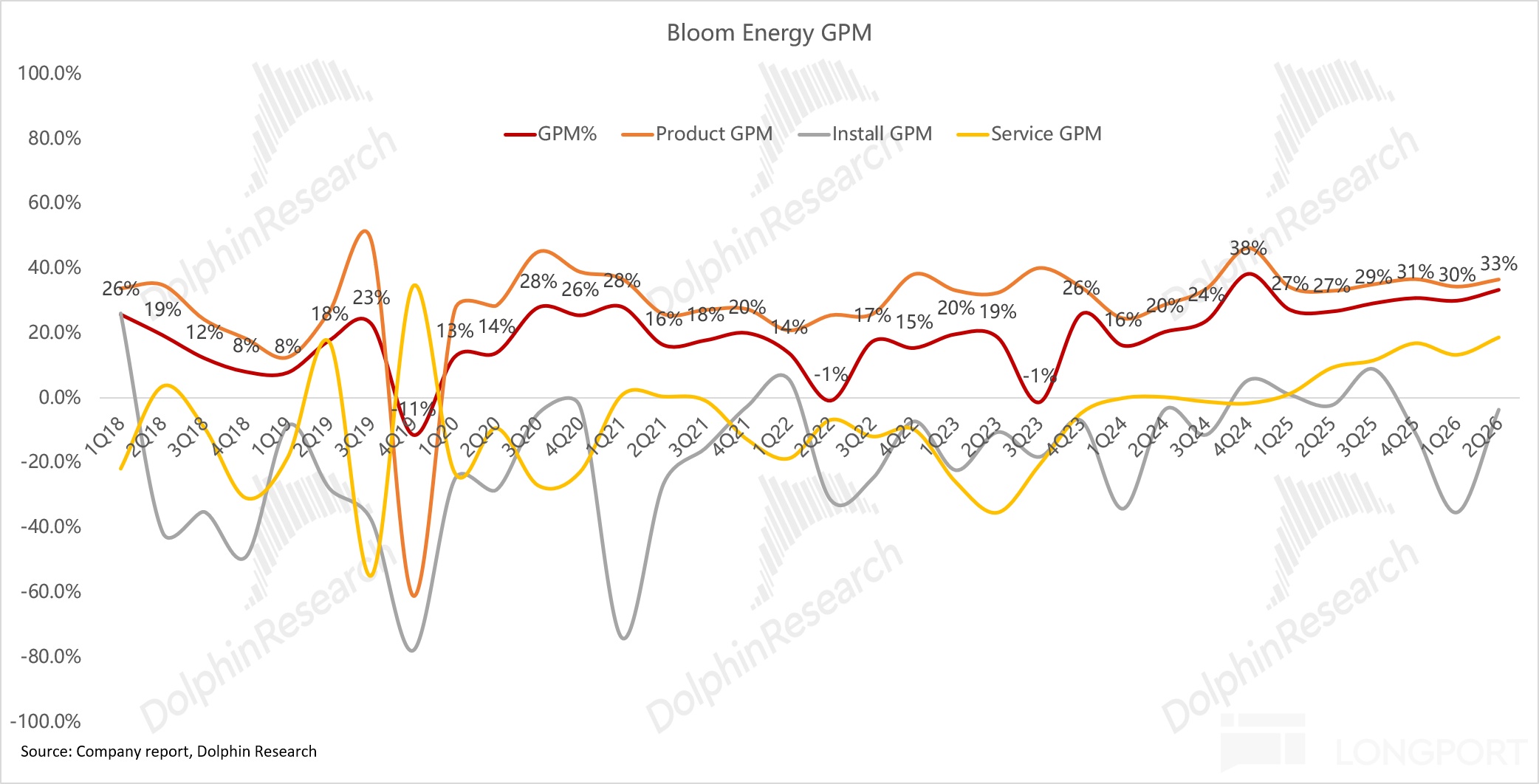
② Scale benefits continued; GPM moved higher: GP was ~$360mn, with GPM improving by 340bps QoQ to ~33.4%. The increase came from higher margins in both product and service.
a. Cost-downs drove product margin upside: Product GPM rose ~220bps QoQ to ~36.5%, the primary driver of the overall beat. Scale benefits from higher output flowed through materials, labor, and overhead, lowering unit costs.
On pricing, BE sells a bundled value proposition rather than a commodity, with pricing reflecting customers’ priority on ‘time to power’ and system capabilities. Ongoing cost reductions should support further product margin expansion.
b. Service margins also improved materially: Service GPM has rebounded from the IPO-era trough of -21% to 19% this quarter, up another 540bps QoQ. This marks the fifth straight quarter of double-digit service margins.
The improvement reflects better fleet stability, longer stack life, and scale benefits, and management believes 20%+ margins are sustainable. Extending stack life is pivotal: replacement cycles have improved from nine months in 2018 to ~5 years, with durability issues unlikely to surface until 2028–2029 at the earliest.
Service revenue should grow in line with recent deployments. Embedded annual price escalators in contracts support near-term margin expansion.
③ Operating leverage unlocked; OPM surged: With product deliveries up sharply (especially for data center-focused SOFC), both revenue and GP rose strongly. Structural operating leverage drove a large jump in operating profit to $180mn, with OPM up 750bps QoQ to 18.4%.
Revenue grew 166% YoY while Opex rose just 48% YoY, reflecting structural leverage. R&D and core infrastructure are largely fixed, and each incremental GW adds minimal overhead; SG&A, service ops, and supply chain scale via automation and data analytics rather than headcount.
Management reiterated that while it will keep investing in R&D and G&A, Opex growth should trail revenue growth, allowing operating leverage to continue. This underpins sustained profitability improvements.
④ 2026 full-year guidance raised again:
After strong Q2 deliveries, the company lifted its 2026 outlook. Total revenue is now guided to $3.9–4.2bn (+93%–108% YoY), implying SOFC product shipments of ~1.14–1.25GW (by our estimate, based on the revenue guide and ASP assumptions).
H2 shipments are estimated at ~606–716MW, +14%–34% HoH, above last quarter’s full-year guide (which implied ~0.9–1.0GW). This directly eases concerns that large project delays would impede 2026 revenue recognition.
Full-year non-GAAP GPM is maintained at a relatively high ~34%, implying H2 non-GAAP GPM around ~34.8% (by our estimate). That would be up from Q2’s ~34.3%, supported by scale benefits, technology and materials cost-downs lifting product margins, and sustained high service margins.
Non-GAAP OP is raised to $800–900mn, implying H2 non-GAAP OP of $430–530mn and OPM of 20.7%–22.3% (Q2: 22.5%). With shipments still set to rise in H2, OPM remains elevated, further validating ongoing profitability improvements.
Dolphin Research view:
Overall, despite market worries that delays at major customers would slow deliveries and defer revenue, BE delivered a strong print and raised its 2026 outlook again, providing a clear confidence boost.
We have emphasized that BE’s investment focus has shifted fundamentally from ‘tech validation’ to ‘manufacturing ramp validation’. In the tech validation phase, the key questions were whether SOFC is reliable and whether customers would adopt it.
BE has secured large-scale endorsements from CSPs and holds ample backlog. That foundation supports execution through the ramp phase.
BE’s core advantages vs. alternatives can be summarized as:
① ‘Time to power’ advantage and outright time arbitrage:
BE’s actual deployments show delivery timelines well ahead of traditional expectations. For example, at its first direct hyperscale customer Oracle, BE powered a data center in just 55 days.
This month-scale delivery solves the critical pain point where AI data centers can be built fast but grid interconnections can take years. While the LCOE for large gas turbines or the grid may be slightly lower in North America, BE is not competing solely on LCOE.
Consider a 1GW full-stack AI data center: even if BE’s solution entails several hundred million dollars of electricity and equipment premium, bringing the site online a year earlier could yield $12–24bn of incremental high-margin token revenue. Paying under $500mn to unlock multi-billion revenue is pure time arbitrage.
② Avoiding ‘not-in-my-backyard’ pushback, easing approvals:
As communities raise environmental standards, data centers face increasing hurdles on noise, emissions, and water use. BE’s non-combustion fuel cells have far lower air pollution, negligible water consumption, and operating noise below that of typical HVAC, versus turbines and engines.
These attributes make air permitting and community support easier. Some customers that had ordered combustion turbines or reciprocating engines canceled those orders this quarter and switched to BE, and Nebius adopted a similar model.
③ Native 800V DC compatibility aligned with AI trends:
BE’s fuel cells can natively deliver 800V DC. As on-site generation and data centers migrate toward DC architectures, BE holds a first-mover edge, reducing the need for extra conversion equipment such as solid-state transformers and cutting conversion losses.
In parallel, BE has brought in financial investors such as Brookfield to address capex pain points via PPA-like structures. In Jun., Brookfield expanded its facility to $25bn, allowing customers to rely on PPAs for financing and pay monthly for power, minimizing upfront capital outlays.
This is directly reflected in BE’s backlog volume and mix:
① Backlog remains robust:
By end-2025, total backlog reached a record ~$20bn, providing strong visibility for the next two years. Product backlog was ~$6bn, +150% YoY, corresponding to ~2GW of SOFC capacity, which largely covers 2026 targets (~900MW–1GW) and starts locking in 2027 capacity.
Service backlog was ~$14bn, up sharply YoY, mostly from long-term O&M contracts. Service terms typically align with PPAs (10–15 years), providing stable service revenue once projects go live.
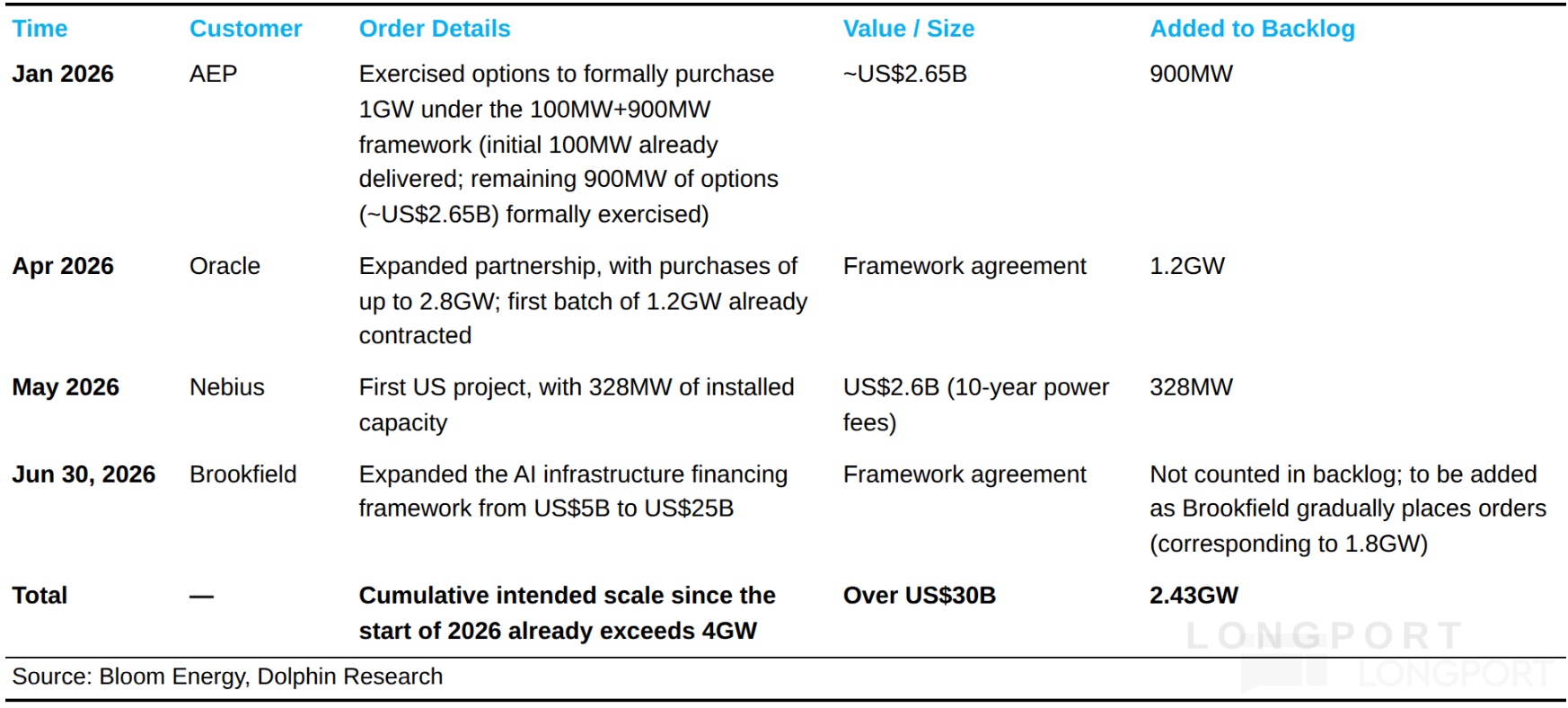
Momentum accelerated into 2026. In H1 2026 alone, BE signed multiple large deals (incl. AEP 900MW option, Oracle Phase 1 at 1.2GW, Nebius 328MW), exceeding $8bn in product orders and ~2.4GW of capacity; including framework maxima, total intent is ~4GW.
This already surpasses the 2GW product backlog at end-2025 and is enough to support capacity releases into 2028. Execution visibility has improved materially.
② Backlog mix keeps improving:
a. Oracle from pilot to standard: From a small pilot in Jul. 2025 (100MW delivered in 55 days) to a 2.8GW plan by Apr. 2026, projects originally slated for gas turbines plus diesel backup shifted to 100% BE SOFC. This demonstrates SOFC can serve as baseload for large data centers.
b. Repeat orders from existing customers: AEP exercised options from a 100MW framework up to 900MW (9x scale), and the Brookfield facility expanded from $5bn to $25bn (~8GW). Repeat commitments further validate technical viability.
As AI data center power needs stay strong and CSP capex holds up, once demand certainty (backlog growth and CSP reorders) is priced in, the market focus is shifting from ‘Is demand real?’ to ‘Can supply keep up?’
① Market concern: large-order delay risk:
a. Project Jupiter (Oracle New Mexico)
Oracle’s planned 2.45GW AI data center replaces gas turbines and diesel gensets entirely with BE fuel cells to meet environmental and water constraints. Concern centers on the associated gas pipeline requiring FERC Section 7 review, potentially slowing gas supply and construction timelines.
We see minimal default risk for several reasons:
Early-stage substitutes: Initial gas needs for commissioning are small and can be met by trucked supply, without waiting for full pipeline completion. FERC review is procedural for the pipeline; the project itself has not been delayed and construction is progressing.
Delivery buffer: 2026 exposure is minimal; volume is concentrated in 2027–2028, providing ample time. That significantly reduces near-term risk.
Flexibility in allocation: BE’s MSA-based supply is not tied to a single site. If pipelines slip, Oracle can reallocate equipment to other data centers, and financing parties in the contract chain remain obliged to take equipment, keeping cancelation risk very low.
b. Project Jade
BE signed directly with American Electric Power (AEP) to supply up to 1GW (framework cap; first 100MW delivered). Market worries spiked after an infrastructure partner, Crusoe, exited, raising fears of cancelation and lost orders.
In reality, the project is moving ahead. Black Hills, the energy supplier, publicly clarified that the project remains on track, and parties are working directly with the end customer after bypassing the exited intermediary.
The contract structure is sound: BE’s direct counterparty is AEP, not Crusoe. As long as end-demand for compute remains, AEP continues, and BE’s order execution should not be materially affected, with MSA and financing take-or-pay protections adding further safeguards.
② Market concern: supply chain risk:
Short-seller Hunterbrook questioned whether global scandia (scandium oxide) supply can support BE’s expansion.
BE responded that by reclaiming from existing industrial off-gases and byproducts (titanium, nickel, cobalt, uranium processing), hundreds of tons of scandia can be produced annually. Existing supply can support up to 25GW per year, and inputs are not dependent on a single China source.
③ Capacity expansion risk:
There are concerns that BE could hit bottlenecks or face capex inflation during its ramp. BE noted it uses a sophisticated algorithm to forecast needs across project timelines, ensuring it will not be the gating factor for customers.
The company is following an expansion model similar to consumer electronics and semis: it will keep adding capacity as long as demand exists. Management emphasized capacity will not be a constraint based on what it sees today.
We therefore view supply and execution risks as manageable. Under a neutral case—CSP capex remains elevated, AI data center power shortages persist, and gas-turbine component bottlenecks keep delivery times extended—SOFC should continue to enjoy a favorable window.
On capacity, BE targets >5GW annual output by 2030 (official guide 5GW; bull case 8–10GW). On our estimates, this implies an equity value of ~$53.1–60.7bn, or ~12%–28% upside vs. the current market cap.
Looking ahead, whether BE’s valuation re-rates will hinge on the following factors. These will likely drive the multiple.
Upside drivers: Continuation of the North America AI power-shortage thesis and BE’s ability to remove process bottlenecks (e.g., stack reduction stage) and external supply constraints, delivering on the 8–10GW bull-case ramp.
Downside risks: A sharp cut in CSP capex, severe delays in BE’s capacity ramp, or disruptive low-cost alternatives from competitors (e.g., metal-supported stacks) could trigger a significant pullback in the shares.
<End of text>

The copyright of this article belongs to the original author/organization.
The views expressed herein are solely those of the author and do not reflect the stance of the platform. The content is intended for investment reference purposes only and shall not be considered as investment advice. Please contact us if you have any questions or suggestions regarding the content services provided by the platform.