
D
Aug 3 at 09:46 AM
LKNCY: Past the delivery hangover, is the 'Little Blue Cup' now riding tailwinds?
 I'm LongbridgeAI, I can summarize articles.
Luckin Coffee (LKNCY) released its Q2 2026 results (quarter ended Jun 2026) before the U.S. market open on Aug 3 Beijing time. Luckin offset last year's high base from delivery subsidies with store expansion and user growth. More importantly, delivery expenses declined YoY for the first time since the delivery war, and the overall print beat market expectations; key highlights below: $Luckin Coffee(LKNCY.US)
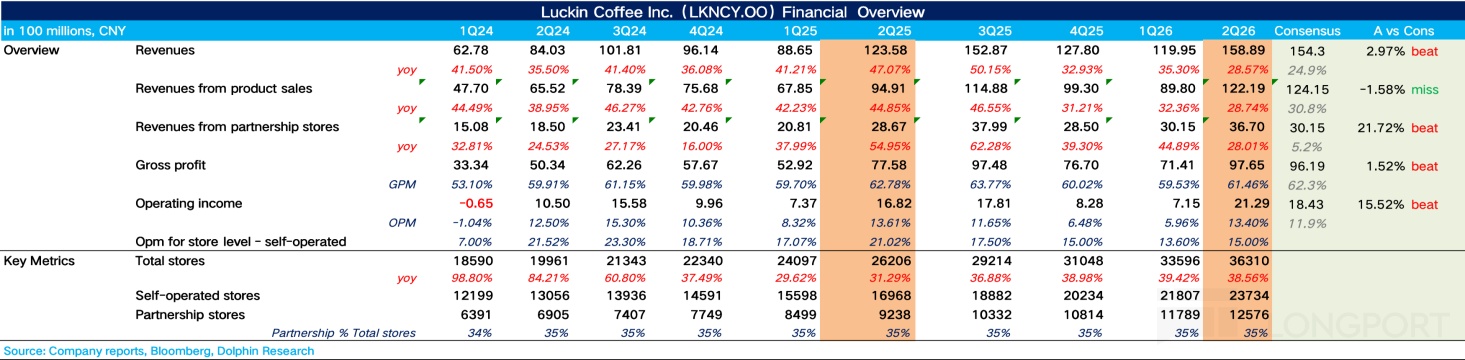
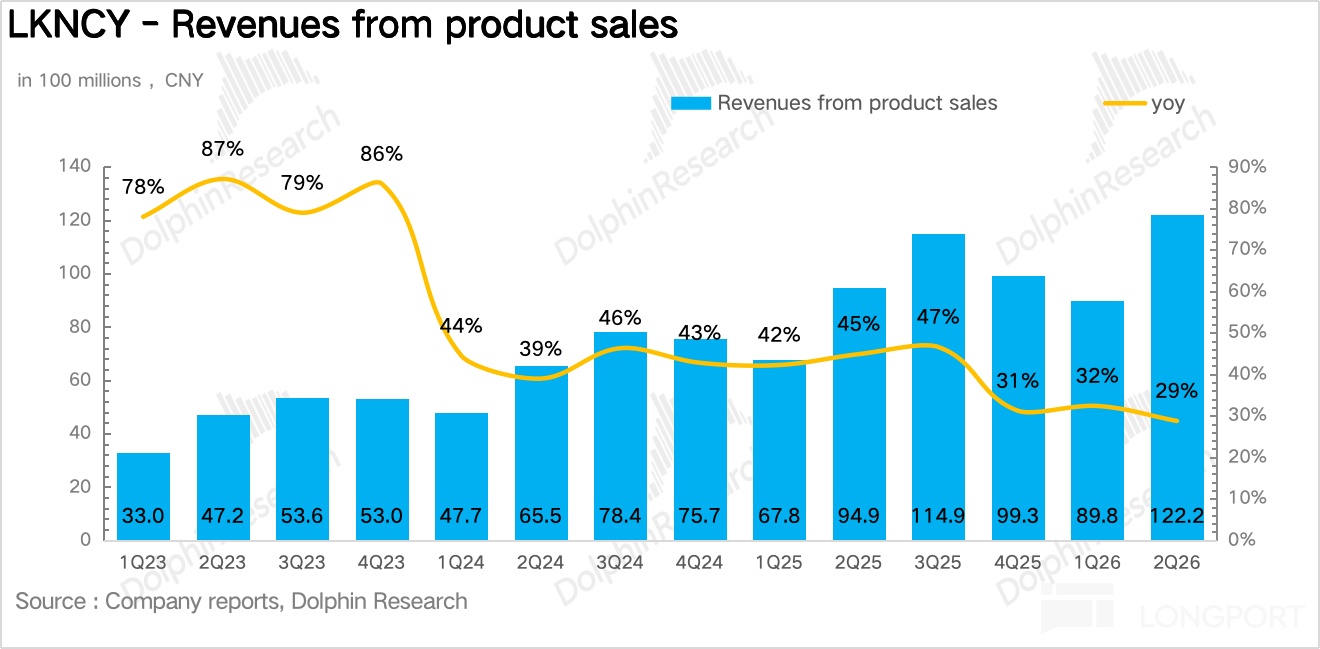
1) Headline results beat; growth naturally decelerated on a high base. Q2 revenue was RMB 15.89bn, +28.5% YoY (vs. consensus ~RMB 15.6bn). Core drivers remained store count expansion and growth in monthly transacting users.
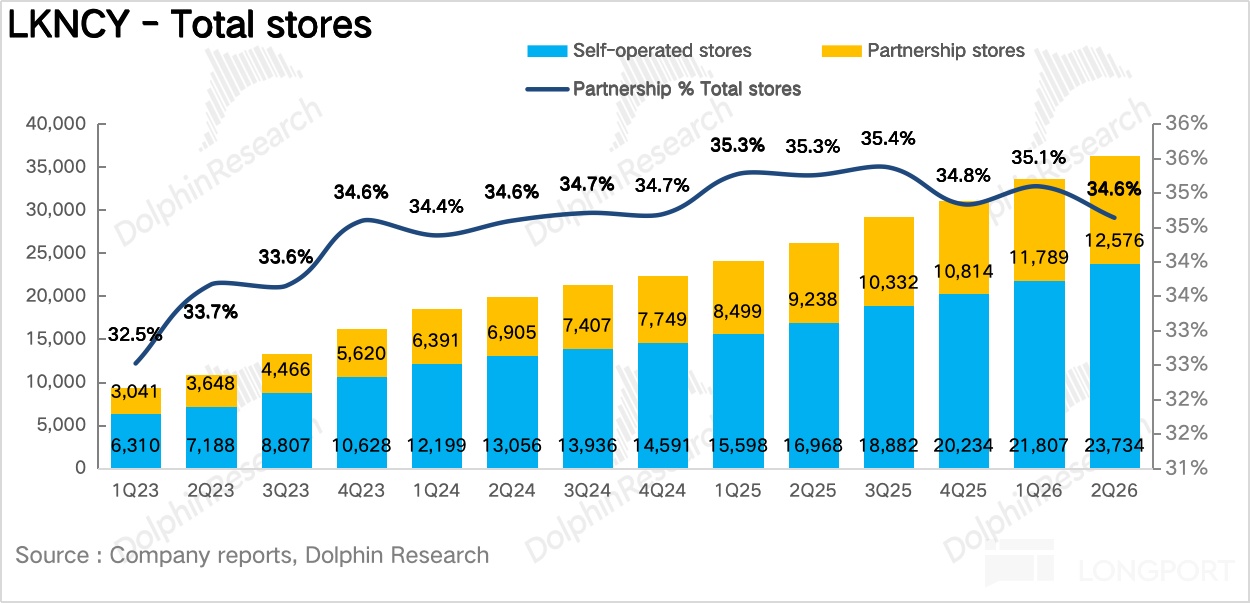
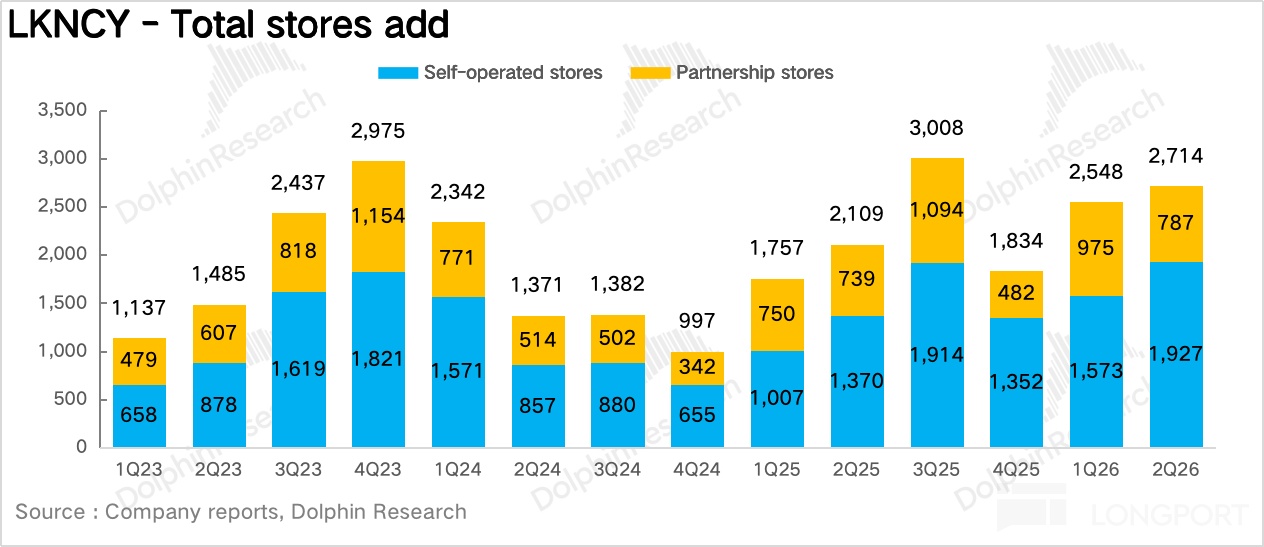
2) Store openings accelerated against the backdrop. Luckin added a net 2,714 stores in Q2, ending with 36,310 stores, with the pace picking up QoQ. Self-operated stores continued to grow faster than franchised stores, indicating ongoing densification in top-tier cities. Overseas stores totaled 223 with a net add of 46, led by Malaysia. Despite single-store pressure, the company did not sacrifice footprint for short-term margins; market share capture remains the top priority.
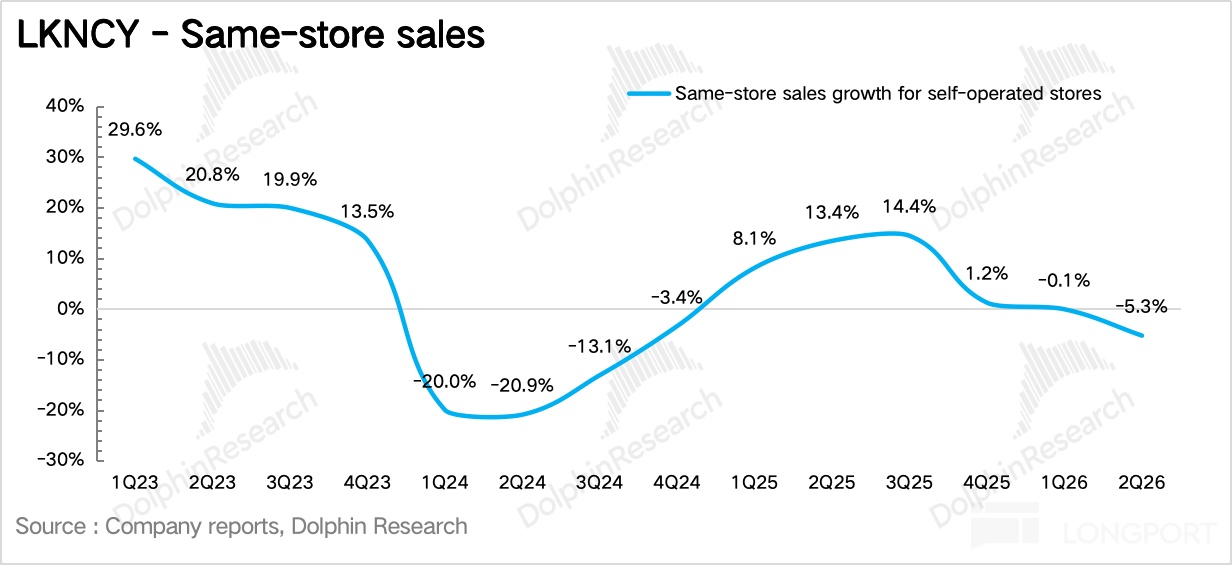
3) Same-store decline narrower than expected. SSSG was -5.3% YoY, reflecting underlying growth excluding new stores. On mix, with 9.9-yuan coupons now below a 10% share, the main price band shifting up to 13–15 yuan, and higher shares of large/XL cups and paid members, we infer cup ASP still contributed positively. Cup volume likely fell ~6–7%, better than expected.
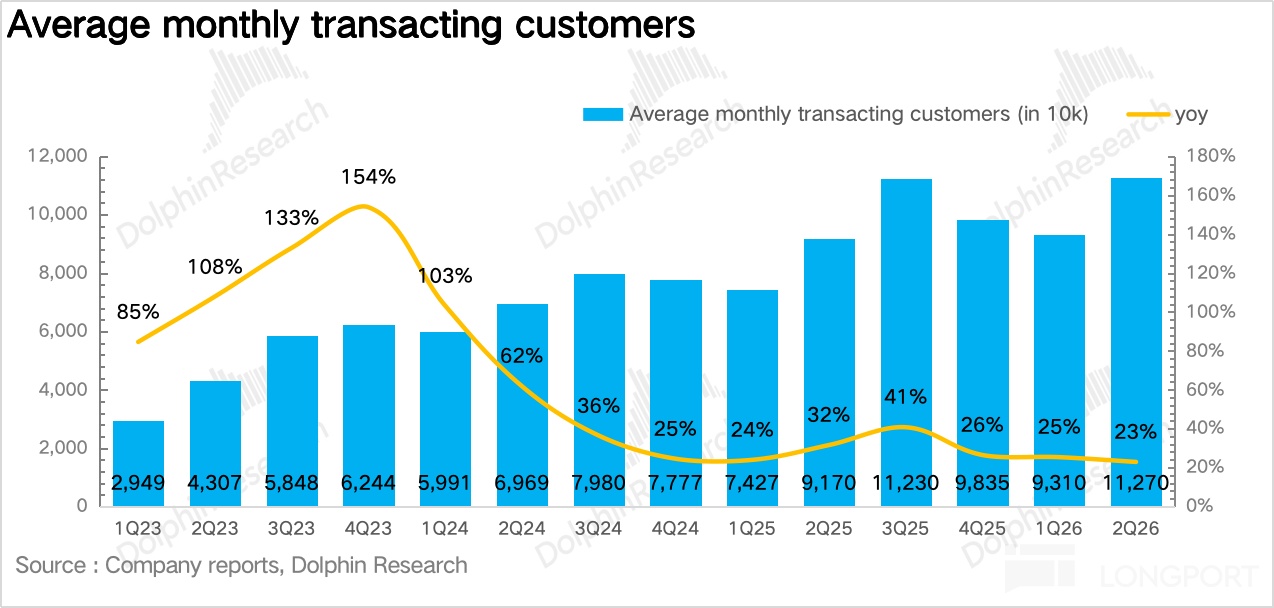
Monthly transacting customers reached 113mn, +23% YoY, a record high and above the Q3 2025 subsidy peak. This suggests the price-sensitive users lost as subsidies faded have been replenished by new stores and organic growth.
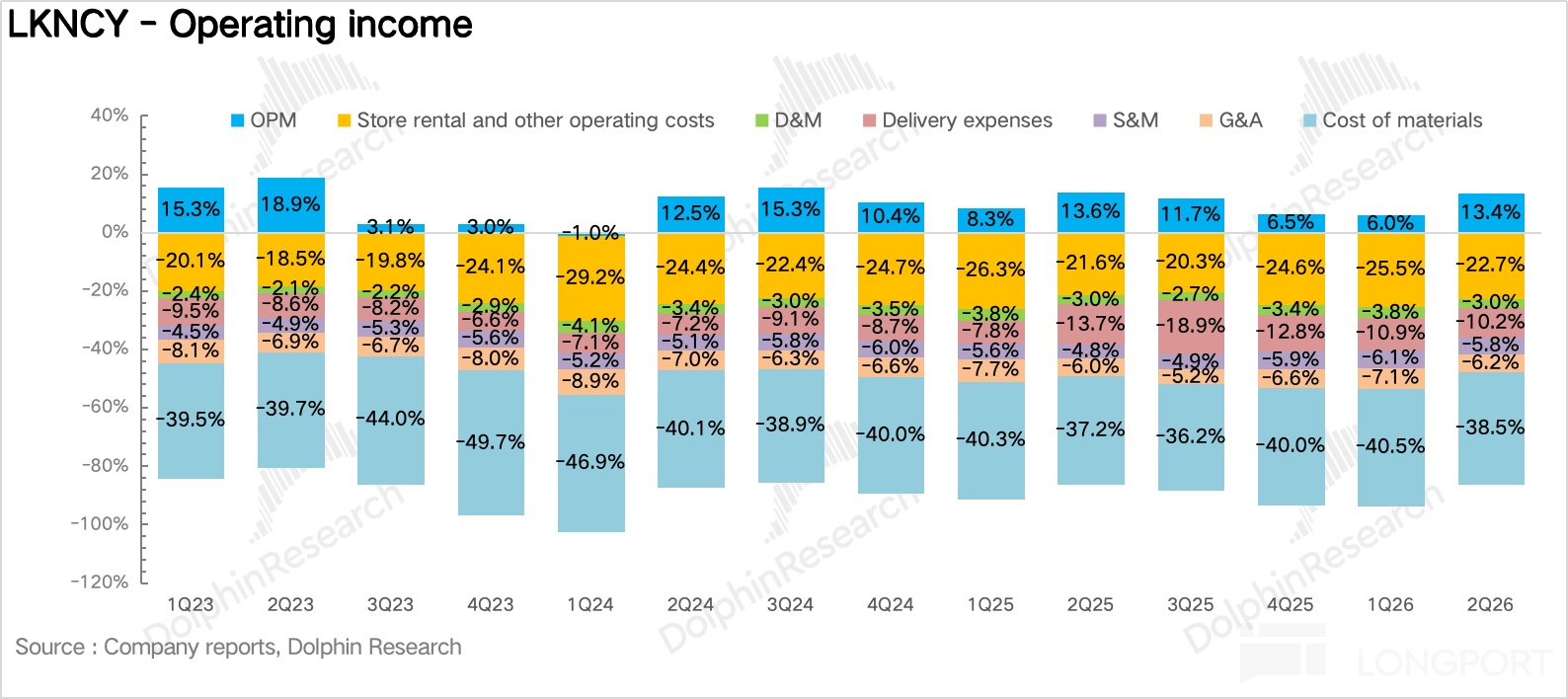
4) Delivery expenses turned negative YoY. Q2 GPM was 61.5%, down 130bps YoY, mainly due to a higher mix of low-margin raw material wholesale. Delivery expenses were RMB 1.62bn, -3.1% YoY, the first negative YoY since the delivery war, with the ratio to revenue falling from 13.5% to 10.2%.
5) Store-level efficiency still improving. Store-level margin was 21.3%, only 20bps below a year ago. With SSSG at -5.3% and store count +38.6% YoY, unit economics were largely intact, implying continued operational efficiency gains at the store level. Given the formal launch of the bottled RTD biz in Q2, related spend increased, pushing the sales expense ratio up 100bps to 5.8% while G&A stayed flat. Non-GAAP OP was RMB 2.4bn, +26.5% YoY.
6) Key financial metrics at a glance
Dolphin Research view:
Dolphin noted last quarter that the market's focus for Q2 had shifted from short-term same-store trends to the sustainability of margin improvement. Specifically, whether delivery expense ratio can keep falling amid ongoing competition, easing fulfillment cost pressure, and whether store-level margins can recover sequentially, validating profitability resilience during price wars. On both counts, Luckin delivered a satisfactory answer.
Beyond a single quarter, competition remains intense even as pressure from Cotti has eased versus last year (it exited '9.9 yuan unlimited' in Feb, retaining only select promos, with regular items back to 11.9–16.9 yuan). Participants in the freshly made coffee chain track continue to expand, and incremental supply pressure has not materially subsided.
On one side is Starbucks, which has lost share in the value segment and taken hits from Luckin. This year, its China JV went live and it shifted to an asset-light model, strengthening local operations. It is set to accelerate expansion into lower-tier markets.
On the other side, tea brands are increasingly crossing into coffee. Guming's coffee series already accounts for ~15% of store transactions, with frequent disruptive promos (storewide coffee as low as 8.9 yuan, limited-time Americanos at 4.9 yuan). Chabaidao began store coffee pilots mid-year, speeding up fresh-brew equipment deployment; Auntea Jenny elevated coffee to a strategic priority, using low-price weekly passes to draw traffic.
For now, tea brands mostly use coffee as a time-slot supplement and traffic tool, with weak profitability in coffee itself, limiting near-term sales diversion from Luckin. But medium-term, persistent low-price traffic may further anchor consumers' price perception, compressing Luckin's room for structural price increases.
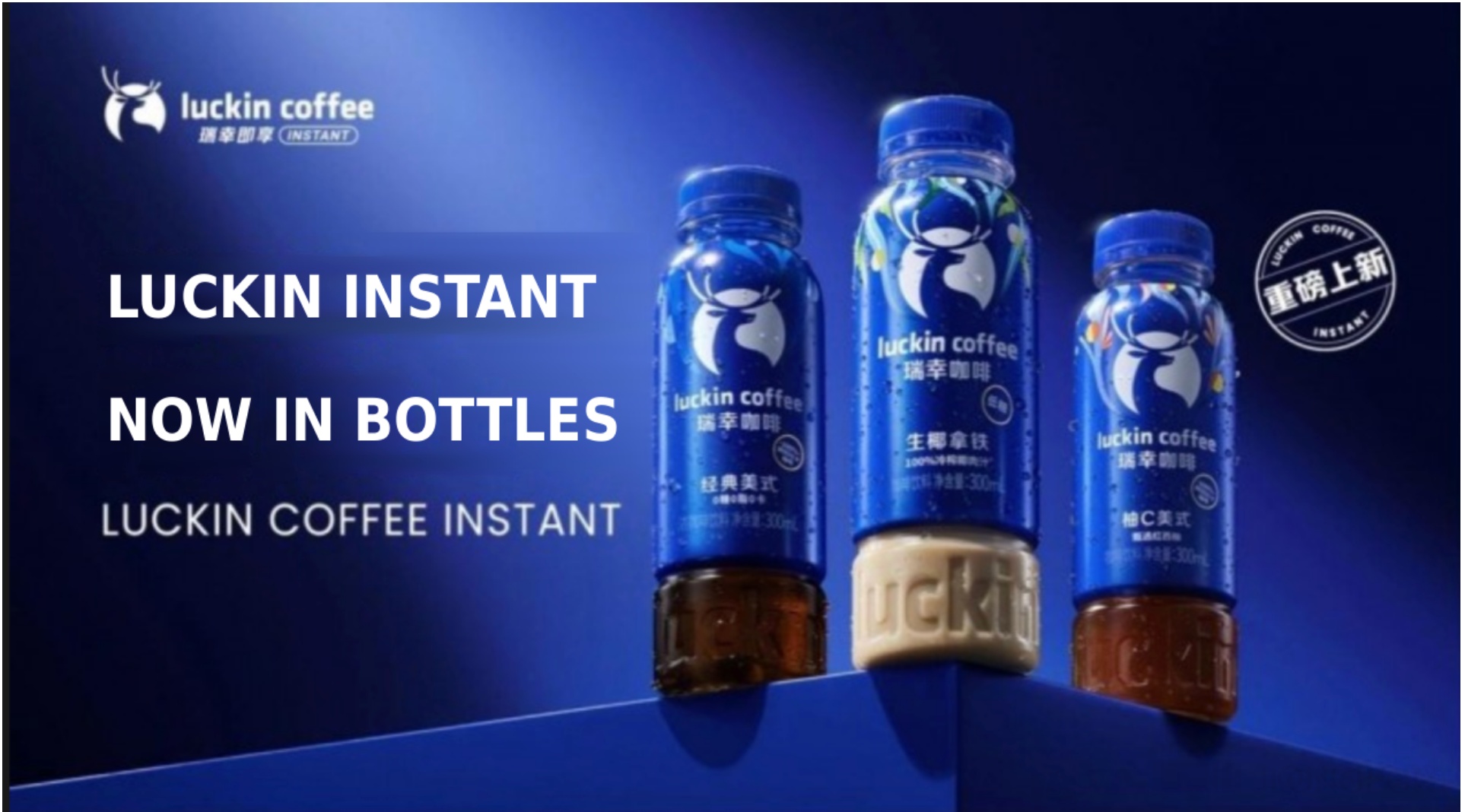
In Q2, Luckin's bottled RTD line 'Luckin Ready-to-Enjoy' officially launched with three SKUs (Classic Americano, Grapefruit-C Americano, Coconut Latte). Single-bottle pricing is 6–7 yuan, and provincial distributors have been recruited in Hebei, Shaanxi, Jiangsu, Shanghai and more.
Though not profitable near term (dealer GPM ~10%), it may dilute overall GPM and lift sales expenses this quarter. Strategically, it extends brand touchpoints beyond the 'three-kilometer radius' to convenience store coolers, supermarkets, transit hubs and campuses, while blocking the 6–7 yuan price band from Lucky Cup and tea brands' downward push.
Valuation: with market expecting 2026 Non-GAAP net profit of RMB 5.2–5.3bn, the stock trades at ~13x. Despite a pink-sheet discount for LKNCY, versus Dolphin's view of 20–25% profit CAGR over the next three years, the current level is not demanding. A re-rating to 15x implies at least ~15% upside.
Detailed analysis follows
I. Investment framework
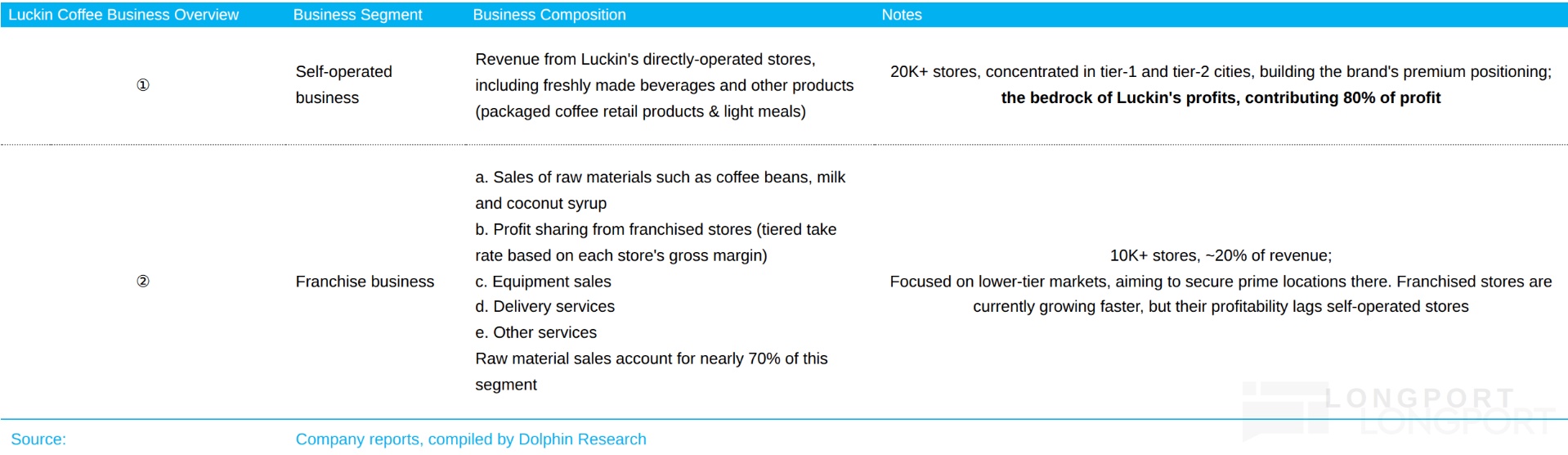
Per disclosure, Luckin operates two major lines: self-operated and franchised.
1) Self-operated comprises revenue from directly run stores; by end-Q1 2026, self-operated stores reached 21,807, primarily in tier-1/2 cities, key to brand building. This is the profit base, contributing over 80%, and is the focus for SSSG, store-level margin and delivery expense tracking.
2) Franchise revenue includes raw material sales (coffee beans, milk, coconut milk), profit sharing (tiered by store GP), equipment sales, delivery services and other services. Raw materials account for nearly 70%, the core revenue driver. By end-Q1 2026, franchised stores were 11,789, contributing ~25% of revenue, targeting lower-tier markets; they scale faster but are less profitable than self-operated.
Additionally, Luckin's retail CPG biz went live in Q2: bottled RTD ('Luckin Ready-to-Enjoy') launched Apr 28 via distributors and retail channels. No in-house manufacturing, OEM by Uni-President's subsidiary (Tongshe); Luckin handles brand, formula, channel development and marketing, a typical FMCG OEM model.
- Same-store decline narrower than expected
On store count, Q2 net adds were 2,714, taking total stores to 36,310 (+38.6% YoY) with a faster QoQ pace. Self-operated grew from 21,807 to 23,734 (+1,927), while franchised rose from 11,789 to 12,576 (+787). Faster growth in self-operated indicates continued densification in higher-tier cities, fully aligned with management's 'market share first' strategy.
Overseas, end-Q2 stores were 223 with net adds of 46 (Malaysia +31, U.S. +8, Singapore +7), only 0.6% of the global base and immaterial to the P&L. Singapore is the benchmark: 100% self-operated, replicating the domestic 'pickup + relaxed' dual formats, prioritizing CBDs and transit hubs. It has delivered stable store-level profitability since H2 2025, making it the No. 2 coffee chain locally by store count. Malaysia is franchise-based via a 10-year exclusive with GASB under Hextar Industries; the 2025 target of 70 stores was met, now over 80, validating the franchise model in SE Asia.
III. Same-store decline narrower than expected
As the key metric for underlying store growth excluding new stores, Q2 SSSG for self-operated stores was -5.3%. Decomposing price and volume: Cup ASP remained a positive and of decent quality; 9.9-yuan coupons now cover below 10% of sales, the main price band moved up from 10–13 to 13–15 yuan, and '+3 yuan to upgrade to XL/XXL' rolled out fully from Q1 and contributed fully from Q2. Overall, we estimate cup ASP up ~1–2% YoY.
Cup volume: Based on checks, beyond May's flavored Americano launch and nationwide rollout of fresh fruit beverages, Luckin further ramped non-coffee R&D in Q2, with non-coffee now over 20% of total cups; we estimate cup volume down ~6–7%.
IV. Store-level efficiency still improving
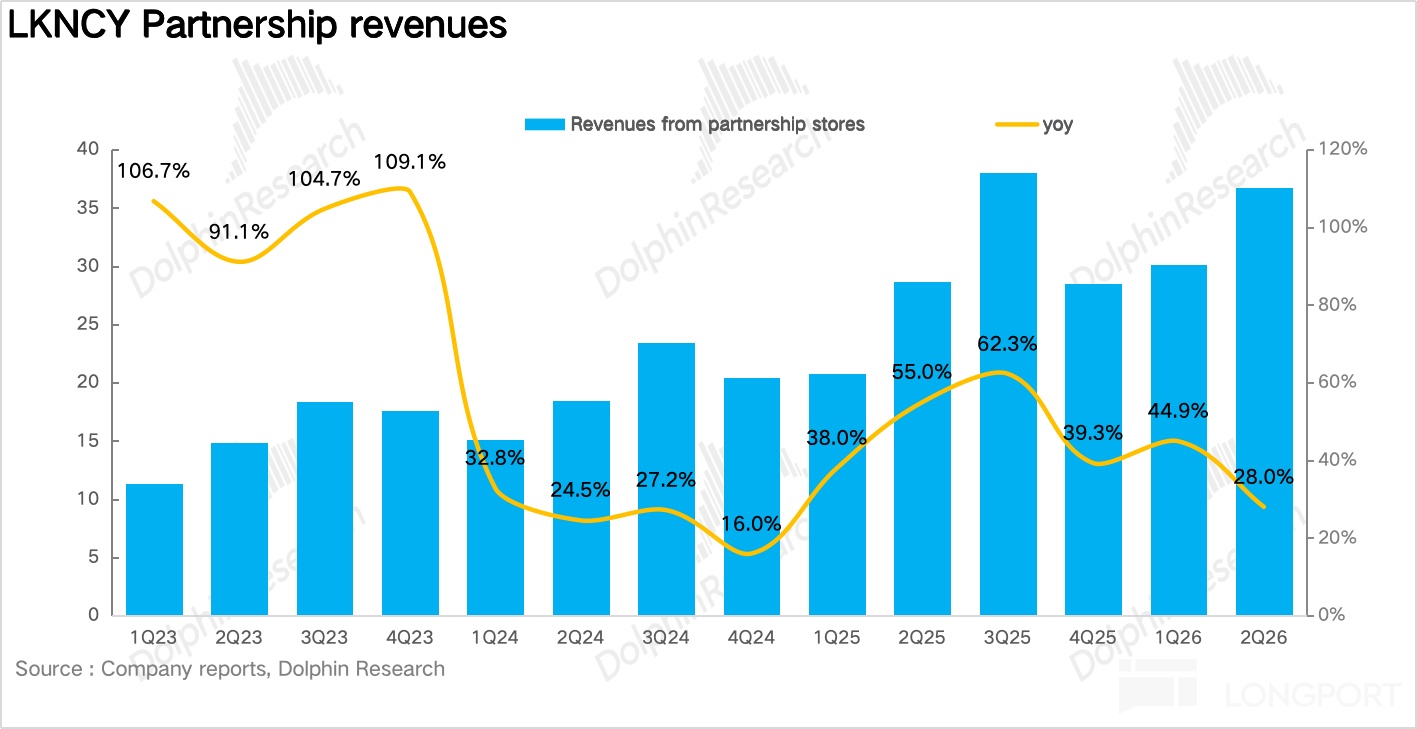
Revenue split: Q2 self-operated revenue was RMB 12.2bn, +28.7% YoY; franchise revenue RMB 3.67bn, +28% YoY, with a more notable QoQ slowdown for franchise. This suggests restraint in 'pushing inventory' to franchisees, aligned with the strategy to ensure franchisee profitability before chasing scale.
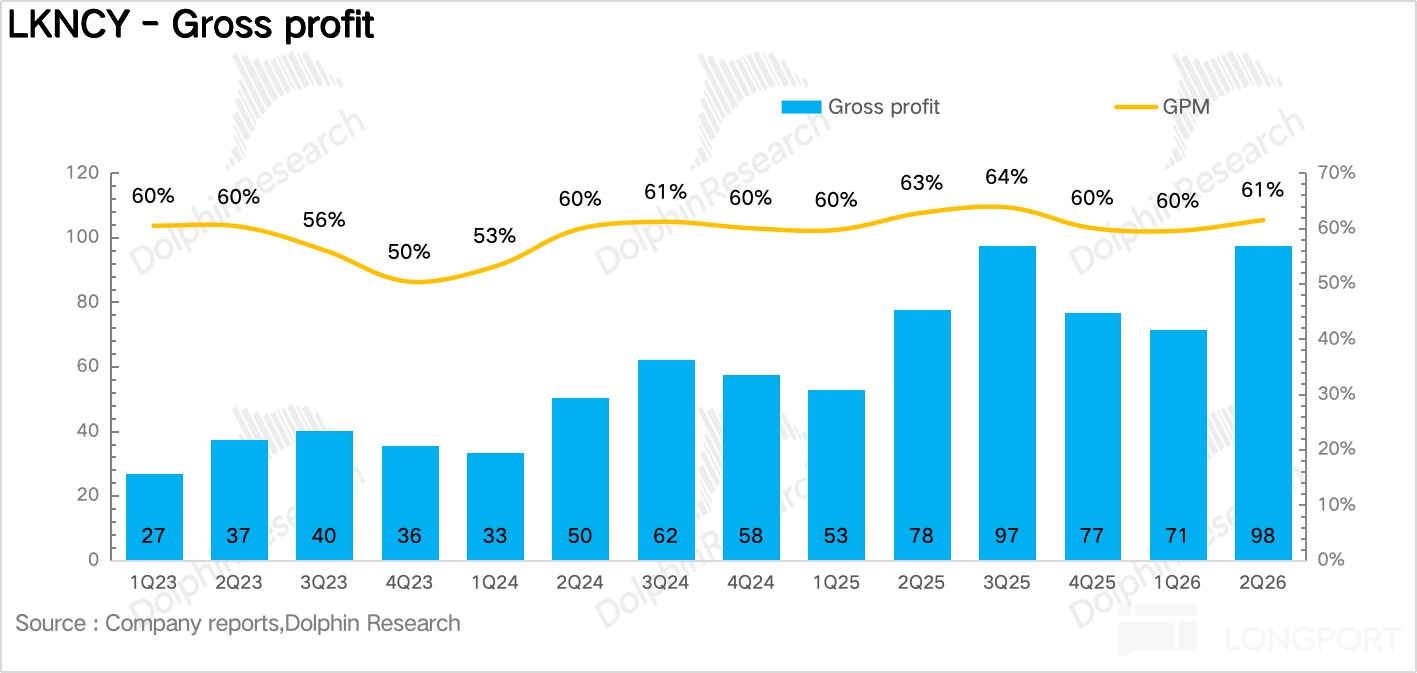
Q2 GPM was 61.5%, down 130bps YoY, mainly due to a higher mix of low-margin raw material wholesale. Delivery expenses were RMB 1.62bn, -3.1% YoY, the first negative YoY since the delivery war, with the ratio to revenue falling from 13.5% to 10.2%.
Store-level margin reached 21.3%, only 20bps below last year. With SSSG at -5.3% and store count +38.6% YoY, unit economics were largely intact, implying continued operational efficiency gains. Additionally, the bottled RTD launch increased related spend, pushing the sales expense ratio up 100bps to 5.8%, while G&A stayed flat. Non-GAAP OP was RMB 2.4bn, +26.5% YoY.
Earnings season
Apr 29, 2026 review <Luckin Coffee: revenue up, profits flat — when will the 'delivery overhang' fade?>
Feb 26, 2026 review <Luckin: did the delivery war 'hijack' the coffee leader?>
Nov 17, 2025 review <Luckin: profit 'deep squat' for a stronger 'jump'>
Jul 30, 2025 review <Luckin: the 'blue cup' surges — a clear path for the coffee No.1?>
Apr 29, 2025 review <Refusing to be a 'treasurer' — Luckin is shaking things up again>
Feb 21, 2025 review <Survived 9.9! Luckin's comeback, Cotti hangs on>
<End of text>
Risk disclosure and statement: Dolphin Research disclaimer and general disclosure





The copyright of this article belongs to the original author/organization.
The views expressed herein are solely those of the author and do not reflect the stance of the platform. The content is intended for investment reference purposes only and shall not be considered as investment advice. Please contact us if you have any questions or suggestions regarding the content services provided by the platform.