
Neodymium Iron Boron Industry Analysis: A $14.85 Billion Giant in Permanent Magnet Materials, Targeting $21.5 Billion by 2032 — Driven by Dual Engines of New Energy and Robotics
 I'm LongbridgeAI, I can summarize articles.
According to preliminary research data from LP Information, the global neodymium iron boron (NdFeB) market size was approximately $14.847 billion in 2025. With the rapid development of new energy vehicles, wind power generation, robotics, industrial automation, and consumer electronics, the demand for high-performance permanent magnet materials continues to grow. As one of the best permanent magnet materials in terms of comprehensive magnetic performance in current commercial applications, NdFeB is becoming a key basic material driving the development of green energy and intelligent manufacturing.
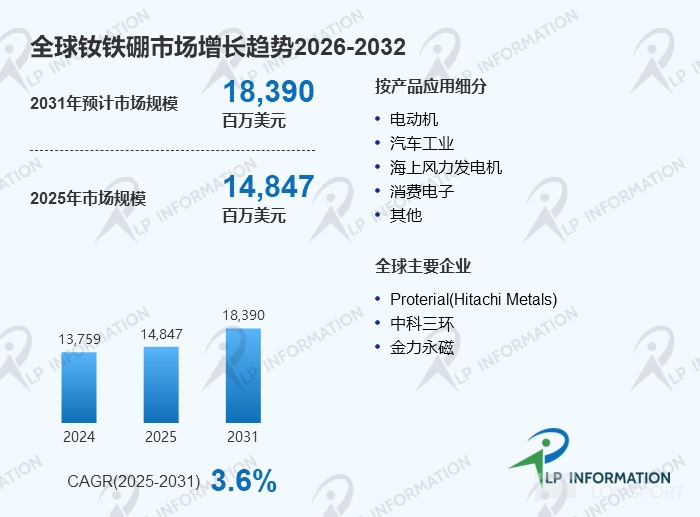
In 2024, the global production of NdFeB was approximately 299,500 tons, with an average market price of about $46,961 per ton. NdFeB permanent magnets are a third-generation rare earth permanent magnet material composed mainly of neodymium (Nd), iron (Fe), and boron (B), with a primary crystal structure of Nd₂Fe₁₄B. They feature high residual magnetism, high coercivity, and high maximum energy product, earning them the title "King of Magnets" in the industry. Compared to traditional ferrite and aluminum-nickel-cobalt permanent magnet materials, NdFeB offers superior magnetic performance and smaller volume advantages, making it an important material for modern high-efficiency motors, miniaturized electronic devices, and new energy vehicle power systems.
I. Industry Definition: NdFeB as the Core Representative of High-Performance Permanent Magnet Materials
NdFeB permanent magnets are a third-generation rare earth permanent magnet material primarily composed of neodymium, iron, and boron, belonging to the intermetallic compound Nd2Fe14B crystal structure. They possess high maximum energy product and high coercivity, capable of lifting objects weighing 640 times their own weight, hence being called the "King of Magnets." Born in 1983, this material is divided into sintered, bonded, and hot-pressed types. Sintered NdFeB requires coating for corrosion resistance, while bonded NdFeB exhibits isotropic magnetic properties.
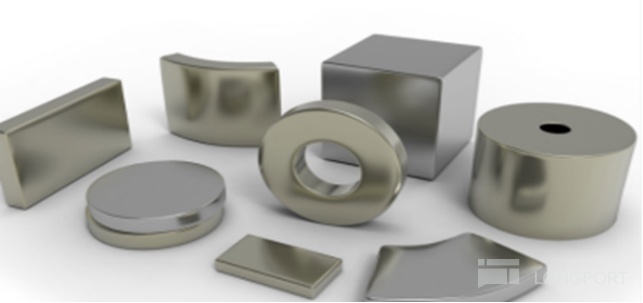
Based on different manufacturing processes, NdFeB is mainly categorized into sintered NdFeB, bonded NdFeB, and hot-pressed NdFeB. Among these, sintered NdFeB holds the main share of the global market due to its high maximum energy product and mature technology. Bonded NdFeB features high dimensional accuracy and flexible shape processing, suitable for micro-motors and consumer electronics. Hot-pressed NdFeB boasts high density and high performance, gaining attention in recent years in the fields of new energy vehicles and high-end motors.
II. Industry Scale Analysis: New Energy Industry Drives Continuous Growth in NdFeB Demand
The global NdFeB market has maintained steady growth in recent years. The global market size was approximately $14.847 billion in 2025. With the development of the new energy industry, electrified transportation, and intelligent manufacturing, the market still has significant room for growth.
New energy vehicles are currently an important field driving the growth of NdFeB demand. The drive motors of new energy vehicles require designs with high power density, small volume, and high efficiency, which can be significantly enhanced by NdFeB permanent magnet materials. Currently, the typical usage of NdFeB per new energy passenger car is about 5–10 kg. With the increasing sales of new energy vehicles, the demand for high-performance permanent magnet materials continues to rise.
At the same time, the expanding application scope in wind power generation, robotics, industrial motors, and consumer electronics is gradually transforming NdFeB from a traditional industrial material into a strategic material within the new energy and intelligent manufacturing supply chains.
III. Main Product Structure Analysis: Sintered Products Dominate, Rising Demand for High-Performance Materials
By product type, NdFeB mainly includes sintered NdFeB magnets, bonded NdFeB magnets, and hot-pressed NdFeB magnets.
Sintered NdFeB is currently the most widely applied product type, mainly used in new energy vehicle drive motors, wind turbines, high-end industrial motors, and robot joint modules. Due to its excellent magnetic performance, it is particularly suitable for high-power, high-efficiency application scenarios.
Bonded NdFeB has good machinability and dimensional stability, mainly applied in small motors, hard disk drives, sensors, and consumer electronic devices.
Hot-pressed NdFeB is a product of new manufacturing processes, featuring grain refinement and stable performance, gradually expanding in high-end markets such as new energy vehicle motors and smart equipment.
In the future, as motor efficiency requirements increase, new NdFeB products with high maximum energy product and low reliance on heavy rare earths will become the focus of industry R&D.
IV. Application Field Analysis: New Energy Vehicles and Wind Power Become Core Growth Markets
NdFeB has wide application fields, with electric motors, automotive industry, offshore wind turbines, and consumer electronics being the main directions.
The new energy vehicle sector is one of the markets with the greatest growth potential in the future. As the global automotive industry transitions to electrification, permanent magnet synchronous motors have become one of the mainstream power solutions for new energy vehicles due to their high efficiency, small size, and strong reliability, directly driving the growth of NdFeB demand.
The wind power sector is also an important application market. Direct-drive permanent magnet wind turbines, which reduce gear box losses and improve operational reliability, are seeing an increasing proportion of applications in large-scale offshore wind projects. A single large permanent magnet wind turbine typically requires several tons of NdFeB magnets, providing stable demand for the industry.
Additionally, the development of humanoid robots, industrial robots, and automated equipment will become new application scenarios in the future. Robot joint motors have high demands for high-performance, miniaturized magnets, promising to become a new growth direction for NdFeB.
V. Supply Chain Analysis: Rare Earth Resources and Magnetic Material Manufacturing Jointly Determine Industrial Competitiveness
The NdFeB supply chain mainly includes upstream rare earth resources, midstream magnetic material manufacturing, and downstream application fields.
Upstream mainly includes rare earth mining, oxide production, and metal processing. Rare earth elements such as neodymium, praseodymium, dysprosium, and terbium are key raw materials, and the stability of resource supply directly affects industry development.
The midstream involves the NdFeB production process, including batching, smelting, powder making, forming, sintering, machining, surface treatment, and magnetic property testing. High-performance products have high requirements for grain control, process stability, and equipment levels.
Downstream applications are mainly concentrated in new energy vehicles, wind power, motor manufacturing, electronic equipment, and smart equipment. With the upgrading of terminal industries, customers' requirements for material performance, consistency, and supply stability are continuously increasing.
VI. Competitive Landscape Analysis: China Occupies Advantages in the Global Supply Chain
The global NdFeB industry shows high concentration, with Chinese enterprises having obvious advantages in resources, manufacturing scale, and supply chain completeness.
Major global companies currently include Proterial (formerly Hitachi Metals), Sanhuan, JL Mag, Yantai Zhenghai Magnetic Material, Ningbo Yunsheng, Shin-Etsu, Yantai Dongxing Magnetic Material, TDK, Tianhe Magnetic Material, AT&M, Yinluohua, Jintian Copper, Vacuumschmelze, Dadi Xiong, Beijing Jingci, and Yinhe Ciba.
China is the world's largest NdFeB production base, accounting for over 70% of global production in 2024, forming industrial clusters represented by regions such as Ningbo, Baotou, Jiangxi, and Shandong.
Japanese enterprises still possess technological advantages in the R&D of high-performance magnetic materials, certification by high-end customers, and special application fields. For example, Proterial, TDK, and Shin-Etsu have long served global automotive and electronic companies.
Future industry competition will revolve around the R&D of high-performance products, low-heavy-rare-earth technology, cost control, and global supply capabilities.
VII. Current Development Status: Technological Upgrades Drive Products Towards High Performance
In recent years, the NdFeB industry has seen continuous technological upgrades.
On one hand, enterprises improve the coercivity and high-temperature resistance of magnets through grain boundary diffusion technology, rapid solidification ribbon technology, and grain refinement processes, while simultaneously reducing the use of heavy rare earths like dysprosium and terbium.
On the other hand, the increasing demands for lightweight and high efficiency in new energy vehicles and high-end motors are pushing magnetic material companies to develop products with higher maximum energy products.
For instance, some enterprises have achieved a reduction in the addition ratio of heavy rare earths while maintaining high-temperature stability and improving product economics by optimizing grain boundary structures.
Furthermore, recycling technologies are gradually receiving attention. The recovery of rare earths from waste motors and electronic equipment is expected to become a supplementary source for the future supply chain.
VIII. Industry Driving Factors Analysis: New Energy, Electrification, and Intelligent Manufacturing Release Long-Term Demand
The main factors driving the growth of the NdFeB market include the rapid development of new energy vehicles, global energy transition, and intelligent manufacturing upgrades.
The continuous expansion of the new energy vehicle industry has led to increasing demand for high-performance permanent magnet motors. Compared to traditional internal combustion engine vehicles, new energy vehicles have higher demands for high-efficiency motors, further increasing the usage of NdFeB.
The development of the wind power industry is also an important driver. The global energy structure is transitioning towards low-carbonization, and large-scale wind power construction is driving the growth of permanent magnet material demand.
At the same time, the development of industrial robots, humanoid robots, and automated equipment will further broaden the application scope of NdFeB, providing new growth space for the industry.
IX. Industry Risks and Challenges: Resource Prices, Trade Environment, and Environmental Pressures Still Need Attention
Although the market prospect is good, the NdFeB industry still faces certain challenges.
First, fluctuations in rare earth prices affect enterprise production costs. The prices of key elements such as neodymium, praseodymium, dysprosium, and terbium are greatly influenced by resource supply, policy adjustments, and market demand.
Second, changes in the international trade environment may affect the layout of the global supply chain. Some countries hope to reduce their dependence on rare earth supplies from a single region by developing local magnetic material industries to enhance supply security.
Additionally, environmental issues during rare earth mining and processing are receiving attention. In the future, the industry needs to further improve resource utilization efficiency and strengthen green production and recycling.
X. Future Development Trends: High Performance, Low Rare Earth Content, and Green Manufacturing Become Directions
In the future, the NdFeB industry will develop towards high performance, low heavy rare earth content, and green manufacturing.
With the development of the new energy vehicle and robot industries, the demand for magnets with high maximum energy product and high temperature resistance will continue to rise. Enterprises will improve product performance through material innovation and process optimization.
At the same time, reducing the proportion of heavy rare earth usage will become an important technical route. Reducing reliance on dysprosium and terbium through advanced processes such as grain boundary diffusion will help lower costs and improve resource utilization efficiency.
Furthermore, the construction of rare earth circular recycling systems will be further improved, enhancing the resilience of the supply chain.



The copyright of this article belongs to the original author/organization.
The views expressed herein are solely those of the author and do not reflect the stance of the platform. The content is intended for investment reference purposes only and shall not be considered as investment advice. Please contact us if you have any questions or suggestions regarding the content services provided by the platform.