

Why are items getting cheaper to sell, yet encountering 'Xiao Mian' leads to even higher profits?
 I'm LongbridgeAI, I can summarize articles.
On August 17, Meet Xiaomian disclosed its H1 2026 results: revenue reached RMB 939mn in the first half of the year, a YoY increase of 33.6%; profit attributable to shareholders was RMB 63.26mn, up 51.2% YoY; adjusted net profit stood at RMB 73.06mn, rising 40% YoY, with the adjusted net margin expanding from 7.4% to 7.8%.
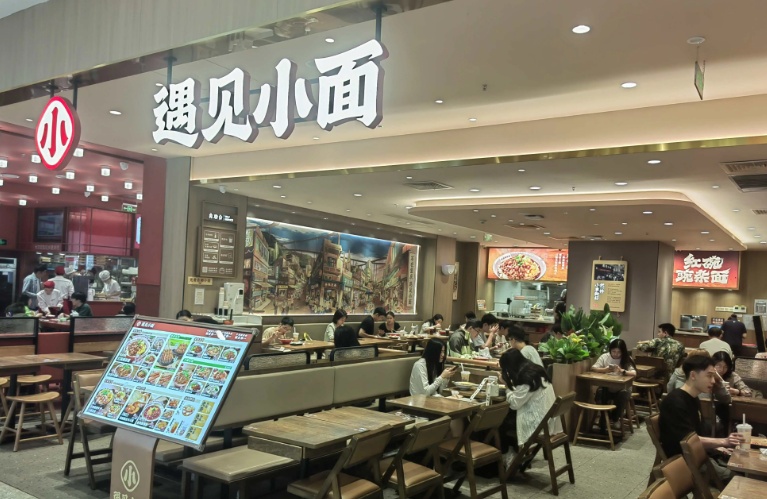
Data from the National Bureau of Statistics for the same period showed that national catering industry revenue hit RMB 282.55bn in H1, a modest 2.8% YoY growth. For rapidly expanding restaurant chains, outperforming the market top-line is not surprising, but sustained profit growth outpacing revenue suggests it's far more than just "selling more volume."
The contradiction lies in pricing. Financial reports indicate that same-store average ticket prices dropped from RMB 31.3 to RMB 27.7, a 11.5% YoY decline. While same-store daily orders rose from 372 to 401, same-store sales still fell by 4.3%. The price cuts did drive higher foot traffic, but single-store sales volumes haven't yet fully offset the gap left by lower ticket prices.
The company's improved profitability cannot be simply attributed to thin margins driving high volume. The real drivers behind profit growth are store location optimization, declining rental costs, and the dilution of headquarters expenses through scale.
Consumers are buying the experience a bowl of noodles brings, not just the price tag. The drop in pricing from RMB 31 to RMB 28 is merely superficial; what truly determines whether a business model works is the ability to retain repeat customers and absorb increased traffic within controllable cost structures.
This interim report from Meet Xiaomian serves as an industry sample: the competition for value-for-money in dining has moved beyond sticker prices to focus on actual operational efficiency.
High-frequency consumption is rewriting the profit structure of chain restaurants
As of the end of June, Meet Xiaomian had 550 stores, up from 417 a year ago, a 31.9% YoY increase. This includes 451 directly operated stores and 99 franchised locations. Store expansion speed has nearly caught up with revenue growth, indicating that current growth is primarily driven by new openings.
The inflection point for profitability hides within the cost structure. The company also noted in its financial report that improving profits come partly from network expansion, with many stores moving from core commercial districts to areas with lower rents, and partly from the continued dilution of HQ costs.
Total rent expenditure for H1 was RMB 158.6mn, up 25.6% YoY, significantly lagging behind the 33.6% revenue growth. The rent-to-revenue ratio decreased from 18.0% to 16.9%. Advertising and promotion expenses were compressed from 1.4% to 1.1% of revenue.
In contrast, rigid costs saw slight increases: raw material and consumable ratios rose marginally from 31.4% to 31.8%, while employee cost ratios increased from 22.6% to 23.6%. These figures debunk a common misconception: Meet Xiaomian's profit improvement isn't about squeezing suppliers or lowering ingredient costs. The real leverage released comes from property and organizational costs at the HQ level.
The catering industry carries significant semi-fixed costs. Rent, renovation, equipment, regional management, and digital investments won't decrease just because a bowl of noodles drops by a few yuan. If stores boost order volume through price cuts while escaping high-rent city centers, the fixed cost allocated per order will decline.
In the broader economic context, the value of this model is further amplified. By 2025, the national catering chain rate reached 25%, according to a joint white paper by CCFA and Meituan. While overall industry growth has slowed, chain brands are still fighting for existing market share, making location selection, supply chain, and organizational efficiency the core battlegrounds.
However, Meet Xiaomian's efficiency advantages have not been fully realized. Same-store orders are rising, but same-store sales remain in negative territory. The key metric to watch next is whether order growth can cover the decline in average ticket size. Only when mature store sales stabilize will group-level economies of scale truly flow down to older locations.
Profit direction depends on frequency, inventory, and channel costs
To discuss value-for-money, China Lilang Limited, which released its earnings on the same day, serves as a useful reference.
In H1 2026, China Lilang reported revenue of RMB 2.065bn, up 19.5% YoY; profit attributable to shareholders was RMB 215.4mn, down 11.2% YoY; gross margin retreated from 50.2% to 48.9%, and operating margin fell from 15.1% to 11.3%. The report explained that the increased share of high-value products and promotional items directly lowered the overall average selling price, while cost of sales surged 22.8%, outpacing revenue growth.
Lilang is advancing its DTC and new retail channels. Sales and distribution expenses in H1 totaled RMB 687.2mn, accounting for 33.3% of revenue, a 1.6 percentage point YoY increase. Inventory turnover days extended from 231 to 250 days. While the DTC model enhances terminal control and drives revenue, channel setup, inventory pressure, and price concessions simultaneously erode profits.
Placing these two companies side-by-side highlights the divergence in the consumer sector. Both pursue value-for-money strategies, but dining benefits from high-frequency dividends, whereas apparel must first withstand impacts on gross margins and inventory.
Noodles represent immediate, high-frequency consumption; after price cuts, existing kitchen capacity and seating can handle more traffic. Apparel is different: low purchase frequency means 单品 price cuts rarely stimulate proportional increases in volume. Plus, seasonal inventory, discount losses, and channel fees mean price reductions hit gross margins first, with sales volume unlikely to fully compensate.
Value-for-money doesn't automatically mean profitability. It hinges on two things: how much price reduction sales volume can absorb, and whether unit costs can drop as scale grows. Meet Xiaomian's positive changes stem from diluted rent and HQ costs; Lilang's report proves that during scale expansion, channels and inventory are pressures that need digestion.
The reality for consumer enterprises is straightforward: products can be sold cheaper, but operating costs must fall faster than selling prices.
Store density must ultimately translate into lower unit costs
Meet Xiaomian has set clear expansion targets: planning to open 150-180 new stores in 2026. As of August 10, 84 new stores have opened, with another 93 in preparation. Moving forward from 550 stores, the challenge is no longer just finding locations, but ensuring that new stores across cities maintain stable operational standards.
Another noteworthy point in the report: direct-operated store takeout revenue grew from RMB 128.9mn to RMB 242.4mn YoY, increasing its share of total revenue from 18.3% to 25.8%; service fees paid to third-party platforms also rose from RMB 30.52mn to RMB 52.38mn. Takeout expands service radius, but platform commissions become a rigid new expense. Future profitability requires balancing dine-in efficiency, takeout costs, labor, and rent; order quality matters far more than order quantity.
At its core, chain catering competition is about replicable organization. Standardization ensures consistent output; store density dictates supply chain delivery and regional management efficiency; location determines the rent model; and HQ capability prevents distortion during the expansion of hundreds of stores. Only when all links work smoothly can scale convert into tangible profits.
This is Meet Xiaomian's most fundamental aspect for the next two to three years. With continuous expansion, if new store returns are stable, same-store sales stop declining, rent expense ratios continue to optimize, and takeout/labor costs are controlled, profits have the opportunity to outpace revenue. Conversely, if customer traffic splits between stores, same-store performance weakens continuously, and platform/labor costs rise again, the profit elasticity brought by scale will be neutralized.
Consumer sensitivity to price doesn't mean the market only accepts low prices. Consumers are unwilling to pay for inflated premiums, but standards for quality, hygiene, and convenience haven't dropped. Behind the 25% chain rate is consumers' preference for brands that deliver stability.
Meet Xiaomian's interim report presents a mixed bag of sweet and bitter. High-quality value-for-money in the consumer sector requires completing the full loop: price drives frequency, frequency builds store density, density dilutes unit costs, ultimately landing on stable profitability.
For Meet Xiaomian, reaching 1,000 stores is just a number. What holds true industry reference value is whether they can sustainably achieve: selling things cheaper while making the business thicker and more profitable.
The copyright of this article belongs to the original author/organization.
The views expressed herein are solely those of the author and do not reflect the stance of the platform. The content is intended for investment reference purposes only and shall not be considered as investment advice. Please contact us if you have any questions or suggestions regarding the content services provided by the platform.