
In the storage storm, the "bottom" for Xiaomi's mobile phone business is approaching.
 I'm LongbridgeAI, I can summarize articles.
In Xiaomi's Q2 2026 earnings report, several data points warrant close attention:
1) A 6.1% YoY decline in total revenue;
2) Gross profit fell by 17.2% YoY, causing the gross margin to drop from 22.5% in the same period last year to 19.8% this quarter;
3) Smartphone ASP rose slightly to RMB 1,351, but total revenue decreased by 4.9% YoY, with the gross margin falling from 11.5% YoY to 8.5% this quarter.
In short, Xiaomi faced a rare double whammy in Q2 2026. On one hand, surging prices for raw materials like memory chips increased the hardware BOM burden; on the other, weak global demand suppressed the ability to pass on costs.
With the issues and causes identified, investors may be wondering: where is the inflection point for Xiaomi's operations? After a detailed review of the earnings report, we found that Xiaomi's turnaround is already taking shape.
Due to space constraints, we focus our analysis on Xiaomi's smartphone business. First, we calculated the memory cost per unit, as shown below.
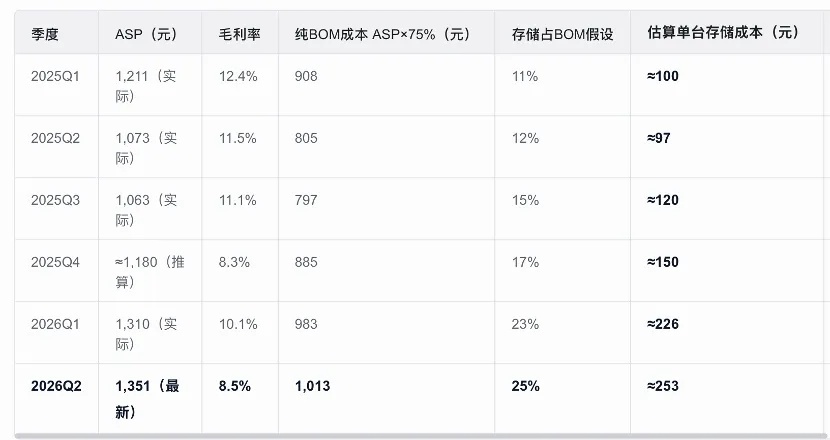
Following industry norms, BOM typically accounts for 70%-80% of ASP (we used 75%). This implies Xiaomi's memory cost per phone rose from ~RMB 100 in Q1 2025 to ~RMB 250 in Q2 2026. Memory still represents an assumed share of the BOM (blended across all models), with lower-end devices having a significantly higher proportion than high-end flagships. For instance, Bernstein's teardown of the Xiaomi 17 Pro revealed that memory accounted for approximately 10% of the selling price in 4Q25.
This confirms the burden of rising memory prices on Xiaomi's smartphones. However, we also observed that while the memory cost per Xiaomi phone increased 2.5x between Q1 2025 and Q2 2026, this rise was far below the overall increase in memory prices (Lu Weibing stated that DRAM quotes in 2026Q1 were roughly 4x year-over-year).
This discrepancy caught our attention. Our research suggests two main reasons:
First, Xiaomi reduced sales of mid-to-low-end phones. We previously suggested this strategy to mitigate the impact of rising memory costs through premiumization. Xiaomi appears to have adopted this approach, pushing ASP to a historical high of RMB 1,351.
Second, Xiaomi secured full-year memory supply agreements for 2026 in advance and expanded domestic substitution via Changjiang and CXMT (which are 15–20% cheaper).
Thus, against the backdrop of industry-wide memory price hikes, Xiaomi has managed to keep risks at a low level through operational adjustments—a rare bright spot in a harsh reality.
So, how should we view Xiaomi's inflection point?
In Q3 2026, Xiaomi implemented three rounds of price increases, as shown below:

Taking the Xiaomi 17 Pro as an example, its post-increase price is approx. RMB 5,399, with a BOM cost of RMB 4,049. Assuming a 25% memory share, the memory cost calculates to RMB 1,012. This means that for the same model under equivalent gross margins, its tolerance for memory price increases rises from RMB 937 this quarter to RMB 1,012, an 8% improvement.
Applying this logic, these developments imply for Xiaomi:
1) With the influx of new models in H2, ASPs will continue to improve, further enhancing Xiaomi's tolerance for memory prices. This also includes further cuts to low-price phone offerings.
2) The market generally predicts that global memory price growth will slow down in Q3-Q4 (though it remains positive).
Therefore, if the room for ASP optimization in the short term exceeds memory price growth, allowing Xiaomi to maximize hedging capabilities in 2026, the "bottom" for Xiaomi's smartphone business is forming.
Of course, this only addresses immediate pressures. True recovery for Xiaomi awaits the end of this memory cycle.
$XIAOMI-W(01810.HK)




The copyright of this article belongs to the original author/organization.
The views expressed herein are solely those of the author and do not reflect the stance of the platform. The content is intended for investment reference purposes only and shall not be considered as investment advice. Please contact us if you have any questions or suggestions regarding the content services provided by the platform.