
新
1 day ago, 08:55 PM
After WorkBuddy, Tencent AI returns to the main track
 I'm LongbridgeAI, I can summarize articles.
Focusing solely on the latest semi-annual report, it's easy to misinterpret Tencent's AI investments as an increasingly expensive gamble.
Net cash flow plummeted from ¥146.9 billion in Q1 to ¥58.2 billion in Q2, with free cash flow turning negative for the first time. Tencent is subsidizing its AI ambitions using the robust cash flows from its 'old guard' businesses like gaming and advertising.
But what has all that burning capital actually produced?
A dramatic contrast emerged early this year: 'Yuanbao,' which launched with a 'high-profile, high-budget' strategy, spent ¥15 billion joining the red packet war, yet its DAU (Daily Active Users) metrics were underwhelming; meanwhile, WorkBuddy, developed by a mere 10-person team over two overnight sessions, surpassed 20 million monthly active users within four months, topping the list of domestic office AI agents.
Why did the ¥15 billion Yuanbao fail to become the answer, while the 10-person WorkBuddy succeeded?
The divergence between the two precisely maps Tencent AI's path from 'inertial charging' to 'rational realignment.'
1. Capturing Demand from the Bottom Up
Strictly speaking, WorkBuddy was not a top-down strategic product at Tencent; rather, it was the result of capturing a bottom-up 'accidental signal.'
Three years ago, riding the wave of Agents, Tencent chose to bet resources on the AI coding tool CodeBuddy.
While CodeBuddy laid the foundation for Agent capabilities, a key signal emerged during this period: over 10,000 non-developer employees were also using CodeBuddy to handle non-code tasks.
The convergence of these two undercurrents accelerated the birth of WorkBuddy.
First was the urgent need to address genuine 'non-code' demands.
In January this year, Wang Shengjie, head of CodeBuddy, along with several core members, created a version tailored for non-technical users. With the technical core unchanged but interaction logic rewritten, the prototype of WorkBuddy was born.
Second was the catalytic effect of the 'Lobster' craze.
In March, the 'deploying lobsters' trend sparked by OpenClaw caused long queues outside Tencent's headquarters, pushing underwater projects into the spotlight. WorkBuddy was one of them.
At first glance, Tencent's 'Lobster Legion' might seem like just another footnote in big tech's internal horse racing.
However, while horse racing involves resource 抢夺 on the same track, the 'Lobster' matrix represents strategic probing via different paths. Laid out side-by-side, a more accurate summary is that Tencent is 'positioning at multiple points.'
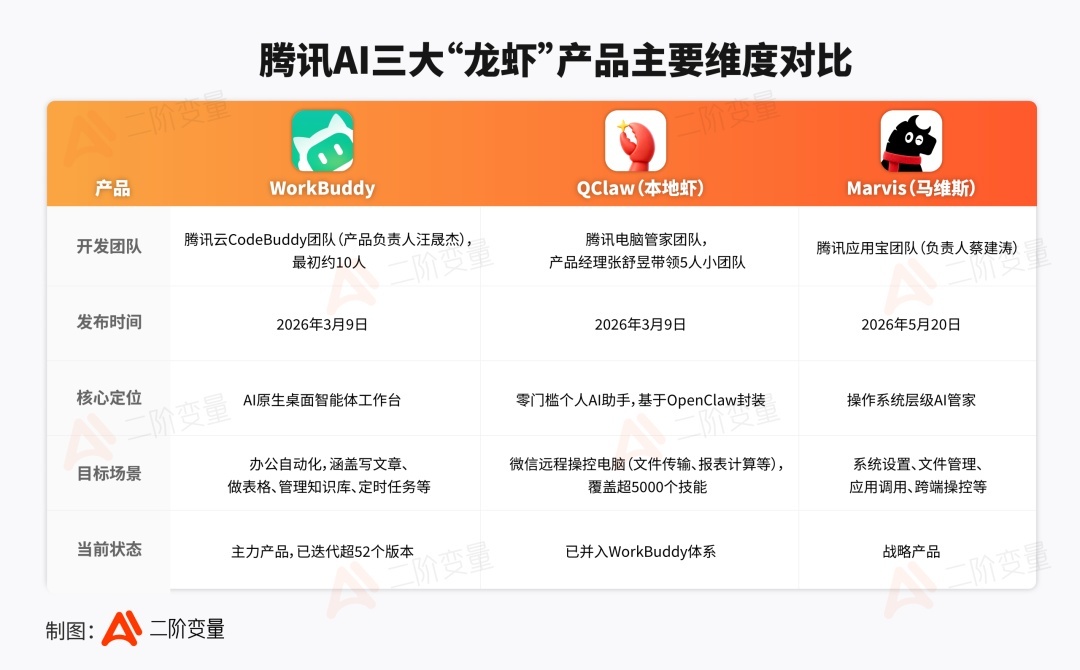
Under Tencent's strategic resolve of 'All in AI', lies the execution point of 'AI in All', meaning letting AI flow into every product like utilities.
WorkBuddy targets office productivity, QClaw bets on open-source ecosystem entry points, and Marvis positions itself at the OS level. The three belong to different battlefields, exploring separately in the same uncharted territory.
In the highly uncertain new track of AI Agents, Tencent chose to find the optimal solution for its own ecosystem through rapid trial-and-error across multiple paths and scenarios, then lock onto the 'correct answer' without hesitation.
In the month WorkBuddy launched, PC monthly visits reached 8.85 million. Tencent immediately made decisive, large-scale bets.
According to 'LatePost', in May, the CodeBuddy and WorkBuddy teams were upgraded to the Sixth Department of Cloud Products at Tencent Cloud;
in June, Tencent integrated Tencent Docs, Tencent Drive, and Tencent Lexiang, and incorporated QClaw business and some teams into this structure.
In the semi-annual report, WorkBuddy's strategic status leaped again. Tencent explicitly listed WorkBuddy's inference computing power as the second most important use of capital expenditure,仅次于 training the Hunyuan large model.
From 'accident' to 'strategic tier', WorkBuddy took less than four months.
Why does Tencent dare to rapidly pour resources into such an edge-born product?
The answer lies in the fact that it simultaneously hit three of Tencent's core preferences.
Technically, it inherited the 'native' technological lineage.
WorkBuddy repackaged CodeBuddy's 'task orchestration, tool invocation, and execution mechanisms' designed for programmers to serve a broader office audience.
This represents the 'orthodox evolution' of Agent capabilities from specialized domains to general scenarios.
Strategically, WorkBuddy perfectly aligns with Tencent's 骨子里 'connection' gene.
As the 'unified agent entry point and platform for Tencent Cloud AI Agents', WorkBuddy aims to integrate high-frequency scenarios like code, office, and design, becoming the first stop for user interactions with all AI capabilities.
Furthermore, it can connect with internal products like Tencent Docs and WeCom, evolving from a single application into a underlying platform 承载 other applications and services.
Commercially, WorkBuddy is naturally suited to open monetization channels.
Unlike CodeX, which can only invoke proprietary models, WorkBuddy supports free switching among multiple mainstream large models including Hunyuan. This openness brings dual commercial benefits: it can charge users via Token invocation fees and take a cut from model vendors 接入。
According to disclosures in the earnings call, the gross margin of WorkBuddy's paying users and the gross margin of Model-as-a-Service (MaaS) have now caught up with Tencent Cloud's overall gross margin.
Through the window of WorkBuddy, you can also clearly see the reversal of product thinking in the AI era.
The traditional internet traffic logic has failed. Yuanbao resembles the 'Odyssey' phase of Tencent AI, following the usual 'build first, think later' logic, but failing to clarify product value and business models, making it hard to succeed.
WorkBuddy is entirely different; its growth trajectory is more like a deterministic product shaped by Tencent's 'think while building', capable of continuously converging through feedback.
Behind this methodological shift is a fundamental change in the understanding of user needs.
User needs are no longer explicit mineral deposits waiting to be mined, but clay that needs to be shaped by the product. In the AI era, users often don't know what they truly need until the product delivers the answer right before their eyes.
But user feedback remains an indispensable closed loop. The essence of AI products is a high-frequency triangular calibration among model parameters, product definition, and user needs. And the rhythm of this calibration is far faster than any previous technology cycle.
This tests the team's agility in responding to changes extremely well, something Tencent is clearly good at.
Following the historical methodology of 'small steps, fast running, rapid iteration',** WorkBuddy released 52 versions in its first four months, launching almost one every two days.
The root cause enabling all this lies in Tencent's deep understanding and execution of Co-Design internally, meaning products and models, algorithms and scenarios must co-evolve.
2. Co-Design Implementation: Tencent AI Tightens Its Rope
In June, a conversation between Tang Daosheng, CEO of Tencent Cloud and Smart Industrial Group, and Yao Shunyu went viral in the industry. The core reason for its virality was that the two openly discussed doubts about 'Tencent AI lagging behind'.
Given Tencent's pragmatic temperament, daring to publicly discuss 'shortcomings' likely means AI progress has reached a level of confidence sufficient for public scrutiny.
The content of the conversation was essentially a review of achievements.
Yao Shunyu, a young scientist parachuted in from OpenAI, is precisely the core variable in this review.
If WorkBuddy's rise is a visible thread, then Tencent AI's internal evolution from organization to models forms a hidden thread.
After Yao Shunyu joined, Tencent AI's organizational structure completed a full consolidation from decentralized to centralized in less than eight months. Centered around him, the R&D system was re-tightened into a single rope.
This contrasts with Alibaba's pace:
Alibaba uses Eddie Wu as the highest decision-making axis, bringing AI strategy, technical coordination, and commercialization fully under direct CEO management; whereas Tencent's choice was to push a young scientist to the center of gear meshing, allowing technical judgment to directly drive resource allocation.
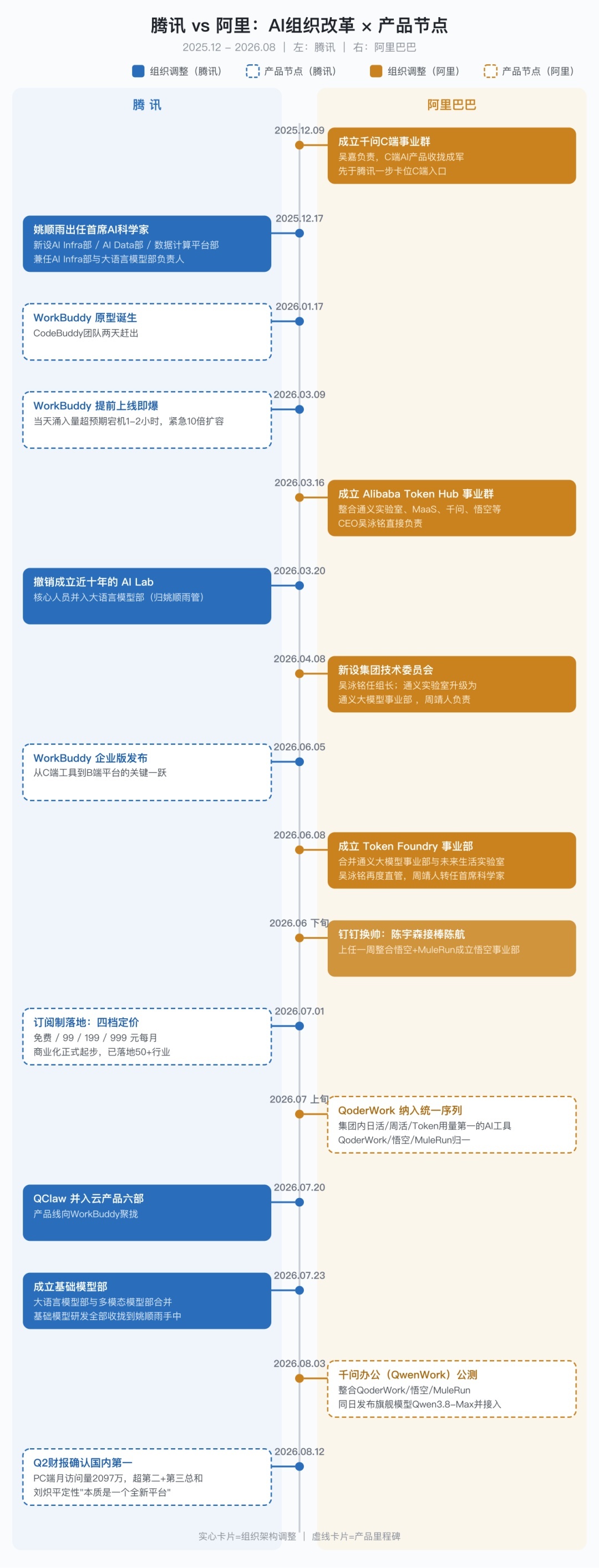
Aligning with the release rhythm of office Agent products, this also confirms an industry consensus: Alibaba tends towards 'organization first', adapting to AI strategy through frequent organizational adjustments. Tencent excels at 'product first', where product design, organizational changes, and model growth are tightly coupled.
Focusing on the office Agent station, WorkBuddy ran a clear time gap: while Alibaba was still repeatedly drawing organizational lines, Tencent had already completed product validation and market positioning.
The combat capability to dare to 'product first' is precisely the essence of Tencent's 'Co-Design' methodology. This term was frequently mentioned and deeply explained in the Tang-Dao Sheng and Yao Shunyu conversation.
But Co-Design is just an open secret in tech product design; the difficulty lies in how to implement it thoroughly.
Understanding this point is the key to truly understanding why Workbuddy secured the number one spot in office Agents.
After taking office, Yao Shunyu focused on three things:
First, correcting the model's bias.
He overturned Hunyuan's previous R&D path of excessively chasing leaderboards, leading the reconstruction of Hunyuan's pre-training and reinforcement learning infrastructure systems, pulling the evaluation standards back from 'gaming the leaderboard' to real user experience.
Previously, Hunyuan mixed relevant corpus into the training set to game the rankings, resulting in a model that was 'good at exams but a mess in real scenarios'.
After Yao Shunyu took office, he required the team to 'stop focusing on leaderboards' and instead establish an evaluation system oriented towards actual product performance.
Second, closing the loop between models and products.
Before WorkBuddy, Yuanbao, as a C-end application, received massive amounts of real user instructions daily. These context data from real scenarios became the most valuable material for Hunyuan's training.
Hunyuan capabilities verified in the Yuanbao scenario were then directly empowered to WorkBuddy. After Hy3 integration, WorkBuddy's task resolution rate increased from 72% to 90%, and processing time was reduced by 34%.
Conversely, the task data generated by WorkBuddy flowed back as iterative nourishment for Hunyuan.
Every event answered the same question: how models serve products, and how products feed back into models.
Notably, Yao Shunyu even suggested building a group-level reinforcement learning platform, allowing different businesses to train their own models on it, while feeding real business data back to Hunyuan—effectively leveraging the entire company's strength to build products.
This is a crazy idea, but also a very correct one.
And WorkBuddy's explosion is gradually validating the feasibility of this path. Tencent has finally twisted models, products, data, and organizations into a single rope.
This inevitably means WorkBuddy will be a sufficiently usable product for mass office needs.
Two distinct backgrounds are clearly visible on WorkBuddy:
It is both the culmination of office Agent tool capabilities and continues Tencent's 一贯细腻 ness in product design. Let me share two details.
WorkBuddy aggregates massive Skills. Besides users being able to build exclusive Skills themselves, they can also directly call official preset skill libraries, allowing ordinary users to start using it immediately without starting from scratch.
Additionally, any model displays real-time deduction details of points when responding, and even accompanies interesting waiting prompts during the model's 'thinking' process, making every invocation perceptible and predictable.
Yes, this familiar product design is likely experienced in many Tencent products like games, representing the most typical feel of Tencent's product craftsmanship.
3. It Won't Be Just One Good Card
WorkBuddy stands under the spotlight inside Tencent, with computing power, technology, and market resources mostly getting quick approval, green-lighted all the way.
There are even rumors that this will be Tencent's third major strategic product after QQ and WeChat.
But a completely new Tencent empowered by AI is definitely not limited to this.
In reality, big tech has always been walking two paths on the AI line:
On one hand, independent new products explore the boundaries of AI; on the other, core businesses grope their own paths to AI-ification.
WorkBuddy belongs to the former, with new quality productive forces stepping to the forefront. The burden of the latter is gradually falling on the WeChat-led Agent—'Xiao Wei'.
Xiao Wei is a top-secret project incubated inside Tencent since the first half of 2025. Unlike WorkBuddy which directly calls group AI resources, Xiao Wei belongs to WeChat internally, with its base model being WeChat's self-developed Chinese large language model WeLM, and some complex tasks calling models like DeepSeek for supplementation.
Its positioning can be understood as the 'all-around butler' of the WeChat ecosystem—embedded in 1.4 billion monthly active users, connecting WeChat's social, content, services, and payments, completing the closed loop from demand to transaction.
Currently, Xiao Wei has started gray testing. In the highly valuable position of the top left corner of the WeChat homepage, the Xiao Wei entry has already been opened. Users can call various WeChat functions through it, such as summarizing group chats, public account content, opening mini-programs to complete ordering, etc.
Notably, previously Tencent Yuanbao also tried to break through WeChat boundaries in functional development, but functions were mostly active in public account comment sections.
WeChat has always been a relatively independent territory inside Tencent. Beyond team independence, WeChat has its own product philosophy, such as particularly valuing platform reputation and user experience, not wanting ads and message harassment to bother users.
Now, the same logic extends to AI Agent capabilities, to what extent it can be developed and which boundaries can be opened, WeChat prefers to guarantee absolute certainty based on 'autonomy rights'.**
Regardless, 'Xiao Wei' remains another ace card for Tencent's exploration of AI transformation.
A possible division of labor is: WorkBuddy leads the 'productivity' path, helping users complete office tasks; WeChat leads the 'life' path, letting AI help users complete daily affairs like socializing and travel.
However, compared to the high-profile promotion of Yuanbao earlier this year, Tencent's investment strategy for Xiao Wei is significantly more prudent.
Michael He explicitly stated in the earnings call that the scale of cost investment for Xiao Wei will be lower than previous investments in Yuanbao, with overall costs 'fully controllable'.
Xiao Wei is more like a rhythmic AI experiment inside WeChat, adhering to WeChat's 一贯 strategic restraint, and reflecting Tencent's current pragmatic characteristics of 'scenario-driven, progressive investment'.
Summarizing Tencent's exploration and actions in the AI sector, one can clearly feel a strategic philosophy of 'advance if possible, defend if necessary'.**
Most obviously, this is seen in the offensive and defensive design at the capital expenditure level. On the surface, Tencent's Q2 capital expenditure of ¥52.78 billion causing free cash flow to turn negative for the first time gives an impression of 'aggressive money burning'.
But Michael He simultaneously revealed two trump cards on the call:
One is prioritizing self-use to earn long-term subscription and Token revenue; the other is a safety net, where idle computing power can also be rented out externally, creating decent investment returns.
In terms of product tactics, when Yuanbao fell behind, WorkBuddy immediately broke out from office Agents; once WorkBuddy stood firm, Xiao Wei was already gathering momentum within the WeChat ecosystem.
Tencent won't let itself have no good cards in hand, nor will it be left with just one good card.
So, why does Tencent always maintain composure?
Actually, the fact that Tencent dared to directly 引进 young scientist Yao Shunyu and give him the authority to 调动 the group's vast resources already explains the problem.
In his conversation with Tang Daosheng, Yao Shunyu stated that Tencent generally operates based on trust rather than metrics, possessing low ego traits in its organizational culture, with an extremely solid side.
These seemingly soft cultural genes are precisely what is most needed for doing AI.
Translated into plain language, it roughly means, Tencent doesn't put on airs, can quickly bow its head in front of mistakes, and then quickly turn around.
Looking at the longer time axis, big tech's ups and downs over the past thirty-plus years have always revolved around the grand prefix of 'Internet +'.
After the arrival of the AI wave, technology shed its subordinate role as a 'tool person' for the first time, returning to the main track of industrial change.
The focus of competition shifted from traffic distribution to frontal clashes in hard-core strengths like underlying computing power, foundational models, and cutting-edge algorithms.
Product insights, ecosystem construction capabilities, and organizational resilience accumulated over long-term business wars remain valuable assets.
It's just that now, they must be re-encoded and deeply coupled with the new logic of 'AI-centricity'.
The significance of WorkBuddy lies not in Tencent producing an AI blockbuster, but more in Tencent's ability to quickly change product and organizational inertia, establishing a new growth mechanism for the AI era, capable of rapid response without easily losing order.
This is Tencent's exit to the next era, and also the direction it must continuously rotate towards.





The copyright of this article belongs to the original author/organization.
The views expressed herein are solely those of the author and do not reflect the stance of the platform. The content is intended for investment reference purposes only and shall not be considered as investment advice. Please contact us if you have any questions or suggestions regarding the content services provided by the platform.