
Few people would have imagined that the Cambrian explosion of embodied AI started with a duck.
 I'm LongbridgeAI, I can summarize articles.
540 million years ago, during the Cambrian period, life completed its leap from a handful of species to a massive explosion of biodiversity in less than 1% of Earth's history. While the paleontological community still debates the causes of this explosion, one consensus is becoming increasingly clear: it wasn't that life became more powerful, but rather that the threshold for survival lowered and the freedom for mutation increased.
On a typical morning in Eastern US time on August 27, 2026, the AI open-source community Hugging Face, in collaboration with Pollen Robotics—a French robotics company it had acquired—released Microduck, a bipedal robotic duck priced at $399, standing 25 cm tall, and weighing under 800 grams. Within six hours of opening orders, sales exceeded $1 million; within 24 hours, cumulative orders surpassed $2.6 million, translating to over 5,000 units. During peak periods, one was sold every four seconds on average. The official subsequently issued an announcement stating, "The community ordered too many ducks," pushing new order delivery schedules back by 4 to 6 months.
Capital markets reacted swiftly, and the "robotic duck concept" quickly went viral. Beyond the buzz, we want to answer three questions: Why a duck instead of a humanoid robot? Where will this duck's technological foundation take it and its imitators? And what role does China's supply chain play in this cost-reduction revolution?
01 The Rise of a Duck: What Does One Unit Every 4 Seconds Mean?
Let's look at the data. Microduck launched at $399, with Hugging Face co-founder and Chief Scientist Thomas Wolf setting a sales target of 20,000 units cumulatively. This figure needs context within the robotics industry: the best-selling robotic product in history has seen sales hover around 20,000 units. Microduck's self-set KPI is to break this record.
The explosive power on the first day of ordering—$2.6 million in 24 hours, one unit every four seconds—signifies two things.
First, demand is real, just long buried by price. Previously, achieving physical validation for bipedal robot reinforcement learning or world models required professional humanoid prototypes costing tens of thousands of dollars. Ordinary developers and student teams simply couldn't afford to get their hands on them. No matter how realistic the simulation environment, it cannot replace ground friction, sensor noise, and chassis vibration in the real world. This $399 duck compressed the complete closed loop of "from simulation to physical implementation" into the RMB 1,000 range for the first time.
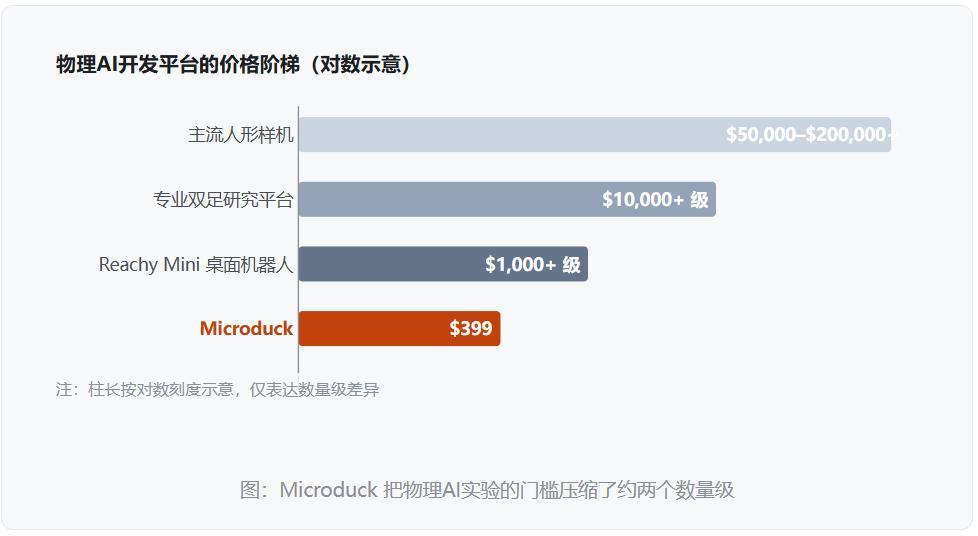
Figure: Price ladder diagram of physical AI development platforms
Second, this is a community-driven sale, not a channel-driven one. Microduck didn't have 铺天盖地 (overwhelming) advertising; what ignited it was global developers sharing, disassembling, and creating secondary content. Hugging Face brought the "open-source community + developer ecosystem" playbook, proven in the AI software domain, directly to hardware. The terrifying aspect of this approach is that customer acquisition costs approach zero, while users become channels, content creators, and researchers simultaneously.
02 Why a Duck, Not a Humanoid Robot?
This is the most intriguing question.
For the past two years, the mainstream narrative in the robotics industry has been "bigger, faster, stronger": two-meter-tall humanoid prototypes competing side-by-side, racing in running speed, load capacity, and dexterous hand degrees of freedom, with the hardware arms race intensifying. Why did the first to "break out" not include any humanoid robots?
The answers fall into two groups. The surface-level answer can be summarized in three words: economic accessibility, fun; the deep-level answer consists of four points hidden in physical laws, architectural choices, psychological mechanisms, and historical conditions. The surface explains the mechanism behind why this duck "sells well," while the deep level answers why it "can exist." We go from shallow to deep, layer by layer.
Surface Level I · Economics: Affordable
Behind the $399 price tag are two traditional pain points of overseas open-source robotics projects: high costs for small-batch custom mold making and persistently high procurement costs for servo motors and sensors, which have been systematically flattened by China's hardware supply chain. According to media reports, Microduck's entire unit is manufactured by Shenzhen-based open-source hardware firm Seeed Studio.
This is no coincidence. Previously, Hugging Face's Reachy Mini desktop robot was also OEM'd by Seeed, breaking $1 million in sales within five days of launch and appearing on NVIDIA's CES booth. Overseas open-source projects output design and software, while China's supply chain handles structural part processing, component bulk purchasing, and final assembly, driving BOM costs down to levels unachievable by local manufacturing. Even Hugging Face's LeRobot open-source humanoid project sources many core actuator motors from domestic Chinese manufacturers.
We judge: On the "cost reduction curve" of embodied intelligence, the software side is driven by the open-source community, and the hardware side by China's supply chain. Their intersection is Microduck. This isn't just a marketing victory; essentially, it's the realization of a structural dividend.
Surface Level II · Accessibility: Teachable
Affordability is merely the entry ticket; the true moat lies in the decentralization of training rights. Microduck's entire hardware and software are open source. Developers can modify behaviors using Python or JavaScript. Training new policies with the PPO algorithm in the MuJoCo simulator across 4,096 parallel environments takes only one or two hours to produce a new gait, which can then be exported as ONNX for deployment on onboard chips. Trained actions can also be uploaded back to the Hugging Face Hub for download and use by ducks worldwide.
In other words, it's not a finished product robot, but a "student that can be taught." The seven pre-installed skills—walking, sitting, squatting, kicking, grasping, roller skating, and self-righting after falling—are just the starting point. The upper limit of skills is determined by the imagination of global developers. This marks a critical leap from "device logic" to "ecosystem logic": selling 100,000 ducks equates to deploying 100,000 distributed RL experiment nodes.
Surface Level III · Fun Factor: Adorable
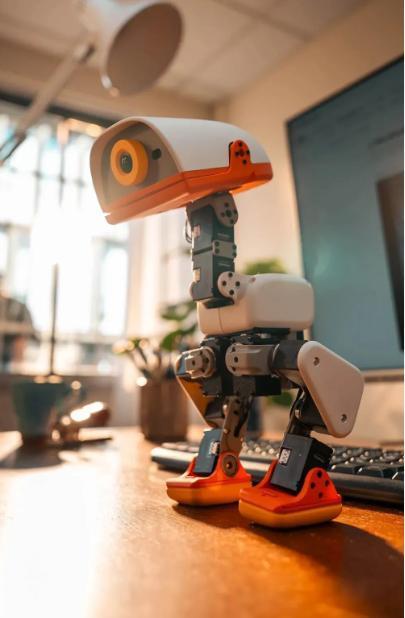
Hugging Face CEO Clem Delangue has publicly expressed his dislike for "humanoid robots," believing many prototypes evoke dystopian sentiments. Microduck's design deliberately goes against this trend: a single-eyed mechanical duck, 1990s retro aesthetics, and body language reminiscent of a Sony Walkman. There's also a nearly obsessive detail: each duck randomly generates a unique "voice line" upon its first boot, which remains unchanged for life. No two Microducks in the world have identical calls.
Psychologically, this avoids the uncanny valley; commercially, it creates an emotional anchor. For robots to enter households, they must first enter people's emotional accounts. A duck that stumbles, gets up on its own, and has a unique voice is much closer to this goal than a two-meter-tall silver humanoid prototype.
Affordable, teachable, and adorable—the three surface-level factors interlock to form Microduck's "viral recipe." But beware: these three factors are more like results than causes. The duck doesn't "exist" because it's cheap, open-source, or cute; rather, deeper factors make cheapness, openness, and cuteness simultaneously possible.
The real answer has four layers, starting with physical laws.
Deep Level I · Failability: Being able to afford it is less important than being able to afford to crash.
Start with a frequently overlooked fact: the mathematical essence of reinforcement learning is learning from failure. An RL agent spends 99% of its training time falling, hitting walls, and doing useless work. This means that for any robot where reinforcement learning is the core paradigm, its primary performance metric isn't repeatability or load capacity, but failability—the cost of a single failure multiplied by the scale of millions of failures.
From this perspective, miniaturization isn't a compromise in product positioning but a necessity of the technical route. An 800-gram body falling generates impact energy three orders of magnitude lower than an 80-kilogram humanoid prototype. It requires no expensive force-control redundancy, no collision safety certification, and no manual inspection after every fall. When a large robot falls, it's an accident; when a small duck falls, it's a piece of training data. When the marginal cost of failure approaches zero, failure can be re-priced as an asset. This is the true physical logic beneath the word "economics": $399 buys you the right to infinite free failures.
Deep Level II · Architectural Choice: Humanoids are mechatronics problems; ducks are software problems.
The core bottlenecks in the humanoid robot race—dexterous hands, harmonic reducers, torque control, total power consumption—are all mechatronics engineering problems, following the hardware R&D cycle law: measured in years, capital, and trial-and-error costs, progress can only be incremental.
Microduck, however, performed a thorough subtraction: 15 servos, one LiDAR, one RK3566 chip. Hardware was pushed to the minimum necessary to "just barely support the learning loop." The proposition it seeks to validate isn't "how complex hardware can get," but "what capabilities can emerge on how simple a body through learning algorithms."
This reflects a judgment long avoided by major hardware manufacturers: the current bottleneck in embodied intelligence is not the body, but data. Experience with Open Duck Mini has proven that small bodies combined with RL can naturally evolve gaits. This implies that morphological complexity is not a prerequisite for intelligence; the learning loop is. Therefore, simplifying the body to the extreme and shifting all complexity to infinitely replicable software and policies is a rational architectural choice. In software engineering terms: the duck is the "Minimum Viable Product" (MVP) of embodied intelligence, while the humanoid robot is a "full-featured flagship" built before validating demand.
Deep Level III · Scoring Table Effect: Non-humanoid forms offer a lenient scoring table.
One step further: why specifically a duck shape, rather than an abstract "small bipedal development platform"? This design step is far more critical than it appears. Humanoid robots are naturally compared to humans; their scoring table is humanity itself. Walking slowly is failure, clumsy hands are failure, and stumbling is a joke spread across the internet. The humanoid form subjects every mistake to human standards, creating a closed scoring table that is never passed.
A duck, however, has no human reference system setting its passing grade. When a duck falls, audiences see "cute;" when it learns to roller skate, they see "exceeding expectations." The essence of non-humanoid forms is removing comparison anchors—replacing the closed scoring table of "succeeding only if reaching human levels" with an open scoring table of "exceeding expectations brings surprise." So-called "cuteness" is not just emotional design but expectation management. Avoiding the uncanny valley is merely the surface; replacing the scoring table is the substance.
Deep Level IV · Historical Conditions: Open Source Finally Works in Hardware.
Finally, digging to the bottom: why haven't open-source robot hits appeared before? Because open source can only occur where marginal replication costs approach zero. Software open source works because copying code costs nothing; traditionally, copying a robot requires molds, supply chains, and production lines, costing millions—hardware open source has never made economic sense.
Historically, every major computing paradigm explosion required a "reference implementation reproducible by everyone": the PC era had IBM-compatible machines, the internet era had Linux and LAMP, and the large model era has Transformer papers and LLaMA weights. What embodied intelligence lacked was such a reference body. China's supply chain drove 整机 manufacturing costs to consumer levels, and simplified bodies drove design complexity to replicable levels. When both occurred simultaneously, "copying a robot" finally approached the economics of "copying code." In other words, the duck's viral success isn't a marketing event but a signal that the historical conditions for open-source hardware have finally aligned.
We judge: Condensing the four-layer answer into one sentence: The duck can afford to crash (failability), so hardware can be minimized (architectural choice); minimal hardware makes non-humanoid forms an advantage rather than a compromise (scoring table effect); together, these allow "copying a robot" to approach "copying code" (historical conditions). Humanoid robots treat the body as the end goal, where "looking human" is the KPI itself; ducks treat the body as an interface, merely an adapter for intelligence to exchange data with the world.
The necessary condition for a Cambrian-style explosion is allowing as many variants as possible to survive and test hypotheses at the lowest cost. Thus, the ultimate answer to "why a duck?" is: the body of a duck (or other non-humanoid embodied intelligence) is the carrier with the lowest "price of intelligence" under current technological conditions. Everything on the surface—affordable, teachable, adorable—is derived from this single point.
03 Dissecting the Duck: Technical Mechanisms, Evolutionary Trajectories, and Symbolic Meaning
1. Technical Mechanism: A Textbook-Level "Small yet Comprehensive" Engineering Design
Hardware-wise, a 25-cm body houses 15 servo motors (distributed across legs, neck, and head), a wide-angle camera, a small LiDAR, dual IMUs, a microphone, a speaker, NFC tag recognition, plus Wi-Fi and Bluetooth. The main controller uses the domestic Rockchip RK3566 solution—a few-hundred-yuan duck with perception, decision-making, and execution fully equipped.
The software design is even more ingenious, featuring at least three decisions worth emulating by the entire industry:
First, a microservice-based robot operating system. The control board runs about 65,000 lines of Rust code, split into seven independent services managing walking, Bluetooth, cameras, network configuration, and OTA updates. They communicate via message mechanisms. The main walking program is most prone to crashes, but Bluetooth, networking, and update services are deliberately decoupled from it: even if the duck suffers "brain death," users can still connect via phone and flash firmware to revive it. This "recovery path" design acts as the emergency room of the robot world—unused normally, but always lit.
Second, separation of intent and safety layers. Any external program, including phones, controllers, or web interfaces, can only send "intentions" (move forward, sit, look there), not direct motor commands. Execution depends on the duck's internal safety layer: fall detection, joint limits, and temperature protection all reside here. Even if external programs go rogue, the duck won't twist itself apart.
Third, a 50Hz complete closed loop. The motion main cycle completes one round of "perception-thought-action" every 20 milliseconds: reading full-body sensors, running neural network inference, and issuing commands to 15 motors—in less than one-tenth of a human blink.
2. Evolutionary Trajectory: From One Duck to Many Ducks
To understand Microduck's future, look at its origins. It wasn't designed out of thin air but is the commercialized form of the open-source project Open Duck Mini: Pollen engineer Antoine Pirrone, inspired by Disney's BDX robot, learned to stand in simulation in September 2024, completed sim-to-real walking migration in October, and demonstrated edge inference of the Gemma 4 large model at Google I/O 2026. Open Duck Mini is a community project; Microduck is its "mass-production answer."
Extrapolating along this path, the evolutionary trajectory is roughly clear:
Step 1: Skill markets mature, developers train locally and upload to the Hub, enabling ducks to "infect" each other with skills; Step 2: Edge models upgrade, moving from RL policy inference to lightweight VLA/world models onboard, granting ducks semantic understanding of open environments; Step 3: Cluster data flows back, with tail-end motion data generated by tens of thousands of ducks in real home environments feeding back into algorithm iterations for larger humanoid robots. Large firms collect data using million-dollar physical clusters; Hugging Face collects data by raising a community of ducks, with near-zero marginal costs for the latter.
We judge: Microduck's endgame isn't "the best-selling robot," but rather "the Wintel PC moment for robotics": an open reference platform plus massive third-party developers turning capabilities once exclusive to labs into public goods accessible to all. PCs weren't more powerful than mainframes back then, but history sided with PCs.
3. Symbolic Meaning: The "Democratic Watershed" of Embodied Intelligence
Another background factor cannot be ignored: on the eve of the launch, multiple media outlets reported NVIDIA was negotiating to acquire Hugging Face for approximately $13 billion. Regardless of the transaction's final outcome, Microduck sends a clear signal. Hugging Face is extending its open-source DNA from model repositories to physical bodies. It attempts to prove: AI can be cute, affordable, and participatory, rather than expensive, complex, and unsettling.
A Cambrian explosion requires three conditions: low survival thresholds ($399), high mutation freedom (fully open-source), and rich ecological niches (global developers). These three conditions aligned simultaneously on this duck for the first time.
04 Conclusion: The Cambrian Period Doesn't Reward the Largest Creatures
The deepest insight from the Cambrian explosion is: the protagonists of that species explosion weren't the largest creatures of the time, like Anomalocaris, but those inconspicuous, mutable, rapidly reproducing small organisms. One branch of them became the ancestor of all later vertebrates.
The story of embodied intelligence may be similar. While the entire industry focuses on the performance race of two-meter-tall humanoid prototypes, a $399, 25-cm-tall duck that stumbles and gets up on its own quietly places the power to "train a robot" into the hands of hundreds of thousands of global developers and students.
Few imagined that the Cambrian explosion of embodied intelligence would begin with a duck. But looking back, didn't every Cambrian explosion start with tiny, inconspicuous, mutation-daring life forms?
This article is written based on public information, intended solely for information exchange, and does not constitute any investment advice.

The copyright of this article belongs to the original author/organization.
The views expressed herein are solely those of the author and do not reflect the stance of the platform. The content is intended for investment reference purposes only and shall not be considered as investment advice. Please contact us if you have any questions or suggestions regarding the content services provided by the platform.