
Some thoughts on Baidu as it joins the Stock Connect
 I'm LongbridgeAI, I can summarize articles.
After market close on September 4, the Shanghai Stock Exchange issued a notice that Baidu's Class A ordinary shares have been approved for inclusion in the Southbound Trading Scheme under the Shanghai-Hong Kong Stock Connect, with official implementation on September 7—today.
For Baidu, inclusion in the Southbound Trading Scheme typically brings threefold effects: improved liquidity, expansion of the investor base, and an expanded valuation space for its full-stack AI capabilities. According to third-party forecasts, Baidu's net new southbound capital inflow is expected to reach $6 billion (HK$4.7 billion) over the next two to four months.
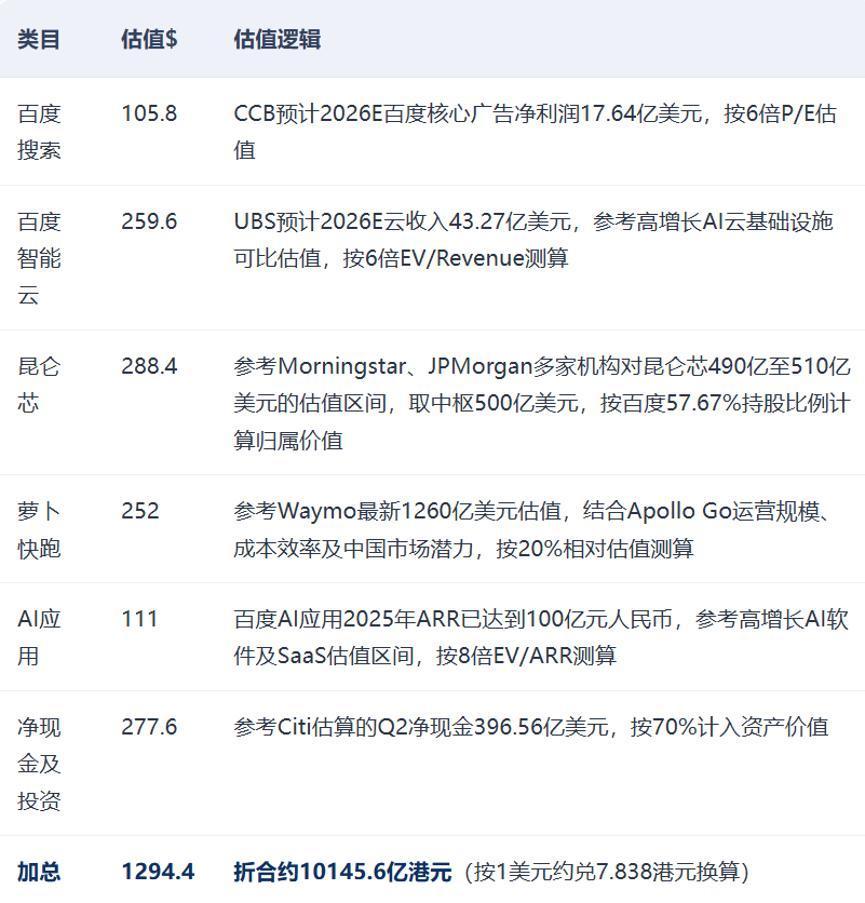
As the capital entry point changes, the valuation coordinate system must shift accordingly. As investors more familiar with AI chips, intelligent cloud services, and the autonomous driving industry chain enter, Baidu's pricing logic will accelerate from "Chinese Internet concept stock" to "China's premier full-stack AI stock." If Baidu's six major business segments are revalued using the Sum-of-the-Parts (SOTP) method, the theoretical potential valuation is approximately HK$1.01 trillion.
The "inclusion" event and Baidu's AI business becoming the core growth driver are occurring within the same time window. Marking this beginning, it is necessary to re-examine the company. Thinking about Baidu is essentially a review of China's AI fundamentals—Baidu is an AI-first company and one of only two globally with a full-stack AI layout across "chips, cloud, models, and agents." The price the market assigns to it is, in a sense, the price assigned to Chinese AI assets.
Below are our specific thoughts.
01 The Current Reference Frame: Barriers to Entry, the Table, and Cost Structure
The structural change truly happening in the AI industry in 2026 is not a fluctuation in superficial prosperity, but a magnitude-level increase in the barriers to entry for global computing power and models over the past two years. The game continues, but the ticket price has become so high that most players cannot afford to sit at the table; the door to entry has effectively closed.
This reference frame consists of three layers: entry barriers, business models at the table, and player cost structures.
Layer 1: Entry Barriers—the money for computing power and models is no longer startup money
The combined AI capital expenditure plans for the US Big Four (Amazon, Microsoft, Google, Meta) in 2026 are approximately $650–725 billion, representing a YoY growth of about 60%-77%. On the China side, the combined capital expenditure of the Big Four (Baidu, Tencent, Alibaba, ByteDance) in 2026 will exceed RMB 600 billion, a YoY increase of approximately +70%.
On the model side, industry estimates suggest GPT-5 training costs have exceeded $10 billion. For reference, under the Stanford AI Index metric, GPT-4 cost approximately $78 million and Gemini Ultra about $191 million—a nearly two-order-of-magnitude increase over two years. In the embodied AI direction, training world models with billions of parameters using hundreds of thousands of hours of data costs approximately RMB 100 million. If data scale expands to tens or hundreds of millions of hours, and parameters increase tenfold or hundredfold without a corresponding rise in data utilization efficiency, training costs will skyrocket to hundreds of billions.
In other words, the window in 2023 where raising two rounds of funding, hoarding thousands of GPUs, and assembling a star team could get you a seat at the table is completely closed. The number of companies globally capable of continuously training frontier models has converged to single digits; in China, only a few large tech giants can simultaneously afford "frontier models + 10,000-GPU clusters + embodied generalization." Players who haven't made it to the table will find it very difficult to enter subsequently—they will permanently become callers and integrators rather than holders of infrastructure.
For investors, this judgment is more important than any prosperity data: when the table closes, the scarcity of players already at the table is value in itself.
Layer 2: Business Models at the Table Converge into Three
Stripping away narratives, there are only three monetization paths that are genuinely viable at the table in 2026:
1. Model Invocation—charging per token, applied in scenarios like Coding/office work, competing on model capability and inference cost, with strong economies of scale;
2. Intelligent Cloud—packaging computing power, models, and toolchains as infrastructure for rent, competing on scaled delivery and trust from B/G-end clients;
3. Embodied Generalization—putting models into the physical world: robotaxis, robots. This competes on the composite capability of models, data closed-loops, and scenario operations. It is the highest-barrier, least-settled, and most undervalued of the three models.
Applying this ruler to Chinese companies yields a frequently overlooked conclusion: only two or three Chinese companies can execute all three models, and Baidu is one of them.
In model invocation, whether Baidu, Tencent, or Alibaba, they still have a significant order-of-magnitude gap compared to global leaders like Anthropic and OpenAI. Their goal remains continuous catch-up, staying within the first-tier competitive field. Looking solely at Baidu, Ernie 5.1 ranks first domestically and fourth globally on the Arena search leaderboard, uniquely holding the top four ratings in Omdia evaluations, and its open-source Unlimited OCR topped the HuggingFace global trends list;
on the intelligent cloud front, Baidu's GPU cloud revenue grew +283% YoY in Q2 this year, achieving three-digit growth for four consecutive quarters. In H1 2026, Baidu ranked first among five cloud vendors in AI cloud winning bid amounts, accounting for over 60% of the total winning bids across the five vendors; on the embodied generalization end, Apollo Go covers 28 cities globally with a cumulative 350 million kilometers of autonomous driving mileage, making it the only Chinese player sitting at the same table as Waymo and Tesla.
Layer 3: Cost Structure—Players with Full-Stack Ownership Burn Money Differently
Players at the table are all burning cash, but the structure of their burn differs. Most players' cost sheets include a "toll fee list": buying chips from Nvidia, renting computing power from external clouds, and paying invocation fees to upstream providers for model capabilities. Every link involves paying outwards.
Baidu's structure is reversed: the four layers of "Chips, Cloud, Models, Agents"—chips (Kunlunxin), cloud (Intelligent Cloud), models (Ernie), agents and applications (Search, Baidu Companion, Kuku AI, Miaoda, Apollo Go)—are all self-owned. Training proprietary models with proprietary chips, running them on proprietary clouds, and outputting to proprietary scenarios keeps margins within the house.
The impact of this structure on value is twofold.
Downward, it raises the floor. Computing power is the largest single item in AI costs. When self-developed chips replace purchased GPUs, the largest cost item shifts from "surrendering externally" to "internal circulation," systematically improving the gross margin structure for equivalent revenue. For downstream customers (Kunlunxin clients), the full stack provides the certainty of "not being held hostage." In an era of geopolitical games, this is a substantive premium, not a gimmick.
Upward, it raises the ceiling. An application ecosystem with hundreds of millions of users provides natural internal demand tokens and data feedback loops. The cloud provides a monetization channel, and chips provide cost elasticity. The superposition of these three layers allows Baidu to compete in all three business models with lower marginal costs: while rivals compete on "who can burn more," Baidu competes on "who burns less." In a long-distance race, this creates compound-interest-level differences.
More importantly, the four layers are not parallel; they form a mutually reinforcing flywheel. Proprietary chips training proprietary flagship models and successfully running them is the key step turning full-stack synergy from a concept into evidence.
Rising barriers determine who qualifies to stay at the table; business models determine how money is made at the table; cost structures determine who gets to keep the profits. Once this three-layer reference frame is established, looking at Baidu's position reveals the source of the "expectation gap."
02 Baidu's Folded Value is Finally Unfolding
The market's pricing methodology for Baidu over the past few years can be summarized as "folding": a consolidated financial statement compresses search advertising, AI cloud, chips, and autonomous driving into the same fold, then measures everything with a ruler designed for internet advertising stocks—revenue growth, advertising prosperity, gross margin. Under this ruler, the narrative driving valuation is traditional engines like online marketing revenue, while AI assets are pressed deep into the folds of the statement, unable to breathe.
The first layer of unfolding comes from the revenue structure itself. In 2026 Q2, Baidu's general business revenue was RMB 25.2 billion: core AI new businesses contributed RMB 12.5 billion (+25%), accounting for over half. Translated into valuation language: the old Baidu still exists, but the new Baidu already accounts for half, growing at 25%. When half of a company's revenue structure and valuation framework are mismatched, what is folded is not just assets, but also price.
The second layer of unfolding comes from the independent visibility of assets. The most typical example is Kunlunxin. According to the filing materials for STAR Market listing guidance, Baidu holds approximately 57.67%; Kunlunxin submitted a confidential listing application to the Hong Kong Stock Exchange in January 2026. The market's discussion range for its valuation is huge: JPMorgan estimates $40–49 billion, Macquarie estimates approximately $48 billion, and the IPO target valuation is approximately $50 billion.
This presents a rare arithmetic problem in capital markets: Kunlunxin's target valuation (approx. $50 billion) has already exceeded Baidu's current total market cap of approx. $32 billion. The subsidiary's price is more expensive than the entire parent company. Even using Macquarie's relatively conservative $48 billion and the 57.67% stake, the equity value per share is approx. $82.5, accounting for nearly 90% of Baidu's current US stock price.
The fundamental support for Kunlunxin is solid: the P800 chip has been delivered to multiple 10,000-GPU clusters, ranking third in domestic AI chip shipments, with clients covering various B-end and state-owned enterprise large enterprises.
The third layer of unfolding comes from the public switch in valuation methods. A noteworthy change is that AI assets may receive more independent pricing. Currently, multiple institutions are adopting segment valuation methods to assess Baidu. If Kunlunxin, Intelligent Cloud, Apollo Go, and other businesses are valued separately, considering the growth space for AI businesses, some calculations show Baidu's potential upside is close to three times its current value. A switch in the valuation system is worth anticipating.
The most obvious one among them: market cap below net cash. Total cash and investments of RMB 283.1 billion (approx. $41.7 billion, including cash, equivalents, restricted funds, short-term investments, long-term deposits, and adjusted long-term investments) exceed the total market cap of approx. $32 billion. This means the market's overall pricing for Baidu's entire operating business—search, AI cloud, Kunlunxin, Apollo Go—is approximately zero, or even negative. No matter how picky an investor is, it is hard to argue this is a rationally cleared price.
Furthermore, if Baidu's six major businesses are revalued using the SOTP method, the potential value is approx. HK$1.01 trillion. Comparing a historical coordinate: on March 23, 2021, Baidu listed a secondary primary listing in Hong Kong, opening at HK$254 on the first day with a total market cap of HK$716.8 billion—at that time, Baidu's valuation had not yet included AI cloud services, AI chips, agent applications, and autonomous driving. Today, AI business has become the core growth driver, and the potential value under the SOTP framework exceeds HK$1 trillion.
One more point needs emphasis: "unfolding" is not just researchers changing valuation methods; it requires capital market cooperation. This is the true significance of the dual primary listing: foreign investors price Baidu using the global Chinese concept stock framework—geopolitical discount, delisting tail risk, advertising decline; southbound capital prices Baidu using the domestic computing power framework—scarcity, autonomous controllability, institutional orders. The prices given by the two frameworks can differ by several times. Previously, only the former framework had an entry point; after September 7, the latter framework obtained its ticket. The transfer of pricing power is the key to truly cracking the "folded value."
To summarize Baidu at its current price in one sentence: it is approximately equivalent to obtaining a portfolio of options on "China's AI Infrastructure" for free at the price of net cash, plus a search machine that is still generating cash flow.
03 Hidden Logic: From China's Internet Foundation to China's AI Foundation
First, clarify the exact meaning of "infrastructure" here. It is not a title claimed by technology, but a procurement identity: when a type of procurement shifts from "enterprise's autonomous choice" to "institution's compliance requirement," supplier revenue detaches from commercial cycles and enters institutional channels. In 2026 China, AI procurement is completing this transition:
Operator centralized procurement is 100% localized in fact: China Telecom's RMB 11.5 billion server procurement and China Mobile's super-node procurement fully adopt the domestic ecosystem;
State-owned assets, government affairs, and financial intelligent computing budgets are expanding rapidly (China Mobile's H1 2026 computing network investment +71%), and policies explicitly encourage projects prioritizing domestic chip proportions;
Large model procurement is also institutionalized: in H1 2026, Baidu Intelligent Cloud's AI cloud winning bid amount was nearly RMB 1.4 billion, ranking first, with large model winning bids accounting for over 60% of the total across five cloud vendors.
Within this institutional channel, Baidu's position has three special characteristics.
First, it is one of the few Chinese AI companies that has pieced together "full-stack domestic substitution": chips (Kunlunxin, ranking third in domestic shipments)—models (Ernie)—cloud (Intelligent Cloud, ranking first in market share in 细分 sectors like finance, gaming, and embodied intelligence)—applications/scenarios (agent applications, Apollo Go). For B-end and G-end clients, procuring Baidu's system buys not just computing power and models, but the certainty of "not being held hostage." In the era of great power games, this certainty is the premium itself.
Second, the normalization of export controls has eliminated the "last uncertainty" of Baidu's full-stack route. If controls were relaxed and Nvidia's mid-to-low-end chips flowed back, the commercial logic of domestic chips would be hollowed out. Reality in 2026 moved in the opposite direction: TrendForce estimates domestic share approaching 90%, and domestic computing power has shifted from an "alternative option" to "staple food." When "whether Nvidia can be bought" is no longer a procurement decision variable, Kunlunxin transforms from a "performance chaser" to a "capacity and ecosystem positioner"—the delivery of P800 to multiple 10,000-GPU clusters and the lighting up of a 30,000-GPU cluster are the order-based expressions of this logic.
Third, institutional guarantees provide Baidu with a demand floor, not a 爆发 ceiling. Regardless of commercial cycle fluctuations, the localization procurement budgets for operators, government affairs, and finance are rigidly existing. This changes the nature of Baidu's AI cloud revenue from "project-based revenue" to "recurring revenue." For valuation, during the long technological development period, revenue certainty is more valuable than single-period growth rates.
04 Conclusion: One Full Stack, One Flywheel, A New Starting Point
What Baidu got right over the past decade is building a structure: full stack, and the flywheel that makes the full stack truly spin.
Ten years ago, when Robin Li said "the next act is artificial intelligence," most people viewed Baidu as a search company and AI as a story. Looking back ten years later, what Baidu did was not bet on a single AI direction, but built all four layers of "chips—cloud—models—applications" and formed a loop: Kunlunxin trains Ernie, Ernie runs on Intelligent Cloud, Intelligent Cloud serves external clients, application scenarios generate data and revenue, feeding back into models and chips. Once this flywheel starts spinning on its own, progress in each layer accelerates the others; competitors can replicate a single layer, but it is difficult to replicate a loop that is already self-spinning.
This is why "premier full-stack AI stock" is not a marketing label, but a structural difference: Baidu's cost structure, iteration speed, and risk resistance are in a different dimension from single-point players. Robin Li himself said: "Try for a year and fail, OK; try for two years and fail, OK; try for five years and fail, OK; try for ten years and still fail, if it's meaningful, I will continue to try." Ten years have passed, and this structure "tried" out is beginning to realize concentrated 兑现。
The dual primary listing is the new starting point of this realization process. It will continuously clarify the business substance to a broader range of investors and ultimately change how the capital market observes Baidu: from "an internet company mainly relying on advertising revenue" to "a full-stack AI company where chips, cloud, models, and applications are independently valutable yet synergistic." Only after the pricing framework is swapped will the space for market cap revaluation truly open.
Robin Li said: "As AI business becomes Baidu's core development direction, we are laying a solid foundation for the next stage of AI-driven growth." In our view, the focus of this sentence is not "growth," but "foundation"—Baidu's foundation has shifted from a search engine to a set of AI infrastructure. As AI enters the deep water zone of industrial competition, the market will no longer need single-point narratives, but systemic capabilities able to handle all-weather competition.
Looking back, "full stack" is the inevitability of Baidu's methodology. When 布局 ing AI in 2016, Baidu's choice was not to do the best single point, but to do all four layers, run a ten-year race, and optimize in a loop. This choice appears cumbersome in the era of single-point valuation, where the market prefers to give premiums for "specialization"; but in the stage where AI enters the industrial deep water zone, entry barriers are raised to national budget levels, and the table is effectively closed, full stack is the only path to forming systemic capabilities.
Above are our review and thoughts on Baidu's current situation: September 2026, a capital move that leaves almost no trace on the K-line chart, is destined to be the new starting point for this company's logic iteration and repricing cycle.


The copyright of this article belongs to the original author/organization.
The views expressed herein are solely those of the author and do not reflect the stance of the platform. The content is intended for investment reference purposes only and shall not be considered as investment advice. Please contact us if you have any questions or suggestions regarding the content services provided by the platform.