
GPT-6 Astra uses 100,000 GPUs, and Jensen Huang says the next batch will have another 400,000...
 I'm LongbridgeAI, I can summarize articles.
On September 6, Jensen Huang responded to OpenAI's latest release of GPT-6 Astra on X, highlighting two figures more noteworthy than model benchmarks: Astra used approximately over 100,000 NVIDIA Grace Blackwell-class GPUs for training, with "another 400,000 GPUs coming online in the next phase."
Information disclosed by OpenAI corroborates these numbers. VP of Research Aidan Clark stated at the Astra launch that this is OpenAI's largest pre-training task to date and the first time over 100,000 GPUs were used for pre-training at Texas's Stargate facility. CEO Greg Brockman later confirmed it was the company's first training run exceeding 100,000 GPUs.

The key area to track is how infrastructure constraints shift once training scales past 100k cards. While GPUs remain the highest-value component, organizing 100,000 GPUs simultaneously means rack internal interconnects, inter-rack networking, power, and liquid cooling directly determine effective compute.
I. The Basic Unit of 100k Cards: A Rack of 72 GPUs
The design logic of the GB200 NVL72 is to organize 72 Blackwell GPUs into a high-speed NVLink domain. One NVL72 set features 72 Blackwell GPUs, 36 Grace CPUs, 13.4TB HBM3E memory, and 130TB/s NVLink bandwidth. Defined by NVIDIA as a rack-scale liquid-cooled system, these 72 GPUs operate within a single NVLink domain.
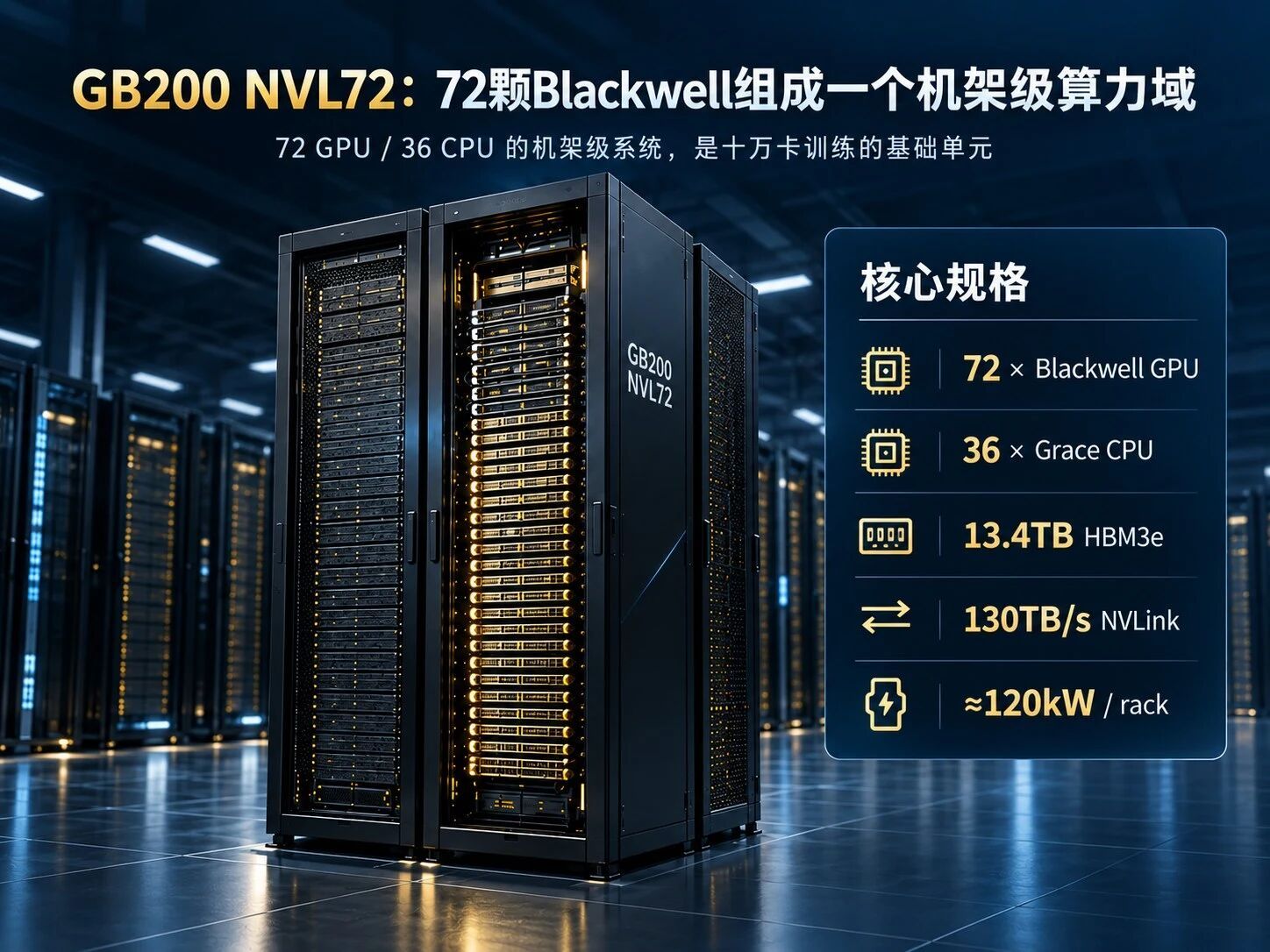
This layer addresses Scale-up, creating a high-bandwidth compute unit within the rack. Issues arise outside the rack. Roughly calculating at 72 GPUs per cabinet, over 100,000 GPUs implies thousands of NVL72-level compute domains participating simultaneously in one training job. Internal 130TB/s NVLink bandwidth does not guarantee efficient coordination across thousands of racks.
For synchronous pre-training, if any link slows down significantly, other GPUs may enter idle wait states. Larger cluster sizes increase the opportunity cost of tail latency and failures.
II. Why OpenAI Redesigned Networking for 100k Cards
OpenAI's publicly released MRC—Multipath Reliable Connection—directly addresses this. OpenAI disclosed that a single large model training step may involve millions of data transfers. Network congestion, link jitter, and device failures cause data delays that propagate through the entire cluster via the synchronous training chain.
MRC first changes network organization. A single 800Gb/s network interface can be split into eight 100Gb/s links connecting to eight network planes. Thus, a switch with 64 800G ports can connect 512 ports at 100G granularity.
The engineering result provided by OpenAI: Approximately 131,000 GPUs can be interconnected using only two layers of switching networks. Traditional 800Gb/s architectures typically require three to four layers for similar scales. Fewer layers mean fewer devices, lower power consumption, fewer failure points, and more available paths.
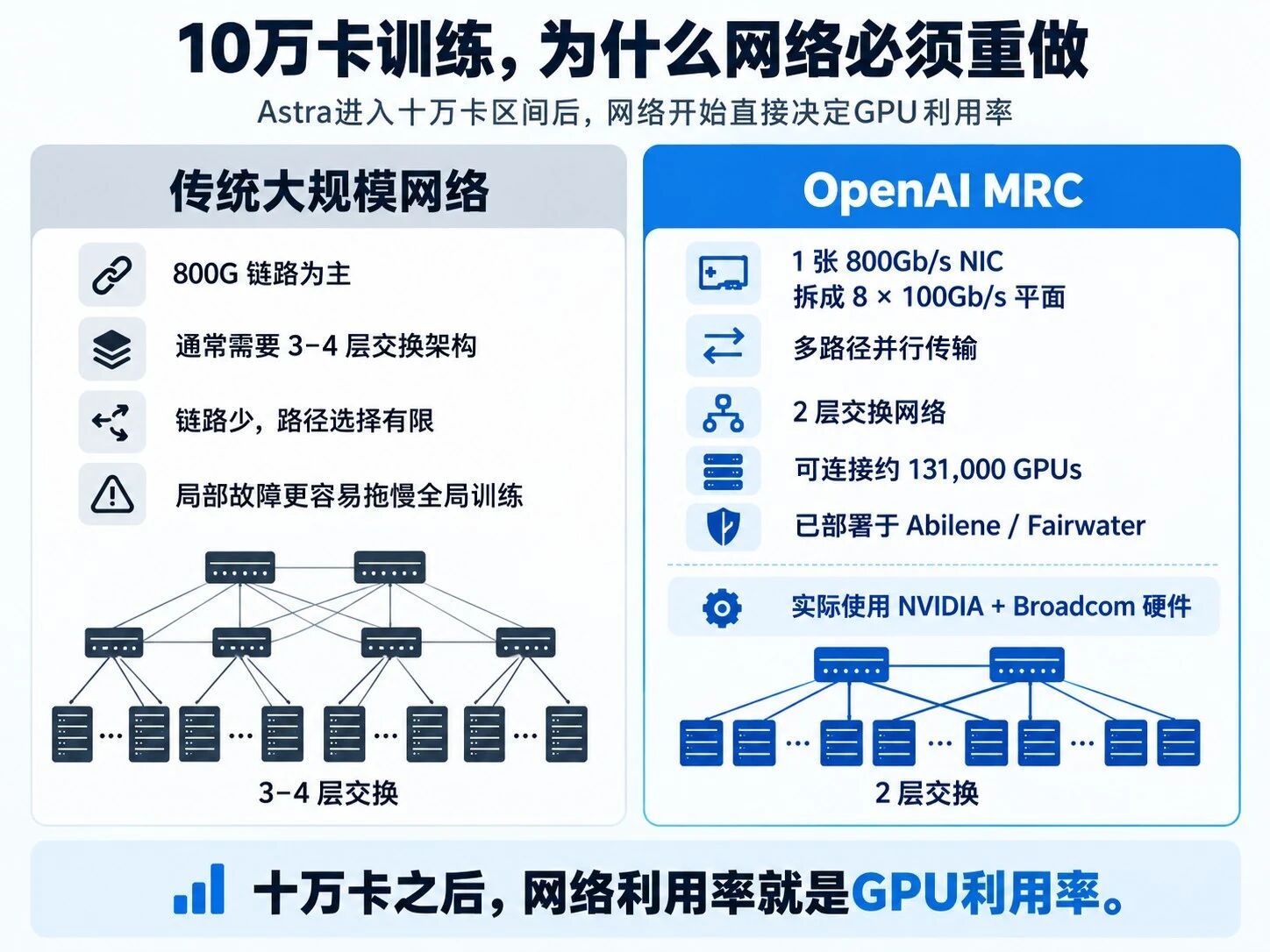
These figures align closely with Astra: Astra's pre-training scale exceeds 100,000 GPUs, while the MRC two-layer network design capacity is approx. 131,000 GPUs.
OpenAI has already deployed MRC in its largest NVIDIA GB200 supercomputers, including Oracle OCI's Abilene and Microsoft Fairwater, explicitly stating it has trained multiple OpenAI models using NVIDIA and Broadcom hardware. Beyond 100k cards, Scale-out networking enters the training efficiency function: whether the network keeps purchased GPUs working continuously directly impacts the cluster's effective compute.
III. Abilene Enters Actual Training Load
Abilene is one of the most representative physical assets in this compute expansion. In June 2025, Oracle began delivering the first batch of NVIDIA GB200 racks to Abilene; OpenAI subsequently started running early training and inference tasks there. OpenAI later confirmed Abilene handles frontier model training, running on Oracle Cloud Infrastructure using NVIDIA GB200 systems.
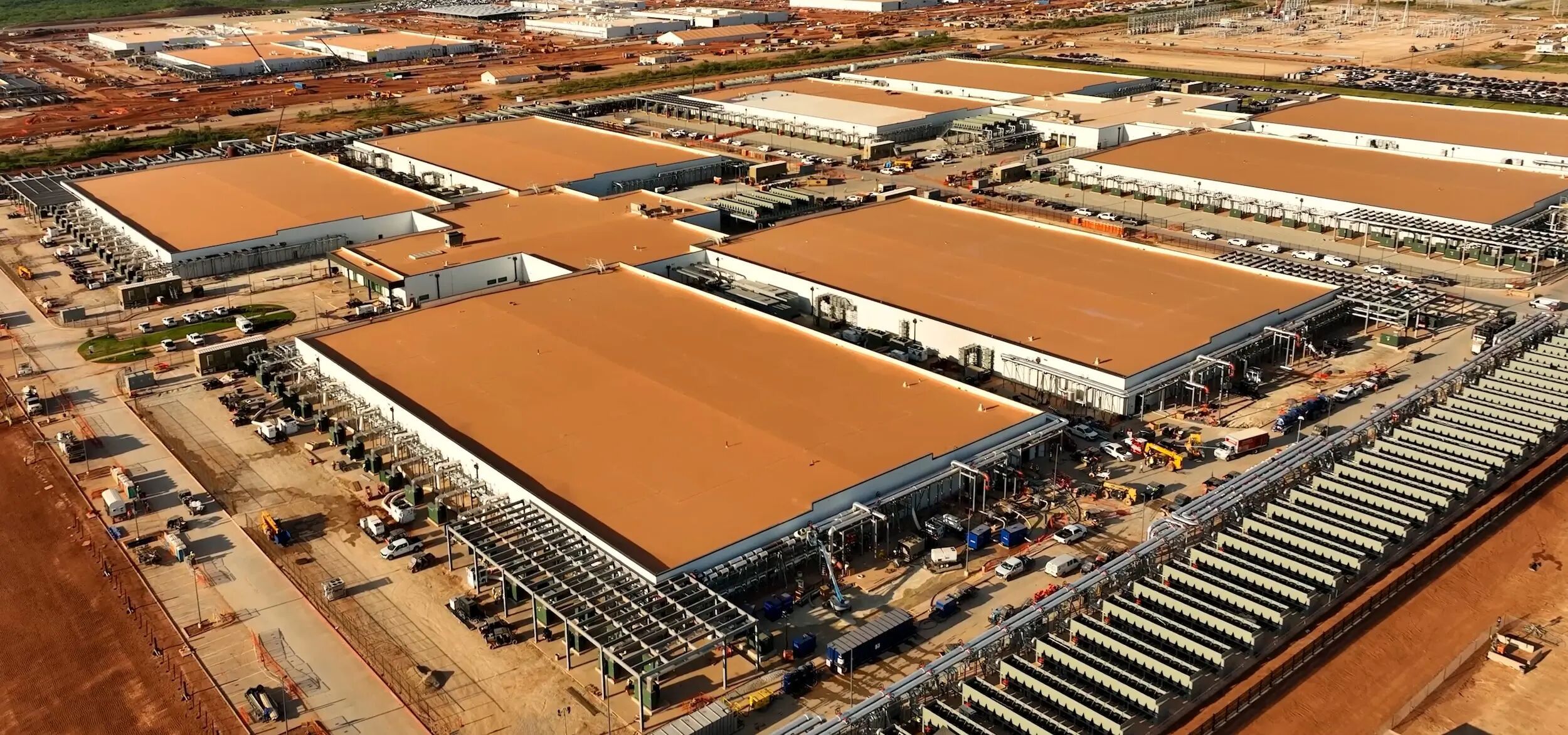
Oracle currently discloses the Abilene campus includes 8 buildings, 1,100 acres of land, and 4 million square feet of building area, utilizing closed-loop, non-evaporative liquid cooling systems.
These campuses differ from traditional cloud data centers. Traditional centers run many relatively independent workloads; 100k-card AI training requires organizing GPUs, NICs, switches, storage, power, and cooling into a highly synchronized large-scale system. At this scale, data centers begin exhibiting supercomputer attributes.
IV. Fairwater Pushes Expansion to Multi-Site
Single campuses still have physical boundaries. Microsoft's Fairwater offers another route: instead of concentrating all compute resources in one data center, connect multiple sites via dedicated networks.
Atlanta Fairwater is operational, connected to Wisconsin Fairwater and other Microsoft AI infrastructure. Microsoft states Fairwater uses a single flat network capable of connecting hundreds of thousands of NVIDIA GB200 and GB300 GPUs, organizing multiple sites into a larger AI superfactory via a dedicated AI WAN.
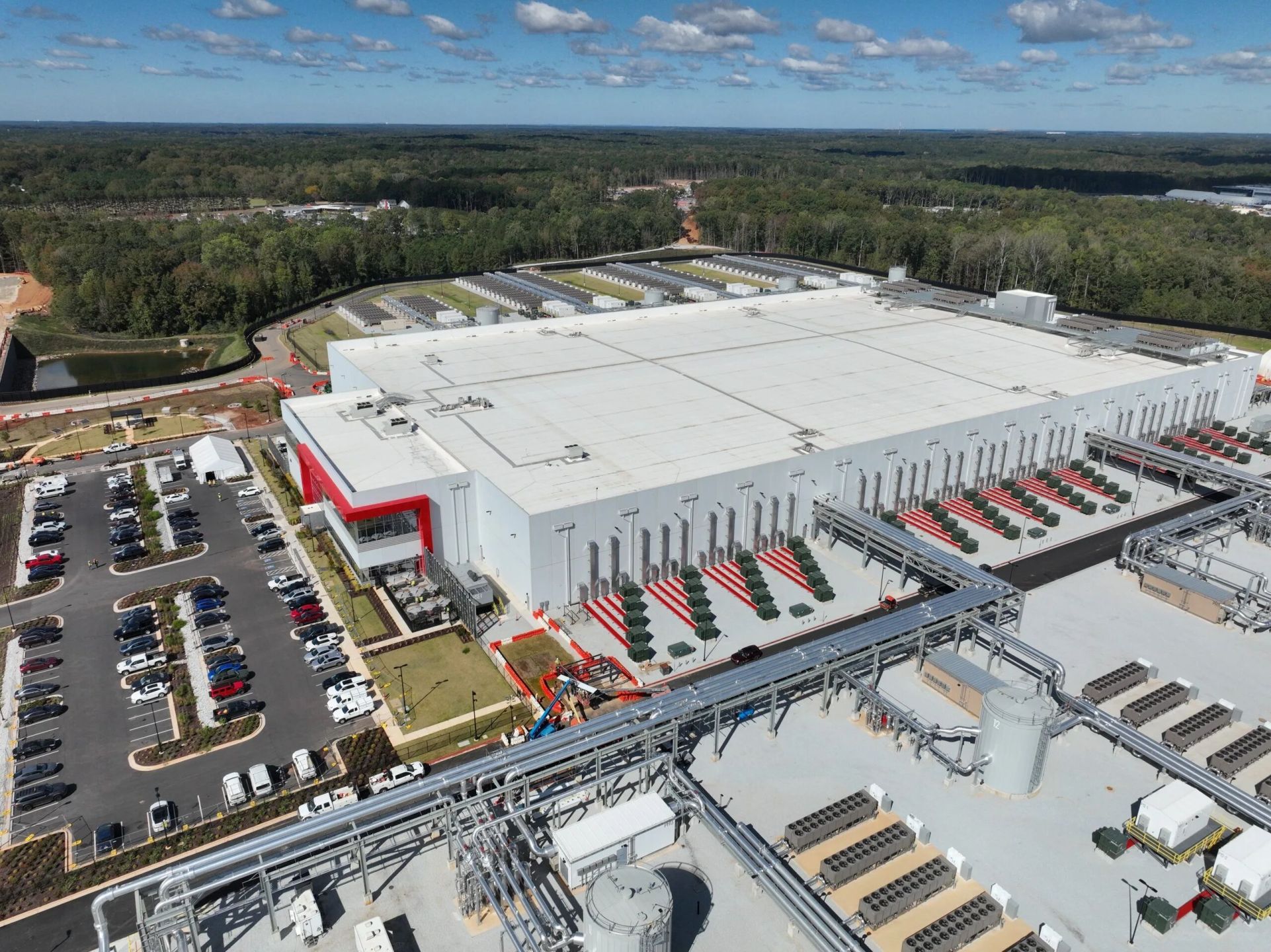
Microsoft describes this architecture straightforwardly: an AI training task can be supported jointly by multiple sites within one network. Its AI WAN connects supercomputers of different generations and combines sites further via cross-regional fiber optics.
AI training infrastructure thus forms three layers: Rack-scale Scale-up → Campus-scale Scale-out → Cross-campus Multi-site.
The direction is clear: 100k cards are no longer just planned scale; hundreds of thousands of cards are becoming the target range for next-gen AI supercomputing design.
V. From 100k to 400k GPUs: The First Hurdle is Hundreds of Megawatts
Converting GPU counts to physical infrastructure makes the magnitude intuitive. NVIDIA currently lists the GB200 NVL72 design rack power at approx. 120kW. For magnitude estimation, assuming 72 GPUs/cabinet and 120kW/cabinet:
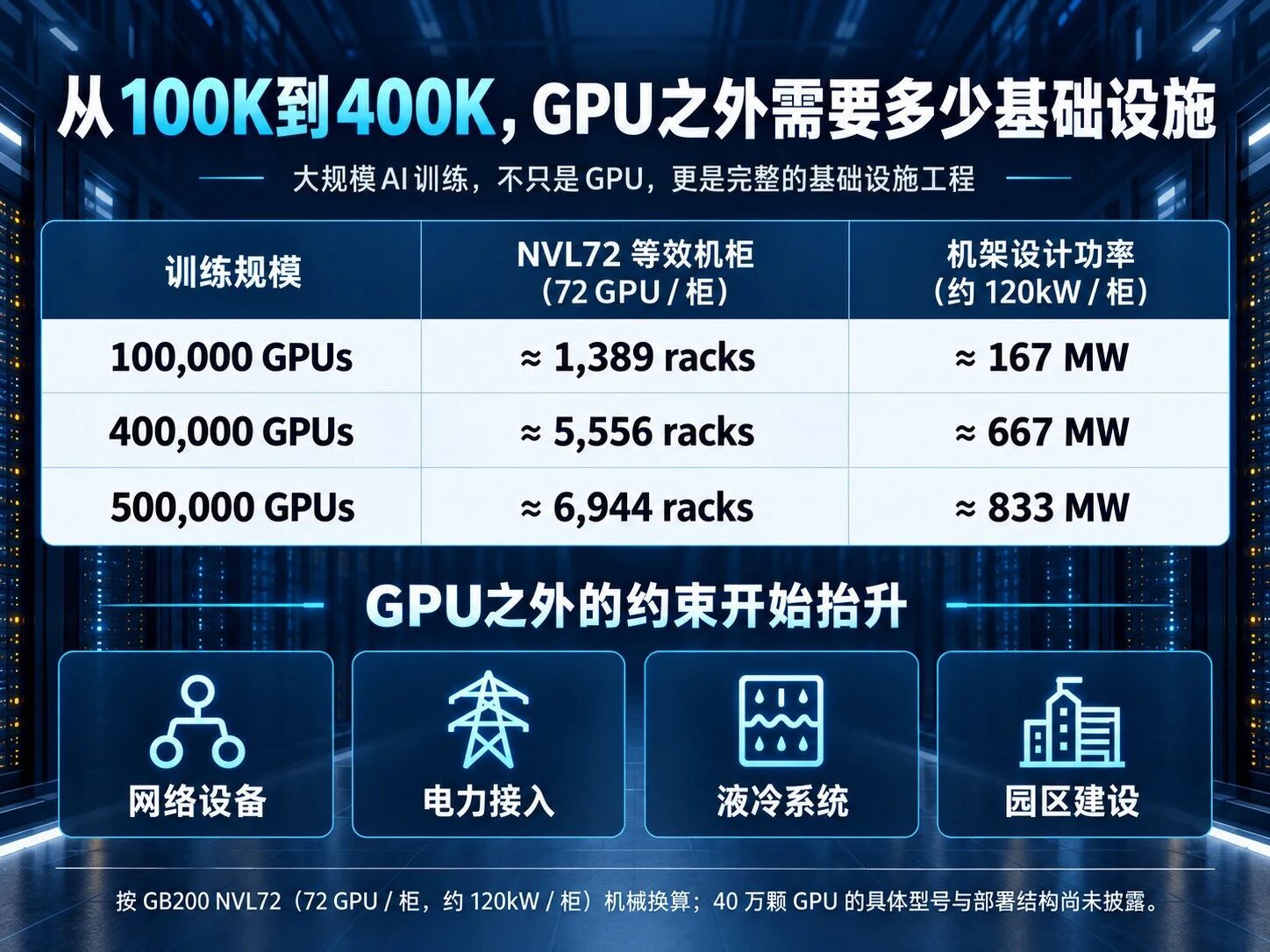
100,000 GPUs correspond to approx. 1,389 cabinets, 167MW rack power; 400,000 GPUs correspond to approx. 5,556 cabinets, 667MW; adding existing 100k and next-phase 400k simply yields 500,000 GPUs corresponding to approx. 6,944 equivalent NVL72 racks, with rack design power approx. 833MW.
This is not a prediction of actual site power consumption. Specific models for the 400k GPUs are undisclosed and may include GB300 or other platforms. However, mechanical conversion sufficiently demonstrates the magnitude: Hundreds of thousands of GPUs correspond to hundreds-of-megawatts-level rack loads.
Rack power does not equal total data center power demand. Campuses also need distribution, cooling, networking, storage, and auxiliary systems. Therefore, as GPU counts increase, deployment constraints naturally propagate outward.
VI. Post-100k Cards, AI CapEx Spreads Outward Alongside GPUs
NVIDIA retains the core value share. The GB200 NVL72 itself integrates Blackwell GPUs, Grace CPUs, NVLink, NVSwitch, and liquid-cooled racks into a complete system; at the inter-rack level, NVIDIA also offers ConnectX, Spectrum-X, and InfiniBand. Compared to merely counting GPUs previously, rack-scale architecture means system-level value per GPU increases synchronously with GPU growth.
Networking is the second layer. OpenAI explicitly uses Broadcom hardware for MRC training environments. As requirements for tail latency, fault recovery, and network paths rise for 100k-card synchronous training, the economic value of switching chips, NICs, and switches stems from a direct logic: they determine the effective utilization rate of expensive GPUs.
Outward further are power and liquid cooling. GB200 NVL72 design power reaches approx. 120kW/cabinet; Microsoft discloses Fairwater's high-density racks reach approx. 140kW, relying on facility-level closed-loop liquid cooling. The CapEx chain ultimately lands on several trackable metrics: GPU delivery volume, network port and switching capacity, per-cabinet power density, new megawatts added to data centers, and actual delivery cycles for liquid cooling and power equipment.
VII. The Core Signal from Astra: Scaling Still Consumes Larger Infrastructure
From an industry chain perspective, what's more worth recording is one thing: OpenAI has completed a real pre-training task exceeding 100,000 GPUs. This means 100k-card clusters have moved from industry roadmaps to actual model training sites.
Meanwhile, MRC solves 100k-card networking issues, Fairwater addresses hundreds-of-thousands-of-cards and cross-site problems, and Abilene is converting large-scale GPUs, power, and liquid cooling into actual training resources.
If the next batch of 400,000 GPUs comes online sequentially, the observation framework for AI infrastructure investment must change accordingly. Focusing solely on GPU shipments is insufficient. The next round requires tracking together: How much networking, power, liquid cooling, and data center assets are needed behind each GPU, and whether this infrastructure can keep pace with GPU delivery rhythms.
Sources: Public materials from OpenAI, NVIDIA, Microsoft, Oracle; Jensen Huang's public post on X. Rack and power conversions in the text are for magnitude analysis only. For learning reference only, not investment advice.


The copyright of this article belongs to the original author/organization.
The views expressed herein are solely those of the author and do not reflect the stance of the platform. The content is intended for investment reference purposes only and shall not be considered as investment advice. Please contact us if you have any questions or suggestions regarding the content services provided by the platform.