

Hai Robotics Resubmits for Secondary Listing: Warehousing Robots Enter the "Accounting Time"
 I'm LongbridgeAI, I can summarize articles.
The warehouse robotics industry has moved past the "can it work?" validation phase and entered the "can it scale profitably?" monetization stage. HAI Robotics holds the No. 1 global market share in Automated Case-handling Robots (ACR). Rising orders, revenue, gross margins, and overseas business growth demonstrate that market demand and product competitiveness have formed a virtuous cycle; however, persistent losses, project delivery pressures, and a massive global service infrastructure remind investors this remains a capital-intensive, delivery-heavy, and long-term operational business.
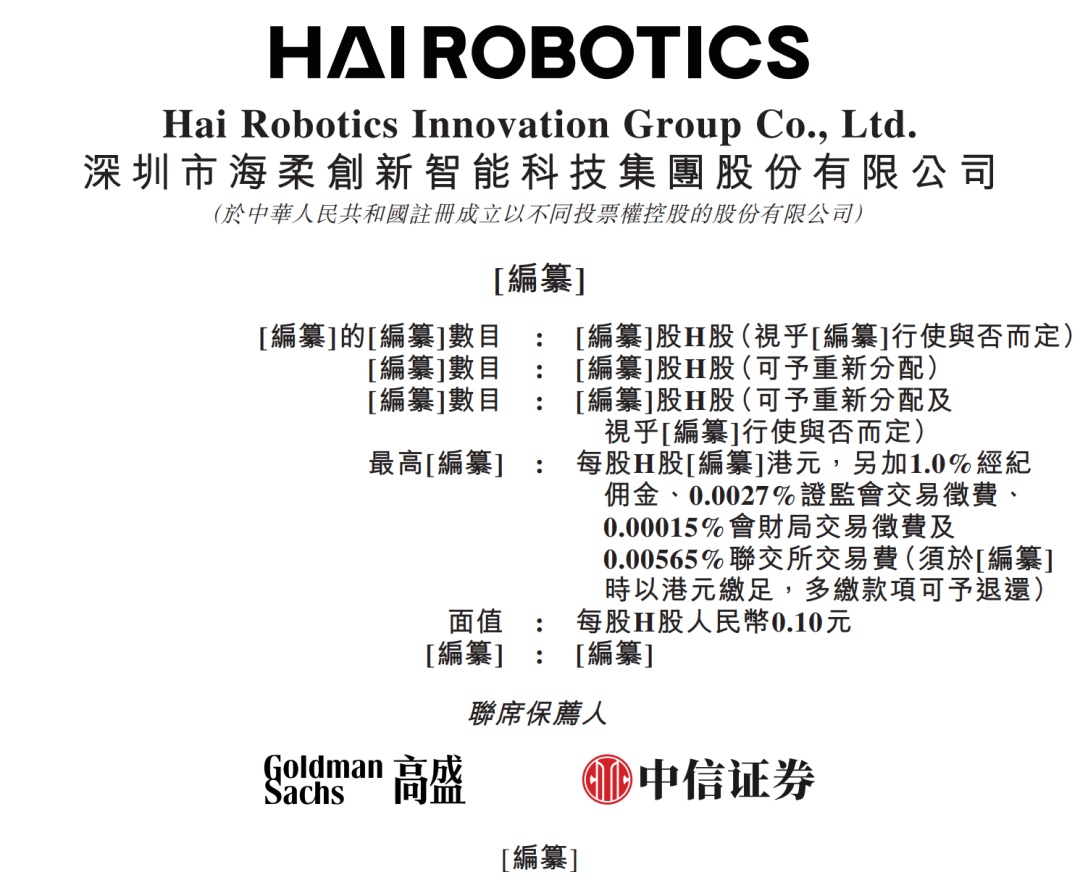
On September 13, HAI Robotics resubmitted its application for a Main Board listing at the Hong Kong Stock Exchange, with Goldman Sachs and CITIC Securities serving as joint sponsors. The company first filed in February this year, updating its materials six months later; the latest financial data covers through June 30, 2026.
HAI Robotics primarily provides automated warehousing picking solutions, with its core product being the ACR, or case-handling robot. According to Frost & Sullivan, HAI Robotics was the world's largest ACR solution provider by both revenue and shipment volume in 2025, capturing over 30% market share. Its operations now span more than 40 countries and regions, having served over 900 clients and channel partners cumulatively by the end of June 2026, with over 2,000 signed projects.
The most conflicting aspect of this prospectus is the coexistence of growth and losses. From 2023 to 2025, HAI Robotics' revenue grew from RMB 807 million to RMB 2.017 billion, representing a CAGR of 58.1%; H1 2026 revenue reached RMB 1.118 billion, up 70.2% YoY. In the same periods, the company reported net losses of RMB 1.009 billion, RMB 1.256 billion, RMB 828 million, and RMB 431 million respectively, accumulating roughly RMB 3.523 billion in losses over three and a half years.
Revenue is already scaling, but profitability is still on the way. The ultimate question for HAI Robotics' IPO pricing is a simple one: When will its No. 1 global market share translate into stable operating returns?
HAI Robotics sells a continuously upgrading warehouse system
It is easy to categorize HAI Robotics as a "robotics company." While not incorrect, this label often underestimates the complexity of the business. HAI Robotics delivers an integrated package including robot units, shelving and workstation hardware, warehousing software, algorithms, as well as installation, commissioning, and after-sales services. Clients are not buying standalone machines, but rather an automation infrastructure that must be embedded into warehouse workflows, inventory systems, and order management.
The value of the ACR lies in shifting traditional "human-to-goods" picking to "goods-to-human." Robots move designated cases from shelving areas to workstations, where workers or robotic arms complete picking at fixed locations. For e-commerce, apparel, third-party logistics, and retail clients with high SKU counts and volatile order volumes, this solution improves storage density and offers greater scalability and flexibility compared to fixed conveyor lines.
HAI Robotics' growth stems from the shift in warehousing automation from standard equipment procurement to flexible system deployment. In 2025, the company launched the HaiPick Climb single-side climbing ACR solution, applicable to new builds and retrofits, supporting storage heights up to 15 meters. Higher shelf utilization and lower retrofit thresholds help expand the existing warehouse market, evolving the ACR from a single-product robot into a comprehensive warehouse space utilization solution.
Order changes disclosed in the prospectus offer more forward-looking signals than revenue growth alone. In H1 2026, HAI Robotics secured new orders worth RMB 2.353 billion (+48.8% YoY); by the end of June, backlog orders exceeded RMB 4.1 billion. For automation firms recognizing revenue based on project progress, backlog determines revenue visibility for upcoming quarters, while delivery efficiency dictates how smoothly revenue gets realized.
This also explains why HAI Robotics needs to continue expanding its manufacturing, supply chain, and service capabilities. Sufficient orders are just the starting point; equipment production, on-site implementation, software integration, and client acceptance can all impact recognition timing. As large-scale projects become more frequent and contribute more per client, the stability of revenue growth becomes increasingly dependent on project management prowess.
The good news is that client stickiness is evident. HAI Robotics reports an 89% client repurchase rate, with seven of the world's top ten fashion/apparel enterprises and seven of the top ten third-party logistics providers as clients. Once a warehousing system is deployed, subsequent expansions, additional robot deployments, software upgrades, and maintenance typically continue using the existing tech stack. High repurchase rates carry strong commercial implications: initial customer acquisition and delivery costs can be amortized over the client lifecycle.
The fundamental focus for HAI Robotics' next phase has shifted from "how many robots can we sell" to "how much long-term revenue can each client generate." If software subscriptions, technical support, spare parts, and expansion revenues gradually increase, the volatility inherent in project-based businesses will decrease, improving overall revenue quality.
Gross margin has cleared one hurdle; expense efficiency still needs to deliver
The P&L cannot be judged solely by the bottom-line loss. Early-stage financing included redemption rights, classified as financial liabilities under IFRS; related interest and fair value changes amplified book losses. Redemption liabilities grew from RMB 2.886 billion in 2023 to RMB 5.071 billion in 2025, with related interest reaching RMB 198 million in H1 2026. Upon completing its IPO, if qualifying preferred shares convert to common stock, this financial structure could see significant improvement.
Excluding these financing instruments, the core business remains unprofitable, but marginal improvements are observable. Gross margin expanded from 16.0% in 2023 to 31.2% in 2025, further reaching 34.4% in H1 2026; meanwhile, the adjusted net loss margin narrowed from 86.1% to 18.6%.
Gross margin improvement is driven by scale expansion, product mix optimization, and overseas growth. In H1 2026, revenue from markets outside mainland China exceeded 50% of total revenue and over 55% of orders, with overseas gross margins maintaining above 40%. Overseas clients typically demand higher standards for system stability, compliance, after-sales response, and full-lifecycle services, and are willing to pay a premium for such capabilities.
These figures indicate HAI Robotics' globalization is beginning to reflect in its financial statements. Increasing overseas revenue share expands market size and improves blended margins. The key observation going forward is whether sales networks, on-site services, local spare parts, and compliance costs rise in tandem with increased overseas projects. If incremental margins are consistently consumed by global operating expenses, revenue expansion will struggle to fully convert into profits.
R&D investment presents another contradiction in the path to profitability. From 2023 to 2025, R&D expenses were RMB 309 million, RMB 334 million, and RMB 385 million respectively; H1 2026 R&D spending hit RMB 249 million, accounting for 22.3% of revenue, well above the ~15% industry average cited by Frost & Sullivan for the global ACR market. By the end of June 2026, the company had filed 2,495 patent applications globally.
Robotics firms must continuously invest in algorithms, dispatch systems, safety controls, and next-gen hardware; R&D spend is hard to simply compress. A more realistic path to profitability is for revenue growth to outpace expense growth over the long term, allowing R&D, sales, and management structures to be absorbed by a larger business base. HAI Robotics' significantly narrowed adjusted loss margin in H1 suggests operating leverage is releasing, though the profitability inflection point requires more full-quarter validation.
Cash flow quality is equally critical. Operating cash flow net amounts were negative RMB 482 million, RMB 196 million, and RMB 34 million for 2023–2025 respectively, turning positive at RMB 360 million in H1 2026. For project-based companies, a single half-year turnaround can be skewed by client prepayments, project acceptances, and supplier payment terms. Investors must continue monitoring whether AR collection, inventory turnover, and operating cash flow show consistent improvement. Sustained positive cash flow is what signals HAI Robotics transitioning from funding-driven to self-sustaining operations.
The next battle in warehouse robotics: winners must master both equipment sales and cash flow management
Frost & Sullivan estimates the ACR penetration rate in the global automated picking solutions market was only 3.2% in 2025, but the total addressable market could reach RMB 86 billion by 2030, implying a CAGR of ~70% from 2026 to 2030. Low penetration and high growth forecasts provide HAI Robotics with ample runway, but also mean competitors, system integrators, and traditional automation equipment makers will continue entering the fray.
HAI Robotics has established clear leadership in market share, client base, product matrix, and global delivery network. HK market investors will now ask stricter questions: Is backlog conversion stable? Can high overseas margins cover local service costs? Will repurchases generate more recurring revenue? When will R&D release economies of scale? Is the operating cash flow turnaround sustainable?
In my view, HAI Robotics' most compelling capital narrative is that Chinese warehouse robotics firms are finally possessing global pricing power and global delivery capabilities. The most direct risk to watch is also straightforward: automation projects are inherently heavy; revenue recognition, client capex cycles, and on-site delivery can all introduce volatility. Market share leadership does not automatically convert to profits.
This company's growth is proven by orders and revenue, and its business model is showing improvement in margins and cash flow. Moving forward, look past the "No. 1 in the World" halo and focus on several quarters of expense efficiency, collections, and overseas operational quality. The robotics industry ultimately competes not just on how fast robots run, but on whether a company can truly translate every physical move into line-item profits.
The copyright of this article belongs to the original author/organization.
The views expressed herein are solely those of the author and do not reflect the stance of the platform. The content is intended for investment reference purposes only and shall not be considered as investment advice. Please contact us if you have any questions or suggestions regarding the content services provided by the platform.