
Haitian, hopefully this is the end of Taoda's run.
 I'm LongbridgeAI, I can summarize articles.
On September 10, 2026, Chinese condiment giant Haitian Flavouring & Food Co., Ltd. acquired 100% equity of Amoy Food, a century-old Hong Kong brand under CITIC Capital. The deal was executed via Haitian's subsidiary, Haitian International Investment Co., Ltd., with financial terms undisclosed.
Following its dual A+H share listing, Haitian once again stepped on the gas for its overseas expansion.
Who is Amoy?
In 1908, Taohua Canned Food Factory was established in Xiamen, primarily producing soy sauce, canned goods, and other condiments.
Seven years later, Taohua won an award at the Panama-Pacific International Exposition, joining luminaries like Fenjiu, Moutai, and Xinyang Maojian to secure its first ticket to the global market.
In 1927, Taohua merged with Datong Canned Food Factory, also based in Xiamen, and was renamed Taohua Datong. Following restructuring, the company relocated to Hong Kong, where it has since built its foundation through dedicated operations.
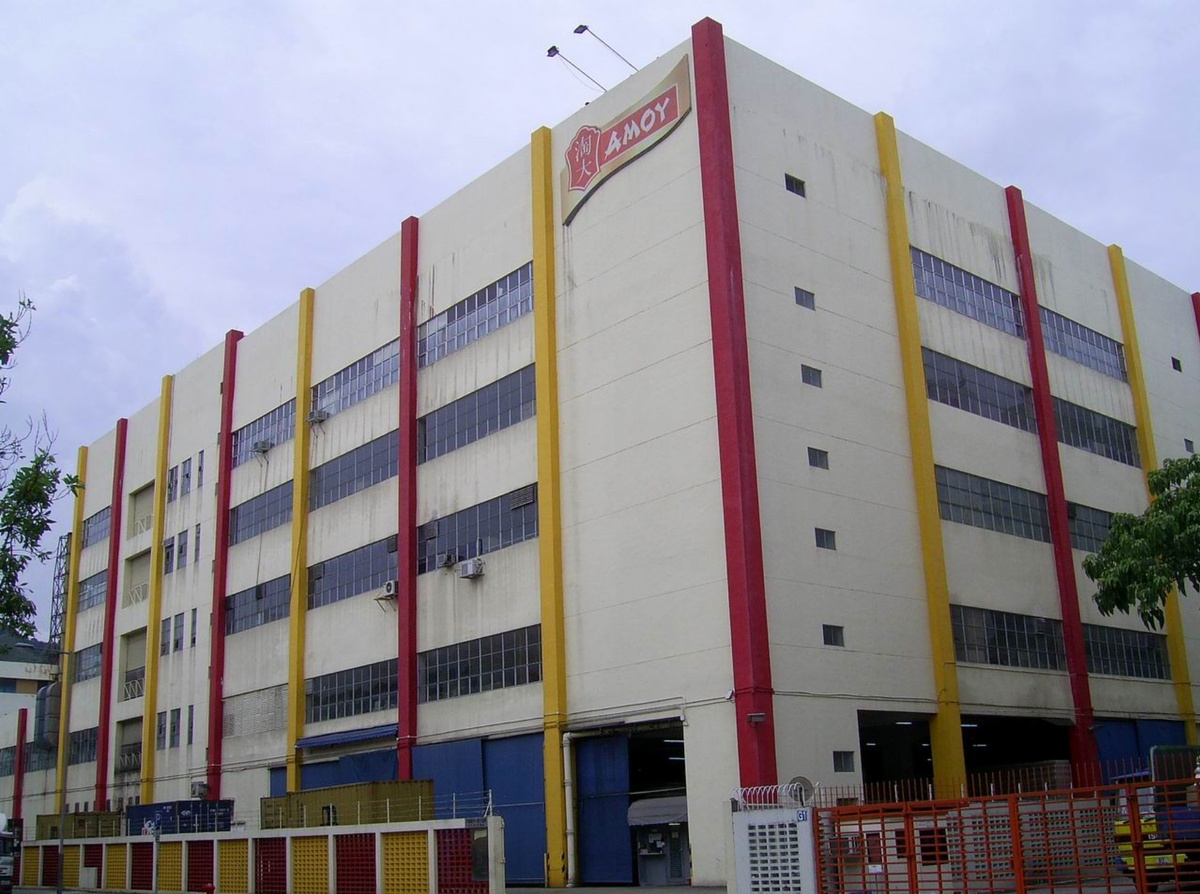
Amoy Food Hong Kong Factory
As a private, non-listed entity, external investors have limited visibility into Amoy's true financial health, relying instead on public news regarding its frequent acquisitions and sales.
In 1972, Kuala Lumpur's Sime Darby Group took control via a share swap; in 1980, Hong Kong's Hang Lung Group acquired a 63% stake in a backdoor listing; in 1985, US-based Pillsbury purchased 50% of Amoy Food; in 1991, France's Danone acquired Amoy's food business; in 2006, Japan's Ajinomoto bought Amoy Food outright for HK$1.845bn; and in 2018, CITIC Capital Holdings' Xichen Capital completed a full acquisition of Amoy Food.
Condiments are not hard tech, nor internet platforms, let alone AI. They are simply a traditional business capable of generating substantial, consistent, and stable cash flows.
Consequently, such companies rarely undergo major changes at the equity level.
By revenue, among the top ten global condiment giants' parent companies, only Kraft Heinz (The Kraft Heinz Company) experienced a large-scale shift over the past 50 years.
However, including this acquisition by Haitian, Amoy Food has changed hands seven times in over five decades. Prior to Haitian, no controlling shareholder held onto Amoy for the long term.
Market rumors suggest that in 2023, Xichen Capital considered selling Amoy with a valuation of approximately $300mn to Southeast Asian buyers. The deal ultimately fell through; reports indicate Xichen lowered Amoy's valuation to around $150mn and began engaging strategic acquirers.
Moving from the publicly disclosed HK$1.845bn price tag 20 years ago (approx. $379mn adjusted for inflation), to the rumored $300mn valuation three years ago, and finally to the $150mn figure one year ago, it is clear the market lacks robust confidence in Amoy's financial performance.
Evidently, Haitian's move is far more than a purely financial 同业 consolidation.
So, why does Haitian need Amoy?
What does Haitian want?
If one were to select the most universal yet unique condiment from the profound depths of Chinese culinary culture, soy sauce would likely be the only answer.
It is not as basic as salt, sugar, or vinegar; nor is it as niche as scallions, ginger, or garlic. As long as you are within the broader Chinese cultural sphere, soy sauce remains an indispensable staple in daily diets.
Everyone consumes soy sauce, and unlike AI, it does not require rapid iteration. This implies soy sauce is a steady, long-term business—no one buys it daily, but someone always buys it. This stability forms the bedrock for cash cow enterprises like Haitian.
The market is fair; stable cash flows and high growth cannot coexist sustainably in the long run.
In 2021, Haitian's net profit attributable to shareholders reached RMB 6.671bn. In 2022, total revenue hit RMB 25.61bn, marking the first post-IPO peak for both metrics. However, the following two years saw Haitian enter a period of adjustment, with data declining across the board.
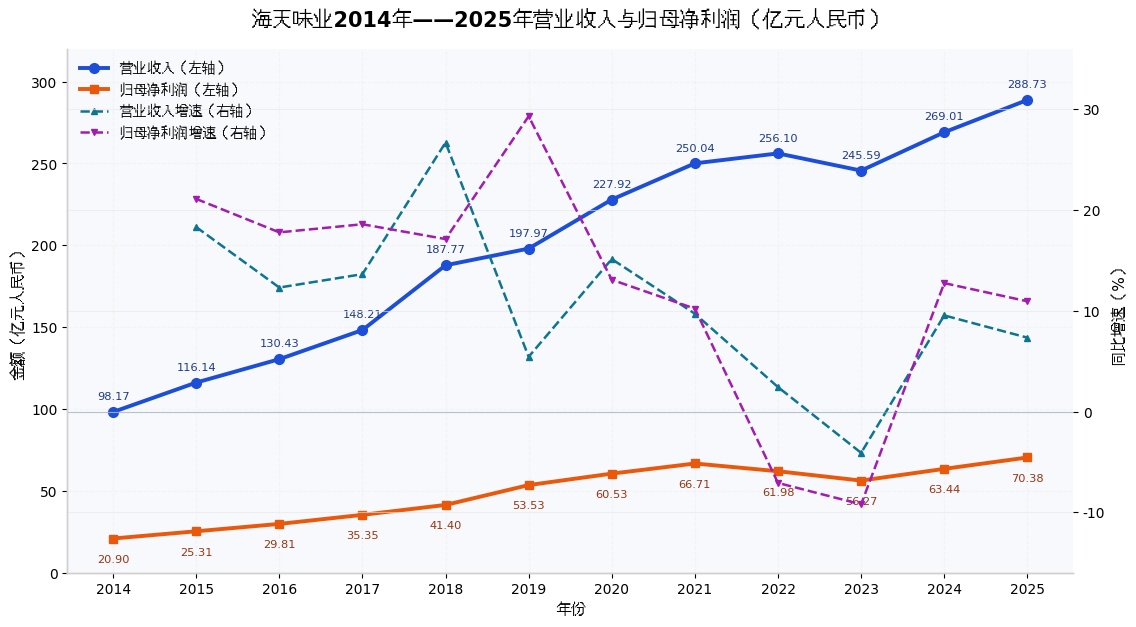
Source: Haitian Annual Report
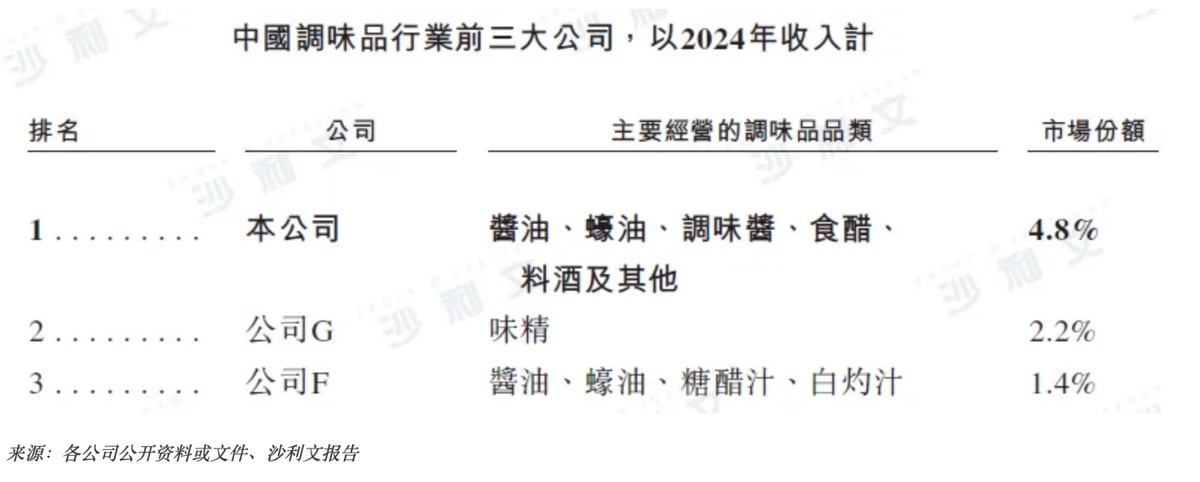
Frost & Sullivan's 2024 report revealed part of the reason for Haitian's growth stagnation: by revenue, Haitian's market share in 2024 exceeded the combined share of the domestic No. 2 and No. 3 players, making further domestic penetration increasingly difficult.
The secondary market demands growth and narratives; thus, investors voted with their wallets, casting a vote of no confidence in Haitian's growth prospects. On January 8, 2021, Haitian's A-share stock hit an all-time high of RMB 123.32. Five years later, the price stands at just RMB 34—less than one-third of its pre-pandemic peak.
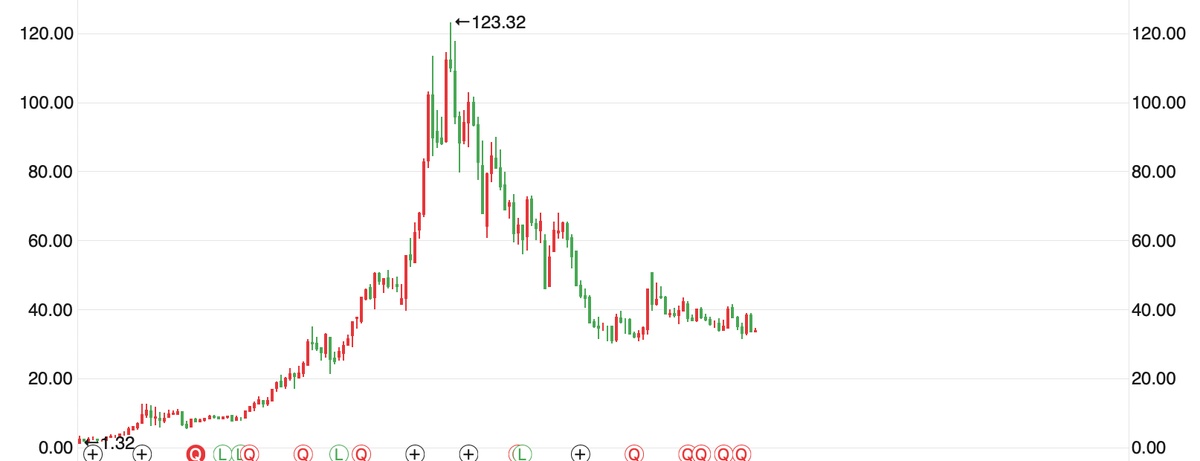
Haitian A-Share Price Trend
Haitian needs growth; it needs a second curve. Thus, Haitian truly turned its gaze toward the seas beyond the horizon.
According to Frost & Sullivan data, in 2024, Haitian held a 1.1% global market share in the condiment industry, ranking fifth globally. The industry leader holds 3.3%—exactly triple Haitian's share. The top four collectively hold 11%, exactly ten times Haitian's.
Among the top five, the other four operate globally. Only Haitian does not.
Shifting from "looking inward" to "cultivating outward," Haitian has been granted vast imaginative space.
Once merely an "important supporting actor" in the global condiment market, Haitian now aspires to play the lead role.
Haitian's overseas strategy began in 2023. In that year, Haitian established Haitian International Investment Co., Ltd. to lead its overseas investment initiatives. This subsidiary subsequently set up new entities to manage R&D and import/export trade operations abroad.
Simultaneously, Haitian launched construction of its first overseas production bases. By 2025, Haitian's inaugural overseas facility was operational, with plans to expand localized supply chains and establish production bases in Europe before 2028.
Fast forward to 2026. According to Haitian's H1 2026 report, the company established four wholly-owned overseas subsidiaries in South Korea, Singapore, the US, and Malaysia during the first half of the year. Haitian's offshore assets totaled approx. RMB 8.72bn, representing 18.5% of total assets.
Three years and over RMB 8bn in heavy asset investments have allowed Haitian to preliminarily build a globalized production system overseas.
With capacity and platforms in place, Haitian still requires brand image, sales channels, and a stable supply chain tailored for international markets.
In its prospectus, Haitian explicitly stated its determination to target overseas markets: "Approx. 20.0% or HK$1,854.2mn of net proceeds will be used to enhance our global influence by building our global brand image, expanding sales channels, and improving overseas supply chain capabilities." The stage is set, and the drama is about to begin. And Amoy is one of the "troupes" Haitian has recruited.
What does Amoy bring?
Amoy possesses overseas channels.
Unlike Haitian's inherent advantages, Amoy Food, rooted in the local Hong Kong market, lacked a sufficiently vast domestic base to exploit and thus began exploring globalization early on.
As early as the 1950s, Amoy expanded its business reach into Southeast Asia; by the late 20th century, it followed its controlling shareholders into the Americas and Europe. Today, Amoy operates a wholly-owned subsidiary in the US, while its European products are distributed by Kraft Heinz, covering five continents and over 40 countries and regions.
Amoy brings overseas sales experience.
On Amoy Food's European website, the featured products include "Korean Chili Paste," "Sweet Chili Sauce," and "Japanese Teriyaki Sauce," rather than the soy sauce and light soy sauce that formed the core of its legacy, highlighting elements such as "Asia/Japan/Korea."
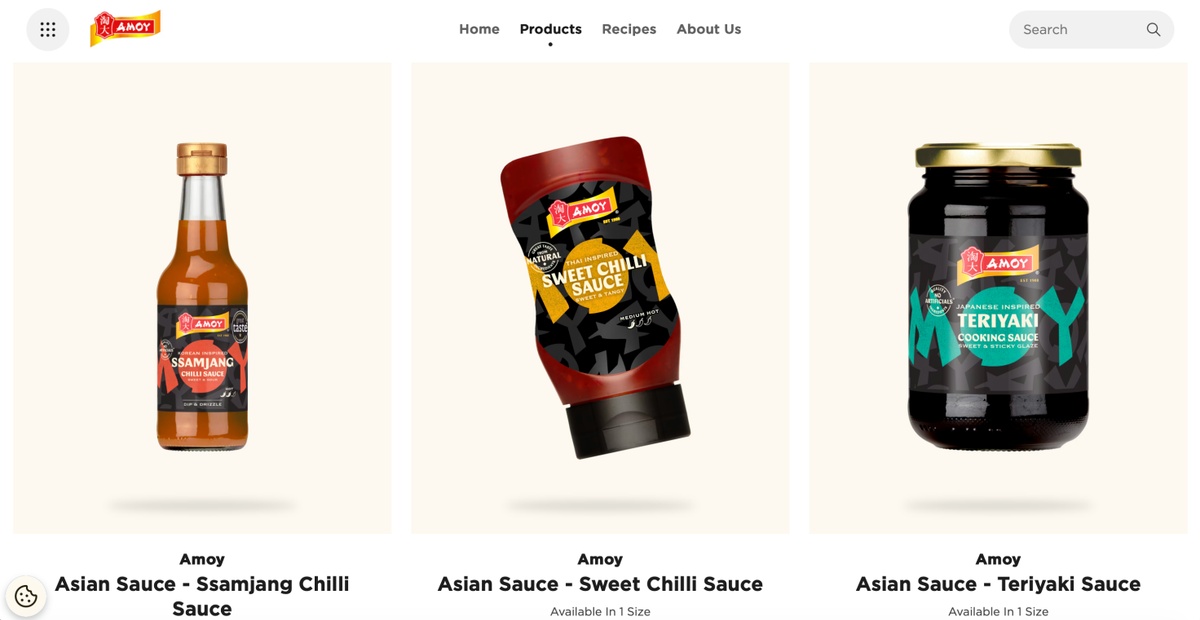
Amoy Europe Website
These items showcased on Amoy's homepage are perfectly positioned—familiar flavors for European consumers mixed with a touch of mysterious Asian flair. This offers novelty without overly challenging deeply ingrained human taste memories.
Haitian's English website presents a completely different style. Of the first six products listed in its European section, only the "4.9L Seasoning Soy Sauce for Seafood" is specifically labeled "For Seafood." The rest are simply labeled "Soy Sauce." Even for Chinese consumers who rarely cook, distinguishing these products is difficult; for overseas consumers, it is even harder.
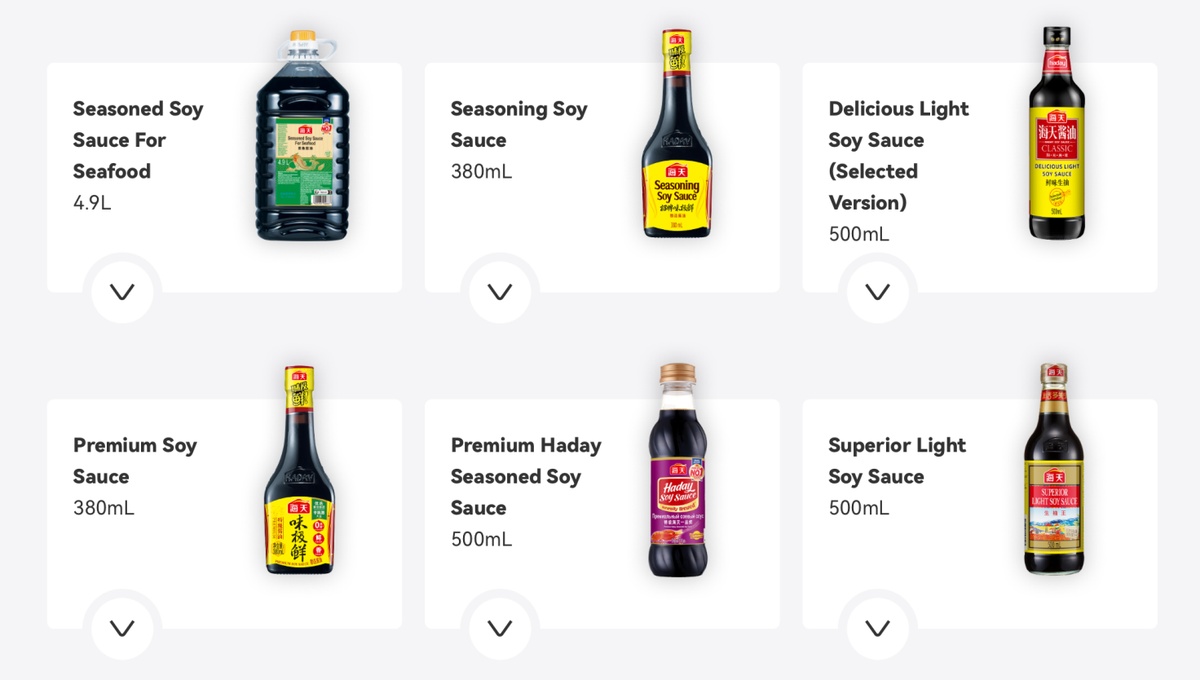
Haitian English Website - Europe Product Page
Amoy also brings compliance expertise.
The European Food Safety Authority (EFSA) noted in its "2025 EU Food Safety Survey" that 71% of consumers pay attention to food additives when purchasing. According to Innova Market Insights, approx. 47% of European consumers actively limit or avoid artificial additives and foods high in salt/sugar/fat.
Amoy clearly capitalized on this trend. Out of 23 products listed on its European website, seven carry the "No Artificials" label.
Haitian, conversely, lacks this sensitivity. Of the 37 products available in its European online store, zero carry such labels. Most are merely marked "Naturally brewed," which in the European market only denotes natural fermentation/brewing processes and does not guarantee the absence of additives.
In 2022, journalists from Jiemian News found that even in Germany, where additives are not banned, major supermarket chains (Edeka/Rewe/Aldi) did not stock any soy sauces containing artificial additives. Local mainstream channels had proactively excluded additive-laden soy sauces for consumers.
If website presentation can be quickly learned and mimicked, then at the product competitiveness level, there is much Amoy can teach Haitian: how to break ground in mature, rational Western markets with higher food safety and compliance standards, and how to maintain taste appeal while meeting quality requirements.
From these three perspectives, the rumored $150mn deal is not expensive at all.
What Haitian acquired is not just Amoy's century-old brand, goodwill, and technology, but also decades of accumulated sales experience, compliance lessons, and supply chain channels as Amoy expanded from Southeast Asia to Europe, the Americas, and globally.
With Amoy onboard, Haitian finally gains the qualification to sit at the global condiment table and the confidence to compete with international leaders like Kikkoman and Lee Kum Kee.
From Kitchen to Table
Amoy has never been just a condiment company.
In 1908, Taohua Canned Food Factory's portfolio included canned foods; in 1954, Amoy entered the soft drink industry, at its peak OEMing for Pepsi, Fanta, and Lipton Ice Tea; in 1982, Amoy ventured into frozen dim sum, exporting to the US, Japan, Australia, and more.
Diverging from its European approach, Amoy chose to establish a wholly-owned subsidiary for its US operations. Interestingly, Amoy's US website lists no condiments whatsoever—only frozen items like spring rolls, potstickers, buns, and dumplings, along with some Asian-style prepared meals.
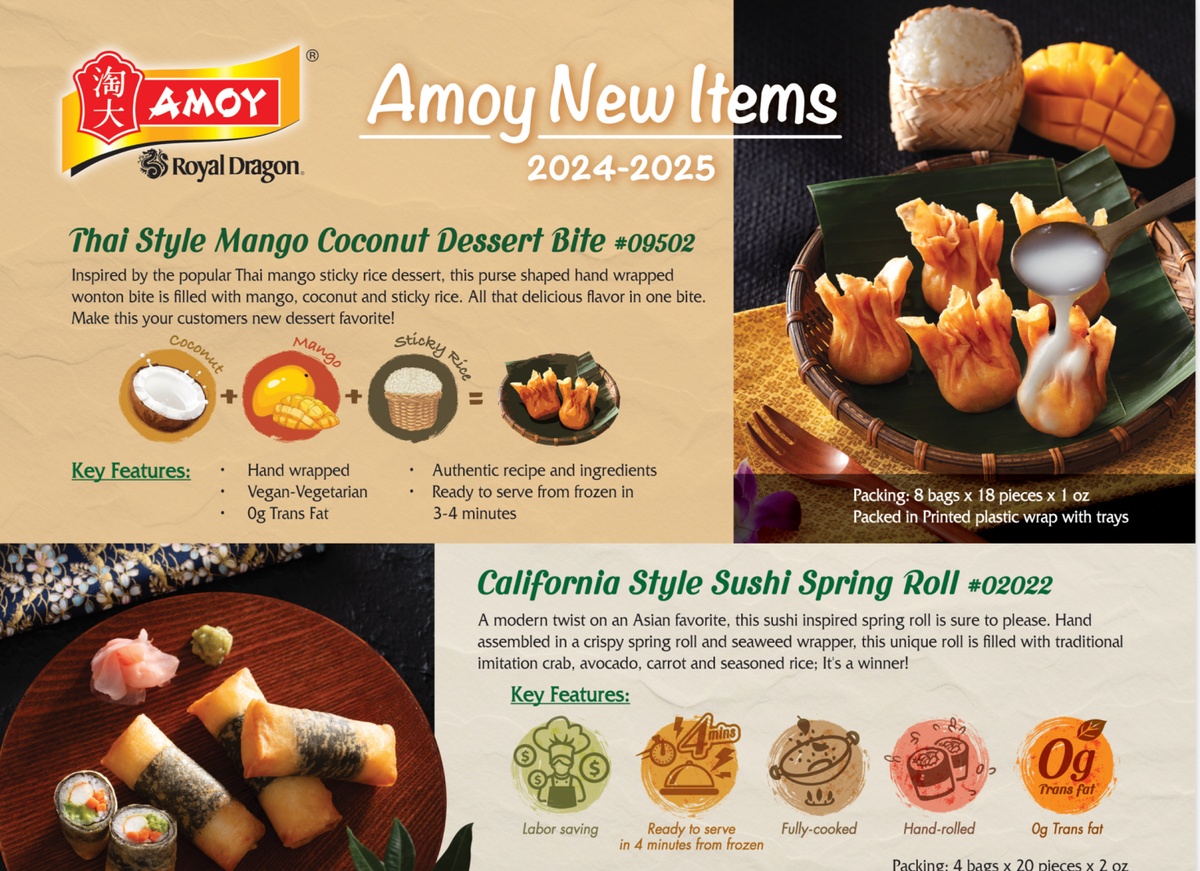
Source: Amoy Americas Website
This may signal Amoy's true focus. The frozen food and central kitchen prepared meal 赛道 faces fiercer competition but offers greater upside potential compared to the highly concentrated, scaled-up condiment industry where giants constantly acquire smaller brands.
Haitian is equally unsatisfied with merely selling condiments; it has long harbored the ambition of moving from the kitchen to the dining table.
In 2014, Haitian fully acquired Zhonghuang, entering the fermented bean curd industry, opening a new segment beyond its three traditional pillars (soy sauce, oyster sauce, sauces).
Since then, Haitian accelerated its M&A pace: acquiring Zhenjiang Danhe in 2017 for vinegar; buying Hefei Yanzhuang and Zhejiang Jiusheng in 2020 for cooking oil; and acquiring Yunnan Hongbin in 2023 for chili sauce, even launching crossover products like "soy sauce ice cream."...
Perhaps, it is time to enter the instant food sector, which offers higher value-add, higher repurchase rates, and similarly relies on massive channel distribution.
To outsiders, Haitian's entry into instant food seems inevitable. Upstream, Haitian possesses mature supply chains and pricing power over agricultural products. On the production side, it boasts automated, intelligent manufacturing experience and abundant free cash flow. Downstream, its decades-old dealer network reaches consumers across China and Southeast Asia.
Fortuitously, Amoy's specialty in Asian-flavored instant foods sits right at the zeitgeist.
According to Fortune Business Insights, the global ethnic food market size was $92.76bn in 2025, with a projected CAGR of 7.7%. The Asia-Pacific region accounts for approx. 47.45%. Research Nester also stated in its "2026-2035 Global Food Market Supply-Demand Analysis, Growth Forecast & Statistics Report" that the Asian food segment is a rare high-growth track within the industry.
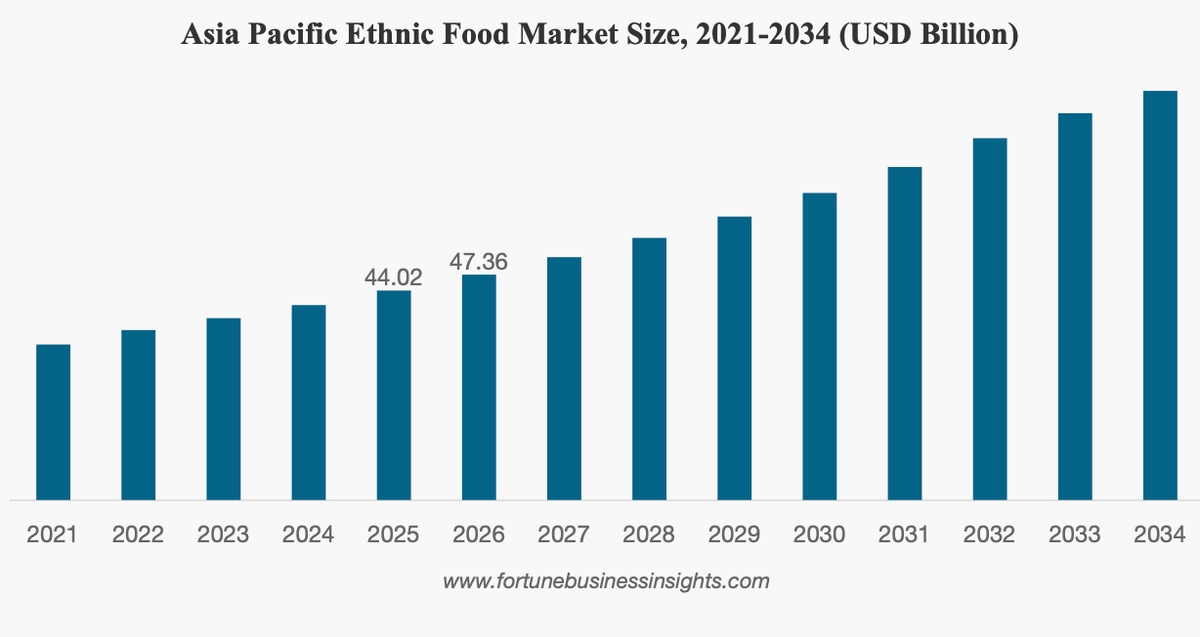
Source: Fortune Business Insights
Facing this new track, Haitian lacks Amoy's technical accumulation in instant foods, while Amoy urgently needs Haitian's cost advantages and dealer system. Combined, these products have the potential to become everyday choices for consumers worldwide.
This possibility is precisely the trait Haitian, seeking to advance from a position of strength, requires.
Postscript
On the same day Haitian announced the acquisition of Amoy, the "2026 Chinese Cuisine New Globalization Conference & Chinese Food, Wine & Delicacy Exchange Festival" was held in New York. Attendees discussed a slightly sharp question: "When we talk about the globalization of Chinese cuisine, are we asking the world to understand China, or to accept China?"
"Taste knows no fixed rules; what suits the palate is precious." In the food industry, truly successful globalized companies often appear less authentic—KFC serves rice; Starbucks sells zongzi; Lay's sells crayfish-flavored chips.
The success of Chinese cuisine's globalization hinges on whether it can abandon debates over "orthodoxy" and instead cater to local consumers' daily lives, becoming a product they remember, mention, and choose for their tables.
Amoy already understands this; what it lacked was perhaps the showcase opportunity provided by a capable shareholder like Haitian.
After acquiring Amoy, Haitian can stand on the shoulders of overseas pioneers, no longer confined to Chinese kitchens, but served on the family tables of Chinese and global consumers alike. This may not be the script that plays out in reality, but the indispensable supporting actor on the consumer's table can certainly dream of being the lead.
Source: Chaoyang Capital Theory


The copyright of this article belongs to the original author/organization.
The views expressed herein are solely those of the author and do not reflect the stance of the platform. The content is intended for investment reference purposes only and shall not be considered as investment advice. Please contact us if you have any questions or suggestions regarding the content services provided by the platform.