

"Bottlenecks" are opportunities: One-click layout of AI hardware core links with 3499.HK [South East Asia ETF New Product Launch]
 I'm LongbridgeAI, I can summarize articles.
The AI bottleneck track focuses on the high-barrier upstream hardware segment of AI computing infrastructure, which is the core sector where profits and cash flow are highly concentrated under this round of AI industry capital expenditure.
Leading enterprises in Asia, Japan, and South Korea control globally scarce AI hardware capacity, meeting global computing expansion demands, and possess higher certainty in profitability, making them the core beneficiaries of the AI industry chain.
CSOP Solactive Asia AI Bottleneck Index ETF (3499.HK)Along the complete core links of AI infrastructure, it provides investors with a convenient tool for one-stop layout of the Asian AI computing hardware supply chain.
$CSOP AI BOTTLNK(03499.HK)
In the industrial logic of large-scale AI computing expansion, the "bottleneck" does not refer to industry weaknesses, but rather the key scarce links that the entire industry cannot do without, whose capacity is difficult to expand quickly, and which have extremely high technical barriers. These links control industry pricing power and are also the core gathering places for AI cycle profits and cash flow.
The current development of AI is still in the early stage of "large-scale infrastructure construction," and these "bottleneck" links are concentrated in the upstream hardware industry, which happens to be controlled by Asian enterprises.
Currently, cloud providers and global large technology companies are investing hundreds of billions in capital expenditures to prioritize solving the problem of computing hardware supply. A large number of Asian semiconductor companies have thereby joined the ranks of global profitable enterprises, and industry profits and free cash flow are continuously concentrating on Asia-Pacific hardware leaders. Global AI computing construction relies heavily on the physical capacity and key technologies provided by listed leaders in China's Taiwan region, South Korea, and Japan.
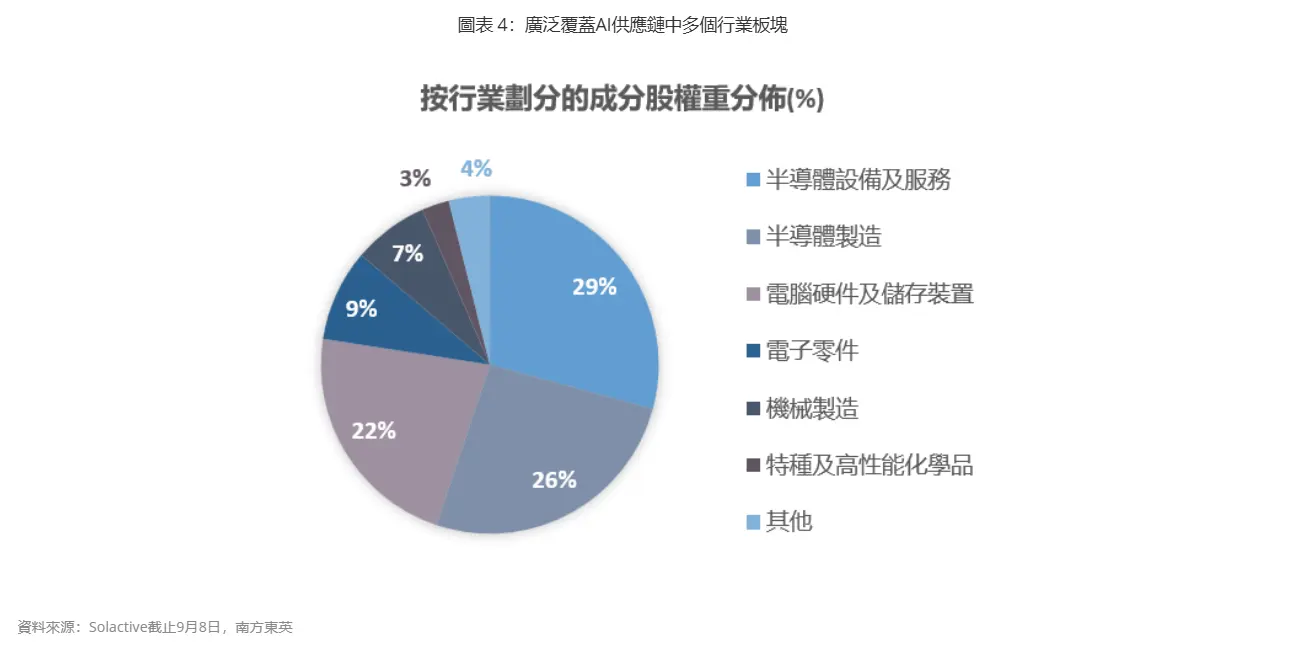
CSOP Solactive Asia AI Bottleneck Index ETF (3499.HK) $CSOP AI BOTTLNK(03499.HK) Layouts along the complete AI computing industry chain. In addition to semiconductor chip-related enterprises, the product widely covers the indispensable supply side of AI infrastructure, including substrate materials, components, and advanced manufacturing enterprises.
Investors only need a regular Hong Kong stock account to trade in HKD, without needing to open separate accounts for Taiwan stocks, Korean stocks, and Japanese stocks, to achieve a one-stop layout of the entire Asia-Pacific AI computing hardware supply chain, seizing the industry growth opportunities brought by high-barrier hardware links during the AI infrastructure construction process.
What is an AI Bottleneck?
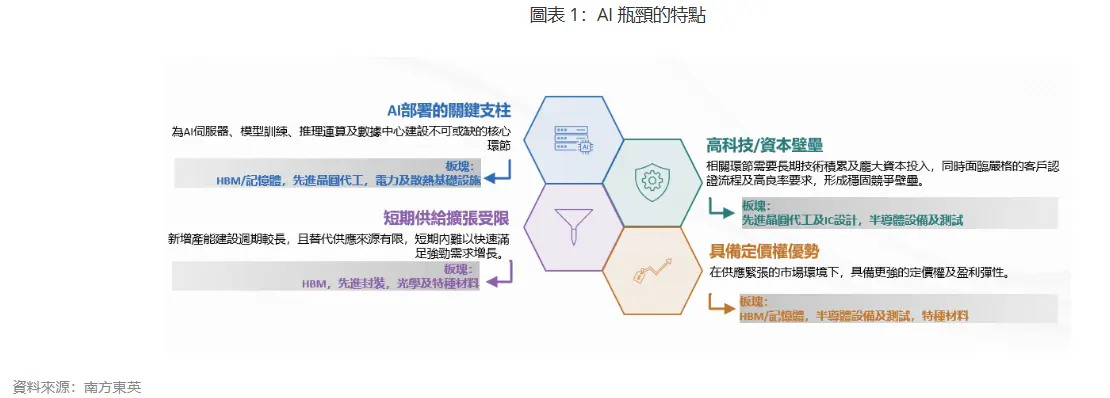
In the AI industry, Bottleneck = Strategic key nodes that are essential to the AI industry, difficult to replicate, and limited in short-term capacity expansion.Upstream hardware such as HBM high-bandwidth memory, advanced wafer foundries, semiconductor testing equipment, ABF substrates, and MLCC passive components all belong to typical AI bottleneck links.
They have the following characteristics:
– 1. High technology and capital barriers:Requires long-term technological accumulation, huge capital investment, and strict customer certification; new players find it difficult to enter;
– 2. Limited short-term supply expansion:Factory construction and yield ramp-up cycles are long; even if demand explodes, production cannot be expanded immediately;
– 3. Strong pricing power:In a situation of insufficient supply and excess demand, suppliers hold bargaining power, resulting in strong profit elasticity.
Why look at Asia-Pacific? Global AI computing relies on key Asian capacity
Currently, the core capacity of many bottleneck links in the global AI supply chain is highly concentrated in China's Taiwan region, South Korea, and Japan.
South Korean enterprises possess globally leading capacity in the HBM memory field, with SK Hynix and Samsung accounting for approximately 80% of the market share combined during the forecast period from 2025 to 2027 1.
Enterprises in China's Taiwan region occupy the core supply share of advanced wafer foundries and AI server power hardware. TSMC dominated 70% of global advanced foundry in 2025 2, and the mass production and advanced packaging of most high-end AI chips are closely related to its capacity.
Japanese manufacturers maintain industry-leading positions in semiconductor equipment, special materials, and high-end MLCC components.
Why is the AI "bottleneck" stuck in the upstream hardware link?
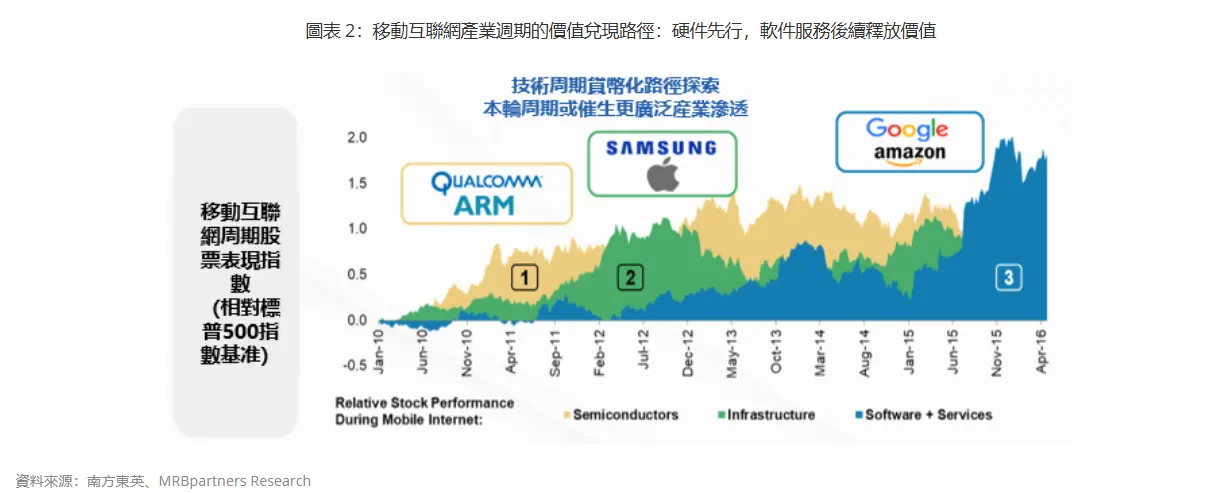
AI is currently still in the early stage of "large-scale infrastructure construction" and has not yet reached the stage of large-scale commercial application explosion. Comparing the mobile internet cycle with the current AI cycle, it can be seen that in the early stage, semiconductor-related links often benefit first and achieve leading returns, while the commercial value of the software and service layers is usually released gradually in the later stage.
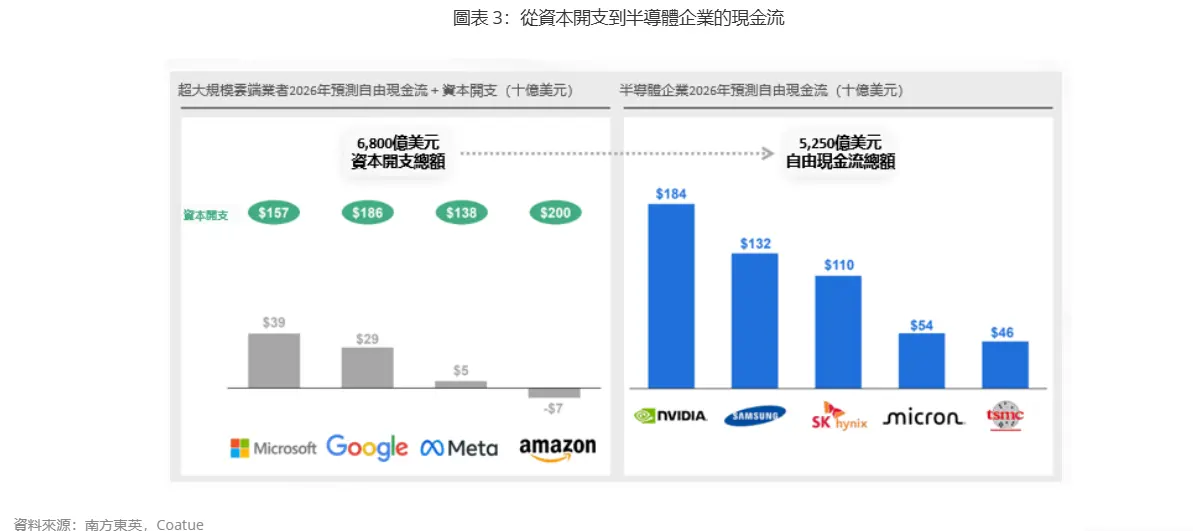
Cloud providers and ultra-large technology companies, such as Microsoft, Google, and Amazon, are investing hundreds of billions in capital expenditures to prioritize solving the computing hardware problem, so these huge funds will flow preferentially to upstream semiconductors and key components. For cloud service providers, compared to parts price increases, failing to get goods and falling behind competitors in deployment poses a greater risk. To ensure supply, they are willing to pay premiums for key hardware.
According to Morgan Stanley's forecast, the capital expenditure of ultra-large cloud service provider data centers will break through $800 billion in 2026 and exceed $1 trillion in 2027. Jensen Huang of NVIDIA made an even bolder prediction that annual global AI infrastructure investment could reach $3-4 trillion by 2030.
Taking NVIDIA's next-generation VR200 AI cabinet as an example, the material cost of the entire system increased by 95% compared to the previous generation 3. The public often only focuses on GPUs, but dismantling the cost structure reveals that besides GPUs, components dominated by Asia-Pacific manufacturers such as memory, PCB circuit boards, MLCC ceramic capacitors, and substrates have also seen significant cost increases.
Since the end of 2025, these types of components have successively entered a price increase cycle, reflecting that the supply and demand of bottleneck links continue to tighten, profits are concentrating on leaders who control capacity, and the cost pressure of AI computing has spread from GPUs to the entire Asian semiconductor supply chain. A large number of Asian semiconductor companies have thereby joined the ranks of the world's most profitable enterprises, and industry profits and free cash flow are continuously converging on Asia-Pacific hardware leaders.
Five major AI upstream hardware tracks: Understanding the opportunity of scarce Asia-Pacific computing capacity
AI computing construction is a coordinated upgrade of a complete hardware supply chain. The following will break down these five high-barrier upstream hardware links to understand the growth opportunities for Asia-Pacific supply chain leaders in global AI computing construction.
1. HBM and High-End Memory
HBM high-frequency bandwidth memory is a high-end storage chip designed specifically for AI, responsible for high-speed data transmission, directly determining the operating speed of large model training and inference. The R&D and factory production of such products require massive capital investment, and the industry entry barrier is high, forming a stable oligopoly dominated by SK Hynix and Samsung.
AI is rapidly elevating the commercial value of memory: it is expected that by 2028, the value share from AI in the overall memory market will exceed 50%. Due to limited capacity, cloud technology companies have signed 3-5 year long-term procurement agreements, and some cooperation will prepay for goods to lock in capacity, giving suppliers stronger bargaining power 4.
Representative companies: SK Hynix and Samsung accounted for approximately 80% of the market share combined during the forecast period from 2025 to 2027 5.
2. Advanced Wafer Foundry and CoWoS Advanced Packaging
Advanced wafer foundries are responsible for producing high-performance AI chips; CoWoS is a special advanced packaging technology used to assemble computing chips and HBM storage chips together, which is an important link for the mass production of high-performance AI chips.
As the performance indicators of AI chips continue to upgrade, the industry's requirements for production yields are constantly increasing. TSMC not only maintains leading yields in advanced processes such as 3nm, but its CoWoS capacity faces strong demand from global AI customers and is in a state of persistent shortage. Capacity construction and process tuning require long cycles, and the pace of capacity expansion is difficult to match the hardware needs brought by technological iteration. As reported by Nikkei Asia in August last year, TSMC may raise wafer foundry prices by 10% in 2027.
Representative company: TSMC dominated 70% of global advanced foundry in 20256.
3. Semiconductor Equipment and Testing
The entire process of semiconductor manufacturing, packaging, and testing relies on various specialized equipment.
The R&D cycle for new equipment itself is long, and completing equipment process verification and certification for chip factories also takes a lot of time, making it difficult for new companies to enter the market. Many key process equipment markets are highly occupied by Japanese manufacturers, making them an important link in the entire AI semiconductor manufacturing chain.
Representative companies: Tokyo Electron is nearly monopolistic in the coating/development (photoresist processing) equipment field (approx. 90% market share); Advantest accounted for nearly 65% of the automated test equipment market in 2025 7.
4. AI Server Power and Cooling
The expansion of data centers drives up overall power consumption, and the power consumption of single server cabinets continues to rise, requiring dedicated power supplies and cooling modules to ensure stable machine operation. If power supply and cooling capabilities cannot keep up with power consumption increases, even with a large number of chips, data centers cannot carry out large-scale computing operations. Power and cooling are realistic constraints on computing expansion.
Conventional power supplies on the market are sufficient, but the specifications for dedicated power supplies for next-generation high-power AI cabinets vary greatly, and the product modification and customer certification processes are cumbersome, making it difficult to scale up quickly. The supply of high-end products cannot keep up with the pace of computing expansion.
Representative company: Delta Electronics is a core supplier of global AI server power supplies, holding over 60% market share in the global AI server power module market 8.
5. MLCC and Special Optical/Packaging Materials
MLCC (Multi-Layer Ceramic Capacitor) belongs to micro basic electronic components, along with substrates, copper-clad laminates, and other packaging materials, which are essential materials in the AI server and chip packaging process. With the continuous increase in AI server power consumption and integration density, the consumption of such components per cabinet is far higher than that of ordinary servers.
These basic components seem simple, but high-end specifications suitable for AI high-computing scenarios require dedicated production lines. The investment in production line transformation is huge, and yield improvement requires long-term process accumulation, making rapid capacity expansion difficult in the short term, resulting in low supply elasticity. With the iterative upgrade of industry hardware standards, relevant leading enterprises are 迎来 ing profit growth space.
Representative company: Murata Manufacturing of Japan holds approximately 40% market share in the AI server-grade high-end MLCC market9.
CSOP Solactive Asia AI Bottleneck Index ETF (3499.HK) Focuses on Asia-Pacific High-Market-Share Bottleneck Leaders
CSOP Solactive Asia AI Bottleneck Index ETF (3499.HK) concentrates on listed enterprises in China's Taiwan region, Japan, and South Korea, laying out along the complete AI computing industry chain. The investment scope is not limited to semiconductor chip enterprises, but also covers the indispensable upstream supply side of AI infrastructure, including substrate materials, components, and advanced manufacturing enterprises.
3499.HK was listed in Hong Kong on September 17, 2026, with an initial minimum investment threshold of only about HKD 780, and a lot size of 100 units. In addition to the listed category, 3499.HK also offers non-listed categories, with a minimum initial investment amount of USD 10 or equivalent. For more product details, investors can visit the product page for information.
The index adopts free-float market cap weighting, giving higher weights to larger-scale enterprises with higher market recognition, striving to fully capture the overall industry upside; meanwhile, it sets a single stock weight cap of 20%, with excess portions redistributed proportionally to mitigate the risk of excessive individual stock concentration. The index implements a quarterly rebalancing mechanism, driven entirely by rules, unaffected by short-term market sentiment, dynamically updating the list to follow industry landscape changes, and continuously maintaining exposure to the AI bottleneck track.
Investors only need a regular Hong Kong stock account to trade in HKD, without needing to open separate accounts for Taiwan stocks, Korean stocks, and Japanese stocks, to achieve a one-stop layout of the entire Asia-Pacific AI computing hardware supply chain, seizing the industry growth opportunities brought by scarce capacity under the wave of AI infrastructure construction.
1 Counterpoint Research, forecast data for reference only and does not represent or guarantee future actual performance.
2 TrendForce
3 Morgan Stanley Research
4 JPMorgan, Ajunews, TradingKey, forecast data for reference only and does not represent or guarantee future actual performance.
5 Counterpoint Research, forecast data for reference only and does not represent or guarantee future actual performance.
6 TrendForce
7 Tokyo Electron Company Website; Advantest 2025 Fiscal Year Results
8 KGI Industry Report
9 Murata Website
Disclaimer and Important Notice
The products described in this document are endorsed by the Securities and Futures Commission of Hong Kong ("SFC"). Such endorsement does not imply recommendation by the SFC.
This document is for general reference only and does not constitute investment advice or opinion of any kind, nor should it be construed as an offer or solicitation to invest in any investment product. For investment advice, please consult your professional legal, tax, and financial advisors.
Investment involves risk. Past performance data does not predict future performance. Investors should carefully read the sales documents and product key facts statement of the relevant fund to obtain further information, including product features and all risk factors contained therein. Investors should not make investment decisions solely based on this document. This document is not applicable to jurisdictions where its distribution or sending is prohibited.
This document is not legally binding. CSOP reasonably believes that the information contained in this document is accurate and complete when preparing this document, and shall not be liable for any loss arising from the improper use of all or any part of this document by any person or caused by reliance on such content. This document does not grant recipients any copyright or intellectual property rights to use the contained information (whether direct, indirect, or implied). Without the written consent of CSOP, no material or part thereof in this document may be copied, distributed, or reproduced.
The products described in this document may face regional, market, industry, or investment instrument concentration risks. Compared to funds with more diversified portfolios, the value volatility of the products described in this document may be greater.
For the disclaimer of the index provider, please refer to the offering documents of the relevant fund. This document is prepared by CSOP and has not been reviewed by the SFC.
Issuer: CSOP Asset Management Limited
$SK Hynix(SKHY.US) $NVIDIA(NVDA.US) $Hang Seng TECH Index(STECH.HK) $Invesco QQQ Trust(QQQ.US) $Taiwan Semiconductor(TSM.US)
The copyright of this article belongs to the original author/organization.
The views expressed herein are solely those of the author and do not reflect the stance of the platform. The content is intended for investment reference purposes only and shall not be considered as investment advice. Please contact us if you have any questions or suggestions regarding the content services provided by the platform.