

<p>Inno Packaging files for HKEX listing: Glass business is adopting a new revenue model</p>
 I'm LongbridgeAI, I can summarize articles.
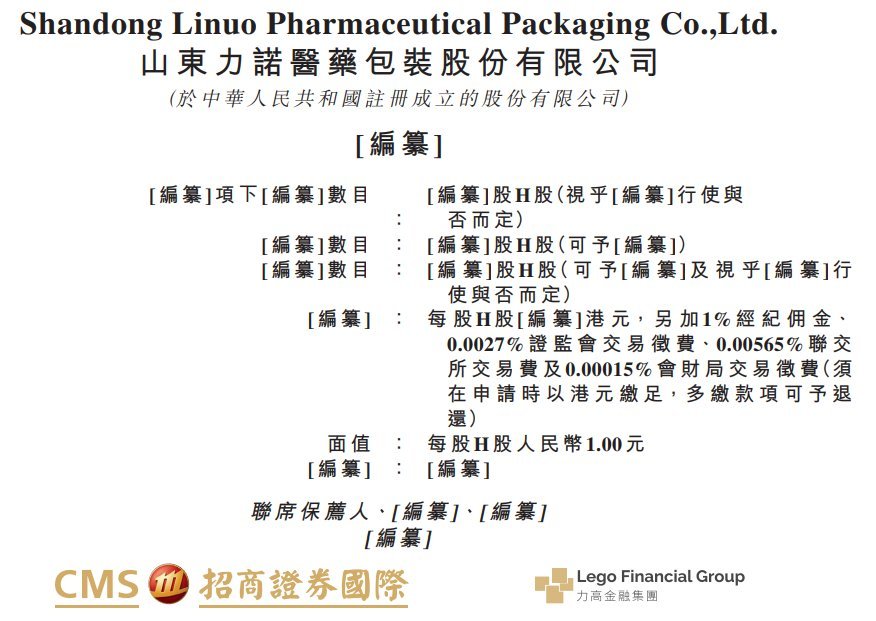
On September 28, 2026, Linuo Pharmaceutical Packaging filed for a main board listing on the Hong Kong Stock Exchange, with China Merchants Securities International and Ligao Financial Group serving as joint sponsors. This borosilicate specialty glass company, already listed on the A-share market, is expanding its financing channels in overseas capital markets while mapping out growth across pharmaceutical packaging, heat-resistant glass, and new material R&D into a single strategic roadmap. While the filing awaits regulatory approval, the business transformation has already begun to reflect in financial statements.
According to the latest periodic report as of now, revenue reached RMB 673 million in H1 2026, up 34.93% YoY, while net profit attributable to shareholders was RMB 31.16 million, down 23.95% YoY. The divergence between top-line growth and profit contraction raises a compelling commercial question: how much of the incremental value generated by higher sales volume actually stays in the pocket?
For manufacturing firms, capacity dictates delivery capability, while what customers are willing to pay determines margin space. Linuo is attempting to provide higher-value-added packaging to pharma companies, engage consumers directly through brand and channel strategies, and identify new industrial applications for glass materials. The direction is attractive, but the pace of realization varies. To understand this company, one must separate realized operational improvements from ongoing growth investments.
The most significant aspect of this transformation is Linuo's push for greater profit-sharing power; the greatest test of operational capability lies in the upfront costs required to secure these rights.
The value of pharmaceutical bottles is extending into clients' production processes
The commercial value of upgrading pharmaceutical packaging can be understood through the client's production workflow. For pharma companies, packaging must not only hold drugs but also accommodate subsequent production, storage, transport, and usage requirements. If suppliers can take on more processing and quality control steps, products can escape pure per-unit pricing competition, but they must also assume higher delivery responsibilities.
RTU (Ready-to-Use), or pre-sterilized pharmaceutical packaging, offers a window into this shift. According to investor relations records disclosed in July this year, the RTU production line commenced operations in November 2025. Monthly sales grew from several hundred thousand yuan at launch to over RMB 3 million in Q2 2026, and the company has begun building a US sales team.
The significance of these figures lies in the fact that new products are already generating revenue. For clients, procuring pre-processed packaging allows them to re-evaluate their internal production configurations; for suppliers, competition extends into process control, quality stability, and service capability. This gives Linuo an opportunity to deepen integration into client workflows. Whether subsequent orders continue to expand is more critical than simply adding to the product catalog.
Traditional businesses have also improved. Revenue from pharmaceutical glass reached RMB 227 million in H1, up 11.72% YoY, with a gross margin of 21.78%, an increase of 183 bps YoY. The company disclosed that it implemented price increases for its core medium-borosilicate products starting this year. Simultaneous growth in revenue and margin provides a solid operational foundation for high-end product investments.
However, the pharmaceutical packaging business operates on its own timeline. Client validation, order conversion, and capacity utilization improvements rarely align perfectly with supplier expansion plans. The semi-annual report noted that the market development cycle for new products is long, and the downstream market environment has slowed expansion momentum.
Therefore, a more positive assessment of this business line should be built on sustained delivery. Initial sales prove the product has taken a step toward commercialization. It is customer repeat purchases, category expansion, and production line efficiency improvements that will gradually form more stable profit contributions. The appeal of high-end positioning lies precisely in these customer relationships, which are hard to replicate once established.
Heat-resistant glass is moving faster, but brand profits must still clear the channel hurdle
Despite the name "Pharmaceutical Packaging," the clearer driver of revenue growth this year has been heat-resistant glass. Revenue from this segment reached RMB 436 million in H1, up 53.36% YoY. Meanwhile, total overseas revenue was RMB 215 million, up 115.02% YoY, with an overseas gross margin of 27.51%. It is important to distinguish that overseas data covers all related business and cannot be entirely attributed to independent brand performance.
Heat-resistant glass already has a substantial scale base. Citing Frost & Sullivan data in the prospectus, the company ranked first in China's daily-use heat-resistant glass market by 2025 sales revenue. This position provides manufacturing support for branding, but a gap remains between supplier rankings and consumer awareness, bridged by product design, channel reach, and purchase experience.
Under OEM models, manufacturers produce based on client orders; under direct brand operation, companies participate more deeply in product definition and pricing but must also bear customer acquisition, fulfillment, and inventory management costs. Branding is thus a redistribution of profit structures. Earnings gained at the factory level may not immediately translate to the bottom line after channel costs.
Linuo has advanced its independent brand, e-commerce channels, and Singapore brand operation center construction. The cost of transformation is concrete: selling expenses reached RMB 50.89 million in H1, up 90.54% YoY; the Hangzhou e-commerce subsidiary reported a loss of RMB 14.06 million. Additionally, share-based payment expenses of RMB 14.68 million impacted current profits. Profit decline cannot be solely attributed to brand investment.
These factors require separate evaluation. Share-based payments involve incentive costs, while e-commerce losses more directly reflect channel cultivation. The former shouldn't be simplistically viewed as cash outflows, nor should the latter escape operational efficiency scrutiny merely because it's labeled "long-term investment." The effectiveness of the brand strategy depends on whether customer acquisition costs can be better amortized after sales growth and whether product mix enhances customer value.
For Linuo, existing manufacturing capabilities reduce the difficulty of organizing supply for brand businesses, but brand operation remains a skill set requiring relearning. If e-commerce losses narrow while revenue continues to grow, the case for transformation strengthens significantly. If new sales continue to rely on higher ad spend, the company must adjust channel and product strategies. Branding is worth investing in, but requires room for trial, error, and timely correction.
New materials open up upside potential, but operational efficiency determines how far the transformation goes
Glass new materials offer more imagination for Linuo's growth space, but discussion must anchor to accurate business stages. In June this year, the company ignited the pilot kiln for glass new materials. The semi-annual report further disclosed that packaging substrate glass is in the stages of product debugging, formula and molding process optimization, and client sample validation. Related early projects have not yet generated revenue.
This layout rests on industrial foundations. In investor communications, the company explained that new materials can share some processes, equipment, and supply chain resources with existing borosilicate glass businesses. Existing technical accumulation lowers exploration costs, but whether material performance meets client requirements still needs verification. Even if samples pass testing, consistency and cost in mass production require continued resolution.
At this stage, it is more appropriate to view this business as an extension of technical capability. Developing into a "glass new material platform" means the same materials and manufacturing capabilities could serve multiple industries, gradually reducing dependence on a single application market. The key to platform value lies in capability reuse. If new projects always require rebuilding a high-cost system from scratch, synergies need re-evaluation.The flip side of expansion is capital occupation. In H1, net operating cash flow was negative RMB 68.29 million, with ending inventory book value at approximately RMB 514 million. The company explained that e-commerce losses, increased inventory, and higher acceptance bill margins affected operating cash flow. Parallel new business development and capacity construction require management to arrange investment and collection rhythms more meticulously.
Widening financing channels provides greater maneuvering space for transformation, but investment efficiency must be answered by operational results. Linuo already possesses revenue-generating manufacturing businesses and is securing high-end packaging orders, while brands and new materials offer possibilities for outward extension. The next focus is ensuring investment rhythms across different businesses coordinate well, avoiding a scenario where faster growth leads to heavier capital ties.
What makes Linuo Pharmaceutical Packaging worth tracking is a manufacturing enterprise converting technical accumulation into richer commercial capabilities. The most convincing progress in the next phase will be new clients staying, new production lines running at full capacity, and cash flowing back after growth.

The copyright of this article belongs to the original author/organization.
The views expressed herein are solely those of the author and do not reflect the stance of the platform. The content is intended for investment reference purposes only and shall not be considered as investment advice. Please contact us if you have any questions or suggestions regarding the content services provided by the platform.