
With DeepSeek raising hundreds of billions and MiniMax's Hong Kong IPO debut below the offer price, will there be enough capital for large models to burn through until profitability?
 I'm LongbridgeAI, I can summarize articles.
On October 22, MiniMax (00100.HK) broke its IPO price.
On the same day, Bloomberg, citing informed sources, reported that DeepSeek raised approximately RMB 100 billion (about USD 15 billion) in its latest financing round, one of the largest in Chinese history, with CATL and Tencent among the investors.
Just days earlier, CITIC Securities had updated the progress of MiniMax's A-share listing tutoring, preparing for final acceptance.
It has been just over nine months since MiniMax listed on the Hong Kong Stock Exchange on January 9.
The timeline is tight. Zhipu (02513.HK), another of the "duo," completed its STAR Market IPO tutoring acceptance in June, planning to raise RMB 15 billion.
Among peers, Moonshot AI (Kimi) also completed its pre-IPO final round in October, raising its valuation to USD 50 billion. According to rumored schedules, it will file for an HKEX listing in Q1 next year.
While some are rushing through IPOs, those already listed are seeing continuous declines.
After the initial "scarcity premium," MiniMax's market cap has fallen by 80%, while Zhipu's has dropped by trillions.
Yet large models remain cash-hungry. Even OpenAI is rumored to be negotiating a new funding round, targeting a valuation of USD 1.2 trillion.
Compute is too expensive, R&D burns cash rapidly, and profitability is nowhere in sight; ammunition must not run dry.
Comparing the duo, what exactly is MiniMax's financial footing and competitive position?
Founded in 2022, MiniMax was one of China's earliest startups emphasizing "multimodal" large models. Its investor list includes Alibaba, Tencent, Hillhouse Capital, Sequoia China, and IDG.
MiniMax's growth curve is indeed closely tied to its "multimodal" strategy.
Beyond language models, MiniMax has three C-end product lines generating revenue overseas: the global AI emotional companion app Talkie and its domestic counterpart Xingye, the video generation tool Hailuo AI, and a suite of voice, music, and code models.
In 2025, 70% of MiniMax's revenue came from overseas, with total annual revenue reaching approximately RMB 528 million, a YoY increase of 158.9%. Financial data shows the company serves 212 million individual users globally and 130,000 enterprise clients.
2026 marks a turning point for MiniMax's growth.
Total revenue in H1 2026 was approximately RMB 781 million, surpassing the full-year total of the previous year, representing a YoY growth of 283.1%. Q2 revenue saw a further QoQ increase of 81.8%. Token consumption in July was 20 times that of January. The revenue structure is also shifting: income from the open platform and B-end services rose to 63.4% of total revenue, a massive YoY jump of 703.1%, while AI-native products grew 100.9% YoY.
However, despite nearly tripling its revenue growth in H1, MiniMax is still losing money: net losses amounted to approximately RMB 2.39 billion, narrowing by 11% YoY, with cumulative losses reaching about RMB 20.29 billion. Cash on hand remains at RMB 8.83 billion.
At this burn rate, returning to the A-share market for financing is indeed urgent.
Viewing Zhipu alongside MiniMax provides further context.
Zhipu emerged from Tsinghua University's lab in 2019, carrying the "national team" label. Its investors include local industrial funds from Beijing, Shanghai, Chengdu, Zhuhai, etc. Over 80% of its revenue comes from B-end clients, having started by providing localized deployments for large state-owned enterprises.
In 2025, Zhipu's total annual revenue was RMB 724 million, up 131.9% YoY, nearly RMB 200 million more than MiniMax.
In H1 2026, Zhipu's revenue reached RMB 954 million, with an even higher YoY growth of 399.7%. Open platform and API revenue stood at RMB 825 million, accounting for 86.5% of the total, more than twenty times the 15.2% share from the same period last year. However, gross margin fell from 56.3% in 2024 to 26.38% in H1 this year, as the company slashed prices to chase scale.
Like MiniMax, Zhipu is also operating at a loss. Net losses in H1 were RMB 1.964 billion, with cumulative losses around RMB 10.6 billion.
One relies on C-end overseas subscriptions to sustain itself, while the other piles up revenue through B-end projects. This dictates two entirely different narratives in the capital markets.
MiniMax's fundamental risks lie here: emotional companionship and video generation are businesses built on "ad spend for growth," with high marketing costs and significant user retention challenges. Fortunately, in H1 2026, APIs and enterprise services took over as the main growth drivers, reducing reliance on the C-end visibly.
So, how do the "duo's" model capabilities compare?
On the most engineering-relevant SWE-bench Verified leaderboard, as of September 2026, MiniMax M2.5 achieved a pass rate of 75.8%, outperforming GLM 5 (72.8%), Kimi K2.5 (70.8%), and DeepSeek V3.2 (70.0%). This places it in the first tier of global open-source models, but it primarily measures the ability to "fix real code repository issues," not general intelligence. In abstract reasoning benchmarks like ARC-AGI-2, MiniMax M2.5 and GLM-5 scored around 5%, while DeepSeek V3.2 scored 4%, showing a clear gap from leading closed-source models.
But leaderboards don't tell the whole story.
MiniMax's differentiated selling points have always been cost-effectiveness and multimodality.
In pricing announced around March, M2.1's input price was just USD 0.3 per million tokens, roughly 17% of OpenAI's comparable models and 55% of Zhipu's. The speech model Speech-2.6 ranked highly globally in ELO scores, and the video model Hailuo placed 4th on the SuperCLUE image-to-video leaderboard, the only startup product in the top six. The newly released M3.1 Flash in October made generational upgrades in "second-half" capabilities like Agentic tasks, Computer Use, and cybersecurity, with official claims of nearly 3x faster online inference speed and a 70% reduction in usage costs.
After analyzing fundamentals, MiniMax's position is clear.
Although not the #1 comprehensive model domestically, it offers a rare combination of "full-modal + cost-effective + C-end global expansion." Therefore, the narrative for MiniMax's return to the A-shares revolves around three keywords: cheap, capable, and user-rich.
Who is actually paying for large models?
To ask the market for money, one must clarify how it makes money.
At the September Waibei Conference, Jiang Xiaojian from the Chinese Academy of Social Sciences outlined five commercialization paths explored by the industry:
Prioritized private deployment for government/enterprises, MaaS/API charged by call volume, "cloud-model integration" where the model is free but cloud compute is charged, interface business charging agents by token, and C-end subscriptions.
Maturity decreases in this order, but currently, only the API path is contributing incremental revenue.
Previously, a CCTV survey showed that the primary payers are startups in the AI-native industry and agent developers—those building applications on top of large models—not traditional corporate IT procurement budgets.
In Zhipu's semi-annual report, open platform API revenue accounted for 86.5%, paid largely by developers.
MiniMax is walking the same path, with open platform and enterprise services making up 63.4%.
This explains why large model companies are competing fiercely on price and token costs: they are fighting for developers' wallets, who are naturally price-sensitive.
C-end subscriptions are another line. MiniMax's Talkie/Xingye and Hailuo AI make money via membership fees, ranging from tens to thousands of yuan per month. Among Hailuo's paying members, creators seeking dramatic 肢体动作 effects like dance and combat are numerous. But this line has a clear ceiling—the willingness of AI-native app users to pay hasn't been proven sufficient to support the entire vision of a hundred-billion-dollar company.
Using overseas cases as a reference might allow for reasonable expectation setting.
Anthropic's Q3 revenue was USD 16.8 billion, a QoQ increase of 45%, following USD 4.7 billion in Q1 and USD 11.6 billion in Q2. OpenAI's annualized revenue is also approaching USD 50 billion, backed by 1.2 billion weekly active users and 2.5 million enterprise customers.
Overseas AI giants and domestic model companies face the same dilemma: revenue growth numbers look impressive, but the "positive profit loop" remains unachieved.
To date, Anthropic's cumulative financing exceeds USD 125 billion, with operational losses still in the USD 8 billion range. In October, it borrowed USD 9 billion in subordinated debt from Blackstone at a yield exceeding 10%, stating in IPO roadshow materials that it plans to invest up to USD 750 billion in compute. Higher financing rates indicate lower investment willingness or greater difficulty raising funds from the market.
OpenAI's valuation has been touted at USD 1.4 trillion, yet it continues to raise USD 30 billion in new capital.
Viewing both China and the US together, the conclusion is consistent: the API business model is starting to hold, high revenue growth is happening, but the "positive profit cycle" still lacks a turning point—revenue growth must exceed cost growth, and gross margins must cover the rigid investments in R&D and compute.
To date, no large model startup globally has delivered an annual report demonstrating "self-sustaining blood creation."
Those metrics labeled as "profit" are mostly signals of emerging economies of scale, insufficient to offset capital expenditures in the hundreds of billions.
[Chaoyang Capital Theory] tends to call this current stage the "payment verification period": people are paying, but the volume doesn't yet cover the burn rate.
Burning cash has no end; financing is a series of entry tickets
Since money isn't earned enough yet, we must explain why there's always a shortage.
Ultimately, large model burning boils down to three accounts: compute, R&D, and the "second-half" arms race.
Compute is the biggest chunk.
Anthropic's roadshow figures claim a future USD 750 billion spend on compute. It sounds exaggerated, but it's an extreme manifestation of industry consensus.
Look at Tencent's books to see how expensive compute is: 2025 capital expenditure was RMB 79.2 billion, with UBS predicting a rise to RMB 170 billion in 2026. Just in Q1 this year, new AI products dragged Tencent's operating profit by about RMB 8.8 billion.
Giants can absorb AI costs into their group totals, filling gaps with profits from gaming, ads, and cloud. Independent large model companies lack this blood-transfusion channel; every cent for compute must be raised independently.
R&D is the second item. Zhipu's H1 2026 R&D expenditure was RMB 2.131 billion, 2.2 times its 当期 revenue. MiniMax's concurrent R&D spend was approx. RMB 1.982 billion, about 2.5 times its revenue.
Both are trading "R&D growing faster than revenue" for next-gen model capabilities.
In 2025, MiniMax's R&D spend was RMB 1.689 billion, while its full-year revenue was only RMB 580 million. Losing money on R&D is almost a destiny for model companies.
The third account is more hidden but better explains "why there's always a cash shortage."
As competition enters the second half, single-text capabilities are no longer enough. Multimodality, Agents, Computer Use, and self-evolution are increasingly complex engineering feats, raising the bar higher.
MiniMax's M3.1 Flash tripled inference speed and cut costs by 70%. Yet, on the same iteration schedule, its base model went from M2 to M2.7 in just 1-2 months, and the video model Hailuo upgraded from 1.0 to 2.3 in just 4 months.
The cheaper and better the model, the higher the usage volume. Higher volume means thicker compute bills. Thicker bills mean more need for financing. It's a self-reinforcing cycle, the reason large model companies are perpetually hungry.
The primary market is still throwing money in, but attitudes are stratifying.
DeepSeek's recent round raised approx. RMB 100 billion, with a pre-money valuation of RMB 500 billion, implying a P/S ratio of ~148x. Key players included CATL and Tencent, with founder Liang Wenfeng personally contributing approx. RMB 20 billion. Moonshot AI raised USD 3.5 billion in June at a USD 35 billion valuation; four months later, its valuation hit USD 50 billion.
The secondary market's reaction is telling: On Oct 22, MiniMax broke its IPO price, and Zhipu dropped trillions from its highs.
The primary market gives valuations; the secondary market crushes them. The market may believe in AI's long-term story but is now calculating the cost-effectiveness of "burning cash for growth."
For MiniMax, returning to the A-shares is about 抢 time in this divergence, seizing the larger A-share pool before primary market enthusiasm fully recedes.
The move back to A-shares: What are the odds, and at what discount?
MiniMax's A-share journey began in late May. The second tutoring progress report has been issued, stating preparation for tutoring acceptance.
Zhipu moved faster, completing tutoring acceptance in June, planning to raise RMB 15 billion, with RMB 12 billion allocated to general base large models and RMB 2 billion to the MaaS platform.
Purely from a process perspective, the success of returning to A-shares depends on smooth tutoring acceptance, passing the listing committee's inquiries, and whether the valuation during the issuance window is accepted by the market.
History provides references. Cambricon (688256.SH), which listed on the STAR Market while unprofitable, now has a total market cap of approx. RMB 576.3 billion, with a P/E (TTM) still above 170x, and its historical peak market cap once exceeded 1 trillion.
This case shows that the STAR Market's pricing system has sufficient tolerance for "high R&D, unprofitable, hard tech" companies. Regulators and the market understand the stories large model companies tell.
But solving the valuation puzzle isn't easy.
Setting aside Hang Seng's own drawdown, the current valuations given to the duo in Hong Kong are at historic lows.
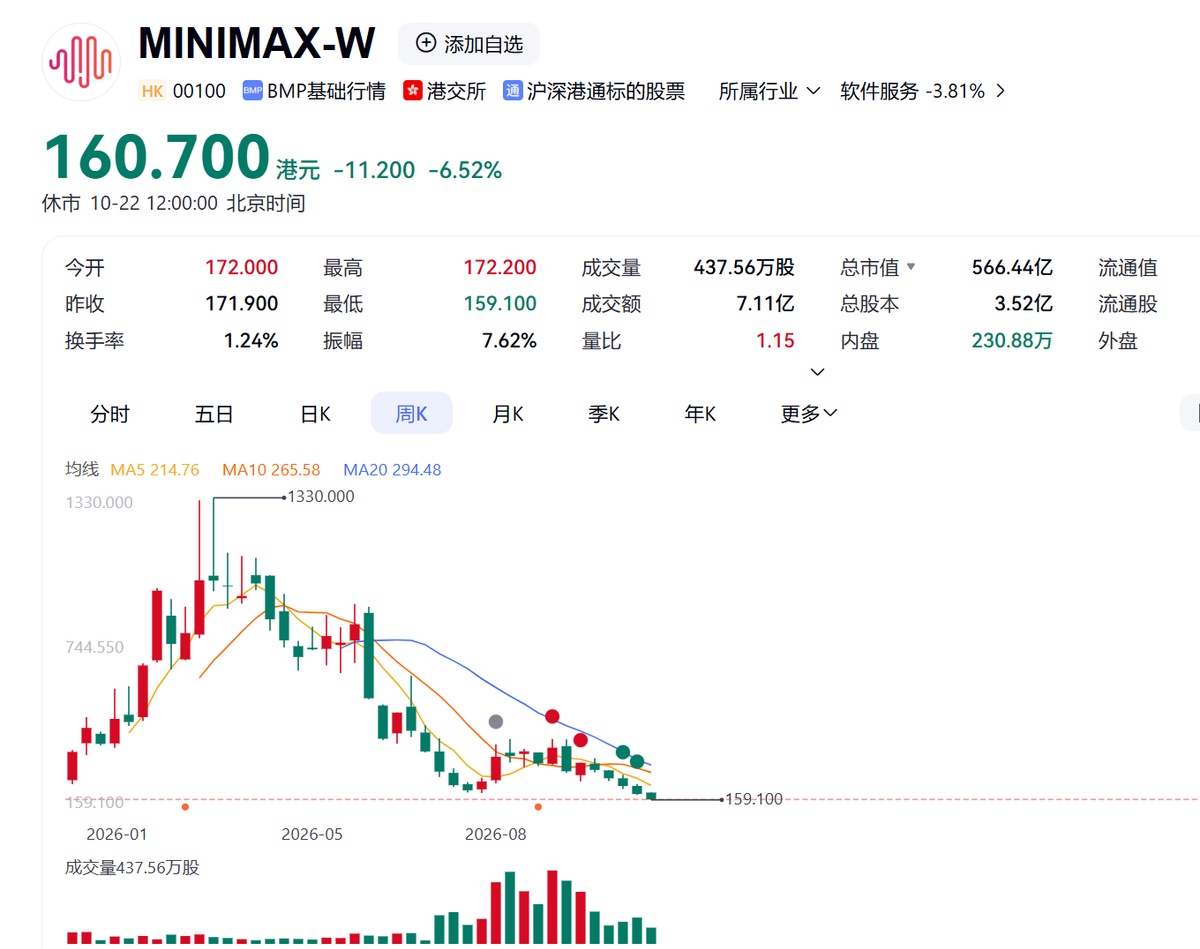
On Oct 22, MiniMax closed midday at HKD 160.7, hitting a new low since listing. Based on its 352 million shares outstanding, its total market cap is approx. HKD 57 billion. In March, it peaked at HKD 1,330, briefly reaching a market cap of HKD 400 billion.
Zhipu closed midday on Oct 22 at HKD 453, with a total market cap of approx. HKD 220.9 billion, having corrected over 80% from its intraday high of HKD 2,980 on June 22, shrinking from a peak of approx. HKD 1.07 trillion.
Even after such drops, annualizing H1 revenue, MiniMax's P/S ratio remains approx. 40x, and Zhipu's approx. 150x (using P/S for losses).
Placing these multiples in the A-share context, we again look at Cambricon.
Cambricon's 170x P/E corresponds to the "scarcity" premium of domestic compute;
For large model companies to command similar premiums, they must convince A-share investors of two things: first, that API and enterprise service revenue can maintain triple-digit growth, and second, that gross margins can rise continuously to cover R&D.
MiniMax's H1 gross margin was 17.9%, far from this threshold, but the direction is correct.
If successful in returning to the A-shares, valuation will likely anchor between two coordinates: the current Hong Kong price won't offer a deep discount, nor will the STAR Market's AI scarcity premium be overly generous.
Zhipu's RMB 15 billion fundraising scale can be seen as a reference for the "capacity absorption space" recognized by regulators and the market.
The true significance of the A+H dual platform for MiniMax lies in adding insurance to financing: Hong Kong handles overseas liquidity and international investors, while the A-share market handles refinancing capabilities and domestic-preference valuation re-rating. If sentiment cools on one side, the other can sustain it.
The cost is dilution pressure from dual platforms and the repeated scrutiny of the same story in two markets—the price comparison effect is the most direct constraint on management.
The capital story of the large model industry, stripped bare, is not complex: burn cash, raise funds, burn more cash.
IPO merely shifts the financing channel from the primary to the secondary market; returning to the A-shares expands the financing radius further.
Reliance on financing is ultimately not a long-term solution. The most critical card on the table remains "self-sustaining blood creation." Source: Chaoyang Capital Theory
The copyright of this article belongs to the original author/organization.
The views expressed herein are solely those of the author and do not reflect the stance of the platform. The content is intended for investment reference purposes only and shall not be considered as investment advice. Please contact us if you have any questions or suggestions regarding the content services provided by the platform.