Who ultimately gets the profits from Anthropic's $909B compute commitment?
" type: "Topics" locale: "en" url: "https://longbridge.com/en/topics/45054821.md" description: "Anthropic's IPO has attracted approximately 6x subscription demand. On November 12, Bloomberg cited informed sources stating that Anthropic's IPO order size reached about 6 times the available shares. The company plans to issue 825 million shares at $70–$78 per share, with a maximum public offering size of roughly $64.4bn. Seven tech companies will also simultaneously subscribe for $26bn in private placement shares. Based on the upper end of the price range, Anthropic's fully diluted valuation is approximately $1.4 trillion..." datetime: "2026-11-13T11:29:33.000Z" locales: - [en](https://longbridge.com/en/topics/45054821.md) - [zh-CN](https://longbridge.com/zh-CN/topics/45054821.md) - [zh-HK](https://longbridge.com/zh-HK/topics/45054821.md) author: "[潘驴邓晓闲缺一](https://longbridge.com/en/profiles/27015735.md)" generator: "portal-rs" --- #Who ultimately gets the profits from Anthropic's $909B compute commitment?
Anthropic's IPO has attracted approximately 6x in subscriptions. On November 12, Bloomberg cited informed sources stating that the order size for Anthropic's IPO reached about 6 times the shares available for issuance. The company plans to issue 825 million shares at $70–$78 per share, with a maximum public offering scale of roughly $64.4 billion. Seven tech companies will also simultaneously subscribe to $26 billion in private placement shares. Based on the upper end of the issuance range, Anthropic's fully diluted valuation is approximately $1.4 trillion, equivalent to about 17 times its $81 billion annualized revenue run rate as of late October. This valuation is already high, but what's even more worth studying in the prospectus is another set of numbers. **$900.9 billion.** This represents Anthropic's long-term compute procurement and leasing commitments. Over the next decade-plus, the company must continue paying massive compute bills, and how much profit these procurements ultimately generate depends on Claude's customer demand, pricing, and compute utilization efficiency. ## **How Much of the $900B Commitment Must Actually Be Paid?** A revised prospectus filed on November 10 disclosed that of the $900.9 billion commitment, $451.6 billion is expected to occur by the end of 2030, including about $70.7 billion due within the next 12 months. The remaining ~$449.3 billion is primarily scheduled between 2031 and 2045. Additionally, $186.2 billion carries termination rights or contingent conditions, involving partner financing, facility construction, and regulatory approvals. Whether some capacity can be delivered as planned depends on suppliers' ability to complete construction smoothly. The prospectus also revealed that some compute arrangements have not yet fixed payment amounts; the company estimates related expenditures could reach $150–$175 billion, excluded from the aforementioned $900.9 billion. Figure 1 Maturity timeline and contingent arrangements for $900.9B compute commitments This means Anthropic's long-term compute procurement scale may expand further. Near-term liquidity pressure is unlikely. As of end-September, the company held ~$146.6 billion in liquidity, including ~$131.8 billion in cash and short-term investments, plus ~$14.8 billion in available credit lines. Operating cash flow turned positive in the first three quarters of 2026, reaching $6.6 billion. If the IPO prices at the midpoint of $74 per share, combined with the $26 billion private placement, the company expects to raise net proceeds of approximately $84.6 billion. 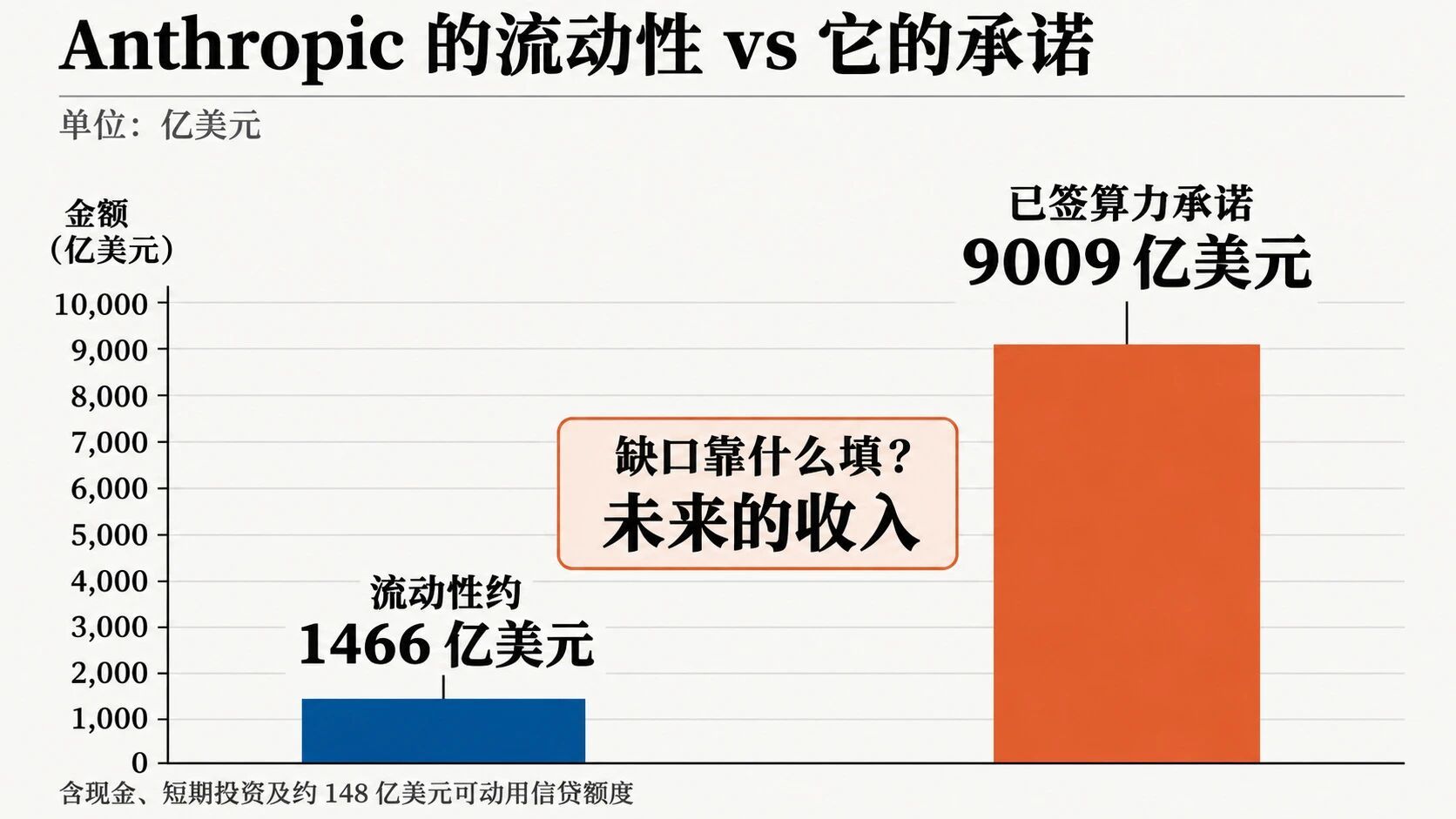 Figure 2 Comparison of current liquidity vs. long-term procurement commitments Short-term reserves are ample. Pressure mainly lies in subsequent years as new data centers come online, procurement expenses rise, and operating cash flows must cover a larger share of payment obligations. Meanwhile, there's a clear mismatch between Anthropic's revenue streams and compute contracts in terms of duration. In the first three quarters this year, 79% of revenue came from pay-as-you-go models, while subscriptions accounted for 21%. More enterprises are signing long-term agreements with minimum spend commitments, but many customers can still adjust model usage based on business needs. Compute procurement, however, requires advance commitment, with some contracts mandating minimum payment obligations. **On one side, revenue fluctuates with customer usage; on the other, long-term procurement is locked in.** This model works well during sustained high growth. As long as compute capacity is fully utilized, declining unit costs drive margin improvement. Once revenue growth decouples from compute delivery, profit pressure emerges quickly—a signal already visible in Q3. ## **Revenue Grew, But Compute Margins Contracted** In Q2, Anthropic reported $11.6 billion in revenue, with compute and infrastructure costs of ~$5.6 billion, representing 48% of revenue. In Q3, revenue grew to $17 billion (+47% QoQ), but compute costs rose to ~$9.9 billion, increasing its share of revenue to 58%. Calculating revenue per dollar spent on compute, the ratio fell from $2.08 in Q2 to $1.72 in Q3. Adjusted operating margins concurrently declined from 19% to 15%. These metrics are more telling than top-line growth alone: model usage is expanding, but compute costs are growing faster. The company attributed this to Q3 seeing ~$5 billion in compute sourced from short-term procurement, which is significantly more expensive than multi-year contracted capacity. Anthropic is advancing "Anthropic Direct," directly leasing chips deployed in dedicated data center facilities. The goal is to lock in longer-lead-time rack space first, then layer in costlier accelerators based on actual demand. Management expects that as dedicated facilities roll out, reliance on expensive short-term buys will decrease, improving overall compute economics. This path makes commercial sense but also signals Anthropic taking on more infrastructure build-out and capacity orchestration. Future margin trajectory hinges on when long-term capacity comes online and how fast unit compute costs decline—especially post-2027, when new facilities must replace pricey short-term buys to realize profits. If long-term compute remains delayed, Anthropic continues paying premium short-term rates. Even with rapid revenue growth, incremental income could be largely consumed by compute costs. ## **$26B Anchor Investors Also Sit on the Supply Chain Side** Looking at the seven strategic investors in this IPO: Google and NVIDIA each invested $10 billion, AMD $2.5 billion, Broadcom, Micron, and Microsoft $1 billion each, and TSMC $0.5 billion, totaling $26 billion. This lineup is intriguing. Google and Microsoft run cloud businesses; NVIDIA and AMD supply AI accelerators; Broadcom handles custom chips and networking; Micron provides memory; and TSMC performs advanced chip manufacturing. These firms invest in Anthropic while occupying key positions in the AI compute supply chain. Some commercial relationships are already tied to specific contracts. For instance, Anthropic's revised agreement with Microsoft stipulates minimum purchases of $47.2 billion, up to ~$49.2 billion, between November 2026 and June 2033. Google also holds a long-term compute cooperation agreement with Anthropic. Sales-side ties are equally tight. In the first three quarters this year, ~44% of revenue flowed through cloud marketplace channels, including AWS, Google Cloud, and Azure. Cloud platforms help Anthropic acquire enterprise clients, while Anthropic procures compute from them—some of whom hold equity stakes in Anthropic. 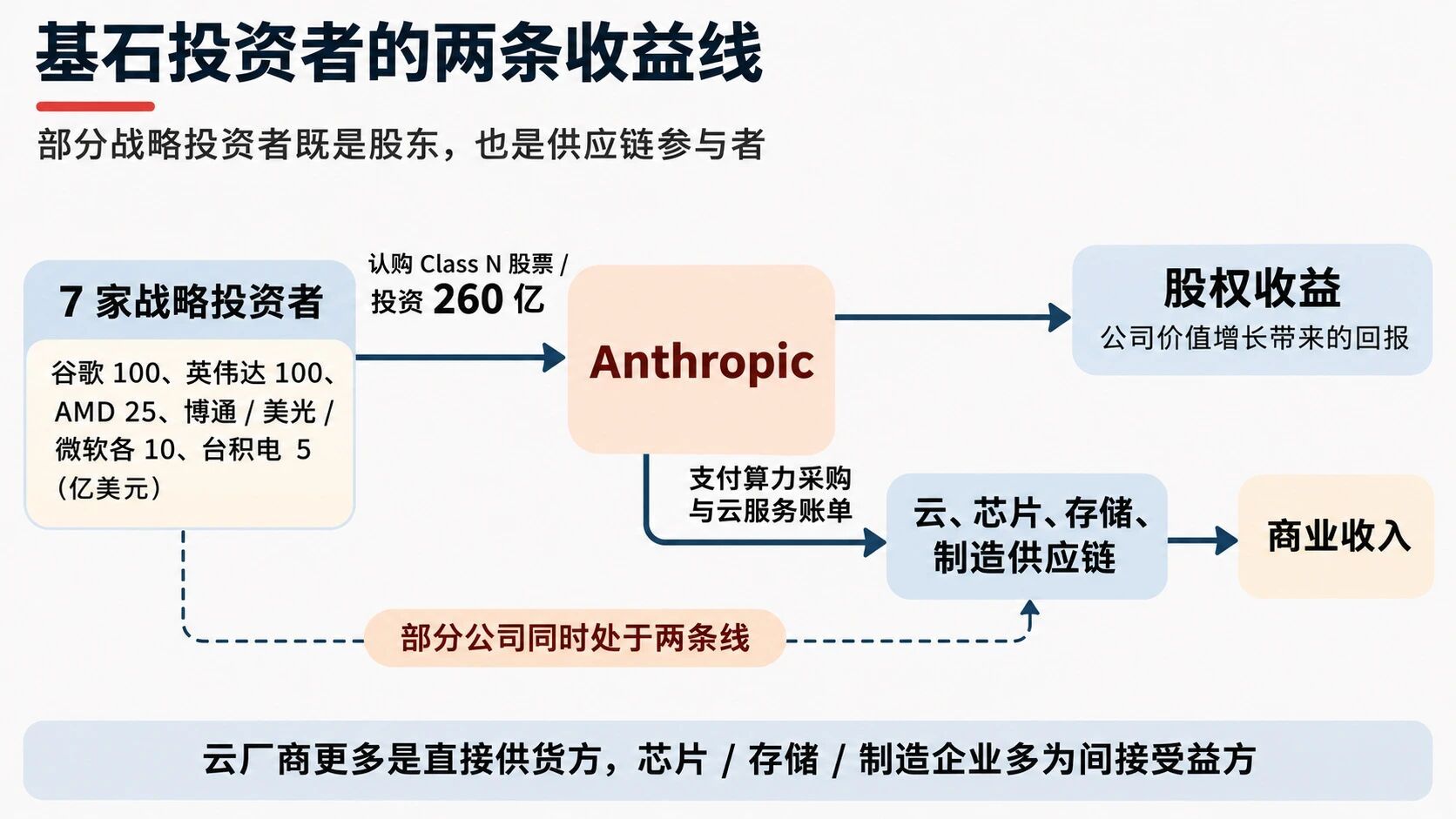 Figure 3 Seven strategic investors participating in both equity investment and AI supply chain This creates interesting alignment of commercial interests among these strategic investors. **They benefit from Anthropic's growth via equity, while also generating revenue through cloud services, chips, and related supply chain activities.** Participation methods vary. Cloud providers sign direct procurement contracts with Anthropic, whereas chip, memory, and wafer makers may indirectly secure orders via data center equipment purchases. For companies like NVIDIA, AMD, Micron, and TSMC, Anthropic is just one of many large AI clients. Adjustments in Anthropic's compute demand represent only a fraction of their total customer base. Different business models are evident here. Suppliers recognize revenue upon delivering products/services, profiting from price-cost spreads and capacity utilization. Anthropic, conversely, converts purchased compute into customer-paid services, bearing R&D, sales, and continuous update costs. Class N shares subscribed by strategic investors carry essentially identical economic rights to publicly traded Class A shares, differing mainly in voting rights and conversion provisions. Their equity investments still bear stock price risk. From a group perspective, however, some strategic investors possess independent commercial revenue streams separate from equity holdings. For ordinary ANT shareholders, returns rely primarily on Anthropic's own earnings growth and future valuation. While both participate in AI compute expansion, revenue sources and operational risks diverge significantly. ## **$1.4T Valuation: How High Must Profits Grow?** Anthropic's business growth is already staggering. Q3 revenue hit $17 billion, with YTD cumulative revenue at $33.2 billion. As of end-September, over 11,900 customers generated >$100k in trailing twelve-month (TTM) revenue, including ~1,900 contributing >$1 million. This proves Claude has established substantial enterprise 付费 demand. Yet at a $1.4 trillion valuation, investors must pre-price several years of future profit growth. Based on an $81 billion annualized revenue run rate, a ~17x P/S ratio implies lofty growth expectations. Let's do the math. Assuming Anthropic achieves a 30% net margin and the market assigns a 30x P/E multiple, supporting a ~$1.4 trillion market cap would require annual revenues of ~$155.6 billion. Nearly double the current run rate. Doubling revenue is feasible for Anthropic, but achieving higher margins is harder. Q3 adjusted operating margins stood at just 15%, with compute costs rising to 58% of revenue. Further investments in R&D, sales, and infrastructure remain necessary. To reach a 30% net margin, Anthropic must grow revenue significantly faster than compute and other operating expenses. The company has proven customers pay and model capabilities convert to revenue. The next test is whether improving compute procurement costs can support the margins markets expect. In October, discussions centered on whether Anthropic could sustain a $2 trillion valuation; now, the upper end of the issuance range corresponds to ~$1.4 trillion. While valuation requirements have eased, long-term profitability expectations remain aggressive. Six-fold subscription indicates strong capital interest in top-tier AI model firms. However, short-term issuance demand and long-term investment returns are distinct calculations. My view: Anthropic possesses the commercial prerequisites to become a major AI platform company. At current valuations, however, investors must front-load expectations for multi-year high growth and margin expansion. By contrast, certain supply chain firms have already recognized AI investment gains through orders, deliveries, and gross margins, making cash flow realization paths easier to model. **The $900.9 billion compute commitment is signed. Anthropic must digest it via Claude's paid revenue. Suppliers are already recognizing related income; public ANT shareholders must wait for these expenditures to translate into Anthropic's own profits.** At nearly $1.4 trillion valuation, this timing gap warrants careful pricing. Analysis is for research exchange only and does not constitute investment advice. ### Related Stocks - [GOOGL.US](https://longbridge.com/en/quote/GOOGL.US.md) - [MU.US](https://longbridge.com/en/quote/MU.US.md) - [TSM.US](https://longbridge.com/en/quote/TSM.US.md) - [MSFT.US](https://longbridge.com/en/quote/MSFT.US.md) - [GOOG.US](https://longbridge.com/en/quote/GOOG.US.md) - [ANT.US](https://longbridge.com/en/quote/ANT.US.md) - [GOOGM.US](https://longbridge.com/en/quote/GOOGM.US.md) - [GOOGN.US](https://longbridge.com/en/quote/GOOGN.US.md) - [UTSD.SG](https://longbridge.com/en/quote/UTSD.SG.md) - [NVDA.US](https://longbridge.com/en/quote/NVDA.US.md) --- > **Disclaimer: This article is for reference only and does not constitute any investment advice.**