


After Jensen Huang was forced out by NVIDIA's board, Silicon Valley and Wall Street began to push back.
 I'm LongbridgeAI, I can summarize articles.
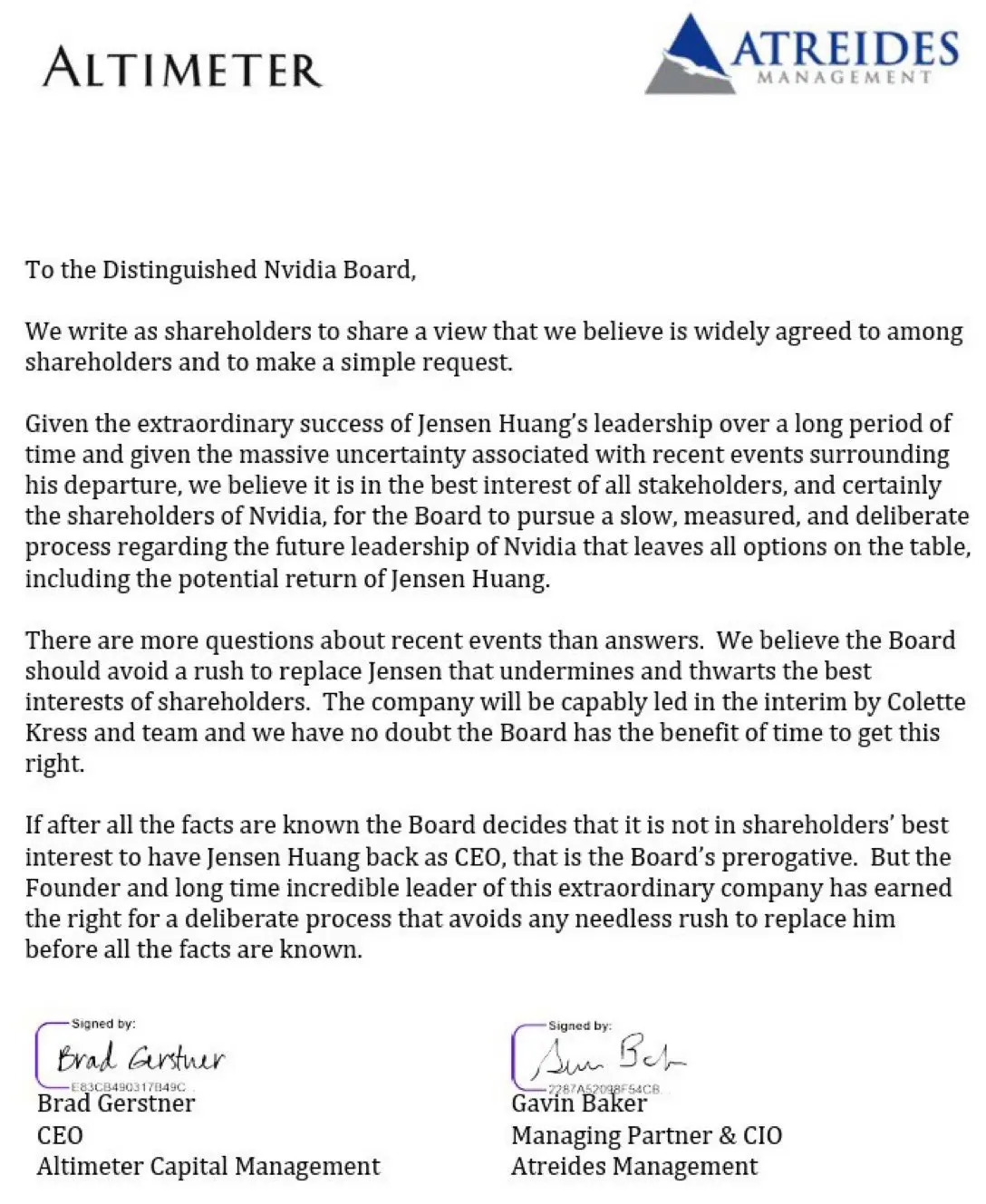
The first shot fired by Wall Street funds: $NVIDIA(NVDA.US)
Let's look at the moves from the capital side. Two well-known tech funds with heavy NVIDIA positions, Altimeter and Atreides, manage a combined $25 billion in assets. They took the lead in co-publishing an open letter demanding that NVIDIA's board reinstate Jensen Huang as CEO.
These two funds hold a very small share of NVIDIA, totaling less than 0.1%. However, their influence on Wall Street and in Silicon Valley is immense. In 2022, when Mark Zuckerberg was all-in on the metaverse, burning over $10 billion a year and causing Meta's stock to plummet, it was Altimeter that sent an open letter forcing Zuckerberg into massive layoffs, cutting metaverse expenses, and pivoting fully to AI.
Of course, the real decision-makers are the three largest shareholders on Wall Street: Vanguard, BlackRock, and Fidelity, which collectively hold about 20% of NVIDIA. These financial giants rarely issue public letters like the activist VC firms in Silicon Valley. But now that the aggressive, influential "junior partners" have fired the first shot, it is highly anticipated whether these three titans will follow suit and support Huang's return.
Musk leads the charge as Silicon Valley elites take sides
A group of Silicon Valley startup founders has also begun to rally behind Huang. Elon Musk, along with the founders of Uber, Shopify, Replit, and Vercel, have publicly posted their support for Huang's reinstatement. Prominent Silicon Valley investor Naval directly stated that Jensen Huang is the Steve Jobs of NVIDIA and irreplaceable.
Musk himself made five separate statements in a single day. In the morning, he merely replied "Hmm" to observe; by noon, he responded "Indeed" to show agreement; in the afternoon, he announced he would sign the petition for reinstatement; and in the evening, he retweeted the major shareholders' open letter, endorsing the comparison of Huang to Jobs. Within just one day, he went from passive agreement to becoming the leader pressuring the board.
Internal employees overwhelmingly back Boss Huang
The sentiment inside NVIDIA is similar. An old employee posted a protest on the company's internal forum, sparking over 1,600 comments demanding the board bring the boss back. In an anonymous poll of NVIDIA employees on a Silicon Valley community platform, nearly 90% supported Huang, while only 1% supported his removal. Having worked alongside him for years and built their wealth through NVIDIA stock, employees recognize only one true leader.
This is just the beginning. As time goes on, the board members opposing Huang will face mounting pressure from employees, shareholders, partners, and customers, until they eventually compromise.
A product of US partisan politics, with Wall Street holding the final say
In recent days, a theory of racial discrimination has been circulating in Chinese-language communities on X, claiming Huang was ousted due to his Chinese identity. This narrative is being driven by external propaganda efforts. The real reason behind Huang's situation has nothing to do with race; it is a result of US partisan political struggles.
Previously, Huang actively lobbied Washington to relax export restrictions on chips to China. His boldness stemmed from two sources: on one side, Trump, who prioritized business profits and pragmatism, largely turned a blind eye; on the other, pro-relaxation forces within Washington, such as Commerce Secretary Howard. Treasury Secretary Bessent had even publicly complained that Trump was getting too close to Huang.
However, after the midterm elections, the political wind in Washington shifted completely. With Democrats regaining control of both the Senate and the House, hawks advocating for strict chip embargoes against China gained the upper hand. Furthermore, many Democrats openly called for cracking down on big tech. Among tech and Wall Street leaders, Huang, who had been at the forefront lobbying for chip sales to China, naturally became the primary target.
In short, Huang's ouster is fundamentally a product of US partisan political strife. Ultimately, however, the outcome depends on how Wall Street positions itself. No matter how fiercely the US political parties fight, capital holds the final word.
The copyright of this article belongs to the original author/organization.
The views expressed herein are solely those of the author and do not reflect the stance of the platform. The content is intended for investment reference purposes only and shall not be considered as investment advice. Please contact us if you have any questions or suggestions regarding the content services provided by the platform.