


Trump's White House negotiation fails, the U.S. government is "more than a day" away from a shutdown, and gold prices break through $3,800

In the urgent moment just two days before funds run out, U.S. President Trump and congressional leaders from both parties failed to break the deadlock during talks at the White House. Concerns over uncertainty, combined with a weakening dollar, pushed gold prices higher. Goldman Sachs stated that if the government shuts down, the non-farm payroll report for September is likely to be delayed from its scheduled release on Friday at 8:30 AM, which could lead to a postponement of the Federal Reserve's interest rate cut plans in October
As the countdown to a potential U.S. government shutdown ticks down to less than two days, critical negotiations between the two parties in Congress over funding have failed. The market anxiety triggered by this political deadlock has pushed gold prices above $3,800 per ounce.
On Monday local time, a meeting at the White House between President Trump and congressional leaders from both parties failed to break the impasse. The existing funding for the federal government will officially run out at 12:01 AM local time on Wednesday. If an agreement is not reached by then, a government shutdown that will force hundreds of thousands of federal employees to take unpaid leave and disrupt public services will be inevitable.
After the negotiations ended, both sides remained firm in their positions and exchanged accusations. Vice President JD Vance warned that the U.S. is "heading towards a shutdown" and accused Democrats of holding the government "hostage." Senate Minority Leader Chuck Schumer countered that the decision to shut down rests with the Republicans, stating that Democrats have made suggestions to the president, but "the ultimate decision-maker is Trump."
Concerns over uncertainty in the U.S. political system, combined with a weakening dollar, have driven gold prices, traditionally seen as a safe-haven asset, to strongly break through the $3,800 per ounce mark on Monday morning. 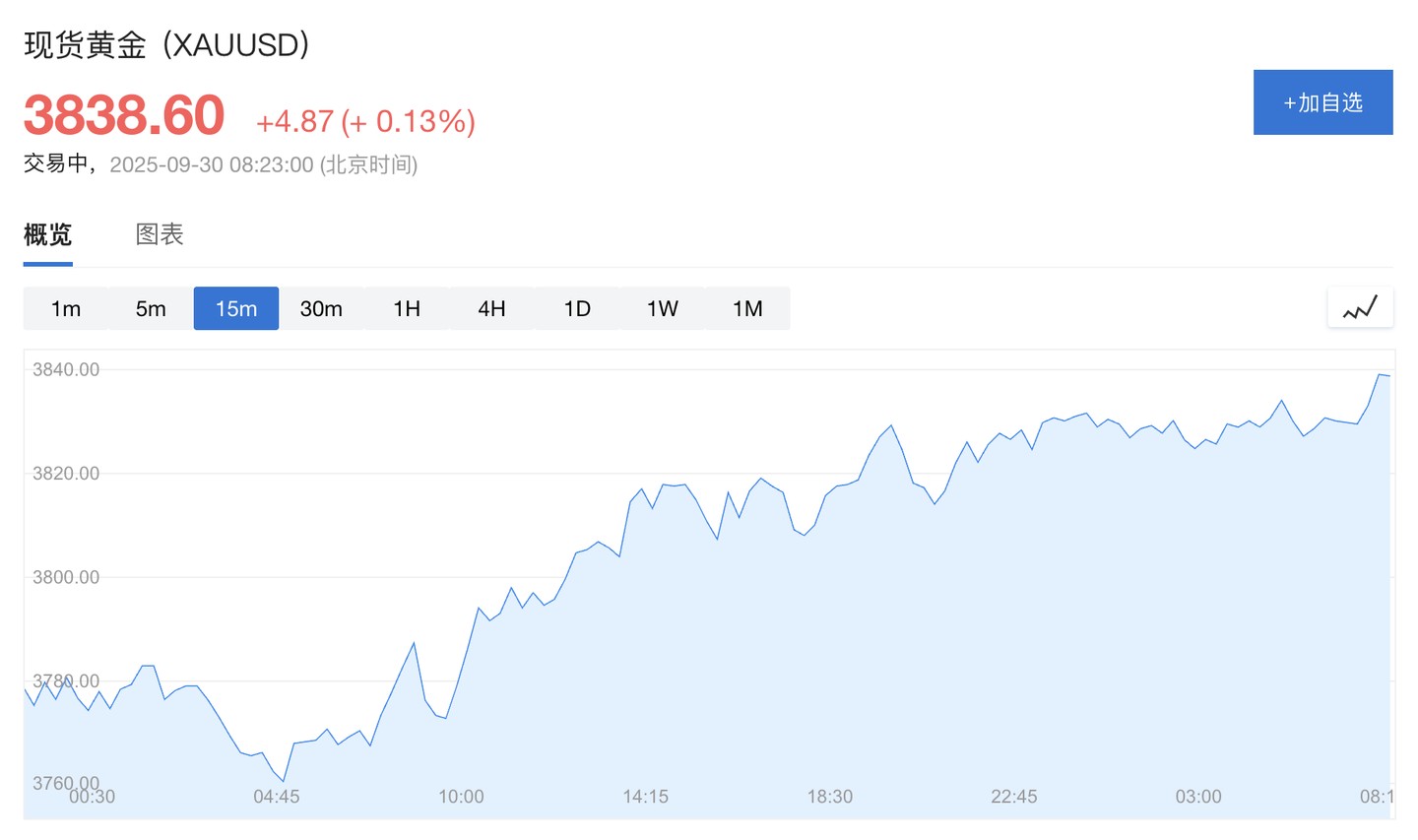
Goldman Sachs indicated that the stock market is most worried about the potential delay in the release of non-farm payroll data due to a government shutdown. If the government shuts down, the September non-farm payroll report is likely to be unable to be released as scheduled at 8:30 AM on Friday, which could delay the Federal Reserve's interest rate cut plans for October.
Negotiations Break Down, Parties Blame Each Other
In the urgent moment, with less than two days until funding runs out, the meeting between Trump, Vice President JD Vance, Senate Majority Leader John Thune, House Speaker Mike Johnson, Senate Minority Leader Chuck Schumer, and House Minority Leader Hakeem Jeffries failed to reach any agreement.
According to Jeffries, it was a "frank and direct discussion." Republican lawmakers had previously proposed a short-term agreement, known as a "Continuing Resolution," aimed at extending current funding levels until November 21 to allow for more negotiation time.
However, Democrats refused to endorse this, insisting that any agreement must include an extension of health insurance subsidies set to expire at the end of the year. Jeffries emphasized, "Democrats are fighting to protect the healthcare of the American people, and we will not support a partisan Republican spending bill that continues to harm people's healthcare."
The crux of the deadlock lies in the fact that, despite the Republicans holding a majority in the Senate with 53 seats to 47, any funding bill requires at least 60 votes to pass, meaning they must secure the support of at least seven Democratic senators. With the significant divide between the two parties still in place, the prospect of reaching a consensus appears bleak.
Trump's Stance Hardens, Risk of Government Shutdown Increases
The White House has shown no willingness to compromise, further intensifying market concerns.
White House Press Secretary Karoline Leavitt stated in a media interview earlier on Monday that Trump has "leverage" and is not interested in compromise. She said, "The leverage is in the president's hands because the vast majority of the American public wants the government to remain open."
Trump himself expressed pessimism during a media phone interview on Sunday night, stating, "I just don't know how we're going to solve this problem." This deadlock recalls the government shutdown that occurred during Trump's first term from 2018 to 2019, which resulted in the longest government shutdown in U.S. history lasting 35 days due to a funding dispute over the U.S.-Mexico border wall.
More concerning is that the White House seemed to suggest last week that this shutdown may not just involve temporarily furloughing non-essential government employees. A memorandum distributed by the U.S. Office of Management and Budget on Wednesday evening instructed federal agencies to "take this opportunity to consider layoffs" or permanent dismissals.
Risk Aversion Rises, Gold Prices Hit New Highs
The political deadlock in Washington has directly translated into market demand for safe-haven assets. On Monday, gold prices surpassed $3,800 per ounce, becoming the preferred tool for investors to hedge against dollar risks and U.S. political uncertainty.
Since the beginning of the year, gold prices have risen by 45%, driven by factors that go beyond mere short-term hedging. Analysts point out that high government debt, persistent inflation, and doubts about the dollar's status as the world's primary reserve currency are fundamental factors supporting the long-term strength of gold prices. The imminent government shutdown has become a catalyst for the latest surge.
Institutional and central bank "dual buying" has also fueled the upward trend.
According to a report by Deutsche Bank analysts, the recent surge in gold prices has benefited from "buying" by ETF investors and central banks.
Data shows that Western investors are pouring into gold ETFs. According to the World Gold Council, inflows into gold ETFs have been positive for four consecutive weeks, with September's inflow nearing 100 tons, marking the fastest monthly growth rate since April. John Reade, senior market strategist at the World Gold Council, noted that some hedge funds that previously missed the rise in gold prices are experiencing "fear of missing out" (FOMO) and are starting to chase the upward trend.
Meanwhile, speculative investors, primarily hedge funds, are also increasing their bullish positions. According to the latest data from the U.S. Commodity Futures Trading Commission (CFTC), their net long positions in gold have reached a record $73 billion.
Michael Haigh, head of commodity research at Société Générale, stated, "They have not reduced these positions because recent policy speeches and inflation data point to lower interest rates and persistent inflation." Central banks around the world are also increasing their gold reserves, viewing it as an effective tool to hedge against dollar risks, providing solid structural support for gold prices
