
New Milestone in China's Commercial Space: Zhuque-3 Successfully Launched into Orbit, First Stage Recovery Failed
 I'm LongbridgeAI, I can summarize articles.
Blue Arrow Aerospace's Zhuque-3 launch vehicle successfully placed the second stage into the designated orbit, validating China's large liquid oxygen-methane rocket development capabilities in commercial spaceflight. However, the first stage of the rocket failed during the recovery process due to abnormal combustion, and the specific cause is under investigation. Catalyzed by favorable policies, the A-share commercial aerospace concept sector surged against the trend, with Shanghai JUSHRI TECHNOLOGIES and FUJIAN TENDERING both hitting the daily limit, ZHHL rising over 10%, and Shunhao Co., Ltd. previously hitting the daily limit
On December 3rd, the Zhuque-3 launch vehicle independently developed by Landspace successfully sent its second stage into the designated orbit, marking an important progress in China's commercial space industry in the development of large liquid oxygen-methane rockets. Although the first stage recovery verification failed due to abnormal combustion, the development team obtained key flight data and is investigating the cause.
According to Xinhua News Agency, the Zhuque-3 Yao-1 launch vehicle was launched on the same day at the Dongfeng Commercial Space Innovation Test Area, completing its flight mission as scheduled, with the rocket's second stage successfully entering the designated orbit. This is an important verification of the capabilities of Chinese commercial space companies in the development and launch of large liquid oxygen-methane launch vehicles. However, the first stage of the rocket experienced abnormal combustion during the recovery process and failed to land softly at the recovery site, with the specific cause currently under analysis.
Despite the recovery failure, the capital market remains enthusiastic about the commercial space sector. Before and after this launch, the A-share commercial space concept sector rose against the trend, with Shanghai Huanxun and Fujian Tendering both hitting the daily limit, ZHHL rising over 10%, and Shunhao Co., Ltd. previously hitting the daily limit, along with Shanghai Huguang, Shaanxi Huada, Aerospace Development, and Aerospace Zhizhuang following suit.
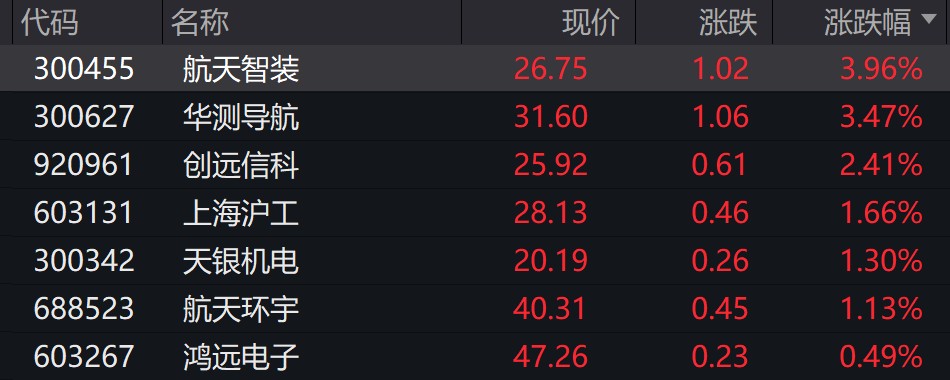
The market's enthusiasm for the commercial space sector is driven by a triple catalyst of policy, technology, and industrialization. The National Space Administration recently established a Commercial Space Administration and released the “Action Plan for Promoting High-Quality and Safe Development of Commercial Space (2025-2027)”, proposing to incorporate commercial space into the overall layout of national space development, accelerate the formation of new productive forces in space, and achieve an overall improvement in space development efficiency, strongly supporting the construction of a space power.
Recovery Test Encountered Setbacks but Technical Value is Significant
Zhuque-3 is a new generation of low-cost, high-capacity, reusable liquid oxygen-methane launch vehicle independently developed by Landspace. The rocket is 66.1 meters long, with a body diameter of 4.5 meters, a fairing diameter of 5.2 meters, a launch mass of approximately 570 tons, and a launch thrust exceeding 750 tons. The first stage is equipped with a reaction control system, grid fins, and landing legs, allowing for vertical return recovery and reuse after completing the orbital launch.
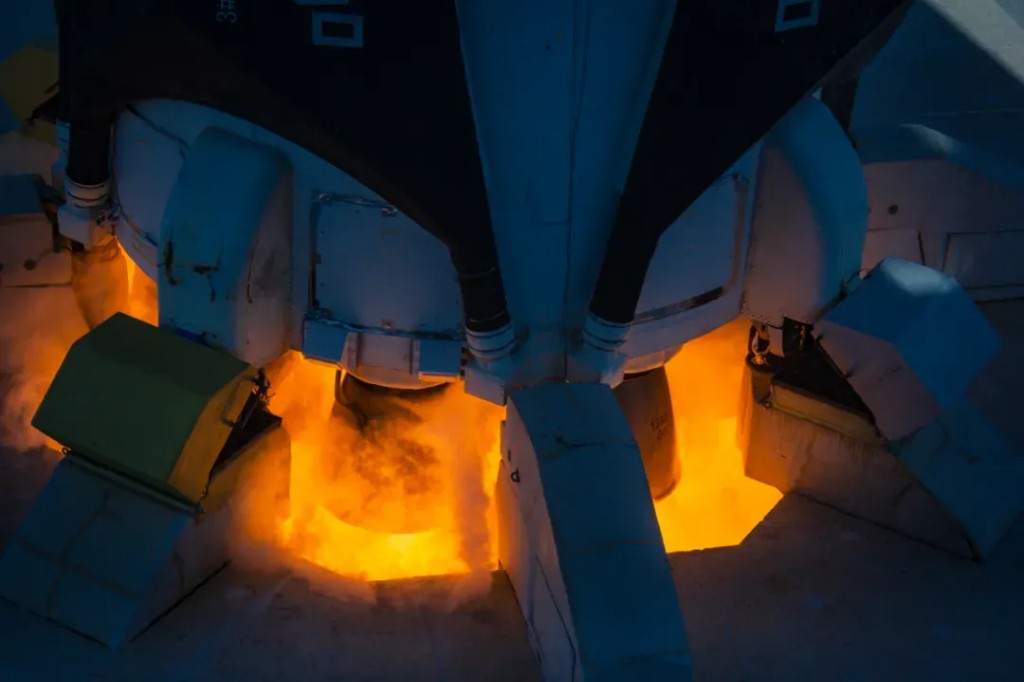
Image source: Landspace official website
Zhuque-3 uses stainless steel as the main structural material for the rocket body, and its power system is based on the Tianque series of liquid oxygen-methane engines, with the first stage using 9 TQ-12B engines and the second stage equipped with 1 TQ-15B vacuum engine. The one-time mission low Earth orbit carrying capacity reaches 21.3 tons, the recovery mission in the flight area reaches 18.3 tons, and the return recovery mission reaches 12.5 tons, with the future first stage reusable times potentially reaching 20 times According to reports, although this mission did not achieve the planned recovery goal for the first stage of the rocket, it verified the correctness and rationality of the entire testing, launching, and flight process of the Zhuque-3, the compatibility of various system interfaces, and obtained key engineering data under the rocket's actual flight conditions. The development team will promptly conduct a comprehensive review and technical reset to identify the cause of the failure and continue to advance reusable verification in subsequent missions.
Zhuque-3 is leading in the development of domestic reusable rockets and has attracted the attention of Elon Musk. In October this year, Musk commented on social media that domestic reusable rockets, including Zhuque-3, incorporate some features of the "Falcon 9" architecture along with Starship, using stainless steel and methane oxidizer, which would enable them to surpass the "Falcon 9." Musk previously remarked that if all goes well, Zhuque-3 could surpass Falcon within five years.
According to the Daily Economic News, the maiden flight of Zhuque-3 has garnered significant market attention. If it successfully launches and achieves recovery, it would have milestone significance for China's aerospace, making China the second country in the world, after the United States, to master reusable rocket technology. At the same time, Blue Arrow Aerospace would become the third company globally, after SpaceX and Blue Origin, to achieve recovery of the first stage of a rocket.
Blue Arrow Aerospace was established in 2015 and is one of the earliest commercial aerospace enterprises in China. The Zhuque-3 project was officially initiated in August 2023, completing a vertical takeoff and landing recovery flight test at a hundred-meter level five months later, and a ten-kilometer flight test was completed in September last year. In July this year, Blue Arrow Aerospace started IPO counseling, with the company's valuation exceeding 20 billion yuan.
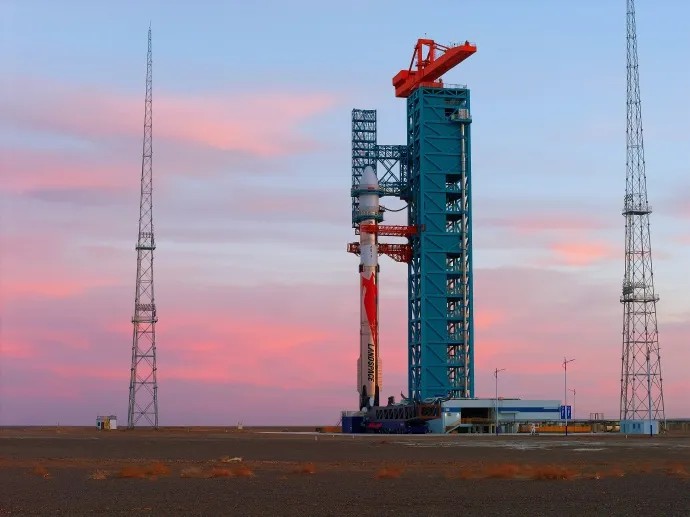
Zhuque-3 reusable liquid oxygen methane launch vehicle
Image source: Blue Arrow Aerospace official WeChat
Acceleration of Domestic Reusable Rocket Competition
In addition to Zhuque-3, other reusable rockets under development in China include "Long March 12A" and "Hyperbola 3." The "Long March 12A" is being developed by the Eighth Academy of Aerospace, and it is scheduled to complete China's first 10-kilometer vertical takeoff and landing flight test for a reusable launch vehicle in June 2024, with plans for its maiden flight in 2025.
The "Hyperbola 3" is developed by Interstellar Glory, which is the first commercial aerospace company in China to complete an orbital launch of a launch vehicle. According to the company's official website, this rocket has a body diameter of 4.2 meters, uses liquid oxygen and methane propellant, with a low Earth orbit payload capacity of 14 tons for one-time missions and a recovery capacity of 8.5 tons, with plans for its maiden flight and sea recovery by the end of 2025 and reuse flights in 2026.
CITIC Securities' research report pointed out that the official website of the Ministry of National Defense and Industry recently released a recruitment announcement for civil servants for 2026, hiring for the "Aerospace Supervision Position" in the Commercial Aerospace Department, indicating that this key functional institution has been officially established. **Huatai Securities' research report noted that the commercial aerospace sector is welcoming a "triple turning point" in "policy," "performance," and "technology," with China Star Network achieving dense networking this year, expected to drive performance realization in upstream satellite manufacturing and other sectors **
Shanghai Huguang's wholly-owned subsidiary, Shanghai Huhang Satellite Technology Co., Ltd., mainly engages in services such as commercial satellite assembly integration, design and manufacturing of core components for aerospace products, and more. Shanghai Huhang has successfully ensured the launch of 16 satellites, with over 40 satellite power systems and solar structures operating normally in orbit, serving more than twenty satellite system units