
 I'm LongbridgeAI, I can summarize articles.
The outlook for precious metals in 2026 is optimistic, with significant price increases for gold, silver, and others, influenced by inflation and interest rates. The upward trend from the end of 2025 continues into early 2026, with gold breaking through $4,500 per ounce and silver surpassing $80. The gold-silver ratio falls to its lowest level since 2013, with silver remaining relatively low-priced compared to gold, exhibiting "High Beta" characteristics. Demand for silver is increasing, particularly in the battery and solar sectors
The surge in precious metal prices at the end of 2025 has continued into early 2026. Gold has surpassed $4,500 per ounce, silver has broken through $80 per ounce, and platinum has reached its first historical high since 2007. Palladium prices have also rebounded significantly but remain well below historical peaks.
Figure 1: Precious Metal Prices Surge with Unprecedented Momentum
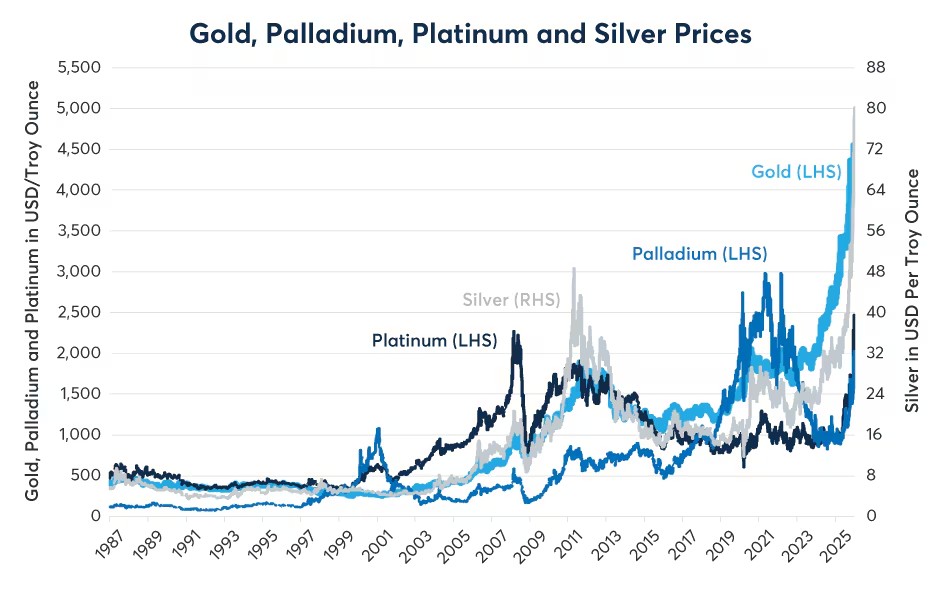
In terms of price returns, as of January 6, metal assets have significantly outperformed any other asset class since the end of 2024. Gold has risen by 65%, palladium by 95%, platinum by 150%, and silver has increased by 170%. Gold's performance has lagged relatively, possibly because its increase from 2000 to the end of 2024 far exceeded that of other metals. In the first five years of the 2020s, gold rose by 73%, silver by 63%, while platinum and palladium fell by 8% and 52%, respectively. Silver, platinum, and palladium have recently performed excellently, reflecting their catch-up rally after a long period of relative underperformance.
How should investors view the relative value among these precious metals? What is the broader outlook for precious metals?
Currently, silver remains undervalued relative to gold. The gold-silver price ratio (the number of ounces of silver that can be purchased with one ounce of gold) has fallen to its lowest level since 2013 (Figure 2).
Figure 2: The Gold-Silver Ratio Has Recently Shifted Strongly in Favor of Silver

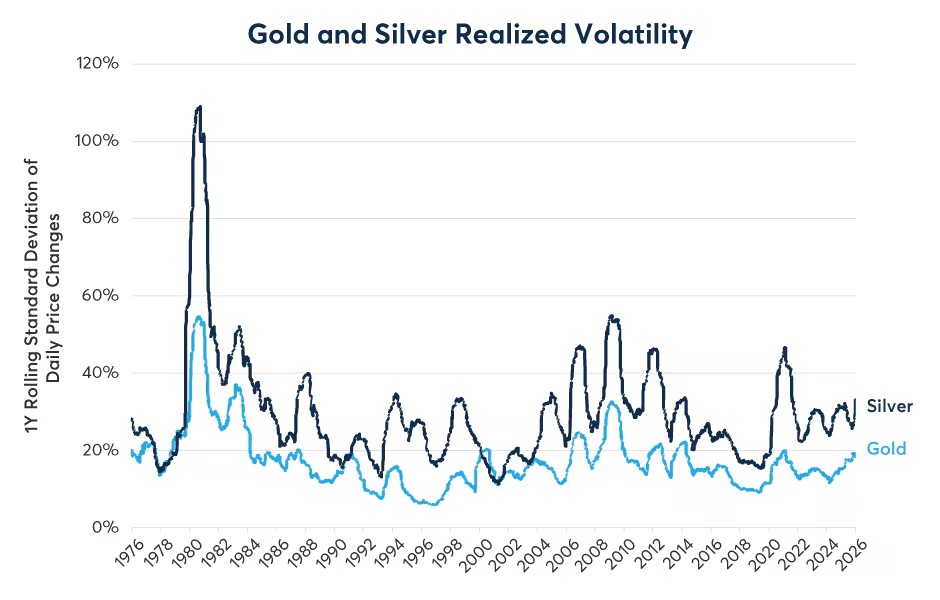
Part of silver's recent gains may reflect its "High Beta" characteristic relative to gold. Silver is closely linked to gold through the jewelry and investment markets, and due to the smaller size of the silver market, it often amplifies volatility, resulting in a "High Beta" effect. Silver is highly correlated with gold and typically exhibits greater volatility (Figures 3 and 4). Therefore, fluctuations in gold are often more pronounced in silver.
Figure 3: Silver Typically Exhibits Strong Positive Correlation with Gold
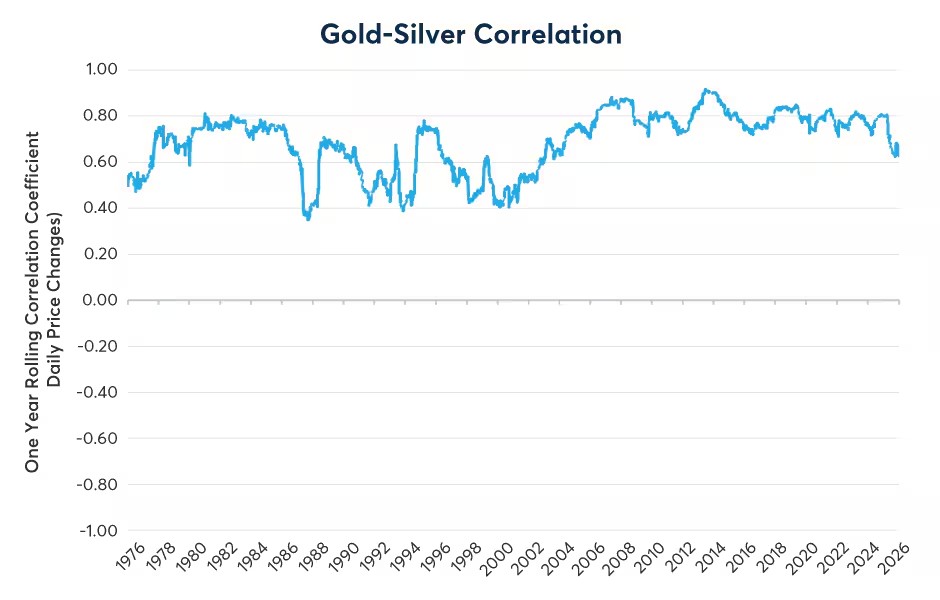
Figure 4: Silver's Volatility Typically Exceeds That of Gold
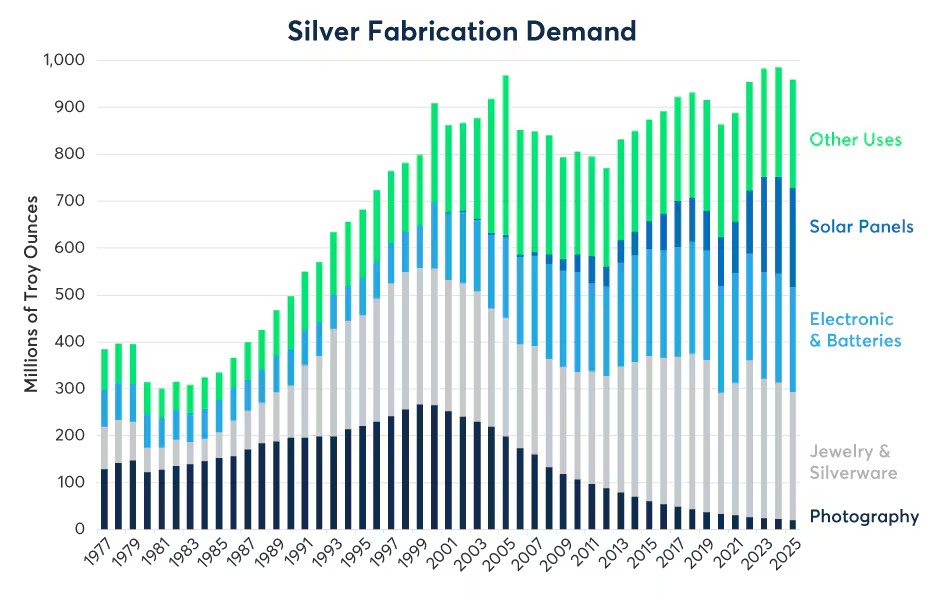
In addition to correlation and relative volatility, other factors are at play. Silver has underperformed for much of this century due to the transformation in digital photography, which has largely eliminated the demand for silver halide development. However, in recent years, silver has found new sources of demand, including batteries and solar panels, which seem to be driving the gold-silver ratio back in favor of silver (Figure 5)
Figure 5: Although silver has lost its photographic use, it has made progress in solar panels and battery fields
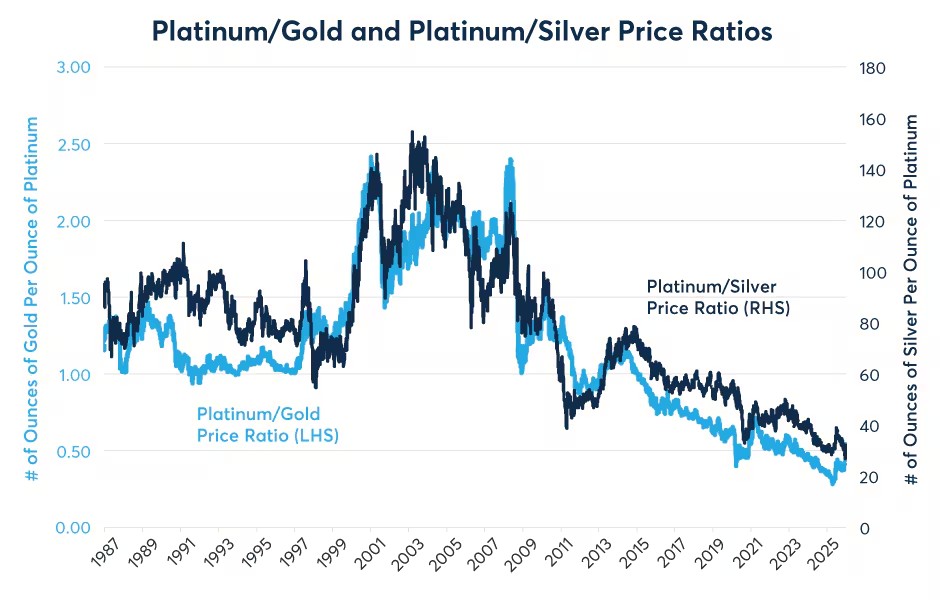
At the same time, despite a recent rebound, platinum remains historically cheap relative to gold and silver. Looking back to when platinum reached its historical high in 2007, its price was nearly 2.5 times that of gold. The situation has changed, and as of early January, the price of gold is close to 2 times that of platinum (Figure 6). The main reason for platinum's underperformance is the decline in demand for diesel vehicles, which has reduced the demand for platinum catalytic converters.
Figure 6: Historically, platinum remains cheap compared to gold and silver
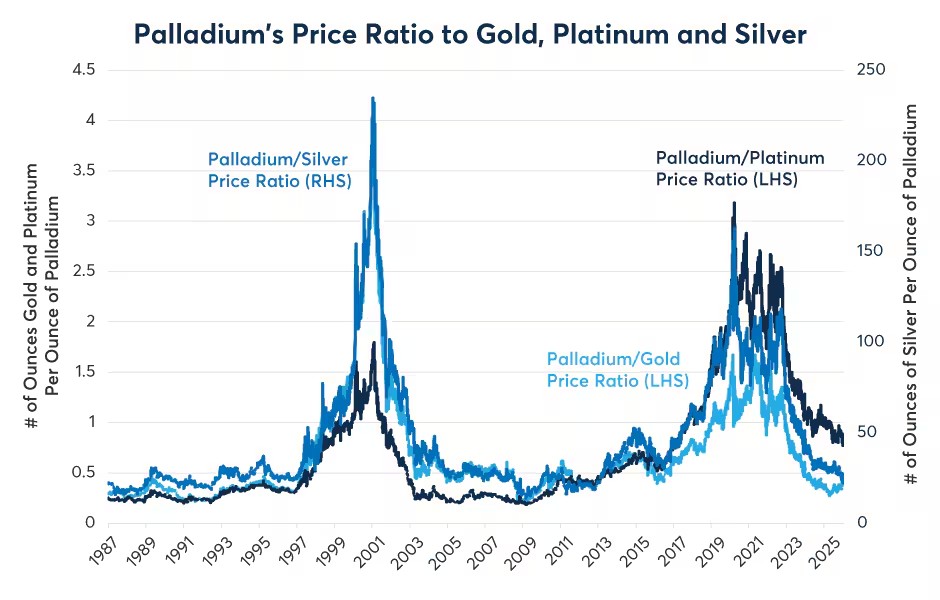
The two historical price peaks of palladium relative to other metals occurred after periods of supply constraints, but the current price has returned to historical lows relative to gold and silver (Figure 7). With the increase in market share of electric vehicles (EVs) globally in recent years, the demand for palladium has also begun to erode. Nevertheless, due to several countries, including China and the United States, reducing subsidies, EV sales may decline in 2026.
Figure 7: Compared to gold and silver, palladium's price is also at a low level historically
Therefore, it is not difficult to understand why investors seeking diversification beyond gold are attracted to silver, platinum, and palladium. However, there is one last point to consider, which is the relative scale of these markets.
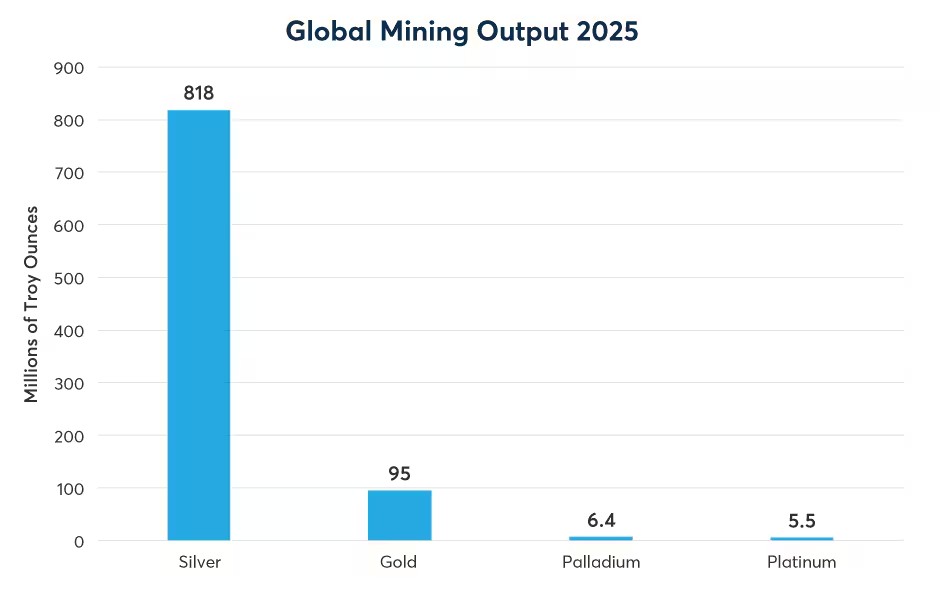
In 2025, global miners extracted 818 million troy ounces of silver, 950 billion ounces of gold, 6.4 million ounces of palladium, and 5.5 million ounces of platinum (Figure 8). However, mineral supply alone does not tell us the relative scale of the market.
Figure 8: The mineral output of silver and gold far exceeds that of palladium and platinum
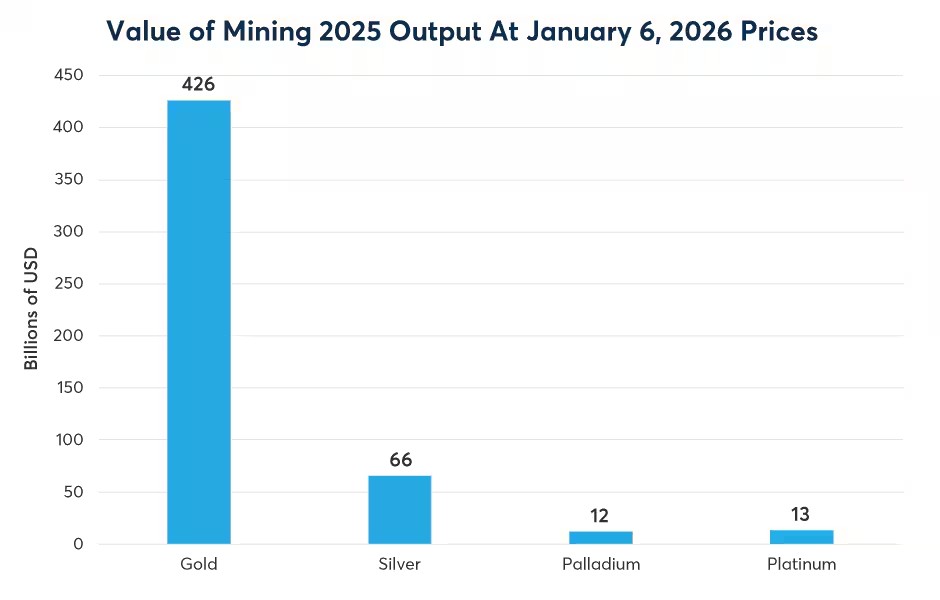
Based on prices at the beginning of January 2026, the value of gold output is approximately 6.5 times that of silver and about 35 times that of platinum and palladium (Figure 9). Therefore, even if only a small portion of gold investors choose to turn to silver, platinum, and palladium for diversification, their investment decisions could push up the dollar-denominated prices of these metals, as well as their price ratios relative to gold. This makes the macro environment driving precious metal price increases particularly important for relative value investors
Figure 9: The economic value of gold production is 6.5 times that of silver and 35 times that of platinum group metals
In recent years, several macro factors have driven gold prices higher, subsequently affecting other precious metal markets:
-
Core inflation rates remain above central bank targets in almost all regions.
-
Despite core inflation exceeding targets, most central banks are still cutting interest rates, except for Brazil and Japan.
-
Major economies are facing large budget deficits.
-
Changes in geopolitical situations.
Investors should closely monitor core inflation rates. If inflation continues to remain above targets or rises further, and central banks do not respond with tightening policies, investors may view this as a reason to continue increasing their metal allocations. Conversely, if core inflation slows down, concerns about inflation may ease, potentially weakening demand for precious metals. The same applies if central banks shift to raising interest rates. The importance of the U.S. Federal Reserve (Fed) is unparalleled, and as the Fed is set to change leadership in May 2026, investors will closely watch its actions.
While there is a high degree of uncertainty regarding the direction of monetary policy and core inflation, the direction of global fiscal policy is relatively clear. Brazil, China, France, Russia, Saudi Arabia, the United Kingdom, and the United States are all facing large budget deficits. Additionally, countries like Germany and Japan are easing fiscal stances to increase military spending. Therefore, fiscal positions may continue to support precious metals in 2026.
Finally, there are geopolitical issues. If geopolitical concerns escalate, it may further drive up gold prices and other metal prices. Conversely, if investors believe that geopolitical situations are stabilizing, it may lead to funds flowing from precious metals to fiat currencies