
Messari: A Complete Overview of Solana's Latest Payment Ecosystem
 I'm LongbridgeAI, I can summarize articles.
In 2025, major institutions like Visa and Worldpay integrated with Solana for stablecoin payments, achieving significant transaction volumes and reduced processing times. Solana's network, known for its fast finality and low fees, supports various payment solutions, including Western Union's new stablecoin and Fiserv's FIUSD. The ecosystem also includes Gusto's instant payments and PayPal's PYUSD, which saw substantial growth. Solana's architecture unifies information transmission and settlement, enabling real-time transactions and reducing operational burdens for financial institutions. As of February 2026, Solana's total payments volume surged 755.3% year-on-year, outpacing traditional fintech.
Author: Youssef Haidar Source: Messari Translation: Shan Ouba, Jinse Finance
Core Insights
- In 2025, major institutions such as Visa, Stripe, and Worldpay integrated with Solana for stablecoin payment settlement and acceptance. Visa's USDC pilot program achieved an annualized transaction volume exceeding $3.5 billion, while Worldpay reduced processing time by 50% through the Global Dollar Network (USDG). 57% of USDG was issued on Solana, benefiting from the network's extremely fast finality and near-zero transaction fees, meeting the high-frequency settlement needs of institutions. Western Union is launching a new stablecoin on Solana, bringing its money management business on-chain and opening its network of over 500,000 offline retail agents to the Solana app. The USDPT token, planned for launch in 2026, aims to eliminate the "working capital trap" of pre-deposited accounts and significantly reduce the average cost of international transfers. Fiserv, one of the world's largest bank processors and merchant acquirers, will launch its bank-centric stablecoin FIUSD on Solana. Fiserv announced the launch of a digital asset platform powered by FIUSD, serving its network of clients and merchants covering 10,000 financial institutions. Gusto is piloting USDC instant payments for over 400,000 businesses globally, based on the Solana network. Launched in January 2026, the collaboration with Zero Hash targets the 11% of US SMEs employing international contractors, bypassing the 3-7 day delays of traditional wire transfers. On February 2, 2025, PayPal USD (PYUSD) reached a market capitalization of $834.7 million on Solana, a year-on-year increase of 500.9%. This growth was driven by “crypto payments” merchant integration, PayPal links supporting URL transfers, and a 4.0% reward rate for users. In 2025, Huma Finance's transaction volume surged 232% year-on-year to $8.9 billion. Following its merger with Arf, the protocol's on-chain lending reached $3.8 billion, replacing the traditional SWIFT system with 24/7 stablecoin settlements, serving global businesses.
Introduction
The current global financial system still relies on outdated infrastructure predating the internet, resulting in an opaque environment and high costs. A core problem with traditional financial architecture is the deep separation between information transmission and settlement. Due to the reliance on agent banking intermediaries in a "multi-hop" model, final transaction confirmation is often delayed by several days.
Besides delays, this fragmentation also creates a huge demand for pre-deposited funds, locking up trillions of dollars of idle capital to bridge the gap between traditional bank hours and 24/7 global markets. Isolated and incompatible internal ledgers create a heavy reconciliation burden, forming a "liquidity tax" on cross-border payments. Ultimately, the fragility of traditional architecture, coupled with the lack of native programmable logic, makes it unable to support the high-speed, automated payment demands of the 21st century.
Solana solves these structural defects by unifying information transmission and settlement into a single atomic operation.
Solana unifies information transmission and settlement into a single atomic operation.
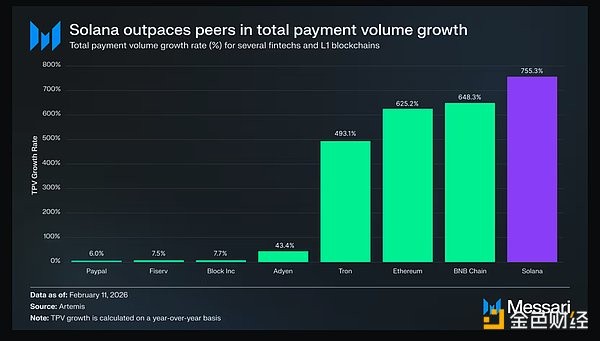
With its high throughput and parallel architecture, the network can settle transactions within milliseconds, bypassing intermediaries like correspondent banks and traditional system latency. The Solana blockchain has consistently maintained a median block time of 392 milliseconds and a median transaction fee of $0.0004. This real-time settlement environment eliminates the need for high-cost upfront deposits, significantly reducing the operational burden on financial institutions and businesses through a shared, transparent, and 24/7 ledger. With its native programmability and predictable near-zero fees, Solana provides a high-speed, internet-native payment track adapted to the modern economy. Solana's payment ecosystem covers multiple categories: Cross-border payments: represented by Gusto, Sphere Labs, and Yellow Card; Payment infrastructure: including giants like Worldpay, Visa, and Stripe; Emerging banks: covering Cash App, Revolut, and Sling Money. Sovereign stablecoins: such as Frontier (Wyoming), Evo (Kazakhstan), and TER (Bhutan's gold-backed blockchain). Fund management: centered around Squads Altitude. Stablecoin issuers: such as Circle, Tether, and PayPal. Digital wallets: such as Fireblocks, Phantom, and Jupiter. As of February 11, 2026, Solana's total payments volume (TPV) increased by 755.3% year-on-year, significantly surpassing traditional fintech giants and similar Layer 1 public chains, nearly three times the median growth rate of 268.24%.
Payment Infrastructure
Bridge
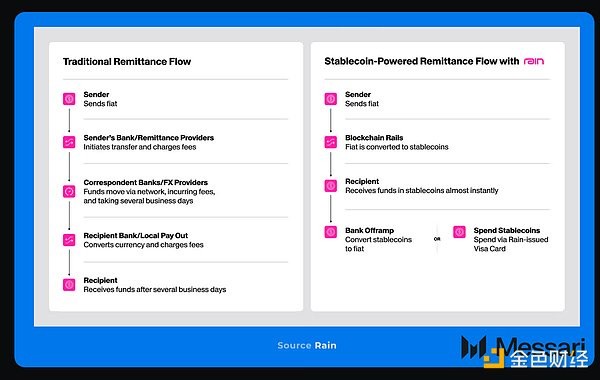
In February 2025, Stripe acquired Bridge for $1.1 billion, integrating its complete stablecoin orchestration platform into one of the world's largest payment processors. Bridge provides an API suite that allows businesses to send, store, and receive stablecoins across multiple public blockchains, with core clients including SpaceX, Coinbase, and Payoneer. By opening its issuance platform, Bridge allows partners to launch branded stablecoins, control their product experience, access a shared liquidity network, and earn interest from reserve assets. It also integrates branded stablecoins with fiat currency deposit and withdrawal networks. Phantom, a crypto wallet with over 15 million users, is launching its new stablecoin, CASH, through its open issuance platform. Other products include: Orchestration Services: Combining fiat currency tracks (ACH, wire transfer, SEPA, SPEI, Pix) with stablecoins to enable global fund transfers, providing 24/7 settlement for platforms such as Bitso and ARQ. Virtual Accounts: Instantly open USD, EUR, GBP, Brazilian Real, and Mexican Peso deposit accounts, providing local bank information. Card Issuance: Supports users to spend stablecoin balances via Visa virtual cards. Wallet Services: Provides secure custodial wallets for large-scale stablecoin balances. In February 2026, Bridge received conditional approval from the Office of the Comptroller of the Currency (OCC) to establish a federally chartered national trust bank. Upon formal approval, this license will enable Bridge to provide federally regulated custody, issuance, and reserve management services, becoming a necessary condition for US companies to migrate their payment flows to Solana. Visa: In December 2025, Visa launched stablecoin settlement services for US card issuers and acquirers, shifting from the traditional "netting" model to a real-time settlement architecture based on the Solana blockchain. To understand its impact, it's necessary to distinguish between the two core entities of card organizations: **Issuing Banks:** Financial institutions that provide credit/debit cards to consumers, responsible for transaction authorization and credit granting. **Acquiring Banks:** Banks or payment processors that provide payment acceptance infrastructure to merchants, managing merchant accounts and ensuring funds are credited to their accounts. These two entities typically do not transact in real time. Card organizations like Visa calculate the net debt between the two parties at the end of each day, and settlement between issuing and acquiring banks takes several days. Based on USDC on Solana, Visa launched a 24/7 settlement layer to replace the traditional route, supporting direct settlement between both parties using stablecoins with Visa, bypassing the shortcomings of systems like ACH. The project initially involves Cross River Bank and Lead Bank, and will be fully rolled out in 2026. As of November 30, 2025, the initial USDC pilot program had an annualized scale exceeding $3.5 billion. Leveraging stablecoins, Visa reduced friction across its global card network, eliminated delays caused by traditional bank operating hours, and established Solana as the core settlement layer for next-generation card products and interbank payments. Worldpay, one of the world's largest merchant acquiring institutions, joined the global USD network in April 2025, enabling merchants to settle transactions via USDG on Solana, helping global merchants bypass the high foreign exchange and intermediary fees of traditional cross-border payments. The key to choosing USDG lies in its revenue-sharing model. Unlike traditional stablecoins, the global USD network returns a portion of its reserve revenue to its partners, allowing Worldpay to share profits with merchants and reduce processing costs. By automating reporting and reconciliation processes, Worldpay reduces processing time by 50% compared to traditional fiat currency transactions. This integration eliminates the operational burden of pre-deposited bank accounts and provides a 24/7 settlement window, unrestricted by traditional bank opening hours. In 2025, Stripe significantly expanded its crypto infrastructure, adding Solana support to its crypto products in October. Through this suite, Stripe can automatically convert stablecoins to fiat currency, with funds settled directly in USD to the merchant's Stripe balance, eliminating price volatility risk. Currently, this is limited to US corporate transactions. The following features are available for private preview only (invitation only): Stablecoin Subscription: Automatic periodic billing via custom smart contracts, supporting users to save their digital wallets as a permanent payment method, eliminating the need for manual signatures on every transaction. Marketplace and Platform Payments: Platforms can directly pay service providers, sellers, and creators in USDC through this infrastructure. Stablecoin Financial Accounts: Stripe is testing dedicated accounts for stablecoins held by companies in over 100 countries, which can be linked to physical/virtual cards. Stripe also offers escrow and embedded deposit channels, allowing developers to directly build fiat-to-crypto entry points within their applications. Huma Finance allows businesses to use future cash flows such as commercial invoices and credit card receivables as collateral to unlock previously difficult-to-access on-chain credit, becoming a bridge between payments and DeFi. It provides infrastructure for payment service providers (PSPs) to achieve 24/7 transaction settlement using stablecoins, replacing inefficient and high-cost systems like SWIFT. Following its merger with Arf in 2024, Huma's transaction volume grew by 232% in 2025, reaching $8.9 billion, driving greater efficiency and capital utilization in the global economy. As of February 2, 2026, negotiated credit issuance reached $4.2 billion. BVNK serves as a crucial bridge between fintech and the on-chain economy, abstracting the complexity of cryptographic technology to enable companies like Worldpay, Deel, and Flywire to achieve instant global payments through Solana. The platform's core value lies in unifying stablecoins and fiat currency into a single experience, supporting businesses in transferring funds between traditional channels (SWIFT, ACH) and Solana without the need to manage the complexities of digital asset operations. In addition to B2B cross-border business, BVNK offers a full suite of services, including an embedded wallet and automatic conversion, allowing merchants to accept stablecoins and receive fiat currency, or to fund transactions in fiat currency and distribute stablecoins to the recipient's wallet. In January 2026, BVNK announced a milestone partnership with Visa Direct, providing it with stablecoin infrastructure. Visa Direct network covers over 190 countries and more than 7 billion devices. This integration leverages blockchains like Solana as a payment platform, enabling Visa customers to deposit funds in real time, with capital efficiency far exceeding traditional wire transfers. MoonPay provides the core infrastructure for fiat and crypto asset deposits and withdrawals for mainstream Solana applications. As the preferred deposit channel for Phantom, MoonPay provides seamless fund transfers for over 15 million users, supporting direct purchases of SOL and Solana's native stablecoin via credit cards, Apple Pay, bank transfers, and more. In addition to deposits, MoonPay's payment solution abstracts blockchain complexity as follows: Business Services: Providing merchants with a one-stop solution for accepting crypto deposits and stablecoins at checkout. MoonPay can automatically route and convert to fiat currency. MoonPay Agents: Launched at the end of 2025, supporting AI agents on Solana to autonomously hold balances, execute exchanges, and provide payment services, offering a compliance layer for inter-agent transactions. Stablecoin Orchestration: Providing an orchestration API suite through its subsidiary Iron, supporting exchanges and deposits, helping enterprises connect traditional fiat currency tracks (ACH, FedWire, SEPA Instant) with Solana's native stablecoin. Noah provides individuals and businesses with infrastructure for converting fiat currency to digital assets, simplifying the fiat-to-stablecoin process, supporting applications and fintech platforms to provide localized payment experiences, and directly connecting to Solana's high-speed settlement track. The platform's core functions are deposit and payment services, covering transactions in over 100 countries. It supports businesses receiving local fiat currency and settling with stablecoins on Solana, or making bulk payments directly from on-chain wallets to traditional bank accounts. Noah is responsible for end-to-end management, including KYC/AML compliance, liquidity management, and real-time foreign exchange conversion, reducing the operational and regulatory burden on partners. Noah's multi-party cooperation goals for 2026 include: Jupiter: In February 2026, Noah will embed compliant banking infrastructure into the Jupiter Global "super app," providing over 50 million users with USD and EUR virtual accounts, supporting direct salary and international wire transfers, and integrating emerging banks with the Solana DeFi ecosystem. Picnic: A dedicated partnership focused on the Brazilian market, providing native USD salaries and settlements for Brazil's global workforce. Remote workers can create their own virtual USD account within the Picnic app to receive ACH payments from their US employers and settle them into stablecoins instantly, bypassing traditional cross-border fees (typically 8% of income). Payd: Noah provides the core infrastructure for Payd, a financial platform serving over 30,000 professionals in sub-Saharan Africa. Through virtual USD and EUR accounts, Payd users can instantly settle their international income to Solana in USDC or USDT, bypassing high fees and long delays from local banks and gaining immediate liquidity. Rain: Rain is a stablecoin-based payment platform that connects digital assets with traditional commerce. As a Visa Core Member, Rain supports businesses launching branded card programs, accepted by over 150 million merchants in over 150 countries. Rain settles directly with Visa 365 days a year, bypassing bank hours and enabling real-time clearing of tokenized receivables. It provides a seamless payment layer for emerging banks and platforms, allowing global cards to be launched within weeks via a single API. This infrastructure is central to the vision of remittance platforms like Zar, a Solana-based payment platform designed to modernize remittance processes in cash-intensive economies in the global South. Zar plans to allow users in regions like Pakistan to receive international remittances in stablecoins, and its partnership with Rain enables funds to be used directly through Visa cards, eliminating the need for traditional withdrawal channels. In its vision, Zar users can convert cash into digital dollars on Solana at local convenience stores, enabling unbanked populations to store value and spend globally.
Zero Hash
Zero Hash, owned by Mastercard, provides regulatory and technical infrastructure for B2B and B2C platforms to directly embed digital asset services into their products. It abstracts the complexity of on-chain settlement, enabling mainstream fintech institutions to leverage Solana's high-throughput architecture without additional operating costs.
Recently, we have reached important partnerships with several exchanges:
- Interactive Brokers: In January 2026, Zero Hash will support Interactive Brokers' 24/7 account funding capabilities.
- Interactive Brokers: In January 2026, Zero Hash will support Interactive Brokers' 24/7 account funding capabilities. International investors can deposit USDC through Solana, which is automatically converted to USD for instant transactions, bypassing the delays of traditional wire transfers and achieving near real-time capital flows. Public.com: By the end of 2025, the retail investment platform Public will migrate all its crypto business to Zero Hash, leveraging its integration with blockchains like Solana to provide 24/7 trading and faster settlement. Cross-border payments. Decaf: Decaf is a non-custodial wallet designed to bring stablecoin utility to everyday commerce, focusing on cash-intensive and high-inflation economies. Through stablecoins on blockchains like Solana, it provides a user experience that bypasses the boundaries and high costs of the traditional financial system. Following its strategic integration with MoneyGram, Decaf enables users in 175 countries and over 350,000 offline locations to transfer cash and USDC free of charge. This provides crucial support for unbanked populations in Latin America, Africa, and Southeast Asia, allowing them to use digital dollars without a traditional bank account. Decaf also offers a simplified merchant interface, allowing businesses to use stablecoins for payments and assistance as conveniently as cash. Merchants enjoy instant settlement, avoiding the high processing fees and chargeback risks of traditional card networks. In January 2026, Gusto, a cloud-based HR platform serving over 400,000 companies globally, announced a partnership with Zero Hash to pilot stablecoin payments for international contractors using Solana. Traditional cross-border wire transfers take 3–7 business days; this integration enables instant global payments in USDC. Zero Hash data shows that 11% of US SMEs have already employed international contractors, and on-chain payroll payments have achieved low-cost, rapid processing for the first time. Sphere Labs provides infrastructure connecting fiat and stablecoins, serving as a settlement layer for high-speed, low-cost cross-border payments for global enterprises. It supports 12 global currencies, including the US dollar, euro, and Mexican peso, covering both mature and emerging markets. The core feature is the Onramper account, which directly assigns dedicated bank information to encrypted wallets, supports businesses receiving standard ACH or wire transfers, and automatically converts them into stablecoins on Solana, abstracting the complexity of encrypted deposits and withdrawals for end users. Sphere offers four main products: Developer Toolkit: Provides powerful APIs and SDKs, supporting teams to embed multi-chain transfers and stablecoin conversions. Enterprise Dashboard: Provides a one-stop solution for end-users and enterprises for fund management and transfers. Embedded Deposits and Withdrawals: The platform can integrate functional components into websites, providing in-application deposits and withdrawals. Dedicated Trading Desk: Serving Institutional Partners with Large-Scale Needs, Handling Massive Forex and Fiat Currency - Crypto Conversion
YouTube
In December 2025, YouTube took a significant step towards mainstreaming blockchain payments by enabling US creators to receive earnings in PayPal USD (PYUSD) via the Solana network. This integration allows creators to bypass the settlement delays and business hour restrictions of traditional financial institutions, achieving same-day settlement and near-zero transaction fees.Leveraging PayPal's compliant 1:1 USD-backed stablecoin, YouTube provides users with instant global asset transfers. Currently limited to US creators, it is expected to expand to the global creator community in the future, especially suitable for regions where traditional cross-border wire transfers are expensive and slow.
Yellow Card is Africa's largest pan-African stablecoin infrastructure provider, offering a complete fiat-crypto asset deposit and withdrawal channel, supporting banks, financial institutions, and global enterprises to access, store, and manage digital assets. Through its API and fund management platform, businesses can use stablecoins to execute cross-border payments and remittances in batches, reducing settlement time from days to seconds. The platform focuses on solving the structural liquidity bottlenecks and high fees inherent in traditional banking, becoming the preferred settlement layer for many global financial institutions expanding into emerging markets: Visa: Simplifying fund management and improving liquidity through Yellow Card, enabling more flexible and low-cost cross-border fund flows. Thunes: Utilizing Yellow Card stablecoin infrastructure to bypass traditional funding bottlenecks and execute global payment flows at unprecedented speed. Western Union: Uses the Yellow Card track for stablecoin settlement, providing customers with near real-time payment clearing and exchange rates far superior to traditional channels. Xoom (PayPal service): Relies on the network to execute cross-border transfers to regions such as Cameroon, Ivory Coast, and Senegal, with funds arriving in mobile wallets and bank accounts in seconds. Zepz: In October 2025, Zepz, the global payments group operating WorldRemit and Sendwave, launched the Sendwave wallet, a peer-to-peer stablecoin cross-border solution based on the Solana blockchain. Beyond traditional remittances, the wallet supports Zepz's 9 million users worldwide in sending, storing, and spending funds in over 130 countries and through 2000 channels. Leveraging the Circle USDC and Portal wallet infrastructure, Sendwave wallet abstracts the complexity of blockchain technology, providing a smooth interface for users worldwide. Users can hold digital dollars to hedge against local currency depreciation and transfer funds within the app in seconds. Users can withdraw their USDC balances to local fiat currency via the Zepz payment network for medical, educational, and daily necessities purposes. In the long term, Zepz plans to expand wallet functionality to include card and QR code merchant payments. In September 2025, Brex launched stablecoin payments, becoming the world's first corporate card to support instant balance payments in USD stablecoins. Integrating USDC on Solana, Brex provides customers with a unified financial platform for managing traditional fiat currency and stablecoin spending at scale. This integration aims to eliminate fragmented processes in managing digital assets and corporate expenses, allowing customers to bypass the limitations of traditional institutional payment platforms and gain 24/7 global liquidity. Core Functions: Instant Balance Payment: Customers can directly repay corporate card debts using stablecoins (USDC is supported initially). Automatic Fiat Currency Conversion: Corporate accounts can receive stablecoins and automatically convert them to USD, or send stablecoins directly from existing USD balances. Zero-Fee Global Settlement: Supports users to send stablecoins across borders for free in seconds, eliminating hidden costs and delays associated with traditional banks. Solana's stablecoin integration supports the instant transfer of millions of dollars for leading companies, combining the speed of native crypto tracks with the security required by global businesses. Block's Cash App breaks with the historical strategy of only supporting Bitcoin by integrating a stablecoin track, with Solana as its first launch network. Upon launch in early 2026, 56 million monthly active users can send and receive USDC. The system assigns a unique Solana address to each Cash App user, allowing them to directly connect to the on-chain economy without leaving the familiar interface. The platform features an automatic conversion engine: USDC received on Solana is instantly converted to USD balance, and can be sent as USDC to any external Solana wallet for external payments. Fuse Wallet is a "smart wallet" based on the Squads protocol. It provides retail users with features not previously available through smart accounts: spending limits to prevent "fraudulent transactions", key rotation for lost devices, and gas abstraction (supporting payment of transaction fees in any token and zero-fee transactions for Solana tokens).
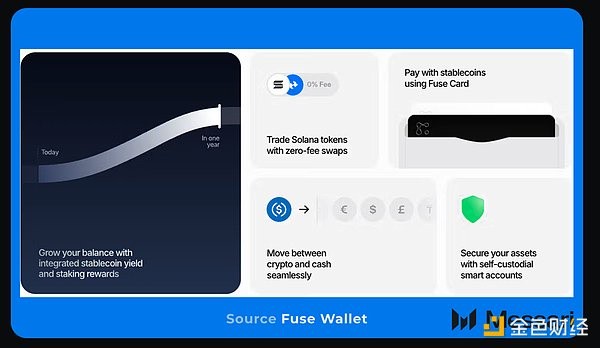
In addition to secure custody, Fuse provides a full suite of tools:
- Fuse Earn: A native yield engine that directly connects to Lulo, rebalancing deposits between Kamino, Drift, MarginFi, and Save, allowing users to self-custody stablecoins while earning yields
- Virtual Bank Account: Provides a dedicated IBAN or account, supporting direct conversion of fiat currency to USDC for European and American users, enabling smooth withdrawals
Phantom Cash
Phantom Cash, launched in September 2025, is a dedicated account within the Phantom wallet designed to bridge the gap between user-managed funds on the Solana platform and everyday spending. This feature is powered by CASH, a USD-pegged stablecoin issued by Bridge.This dedicated account allows users to hold, send, and trade CASH without maintaining a Solana balance to pay network fees, effectively eliminating the gas barrier for everyday users. The platform also offers gas-free stablecoin to CASH exchange and instant P2P transfers that only require a Phantom username, accessible to all users. Core features are now live. Phantom is currently rolling out extended features to US users, requiring KYC verification, including:- Phantom Cash Card: Virtual and physical debit card (issued by Lead Bank), can be added to Apple Pay or Google Pay for online and offline shopping
- Smooth Bank Transfers: Fund your account using provided account and routing information, withdraw directly to the bank, and set up direct deposits
Western Union Dollar Payment Token (USDPT)
A milestone move: Western Union announced the launch of its native stablecoin USDPT on Solana in early 2026. Partnering with Anchorage Digital to provide institutional-grade custody, Western Union is migrating a portion of its over $100 billion annual remittance volume to Solana's high-throughput track. This move aims to eliminate the "working capital trap" of pre-deposited accounts and reduce the average cost of international transfers for customers worldwide. By the end of the first half of 2026, USDPT is expected to become the core settlement asset for Western Union's digital payment channel, marking the most significant institutional recognition of Solana as a global payment gateway. Solana has recently attracted several sovereign and state-level stablecoin projects. These projects aim to modernize public financial infrastructure and allow governments to understand the advantages and nuances of blockchain-based payment methods. Wyoming Frontier (FRNT) Wyoming continues to lead U.S. digital asset innovation through its Wyoming Frontier (FRNT) token. Issued by the Wyoming Stablecoin Council, FRNT is a transparent, fiat-backed stablecoin that provides a trusted, state-approved digital dollar for public and private scenarios. Wyoming aims to reduce state-level payment costs by providing a secure, liquid asset 100% backed by cash and short-term government securities. Solana carries the majority of the circulating FRNT, accounting for 61.1% of the total 1.5 million FRNT in circulation as of January 30, 2026, according to the latest proof report. Kazakhstan Evo (KZTE) The National Bank of Kazakhstan launched Evo (KZTE), the first tenge-backed stablecoin, within its regulatory sandbox. Developed in collaboration with licensed exchange Intebix, Mastercard, and Eurasia Bank, KZTE natively brings the Kazakh tenge to the Solana blockchain. Bhutan Gold-Backed Token (TER) In December 2025, the Kingdom of Bhutan launched TER, a gold-backed stablecoin issued by the Gelephu Mindfulness City Authority (GMCA). Distributed exclusively through DK Bank, which is dually regulated by the GMCA and the Royal Monetary Authority of Bhutan (RMA). Each token represents ownership of 0.01 grams of 9999 pure gold, stored in an audited vault, eliminating traditional barriers to entry such as high storage costs and minimum investment thresholds. The reserves consist entirely of 99.99% pure Emirates Gold ingots delivered in the UAE, distributed across three specialized vaults: UAE Vault (UAE): holding 48 kg of reserves (61.5% of total supply); Methub (Bhutan): 20 kg held in sovereign custody (25.6% of total supply); and Brink (Hong Kong): 10 kg held in Hong Kong (12.8% of total supply), connecting with major Asian financial centers. In summary, Solana continues to attract large institutions and payment service providers, including Visa's native stablecoin settlement project and Stripe. Encryption suites and Worldpay's integration with USDG serve as proof. With a total stablecoin market capitalization of $16.2 billion, Solana accounts for nearly half of stablecoin transactions, making the network a key on-chain payment hub. Looking ahead, Solana's unique combination of sub-second finality and extreme cost efficiency is poised to capture a larger share of the global payments market. As remittance operators, card organizations, and payment service providers move their operations onto the blockchain, traditional payment frictions are being replaced by a unified, transparent, and 24/7 settlement layer. Solana not only has the potential to challenge the dominance of fragmented traditional systems but will also become a core infrastructure of the internet-native financial system.