
Some Investors May Be Willing To Look Past Nomura Research Institute's (TSE:4307) Soft Earnings
 I'm LongbridgeAI, I can summarize articles.
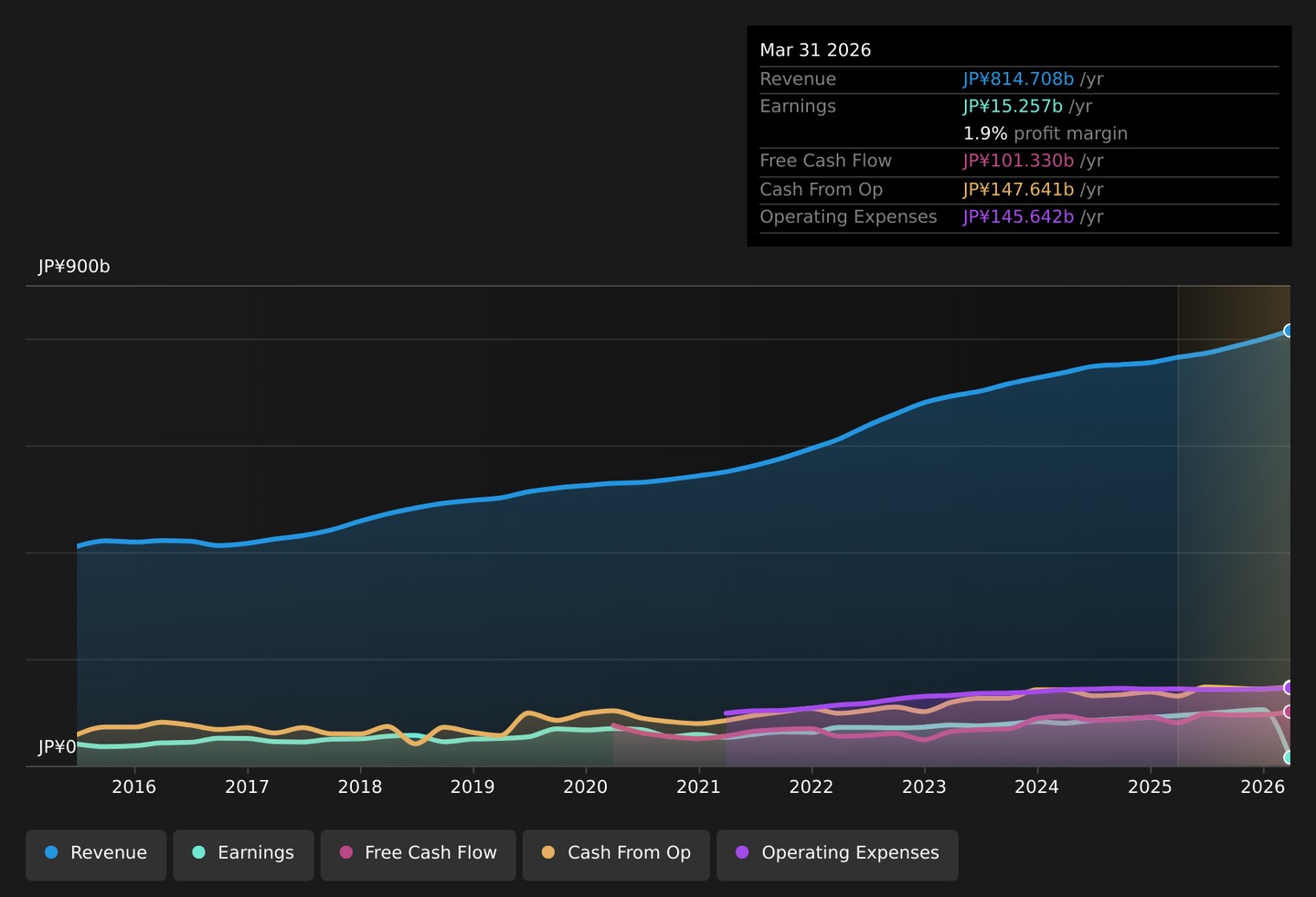
Nomura Research Institute (TSE:4307) reported disappointing earnings, with a profit of JP¥15.3b against free cash flow of JP¥101b, indicating strong cash generation despite soft profits. The company's accrual ratio of -0.17 suggests better cash flow conversion than profit figures imply. Analysts remain optimistic about future profitability, but the earnings per share have declined. Investors should be aware of three warning signs before considering investment, as the company's underlying earnings potential may be better than reported.
The most recent earnings report from Nomura Research Institute, Ltd. (TSE:4307) was disappointing for shareholders. Despite the soft profit numbers, our analysis has optimistic about the overall quality of the income statement.
Trump has pledged to "unleash" American oil and gas and these 15 US stocks have developments that are poised to benefit.
A Closer Look At Nomura Research Institute's Earnings
One key financial ratio used to measure how well a company converts its profit to free cash flow (FCF) is the accrual ratio. The accrual ratio subtracts the FCF from the profit for a given period, and divides the result by the average operating assets of the company over that time. This ratio tells us how much of a company's profit is not backed by free cashflow.
That means a negative accrual ratio is a good thing, because it shows that the company is bringing in more free cash flow than its profit would suggest. While it's not a problem to have a positive accrual ratio, indicating a certain level of non-cash profits, a high accrual ratio is arguably a bad thing, because it indicates paper profits are not matched by cash flow. To quote a 2014 paper by Lewellen and Resutek, "firms with higher accruals tend to be less profitable in the future".
Nomura Research Institute has an accrual ratio of -0.17 for the year to March 2026. Therefore, its statutory earnings were very significantly less than its free cashflow. To wit, it produced free cash flow of JP¥101b during the period, dwarfing its reported profit of JP¥15.3b. Nomura Research Institute's free cash flow improved over the last year, which is generally good to see.
That might leave you wondering what analysts are forecasting in terms of future profitability. Luckily, you can click here to see an interactive graph depicting future profitability, based on their estimates.
Our Take On Nomura Research Institute's Profit Performance
As we discussed above, Nomura Research Institute's accrual ratio indicates strong conversion of profit to free cash flow, which is a positive for the company. Because of this, we think Nomura Research Institute's underlying earnings potential is as good as, or possibly even better, than the statutory profit makes it seem! Unfortunately, though, its earnings per share actually fell back over the last year. The goal of this article has been to assess how well we can rely on the statutory earnings to reflect the company's potential, but there is plenty more to consider. With this in mind, we wouldn't consider investing in a stock unless we had a thorough understanding of the risks. For example - Nomura Research Institute has 3 warning signs we think you should be aware of.
Today we've zoomed in on a single data point to better understand the nature of Nomura Research Institute's profit. But there is always more to discover if you are capable of focussing your mind on minutiae. Some people consider a high return on equity to be a good sign of a quality business. While it might take a little research on your behalf, you may find this free collection of companies boasting high return on equity, or this list of stocks with significant insider holdings to be useful.
Valuation is complex, but we're here to simplify it.
Discover if Nomura Research Institute might be undervalued or overvalued with our detailed analysis, featuring fair value estimates, potential risks, dividends, insider trades, and its financial condition.
Access Free Analysis