
What transformation signals of IoT chips were revealed at the 2026 Japan Wireless Exhibition, from Bluetooth 6.2 to edge AI?
 I'm LongbridgeAI, I can summarize articles.
The 2026 Japan Wireless Exhibition shows that IoT chips are shifting towards low latency, centimeter-level positioning, and edge AI. Telink Microelectronics showcased the TL721X/TL322X chips based on Bluetooth 6.2 SCI characteristics, achieving microsecond-level latency and a 2K+ return rate; its HDT technology supports true 8K wireless connectivity with a speed of up to 6Mbps, aiding in the upgrade of gaming peripherals
The Wireless Japan 2026 exhibition officially concluded recently. As the most significant wireless communication event in Asia, this year's exhibition not only served as a platform for major manufacturers to showcase their strengths but also released clear signals for the future transformation of the IoT industry.
If the previous wireless exhibitions focused on "transmission bandwidth" and "theoretical speed," then at the Tokyo venue in 2026, mainstream chip manufacturers have fully shifted towards deep experiential upgrades and scenario-based technological development centered on "ultra-low latency, centimeter-level positioning, edge AI, and cross-ecosystem integration." Among these, the competition surrounding the next-generation wireless SoC matrix became the focal point of the event.
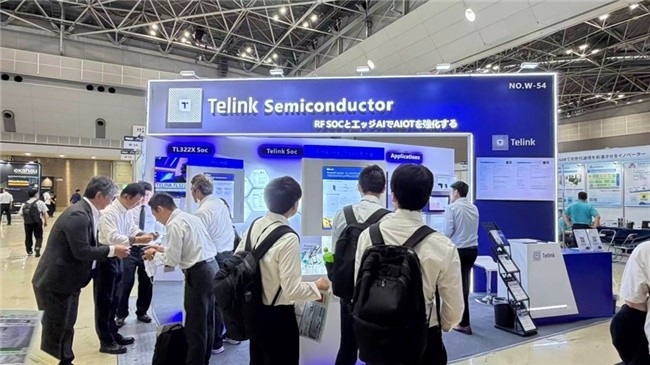
In this context, the globally leading wireless IoT chip company Telink Semiconductor attracted many visitors to its booth, showcasing several cutting-edge SoC chips and innovative demos, signaling four major technological transformations to the industry.
Signal One: Standard Bluetooth Upgrade, Peripheral Market Shifts from "Either/Or" to "Scenario Diversification"
Traditional Bluetooth peripherals often struggle to meet the stringent demands of high-refresh-rate and high-precision interactive devices in high-real-time scenarios like esports and VR due to air latency, leading to lag.
At the exhibition, Telink Semiconductor successfully broke this limitation with a demo based on the new Bluetooth 6.2 protocol stack's SCI (Shorter Connection Intervals) feature.
The SCI feature allows master and slave devices to establish high-speed handshakes with sub-millisecond intervals, breaking through the previous connection lower limit of 7.5 milliseconds. Leveraging this feature, Telink Semiconductor's TL721X and TL322X series chips achieved a wireless return rate of 2K+, with latency compressed to the microsecond level.
Additionally, for extreme scenarios such as professional-grade true 8K high-refresh peripherals, Telink Semiconductor's self-developed HDT technology remains an irreplaceable optimal solution.
This technology achieves a balance of ultra-high throughput and ultra-low latency in the 2.4GHz frequency band by deeply customizing the physical layer and data link layer, stripping away redundant overhead. The TL322X SoC chip now supports true 8K wireless connections, with wireless transmission rates reaching up to 6Mbps. This chip has already been adopted by leading domestic and international brands, helping gaming peripherals officially enter the true 8K wireless era.
Therefore, whether based on the Bluetooth standard's SCI feature or the self-developed HDT proprietary technology, Telink Semiconductor has made substantial breakthroughs on both paths. The simultaneous advancement of standard protocols and proprietary technologies signifies that the peripheral market is moving towards more nuanced scenario diversification.
Signal Two: Centimeter-Level Positioning Says Goodbye to High Costs, Bluetooth Channel Sounding Solution Provides a "Compromise Solution" The high-precision positioning market has long faced a polarized situation: on one side is the high-precision but high-cost and high-power consumption UWB (Ultra-Wide Band), and on the other side is the low-cost but higher error traditional Bluetooth RSSI (Received Signal Strength Indication).
Telink Semiconductor showcased its Bluetooth Channel Sounding solution at the exhibition, bringing a third commercial solution that balances high precision and optimal cost to this market.
As the world's first non-mobile chip company to obtain Bluetooth Channel Sounding certification, Telink Semiconductor has fully integrated a dual mechanism of PBR (Phase-based Ranging) and RTT (Round-Trip Time) in its TL721X platform. PBR effectively eliminates indoor interference caused by multipath effects by measuring the phase changes of radio waves; RTT utilizes time information for range verification. The two work in synergy to achieve precise positioning at a level of 10 to 50 centimeters, relying solely on the existing 2.4GHz BLE RF architecture without incurring additional UWB RF and antenna costs, while naturally providing strong security against relay attacks.
Signal Three: Edge AI Computing Power Sinks, Wireless Audio Hardware Says Goodbye to "Pure Cloud Dependence"
As AI large models penetrate the edge, how to carry edge computing power on ultra-low-power wireless chips is a cutting-edge topic in the industry. At the exhibition, the Wi-Fi AI Recorder solution driven by Telink Semiconductor's TL751X fully demonstrated the evolution of computing power in chip-side architecture.
The TL751X adopts a dual-core design and integrates a high-performance HiFi-5 DSP. This DSP uses a Very Long Instruction Word (VLIW) architecture and large-capacity Multiply-Accumulate (MAC) units, providing four times the hardware acceleration capability for neural network processing compared to previous generation chips. With the help of compiler automatic vectorization technology, audio devices can efficiently complete far-field pickup, AI noise reduction, and voice feature extraction locally, allowing audio hardware to completely say goodbye to "pure cloud dependence," achieving sub-millisecond instant response while protecting privacy.
In addition, to meet differentiated needs, Telink Semiconductor offers two sets of precise chip combinations: the TL721X + TLSR9118 ultra-low-power dual-microphone solution for the mass market, which operates at low current and, together with Wi-Fi 6 high-speed direct connection, enables all-weather recording and minute-level uploading; and the TL751X + TLSR9118 high-performance six-microphone solution for professional scenarios, prioritizing audio quality and computing power, also relying on the local processing capability of the HiFi-5 DSP to deliver professional-grade recording performance.
Hard Signal Four: Multi-Protocol Time Division Multiplexing and Multi-Mode Coexistence Are Becoming Standard for Smart Homes The variety of smart home access protocols and differing standards create significant barriers to device interconnectivity. Whether a single chip can stably and efficiently support multiple communication protocols has become a core factor affecting the smoothness of whole-home interactions and user experience.
To address this pain point, Telink Semiconductor showcased the leading capabilities of its multi-mode fusion chip represented by TL323X in the Zigbee, Bluetooth® LE, and Thread tri-mode gateway solutions.
Under a single RF architecture, the core challenge of having three modes online simultaneously lies in the timing of switching between different RF modes, as well as event scheduling and time slice processing between different protocol stacks. This ensures the stability of 802.15.4 (Zigbee/Thread) communication while also ensuring that Bluetooth® LE mode does not experience disconnections. For example, when the Thread protocol transmits critical events such as sensor status, the chip automatically coordinates and fine-tunes the air time for Zigbee and Bluetooth® LE, achieving dynamic slicing of the physical link and ensuring that the three protocols do not interfere with each other within the shared 2.4GHz frequency band.
In contrast, traditional gateway solutions often require 2-3 independent single-mode chips, which not only leads to bulky hardware structures but also faces co-frequency interference issues. Telink Semiconductor's multi-mode chip supports multiple mainstream standards in parallel with a single chip, which not only streamlines peripheral circuits and reduces BOM costs but also lowers overall system power consumption by more than 30%, completely breaking down communication barriers between devices at the physical layer and eliminating the ecological islands of smart homes.
Signal Five: Ecological Islands Accelerate Dissolution, Panorama Interconnection of Matter and Amazon Sidewalk
Cross-brand interconnectivity has transformed from a PPT slogan into a hard metric at the chip level. From the overall situation of this exhibition, the landing context of global protocols has taken shape.
Matter over Thread has fully entered a normalization phase. The new generation of smart home chip solutions (such as TL323X) has comprehensively supported IPv6 addressing and network layer security encryption at the underlying level. Among them, Thread, as a low-power mesh network, provides a highly reliable and self-healing local transmission channel; the Matter protocol serves as a unified language at the application layer. This allows terminal devices to seamlessly interoperate with smart gateways from different brands such as Apple HomePod and Samsung Gateway at the local area network level, significantly alleviating the pain point of smart homes becoming paralyzed due to cloud outages.
In addition, the integration of short and long-range Amazon Sidewalk ecology has demonstrated new connection possibilities. This solution achieves dynamic RF link switching at the chip level: under conditions of close range and high bandwidth demand, the system operates in Bluetooth® LE mode; once the device moves out of the home range, the chip automatically switches the physical layer modulation method to the 900MHz LoRa/FSK long-range low-speed modulation mode. This long and short-range integration technology extends the connection boundary of a single hardware device from inside the home directly to the entire community, accelerating the arrival of the panoramic interconnection era The conclusion of the 2026 Japan Wireless Exhibition has actually opened a new round of competition in the global IoT market. From the actual adoption of the aforementioned new chip solutions by leading consumer electronics giants at home and abroad in products such as smart lighting, smart speakers, and TWS earbuds, it can be seen that the next generation of wireless communication technology has completed the closed loop from "laboratory research and development" to "mass commercial production."
The second half of IoT chips is no longer a competition of bandwidth and clock frequency parameters, but rather focuses on achieving a more refined and smoother user experience at the endpoint with extreme power consumption and optimal cost, pushing performance and experience to the limit. In this transformation, chip manufacturers with multi-mode integration and endpoint AI processing capabilities will undoubtedly hold more ecological discourse power