
SK Hynix's five-year production capacity doubling is still not enough! NVIDIA urges expansion, and the semiconductor equipment ETF China Merchants (561980) violently rebounds, rising over 3%!
 I'm LongbridgeAI, I can summarize articles.
NVIDIA CEO Jensen Huang urged SK Hynix to expand production capacity, believing that its five-year doubling plan is still insufficient to meet AI computing demand. Affected by this news and the global chip leaders' expansion actions, the A-share semiconductor equipment sector rebounded strongly, with the China Merchants Semiconductor Equipment ETF rising over 3%, and stocks such as AMEC and NSIG also increased. Meanwhile, Musk emphasized that chip manufacturing capacity is a core bottleneck, and Intel's stock price surged due to receiving Google TPU orders
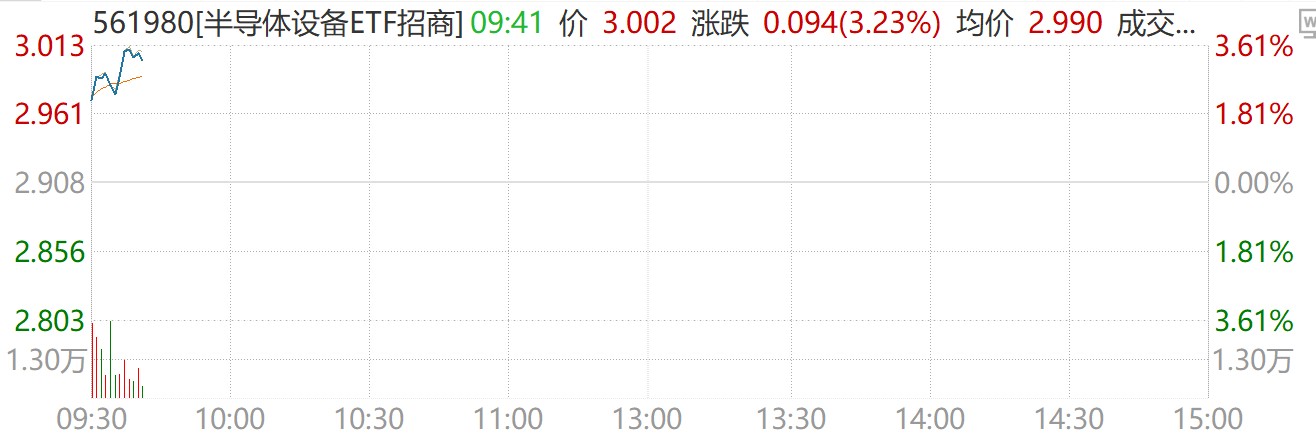
On June 9, U.S. tech stocks rebounded violently overnight, with South Korea's KOSPI opening up 4.8%. Samsung Electronics and SK Hynix quickly regained some of yesterday's losses. In the A-share market, semiconductor equipment led a strong counterattack in the chip industry! As of 9:42, the semiconductor equipment ETF China Merchants (561980) rose 3.23%, with Zhongwei Company, Nanda Optoelectronics, and ChipSource rising over 4%. Northern Huachuang, Changchuan Technology, and Huahai Qingsi rose over 3%, while Hu Silicon Industry surged 7%, with multiple stocks like Cambricon, Tuojing Technology, and SMIC following suit.
On the news front, global chip leaders are taking continuous actions in capital expenditure, capacity expansion, and technological upgrades.
On June 8, NVIDIA CEO Jensen Huang publicly stated that SK Hynix's previously announced plan to double wafer capacity by 2030 is still insufficient, urging further capacity expansion to match the exponential growth in computing power demand in the AI era. Previously, SK Hynix set a goal to double capacity within five years, judging that the bottleneck in memory chip capacity may persist until 2030.
Jensen Huang further revised this judgment— the existence of a capacity gap is not a mismatch of supply and demand in a particular quarter, but a structural imbalance under the large cycle of AI computing power. Currently, NVIDIA has been purchasing billions of dollars worth of chips from SK Hynix annually, and this figure is expected to continue to grow significantly this year, with SK Hynix confirmed as the underlying support for all of NVIDIA's core product lines in the future.
At the same time, Musk emphasized in an interview at JP Morgan's global headquarters that "the real bottleneck is in chip manufacturing capacity," pointing out that Micron's current capacity is far from meeting actual chip demand. He directly addressed the core supply constraint in the chip industry—insufficient capacity supply, which is precisely the logical anchor point for semiconductor equipment and materials: wafer fab expansion requires essential materials and equipment.
On the other side of the capacity shortage, orders are accelerating to be released. According to media reports on June 8, due to TSMC's advanced packaging capacity limitations, Google has placed an order with Intel for over 3 million self-developed TPU chips, planning to produce them before 2028, causing Intel's stock price to surge over 13%. At the same time, NVIDIA is also evaluating Intel's 18A process, with SK Hynix conducting compatibility testing simultaneously.
Domestically, memory leader Changxin Storage reported Q1 2026 revenue of 50.8 billion yuan, a year-on-year increase of 719.13%, with operating cash flow in Q1 reaching 42.6 billion yuan, exceeding the total of 36.5 billion yuan for the entire year of 2025. In Q2, large-scale equipment bidding has officially begun, with annual equipment procurement demand reaching 5-6 billion USD and clear expansion plans.
UBS's latest report has significantly raised its forecast for the year-on-year growth rate of China's wafer fab equipment expenditure for 2027/2028 from 6%/1% to 18%/14%, believing that the proportion of domestic equipment in Changxin's orders will rise to 40%-50%, bringing an annual revenue increase of 6-13 billion USD for domestic equipment from 2026 to 2028 At the same time, the target prices for Northern Huachuang, AMEC, and Shanghai SSM have been significantly raised, with increases ranging from 34% to 48%.
According to Guoyuan Securities, the first 600mm×600mm panel-level packaging de-bonding equipment from Northern Huachuang has been successfully shipped, indicating that domestic equipment manufacturers in China are gradually entering the critical process field of panel-level packaging. Analysts believe that amid the severe fluctuations in global computing power assets, the equipment sector, with its visibility of cross-cycle orders, the pre-need for capacity expansion, and the structural increase in the share of domestic equipment, is becoming a repeatedly validated certainty in the AI industry chain.
Data from the China Securities Index official website shows that the semiconductor equipment ETF from China Merchants (561980) tracks the China Securities Semiconductor Industry Index, with Northern Huachuang and AMEC accounting for a combined 27% of the constituent stocks, Cambrian and Haiguang Information together accounting for 15%, and SMIC at 6%. The top ten stocks account for nearly 75%, with "Changxin Storage" content at about 53%, equipment and materials content at about 80%, and CPU/GPU + wafer manufacturing at about 20%, benefiting significantly from the storage supercycle.
Data shows that as of June 5, the China Securities Semiconductor Index has risen over 140% in the past year and over 390% since 2020, with both short-term and long-term performances ranking first among similar indices such as sci-tech chips and semiconductor materials and equipment.
Galaxy Securities pointed out that the expansion of storage and the high utilization expectations of wafer fabs continued throughout May, with AMEC, Huahai Qingshi, Northern Huachuang, and Xinyuan Micro continuously raising their order guidance; at the beginning of the month, boosted by Wuhan's $38 billion storage expansion plan, the equipment sector led the gains, but at the end of the month, it corrected due to excessive increases; Yangtze Memory's IPO was approved, and the expansion bidding was implemented, providing ample support for long-term orders, highlighting the configuration value of the semiconductor equipment sector after the correction. 