
Towards Large-Scale Quantum Circuit Simulation: HOLO MicroCloud Hologram Creates the Industry's First Multi-FPGA Quantum Fourier Transform Simulation Solution
 I'm LongbridgeAI, I can summarize articles.
MicroCloud Hologram (NASDAQ:HOLO) has launched the industry's first quantum Fourier transform (QFT) simulation solution based on multiple FPGAs and high-bandwidth memory. This solution breaks through the performance bottlenecks of traditional CPU/GPU in large-scale quantum circuit simulation through a parallel distributed architecture, providing core infrastructure for validating quantum algorithms, optimizing circuits, and supporting the software ecosystem in the NISQ era
In the context of the rapid development of quantum computing technology, effectively simulating large quantum circuits during the immature stage of real quantum computers has become one of the core challenges in the global computing field. As a fundamental component of many important quantum algorithms, Quantum Fourier Transform (QFT) possesses a high degree of mathematical structure but poses significant challenges to the performance and storage bandwidth of underlying hardware. To address the bottlenecks of existing classical hardware in terms of simulation scale, speed, and scalability, MicroCloud Hologram (NASDAQ:HOLO) has launched a new scalable quantum Fourier transform simulator technology based on multiple FPGAs and high-bandwidth memory. This groundbreaking achievement lays the engineering foundation for future larger-scale quantum algorithm simulations by introducing a parallel distributed architecture of multiple FPGAs and high-bandwidth memory.
Quantum computing, as a new paradigm that utilizes quantum superposition, entanglement, and interference to perform computations, has the potential to outperform classical computers in solving certain specific problems. However, due to limitations such as noise, gate errors, decoherence time, and insufficient qubit numbers, current NISQ (Noisy Intermediate-Scale Quantum) devices are unable to run truly large quantum algorithms. Therefore, high-performance quantum circuit simulators remain a core infrastructure for quantum algorithm research. They not only help researchers verify the correctness of quantum algorithms and optimize circuit depth but also support compiler development, architecture validation, and the flourishing of the quantum software ecosystem.
Traditional CPUs and GPUs have played important roles in the field of quantum circuit simulation, but they face significant bottlenecks. The storage overhead of classical hardware for quantum states grows exponentially with the number of qubits, and each gate operation requires a large number of complex calculations on the entire $2^n$ dimensional amplitude vector. The storage bandwidth of CPUs struggles to meet the demands for large-scale quantum state updates, while GPUs, despite their advantages in parallel performance, are limited by memory capacity, access patterns, and the difficulty of deep optimization, making it challenging to further break through the simulation performance of large-scale QFT. Therefore, to overcome the performance limits of classical hardware in simulating quantum circuits, MicroCloud Hologram has chosen to start from the hardware architecture level, constructing fully customizable data channels and computation units, and achieving tailored quantum state processing accelerators through the programmable logic structure of FPGAs.
The newly launched multi-FPGA QFT simulation platform is built on this concept. One of its core innovations is storing large-scale complex amplitudes of quantum states in high-bandwidth memory, such as HBM (High Bandwidth Memory) or equivalent architectures, allowing the simulator to read and update at speeds far exceeding that of DDR memory. The QFT simulation process essentially involves a large number of distributed Hadamard transformations, controlled phase shift gates, and bit-reversal-based output structures, all of which require wide-ranging data access jumps on the amplitude vector. Traditional memory cannot withstand this non-continuous, wide-width, dense memory access demand, while high-bandwidth memory precisely fills this gap, enabling multiple cache blocks to be accessed within the same cycle due to its internal multi-channel parallel architecture, allowing the data flow of QFT operations constructed at the logical level by FPGAs to be fully utilized
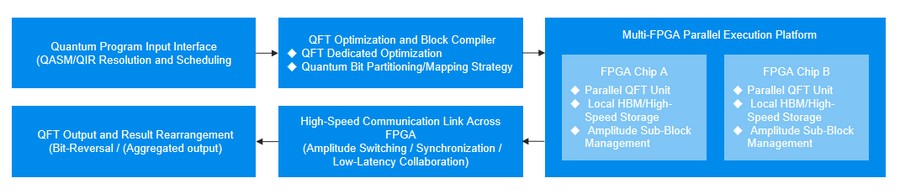
The core processing unit of the simulator is specifically designed to adapt to the parallel structure of Quantum Fourier Transform (QFT). The FPGA logic includes a pipelined complex multiplication array, a parallel index generator, a distributed phase shift computation module, and a bit-reversal permutation data path. Traditional CPUs typically require converting complex data patterns into contiguous access patterns when executing QFT, while the programmability of FPGAs allows for the direct construction of hardware lines consistent with the QFT transformation structure, enabling quantum state updates to occur in a linear pipeline across multiple processing stages, thereby maximizing hardware resource utilization.
Multi-FPGA scalability is another key breakthrough of this technology. In quantum circuit simulation, the size of quantum states increases exponentially with the number of qubits. When the storage space of a single FPGA cannot accommodate the entire amplitude array, the computational tasks must be split across multiple FPGA chips, constructing a distributed parallel simulator across chips. However, the challenge lies in the cross-block data dependencies of QFT, which require frequent data interactions between different blocks. This technology employs an efficient domain decomposition strategy, intelligently grouping amplitude space based on gate dependency relationships in QFT, minimizing inter-FPGA communication. At the same time, MicroCloud Hologram (NASDAQ:HOLO) has built a point-to-point data transmission channel based on high-speed serial interfaces, allowing multiple FPGAs to collaborate in a clock-synchronized manner.
It is worth mentioning that the mathematical structure of QFT contains a large number of controlled phase shift gates, whose phases depend on the distances between qubit indices, leading the simulator to frequently perform complex multiplications and update amplitude vectors. Traditional processing architectures often treat these complex multiplications as independent instruction executions, but FPGAs allow us to parallelize all operations related to the QFT phase shift structure through hardware circuits. The control phase is implemented in hardware using constant lookup tables or direct shifts, making the execution of phase shift gates no longer sequential but rather a parallel stage in the pipeline. This optimization reduces redundant computations, resulting in a significant performance advantage for QFT on FPGAs.
From an engineering perspective, the challenges of combining multi-FPGAs with high-bandwidth memory lie not only in the hardware itself but also in data flow scheduling, gate operation mapping, and distributed communication overhead suppression, among other complex system-level challenges. To ensure that the simulation results are strictly consistent with the mathematical model, the system introduces complex computation modules based on fixed-point or high-precision floating-point formats, ensuring that controlled phase shift operations do not produce unacceptable numerical errors during hardware mapping. For amplitude exchange operations across FPGAs, MicroCloud Hologram has designed strict synchronization protocols to maintain high consistency across all computational stages The launch of the MicroCloud Hologram technology is not only an engineering breakthrough but also symbolizes the gradually established important role of FPGA in accelerating the quantum software stack. As quantum algorithms continue to evolve, there will be an increasing number of large-scale quantum circuits that need to be verified and debugged, and FPGA will become an important bridge connecting classical simulation capabilities with future real quantum devices. The technical roadmap of MicroCloud Hologram has already determined the direction for further development, including distributed quantum circuit simulation clusters supporting more FPGA nodes, fast hardware accelerators supporting arbitrary variational quantum circuits, and customized optimization modules supporting large-scale quantum chemistry and quantum machine learning algorithms.
In the long term, the MicroCloud Hologram (NASDAQ:HOLO) multi-FPGA QFT simulator will not only serve quantum algorithm researchers but will also play an increasingly important role in quantum compiler optimization, quantum chip architecture validation, quantum education platform construction, and early validation of industrial applications. Large enterprises and research institutions are looking for tools that can assess the complexity of quantum algorithms with low cost and high certainty, and the multi-FPGA simulator from MicroCloud Hologram just happens to fill this still scarce technological gap in the quantum computing ecosystem. As the quantum computing ecosystem continues to expand, it is believed that the high-performance simulation capabilities built on this technology will continue to exert influence in quantum algorithm innovation, industrial validation, and cross-domain integration, becoming an important force driving the future wave of quantum computing development