Author: BlockBeats
Following its San Francisco event on July 23, AMD received a reiterated buy rating from Goldman Sachs, with a 12-month price target of $640. The core reason given was that the company's collaborations with two major clients, Anthropic and Microsoft, and the projected $2 trillion total computing market by 2030, reinforced its growth story in AI infrastructure.
This wasn't just a simple GPU specifications release. AMD is attempting to shift the AI competition from single chips to a delivery model encompassing "rack systems + CPU + network + DPU + software tools + large-customer deployments." For investors, the key question has shifted from "Does AMD have a stronger GPU?" to "Can it secure sufficiently large AI cluster orders and deliver on time?"
The report's price target of $640 is based on a P/E ratio of 32 and a normalized earnings per share estimate of $20.
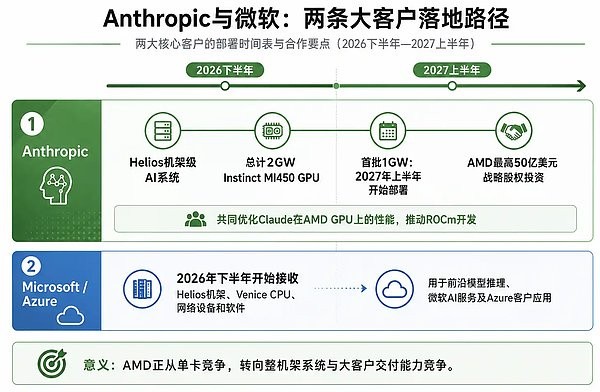
Based on the current share price of approximately $539.69, the potential upside is about 18.6%; the company's market capitalization is approximately $890.5 billion. Revenue is projected to increase from approximately $34.6 billion to $109 billion between 2025 and 2028, with EPS increasing from $2.64 to $17.90, and a target price of $640. Anthropic has secured 2GW of orders, and Microsoft will begin receiving Helios systems from the second half of 2026. The most direct order signal comes from Anthropic. AMD and Anthropic have entered into a strategic partnership, with Anthropic deploying a total of 2GW of Instinct M1450 GPUs in its Helios rack-mount AI systems. The first 1GW is expected to be deployed starting in the first half of 2027. AMD also plans to provide Anthropic with up to $5 billion in strategic equity investment, and the two companies will jointly optimize the performance of Claude models on AMD GPUs and accelerate ROCm software development. The significance of such collaborations extends beyond chip sales. For AI chip suppliers, the deployment by leading model companies determines the credibility of the ecosystem. If Anthropic continues to migrate or expand Claude workloads to the AMD platform, it will help AMD prove that its GPUs, rack systems, and software stack can handle large-scale training and inference needs. Microsoft, on the other hand, offers another path to implementation. Following the expansion of their Azure partnership, Microsoft plans to begin receiving Helios racks, Venice CPUs, networking equipment, and software starting in the second half of 2026 for use in cutting-edge model inference, Microsoft's own AI services, and customer applications. Microsoft will also launch two new virtual machines based on the next-generation 2nm Venice CPU and expand the deployment of Pensando DPUs in its networking services. This means that AMD aims to sell GPUs, CPUs, DPUs, and networking equipment simultaneously within the cloud vendor ecosystem, rather than simply appearing as an accelerator card supplier. For Azure, if the AMD platform can provide sufficient performance and supply elasticity, it will also help reduce the pressure of relying on a single supply chain.
$2 Trillion TAM: Computing Power Amplification from Agent-Based AI
The most impactful figure in the report is AMD's upward revision of its 2030 total computing market size forecast to $2 trillion.
Of this, data center AI accelerator TAM has been revised upward from $200 billion to $1.4 trillion, corresponding to a 40% CAGR; server CPU TAM has been revised upward from $26 billion to $220 billion, corresponding to a 50% CAGR. AMD also predicts that by 2030, the company will hold a 50% share of the data center CPU market.
This assumption is underpinned by agent-based AI. Compared to single-question-answer sessions, agent-based AI requires calling tools, planning tasks, reading context, executing multi-step workflows, and handling more inference and orchestration requests. The computational demands don't just fall on GPUs; CPUs also handle scheduling, data preprocessing, system services, and multi-agent workflow orchestration. This is also the new story AMD wants to tell: the expansion of AI infrastructure not only drives demand for accelerators but also for server CPUs, networks, and system-level solutions. If companies can package EPYC CPUs, Instinct GPUs, Pensando DPUs, and network equipment into Helios racks, the revenue potential will be greater than from single-chip sales. However, this $2 trillion figure is not a realized market size but rather a prediction based on the large-scale adoption of agent-based AI by 2030. It requires enterprises and cloud vendors to continuously expand AI inference deployments, and also requires AI applications to truly move from pilot projects to high-frequency production workloads. Accelerator TAM has been increased from $200 billion to $1.4 trillion, CPU TAM from $26 billion to $220 billion, and total computing TAM to $2 trillion. Helios enters mass production; AMD aims to prove its rack-level delivery capabilities. At the product level, Helios is the core of AMD's campaign. The next-generation Helios AI rack platform is based on the CDNA 5 architecture, with single GPU performance reaching up to 40 PFLOPS (FP4) and 20 PFLOPS (FP8), equipped with 432GB of HBM4 memory and 23.3TB/s memory bandwidth. Each rack integrates 75 GPUs connected via UALink over Ethernet, along with a 96-core EPYC CPU, a Salina DPU, and a Volcano 800G AI network card. The focus of these parameters is not on single-point performance, but rather on AMD's push towards a rack-wide form factor. AI clusters increasingly rely on system-level design: GPU interconnects, memory bandwidth, network throughput, CPU scheduling capabilities, and software stacks all impact final training and inference efficiency. Helios is now in full production, with shipments planned to begin at the end of Q3 and mass production in Q4. Microsoft will receive Helios in the second half of 2026, and the first 1GW deployment of Anthropic will begin in the first half of 2027, meaning that true large-scale customer validation is still to come. AMD has also partnered with Cerebras to combine the Helios system with Cerebras' wafer-level engine to create a high-performance AI inference solution, aiming to achieve lower latency, higher energy efficiency, and up to 5x more tokens per watt. This solution is expected to launch through Cerebras Cloud in the second half of 2026. On the software side, the ROCm.ai platform has been officially launched, integrating AI tools such as Cursor, Claude, Codex, and Gemini, providing developers with an AI-driven software development experience. The accompanying Hyperloom optimization layer has optimized over 14,000 models, achieving an average performance improvement of 3.3x compared to ROCm 7. However, the collaboration between ROCm.ai and Cerebras is more suitable as a supplement to the Helios ecosystem than the main focus of this article. Ultimately, investors will look at whether customers can stably use the AMD platform under real-world loads, not just whether the tools and the list of partners are long enough. Valuation bets have been raised, with risks lying in deliveries in 2026-2027. Goldman Sachs' financial forecasts show that AMD's revenue is expected to be approximately $50.57 billion in 2026, with EPS of $6.20; approximately $86.01 billion in 2027, with EPS of $13.20; and approximately $109 billion in 2028, with EPS of $17.90. These forecasts indicate that the market has high expectations for AMD's AI revenue ramp-up, profit margin improvement, and operational leverage release over the next two to three years. The $640 target price reflects not only the current product launch but also the simultaneous progress of multiple aspects, including Helios shipments, Microsoft Azure deployments, the initial rollout of Anthropic's 1GW, and improvements to the ROCm ecosystem. The real disagreement lies here. First, the adoption of proxy AI may be slower than expected. If enterprise AI workflows do not expand rapidly, the assumption of a $2 trillion total computing market by 2030 will be revised downwards. Second, there is still a time lag in large customer GPU deployments. Microsoft's Helios acceptance will begin in the second half of 2026, and the initial 1GW of Anthropic is expected to begin in the first half of 2027; short-term financial reports cannot fully validate the revenue contribution of these collaborations. Third, competitive pressure will not disappear. Nvidia still dominates the AI accelerator and software ecosystem. Whether ROCm can narrow the developer experience gap will affect AMD's substitutability among large-scale customers. Fourth, the x86 architecture also faces market share risks in enterprise AI scenarios. If customers increasingly adopt custom chips, Arm servers, or other heterogeneous solutions, AMD's expectations for CPU TAM and a 50% data center CPU market share will be challenged. This makes AMD's story more like an execution test: the report has already pushed market space, customer orders, and target prices to higher levels. Whether the stock price can continue to digest these figures depends on whether Helios can ship on schedule, whether Microsoft and Anthropic can expand deployment as planned, and whether AI demand can truly support a $2 trillion market by 2030.

 Complete. Here is the key summary